English











Nasopharyngeal sampling is a commonly performed diagnostic procedure in equine practice, used to identify infectious agents affecting the upper respiratory tract. It involves inserting a deep nasal swab into the nasopharynx to collect samples for testing for viral or bacterial pathogens.
In horses presenting with fever, nasal discharge, coughing, lymph node enlargement, or poor performance, collecting a sample from the nasopharynx can provide critical information to guide treatment decisions, biosecurity protocols, and herd management strategies.
The nasopharynx is located at the back of the nasal passages, above the soft palate, and serves as an important site for pathogen colonization and shedding. Many contagious equine respiratory diseases can be detected through sampling this region, including equine herpesvirus, strangles, and equine influenza.
Because respiratory disease can spread rapidly in equine populations, timely and accurate sampling plays a key role in protecting both individual horses and entire herds. Understanding when and how to perform nasopharyngeal sampling helps veterinarians and horse owners respond effectively to respiratory illness to maintain optimal equine health.
Nasopharyngeal Sampling for Horses
Nasopharyngeal sampling is a diagnostic procedure in which a sterile culture swab is inserted deep into the horse’s nasal passages to collect respiratory secretions.
Respiratory infections commonly result in changes in the secretions found in the horse’s upper respiratory tract. Veterinarians can sample these secretions to diagnose the type of infection present, gaining valuable information about the pathogen to guide treatment.
Signs of upper respiratory infections in horses include: [1]
- Nasal discharge
- Facial swelling
- Foul smelling breath
- Reduced air flow through one or both nostrils
- Difficulty breathing
- Swollen lymph nodes around the head
- Increased noise during breathing
- Nosebleeds
Veterinarians can sample upper respiratory secretions from three main locations in horses: [1][2]
- Nasal passages and pharynx: The main airway where air passes from the nostrils to the nasopharynx (throat). Veterinarians use swabs to collect samples from these areas.
- Paranasal sinuses: The large air cavities within the horse’s skull. Acquiring samples from this location typically requires sinocentesis, drilling a needle through the skull bone into the sinus.
- Guttural pouches: The guttural pouches are extensions of the auditory tube running between the throat and the middle ear. Accessing the guttural pouch requires endoscopy, passing a small camera into the nasal passage. The veterinarian can carefully guide the endoscope into the guttural pouches for sampling.
Nasopharyngeal sampling is most common because it requires no specialized equipment and the sample region is easy to access.
What's your top priority with your horse's health?

Enter your email to receive your store credit
Uses
Veterinarians use nasopharyngeal samples for detecting viruses, bacteria, or fungi within the airway. [3] Some diseases commonly diagnosed by upper airway sampling include: [3][4]
- Equine influenza
- Equine herpesvirus
- Strangles (Streptococcus equi equi)
- Equine rhinitis viruses
- Equine arteritis virus

“By collecting a diagnostic sample early, we can identify contagious pathogens quickly and make informed decisions about treatment and biosecurity to protect the entire herd.”
— Dr. Fran Rowe DVM, PASMad Barn Veterinary Nutritionist
Equipment
A nasopharyngeal swab involves introducing a sterile culture swab into the horse’s nostril. These swabs are typically 20 – 40 cm (8 – 16 in) long. Sampling is performed quickly and usually well-tolerated by sedated horses.
Depending on the test or disease suspected, the veterinarian may also perform a nasopharyngeal lavage, in which sterile saline is flushed into the nasopharynx and then retrieved for laboratory analysis. This technique can improve sample collection and may increase the likelihood of detecting certain pathogens.
Additional equipment required for lavage includes a long catheter or pipette and a syringe to deliver sterile fluid. [3]
Other equipment necessary for sample preparation includes: [3]
- A transport medium for bacterial culture
- Sterile tubes for storage
- Cold packs
- A foam container for shipping
Many of the diseases diagnosed through nasopharyngeal sampling are highly infectious. Given this, veterinary personnel must wear appropriate personal protective equipment to prevent spread of disease to other horses they may work with.
Personal protective equipment may include: [3]
- Gloves
- Disposable plastic boots
- Disposable coveralls
Procedure
The veterinary team sedates the horse to minimize movement and resistance during the procedure. They clean the nostrils with gauze to help remove any excess nasal discharge that may contaminate the swab. [3]
The veterinarian roughly measures the distance between the horse’s nostril and eye to determine what swab length is required to reach the horse’s nasopharynx. They may mark the swab with a marker to help ensure the swab passes far enough into the horse’s airway for effective sampling. [3]
When the veterinarian is ready, a handler helps immobilize the horse’s head by wrapping their arm around the horse’s nose. They may also help the veterinarian by opening the nostril wider to allow smooth passage of the swab. [3]
The goal is to enter the ventral meatus of the nostril, not the “false nostril”, a dead-end pocket of tissue just inside the horse’s nose.
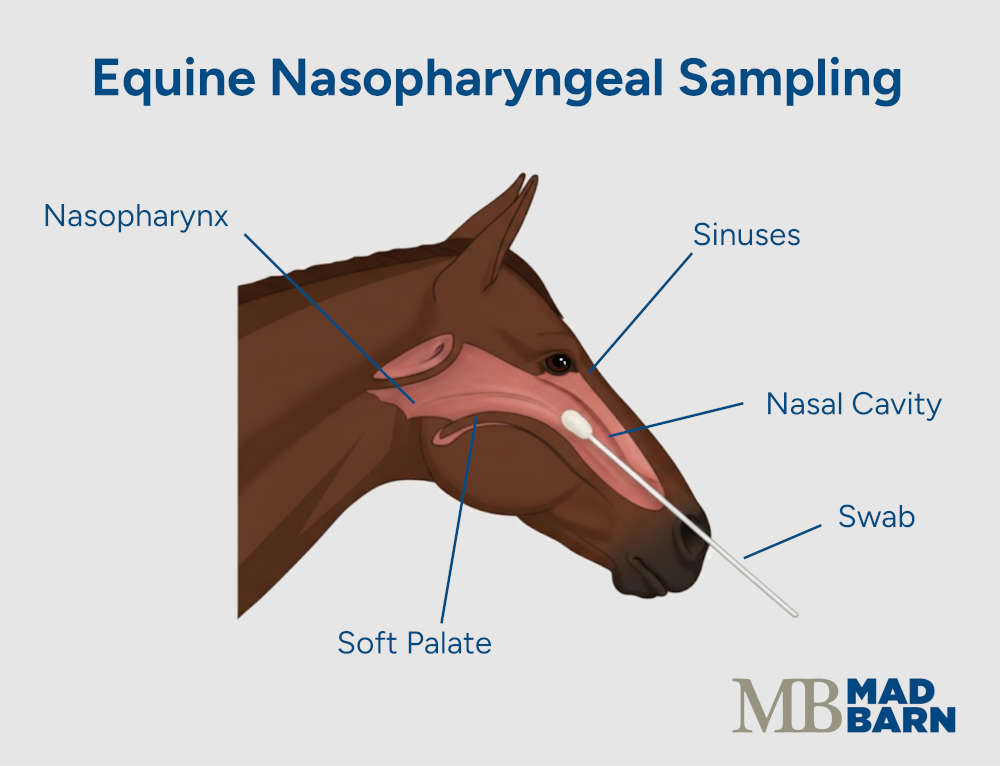
The veterinarian inserts the swab until they feel resistance, indicating they have reached the nasopharynx. They hold the swab in place for several seconds, giving it time to absorb secretions. Then they remove the swab in a swift movement, avoiding touching the swab end to any surfaces. [3]
Depending on the testing the veterinarian wishes to perform, collecting several swabs may be necessary.
Some diseases are best diagnosed using a nasopharyngeal lavage, where fluid is introduced into the nasal passages. The process for lavage is similar, but instead of introducing a swab, the veterinarian passes a catheter or pipette into the horse’s nostril. [3]
Once positioned, they attach a syringe containing sterile saline and infuse the saline into the nasal passage. [3] This fluid immediately drains out through the horse’s nostrils. Another member of the veterinary team catches the fluid in a plastic bag or container.
The swabs or fluid are prepared for submission by placing them into sterile test tubes. For swabs, the veterinary team adds transport medium that allows bacterial or viral growth to continue until the swab reaches the laboratory. [3]
For some tests, sterile saline is sufficient to keep the collected cells moist during shipping. Prior to shipping, the team packs the samples into a foam container with ice packs to ensure they stay cold during transport. [3]
Interpreting Results
Veterinarians typically submit nasopharyngeal swabs and lavage fluid for molecular testing, types of diagnostic tests that detect fragments of pathogen genetic material.
The most common molecular test is polymerase chain reaction (PCR). [4] In this test, specific fragments of DNA or RNA called primers bind to the pathogen’s genetic material, if present. The diagnostician then replicates these bound fragments thousands of times, until the DNA or RNA can be detected. [4]
Extensive replication allows for pathogen detection even if only very small amounts are present in the swab or sample fluid. Some PCR tests can also quantify the amount of pathogen present, which can help veterinarians determine the horse’s pathogen load and risk of spreading the infection to other horses. [4]
Performing PCR requires the diagnostician to introduce a disease-specific primer to the sample. This means that only the requested diseases appear on the diagnostic report.
Given this, PCR is unable to identify novel diseases or diseases that the veterinarian did not request testing for. However, PCR’s major benefit is that it can identify pathogens that do not grow well in laboratories, such as viruses.
Nasopharyngeal swabs or lavage fluid are a common part of the diagnostic work-up for strangles. The causative pathogen of this disease, Streptococcus equi equi, is a bacterium that grows well in a laboratory.
Most diagnostic labs use bacterial culture to diagnose this condition, as this diagnostic test demonstrates that live, replicating bacteria are present in the sample. [4]
PCR is unable to distinguish between dead and live bacteria, so identifying replicating bacteria confirms an active infection. [4] However, bacterial culture results typically take longer than PCR results, so an initial PCR test may be preferable to get rapid feedback on the cause of infection while waiting for bacterial culture to confirm active infection. [4]
False negative results can occur for both bacterial culture and PCR. These are results where testing comes back as negative, but the horse is infected with the pathogen.
Careful interpretation of the diagnostic test, in the context of the horse’s history and clinical signs, is necessary to establish a diagnosis. In some cases, a negative result may prompt your veterinarian to repeat testing to help rule out a potential false negative. [4]
Potential causes of a false negative include: [3][4]
- Poor quality sample due to the horse resisting the procedure
- Improper placement of the swab or catheter
- Timing of sampling, as the pathogen is typically only detectable in the early stages of disease
- Improper storage or handling during shipping

Preparing your Horse for Nasopharyngeal Sampling
There are no specific preparations necessary for nasopharyngeal sampling a horse. However, if your horse is suspected to have an infectious disease, they should be quarantined away from other horses.
This may require setting up a separate examination area on your property where the horse can be assessed safely without exposing other horses. Horses often sneeze or snort after sample collection, sending many infectious particles into the air.
Ensure the examination area can be disinfected easily and does not have porous surfaces like dirt, sand, or gravel footing if possible.
After the sample is taken, your horse should return to a quarantine area until test results are available. Work with your veterinarian to develop an appropriate quarantine zone on your farm.
Some veterinarians may request that you bring your horse to their clinic for examination. Typically, the horse stays on the trailer during sample collection to reduce the risk of infectious particles contaminating the veterinary clinic. Ask your veterinary team about proper procedures once you arrive at the clinic. Do not unload your horse without permission from the veterinary team.
If you have been handling your horse, you could potentially spread infectious disease to other horses and livestock. Avoid walking around the clinic property while you are waiting for the veterinarian. Disinfect your hands prior to touching door handles, pens, or surfaces within the clinic. Some clinics may request that you call their office to check-in for your appointment rather than enter the clinic building.
Complications
Nasopharyngeal sampling is a safe procedure with minimal complications.
Rarely, introduction of the swab or catheter into the nasal passage may irritate the ethmoid turbinates. These are delicate components of the horse’s nasal passages that contain many blood vessels.
If the swab or catheter pokes the ethmoid turbinates, they can bleed profusely, causing a nosebleed. Most nosebleeds resolve quickly on their own and do not cause further harm to the horse. [3]
Frequently Asked Questions
Here are some frequently asked questions about nasopharyngeal sampling in horses:
Nasopharyngeal sampling is a diagnostic procedure in which a long sterile swab is passed through the horse's nostril into the nasopharynx (the upper part of the throat behind the nasal passages) to collect respiratory secretions. The sample is then tested to identify infectious agents that may be causing respiratory disease.
Your veterinarian may recommend nasopharyngeal sampling if your horse has signs such as fever, nasal discharge, coughing, swollen lymph nodes, lethargy, or poor performance. It is commonly used when contagious respiratory disease is suspected, including infections like Equine influenza virus, Equine herpesvirus 1, or strangles caused by Streptococcus equi equi.
Nasopharyngeal sampling in horses is generally quick and well-tolerated. Most horses may briefly react to the sensation of the swab but do not experience significant pain.
Turnaround time for equine nasopharyngeal sampling depends on the type of test performed. PCR results are often available within 24–72 hours, while bacterial cultures may take several days. Your veterinarian will advise you on expected timelines.
If your horse has been swabbed to check for infectious disease, isolation is strongly recommended until results are available. Taking biosecurity measures as soon as your horse shows signs of respiratory illness can help prevent spread to other horses in the barn or facility.
No single test detects every possible cause of respiratory illness. Nasopharyngeal sampling is particularly useful for identifying common viral and bacterial pathogens, but additional diagnostics (such as bloodwork, endoscopy, or imaging) may be needed depending on the case.
A nasal swab involves inserting a long sterile swab into the nostril to collect respiratory secretions directly from the nasal passages or nasopharynx. A nasal lavage uses a catheter or pipette to flush sterile saline into the nasal passage and then collect the fluid as it drains out. Swabs collect surface secretions, while lavage samples retrieve cells and pathogens suspended in fluid, which may improve detection in some cases.
Summary
Nasopharyngeal sampling is a practical diagnostic tool used to identify infectious causes of upper respiratory disease in horses and support timely treatment and biosecurity decisions.
- A sterile swab or lavage sample is collected from the nasopharynx to detect viral or bacterial pathogens
- Common targets include equine influenza, equine herpesvirus, strangles, and other contagious respiratory diseases
- Samples are typically analyzed using PCR or bacterial culture depending on the suspected pathogen
- Accurate technique and proper handling are essential to reduce the risk of false negative results
- Early testing helps guide isolation protocols and limit disease transmission within equine populations
References
- Walton. R. M. et al. Equine Hematology, Cytology, and Clinical Chemistry. 2nd ed. Wiley Blackwell, Hoboken. 2021.
- Reed. S. M. et al. Equine Internal Medicine. 3rd ed. Saunders Elsevier, St. Louis, Mo. 2010.
- Costa. L. R. R. and Paradis. M. R. Manual of Clinical Procedures in the Horse. Wiley Blackwell, Hoboken. 2018.
- Pusterla. N. and Higgins. J.Interpretation of Equine Laboratory Diagnostics. Wiley-Blackwell, Hoboken, NJ. 2017.