English












Lung function is critical to ensuring equine performance and overall health. Heaves, allergies, asthma, and pneumonia are common health concerns that can impact respiratory capacity during exercise and at rest in horses.
These conditions are all characterized by inflammation in the lungs, which can affect athletic performance and well-being in your horse. One strategy to treat respiratory inflammation is delivering medication directly into the lungs using a nebulizer.
Equine nebulizers work by converting liquid medication into a fine mist (aerosol particles), which the horse breathes in. The functional parts of a nebulizer are the nebulizing system that creates the mist particles, a medication reservoir, and a mask that goes over the horse’s nose.
Nebulizers are a popular choice for treating respiratory dysfunction because localized dosing reduces the risk of side effects and ensures a high concentration of medication is delivered directly to the lungs.
Types of Nebulizers for Horses
There are three basic types of nebulizers for horses: jet, ultrasonic, and mesh. [1] Which type of nebulizer to use depends on what medication is prescribed for the horse’s condition.
Medications that are very viscous (i.e. are a thick liquid) or that break down when heated cannot be used in all types of nebulizers. [2] Always follow your veterinarian’s recommendations and the instructions on the prescription label before purchasing a nebulizer for your horse.
Jet Nebulization
Jet nebulizers use pressurized gas to create aerosol particles of medication for inhalation by the horse. [1] Most medications are suitable for use in a jet nebulization system, although the high-pressure gas may break down large-molecule drugs. [2]
Some challenges to consider before selecting a jet nebulizer include: [1][3][4]
- Loud noise, which may frighten some horses
- Requires a compressed air source, which adds cost and storage demands, and is a safety concern
- Administering a dose can take a significant amount of time; horses may become impatient and require specific training to take the medication
- Uptake of the drug by the horse’s body may be less effective compared to other types of nebulizers
- Not portable
Ultrasonic Nebulization
Ultrasonic nebulizers use a mechanism to stimulate electronic vibration in a special type of crystal. High speed vibration of the liquid medication produces fine aerosol droplets for inhalation. [1]
These nebulizers take less time to dispense medication than jet nebulizers, and typically the aerosol particles deliver a higher concentration of medication. [4]
Ultrasonic nebulizers are limited in terms of which medications they are appropriate for. Thick (viscous) liquid formulations do not aerosolize appropriately in this type of nebulizer. [1] Ultrasonic nebulizers also produce heat, which may inactivate some medications. [1]
Mesh Nebulization
Mesh nebulizers are currently the most common type of nebulizer used for horses. [3] These nebulizers force liquid through a mesh to produce fine particles. [1]
Mesh nebulizers are the most expensive of the three types, however offer many benefits specific to equine use, including: [1][3]
- Silent operation
- Adjustable particle size
- Less time needed to dispense a dose
- Wireless options are available
Mesh nebulizers also require low viscosity medication to prevent clogging pores in the mesh. [1] These types of nebulizers are also more difficult to clean than the other types. [1]
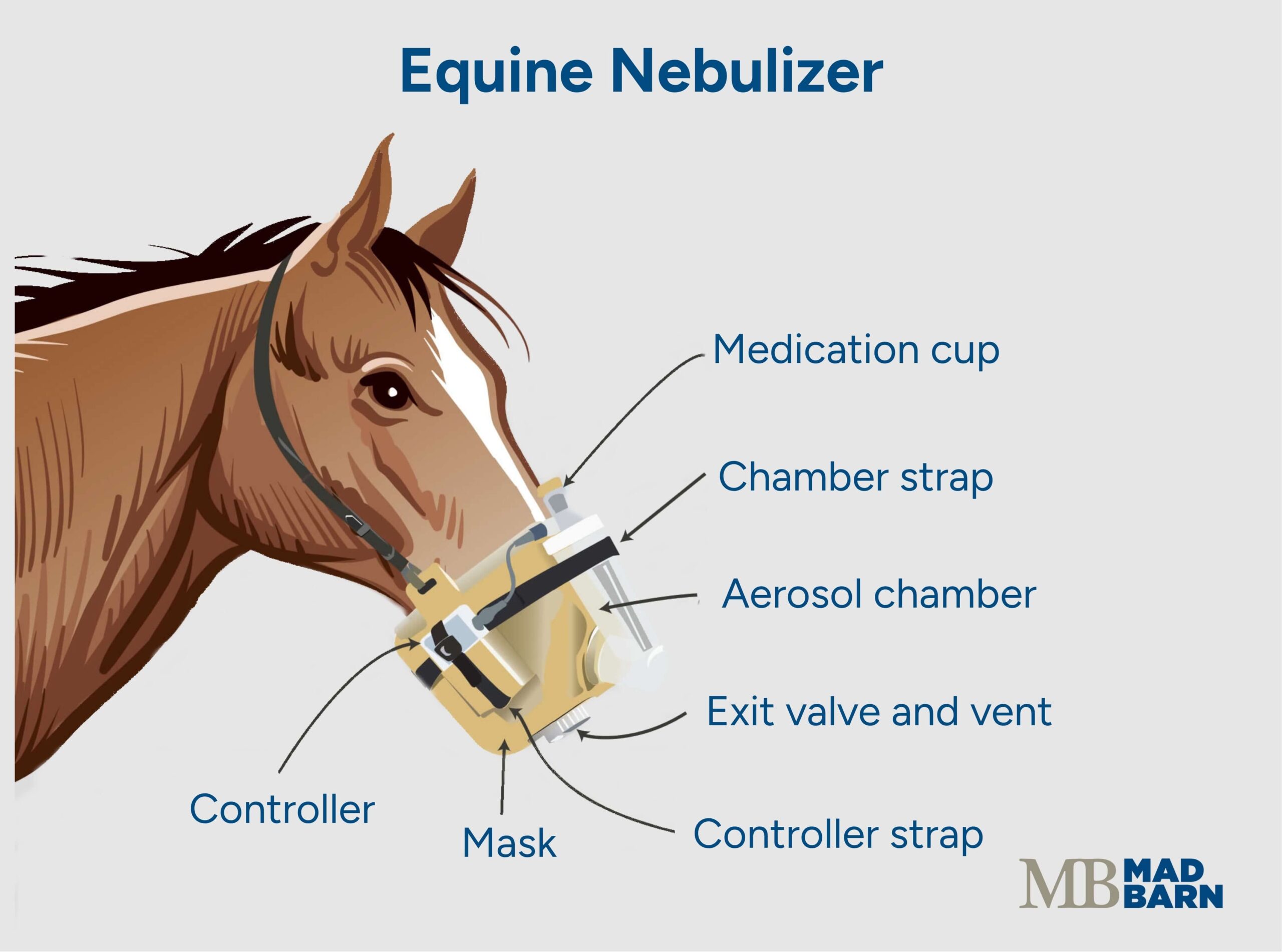 Illustration: Dr. Ana Mesa, PhD
 How to Use A Nebulizer
Regardless of which type of nebulizer is most appropriate for your horse’s specific needs, there are some basic operating and training guidelines to keep in mind before you use one. If you are unsure about your horse’s comfort with using a nebulizer, your veterinarian can provide expert tips and feedback.
Habituation
Using a nebulizer begins with a habituation period for the horse. The nebulizer mask fits over the nose and forms a seal, which can be uncomfortable or frightening for the horse. [5]
Before placing the mask, show it to the horse and allow them to investigate by taking in smells and looking at it. [5]
Once the horse appears comfortable with the nebulizer, place the mask over the nose without any medication canisters attached to the nebulizer, to allow them to practice wearing it while they breathe normally. [5]
Once the horse can comfortably wear the nebulizer and breathe comfortably, treatment can begin. [5]
Treatment
To dispense medication using the nebulizer, the medication reservoir must be filled prior to fitting the mask on the horse. [5] Some medications need to be mixed with pharmaceutical grade saline (salt water solution) in the reservoir before dosing.
Always follow the instructions from your prescribing veterinarian to determine appropriate dosage and dilution, and do not attempt to mix saline solution at home. It is important to follow these recommendations closely to ensure adequate medication delivery and effective treatment.
Once the mask is in place, close the vent allowing outside air into the chamber and activate the nebulizer. [5] After activating, the chamber of the mask fills with aerosolized medication. As the horse inhales, handlers can observe the medication disappearing from the mask. [5]
If the horse becomes uncomfortable during treatment, the vent can be opened slightly to let more outside air into the mask chamber. [5] When the horse relaxes, the handler can close the vent again. [5]
Cleaning
Cleaning is an important part of nebulizer use, as contamination or bacterial growth in the nebulizer equipment may cause respiratory infections. [4][6]
Specific cleaning requirements and methodology depend on the type of nebulizer used. The manufacturer’s cleaning directions should be carefully followed after each use of the nebulizer.
What's your top priority with your horse's health?

What's your top priority with your horse's health?
Benefits of Nebulizing Medication
Nebulization of medication has many benefits over systemic (whole body) administration, such as intravenous infusions, intramuscular injections, or oral medications.
Systemic medications circulate through the entire body, spreading to all organs and tissues. This often results in needing higher doses of medication to ensure the targeted organ receives enough drug to effectively treat symptoms. [6]
The lungs have a higher risk of inadequate drug delivery, as there is a blood-bronchial barrier between the bloodstream and airways. [6] This barrier impedes passage of some medications from the bloodstream into the airways, significantly reducing the efficacy of systemic medications in the lungs. [6]
Direct Dosing
In contrast, the main benefit of aerosolized medication is that inhalation provides localized, concentrated, direct dosing to the respiratory system. [6] Inhaled medications bypass the blood-bronchial barrier, delivering the medication directly into the airways. [6]
By delivering medication to the lungs directly, the same effect as systemic medications is achieved at much lower dosage. [4][6] Further, the blood-bronchial barrier minimizes absorption of the medication by the systemic blood stream. [6] This promotes medication retention in the lungs, maximizing its local effects.
Safety & Efficacy
The combined effect of lower dosage and minimal systemic absorption helps reduce the risk of side effects associated with these medications when given systemically. [6]
Other benefits of nebulization include: [6]
- Efficacy of the medication is not degraded in the intestines
- Does not impact the gut microbiome
- Does not require injections by the owner/handler
- Safe for long-term use
Your veterinarian can help you select the best nebulizer for your horse’s individual needs. Some relevant considerations include cost, level of noise, and what type of medication your horse needs.
| Type of Nebulizer |
Cost | Rate of dosing |
Noise | Power Source |
Usable Medications |
|---|---|---|---|---|---|
| Jet |  |
Low |  |
 |
All types |
| Ultrasonic | |
Med | |
|
Heat resistant, low viscosity |
| Mesh | |
High | |
 |
Low viscosity |
Uses for Nebulizers
The most common use for nebulizers is treating respiratory diseases, particularly equine asthma, which is a collective term for conditions formerly referred to as inflammatory airway disease (IAD), recurrent airway obstruction (RAO) and chronic obstructive pulmonary disease (COPD).
Corticosteroids are usually prescribed to treat asthma and other respiratory conditions. This class of medication can have significant side effects when delivered systemically. [3] By offering nebulized alternatives, the risk of side effects is greatly reduced.
Other uses for nebulizers include: [3]
- Bacterial pneumonia
- Rhodococcus equi pneumonia in foals
- Fungal pneumonia
- Relieving mucus accumulation in the airways prior to performance
Types of Nebulizer Medications
The most common types of medications used in equine nebulizers are: [3]
- Saline
- Corticosteroids
- Bronchodilators
- Antibiotics
Saline
Sterile saline can act as a mucolytic, a substance that breaks down mucus within the respiratory tract. [6] Mucus can block the small airways and partially obstruct larger airways, reducing respiratory efficiency. Horses may have increased mucus during respiratory diseases such as pneumonia or equine asthma. [6]
Inhaling saline dilutes the viscosity of mucus, making it easier for the horse to clear from its lungs. [3][6] There is also some evidence that nebulized saline can reduce inflammatory proteins within the lungs. [7] Currently, there are few studies examining the efficacy of nebulized saline as a mucolytic in horses, however it is considered safe when using well-maintained nebulizers.
Corticosteroids
Nebulizer formulations of corticosteroids are commonly prescribed to treat equine asthma. Corticosteroids have an anti-inflammatory effect, which can control the inflammation triggered by asthma.
The most common corticosteroids prescribed for nebulization treatment are: [3][8]
- Fluticasone propionate
- Dexamethasone
- Budesonide
Fluticasone is usually the first recommendation as it has a stronger effect compared to other steroids, while causing few to no side effects. [3] Studies show long-term administration of fluticasone did not cause immunosuppression or other side effects associated with corticosteroid use over an 11-month period. [9]
Bronchodilators
Bronchodilators are medications that relax smooth muscle, which can become constricted in horses with asthma. [3] Smooth muscle constriction narrows the airways and prevents the horse from breathing properly.
Bronchodilators are usually prescribed during the early stages of equine asthma to provide immediate relief for severe asthma symptoms. [3] These medications can also improve the delivery of other nebulized medications by opening the airways prior to another nebulization treatment. [3]
The most common bronchodilators used for nebulization are: [3][8]
- Ipratropium: Provides bronchodilation for up to 4-6 hours after inhalation, and targets the large airways [3]
- Albuterol: Also called salbutamol, a short-acting drug (around 1-2 hours) that primarily targets the smaller airways [3]
Some veterinarians recommend combining both medications to maximize airway dilation. [3]
Antibiotics
Inhaled antibiotics may be prescribed to treat respiratory infections. [3] Inhaling antibiotics allows for a high local dose while keeping blood levels of the antibiotic low. [3]
The most common antibiotics used for inhalation are: [3][8]
- Cefquinome
- Ceftiofur
- Gentamicin
- Amikacin
- Marbofloxacin
Most studies on inhaled antibiotics focus on their use in treating sick foals. [3] Studies show nebulized antibiotics achieve higher doses within the lungs compared to systemic administration. [10] Additionally, foals tolerated the nebulization process well and no adverse effects were reported from antibiotic administration. [10]
There is one study in racehorses receiving inhaled antibiotics showing similar results between inhaled and systemic amikacin. [3] More research into the efficacy of inhaled antibiotics in adult horses is necessary. [3]

Other Medications
Less commonly, other medications have been tested in nebulized formulations with promising results. Note that it is unsafe to administer any type of medication or alternative remedy using a nebulizer outside of a veterinarian’s instructions.
Lidocaine
Recent research shows nebulized lidocaine, the topical anesthetic, may be a safe and effective treatment option for horses with equine asthma. [11] Studies from humans and cats show nebulized lidocaine can decrease coughing and reduce airway reactivity in asthmatic patients. [11]
In horses, nebulized lidocaine relieved mucus build up, reduced inflammation, and improved symptoms of asthma after 14 days of twice-daily treatment. [11] Further investigation showed nebulized lidocaine appeared to be safe and well-tolerated, with few noted side effects in healthy horses. [12]
These findings suggest nebulized lidocaine may be an effective alternative to inhaled corticosteroids in horses who develop side effects. [11] Additionally, lidocaine is less expensive than nebulized corticosteroids, and may offer a cost savings to owners managing chronic equine asthma patients. [11]
Caffeic Acid Phenylethyl Ester (CAPE)
Caffeic Acid Phenylethyl Ester (CAPE) is an antioxidant extracted from honeybee products. [13] Studies show this compound can inhibit activation of the inflammatory response, particularly asthma-like inflammatory responses. [13]
A recent study in asthmatic horses showed horses receiving nebulized CAPE had reduced symptoms at one hour after treatment compared to control horses. [13] The same study also showed some evidence of anti-inflammatory effects, but these were not statistically significant. [13]
From these findings, CAPE shows promise as a potential anti-inflammatory medication for asthmatic horses. [13]
Immunotherapy Agents
Immunotherapy is the process of administering small doses of an allergen repeatedly to reduce the immune system response over time. [14] Currently, immunotherapy for equine asthma involves subcutaneous injections. [15]
It seems likely that nebulized immunotherapy serum can improve the efficacy of treatment by targeting the immune system within the lungs specifically. [14] Similar to medications, nebulization delivery should also reduce the risk of side effects associated with systemic administration. [14]
To test this, researchers attached allergens to a gelatin nanoparticle, allowing them to nebulize the allergens and deliver them to asthmatic horses. [14] Results show anti-inflammatory markers increased significantly after five treatments. [14] Additionally, horses had lower respiratory rates and improved oxygen intake. [14]
Further research into the efficacy of nebulized immunotherapy treatments as an alternative to traditional allergy injections is necessary, however these findings show promising results. [14]
Frequently Asked Questions
Here are some frequently asked questions about nebulizers for horses:
Signs that my horse might benefit from inhaled therapy with a nebulizer include a persistent cough, nasal discharge, wheezing, flared nostrils, or increased breathing effort at rest or during work. Poor recovery after exercise, reduced performance, or a visible “heave line” also point to airway inflammation. When in doubt, a veterinary exam can guide medication and device choices.
Ways to help my horse get comfortable wearing a nebulizer mask without stress include gradual desensitization: let the horse sniff the mask, touch the face with it, then place it briefly without turning the unit on. Add short sessions with saline only, close the air vent gradually, and reward calm breathing. Work in a quiet area with a consistent handler, and ask your veterinarian about mild sedation only if acclimation stalls.
Horses that should avoid nebulized treatments or need extra caution include those with severe respiratory distress that worsens with a mask, facial wounds or nasal obstruction that prevent a good seal, known drug allergies to the prescribed medication, or contagious infections when equipment cannot be fully disinfected. Pregnant or lactating mares, foals, and horses with cardiac or metabolic disease may still be candidates, but dosing and drug choice should be adjusted by a veterinarian.
To tell my horse is actually inhaling the aerosol and not just breathing room air, look for a snug mask seal, the outside air vent set as directed, and mist that visibly pulses in time with breaths. The chamber should clear between inhalations, the reservoir level should drop at a steady rate, and there should be minimal leakage around the mask edges. If unsure, your veterinarian can demonstrate proper fit and confirm delivery.
Summary
Nebulized medications are a popular choice for treating various respiratory conditions in horses, including equine asthma and certain allergies.
- Nebulizers produce a fine mist of medication which is delivered directly to the lungs via inhalation
- Nebulized medications include saline, corticosteroids, bronchodilators, antibiotics, and others
- Research is ongoing to determine the most effective treatment protocols and to identify new applications for this medical technology
References
- Ari. A., Jet, Ultrasonic, and Mesh Nebulizers: An Evaluation of Nebulizers for Better Clinical Outcomes. Eurasian J Pulmonol. 2014. doi: 10.5152/ejp.2014.00087.
- Martin. A. R. and Finlay. W. H., Nebulizers for Drug Delivery to the Lungs. Expert Opinion on Drug Delivery. 2015. doi: 10.1517/17425247.2015.995087.
- Pirie. R. S. and McGorum. B. C., Inhalation Therapy for Equine Lower Respiratory Tract Disease. In Practice. 2017. doi: 10.1136/inp.j2879.
- Duvivier. D. H. et al., Aerosol Therapy in the Equine Species. The Veterinary Journal. 1997. doi: 10.1016/S1090-0233(97)80020-2. View Summary
- Flexineb E3 User Manual. Flexineb.
- Cha. M. L. and Costa. L. R. R., Inhalation Therapy in Horses. Veterinary Clinics of North America: Equine Practice. 2017. doi: 10.1016/j.cveq.2016.11.007.
- Bond. S. and Léguillette. R., A CONSORT-Guided, Randomized Controlled Clinical Trial of Nebulized Administration of Dexamethasone and Saline on Lower Airway Cytokine mRNA Expression in Horses with Moderate Asthma. Journal of Veterinary Internal Medicine. doi: 10.1111/jvim.16983.
- Flexineb Medication Chart. Flexineb.
- Dauvillier. J. et al., Effect of Long-Term Fluticasone Treatment on Immune Function in Horses with Heaves. Journal of Veterinary Internal Medicine. 2011. doi: 10.1111/j.1939-1676.2011.0717.x. View Summary
- Fultz. L. et al., Pulmonary Pharmacokinetics of Desfuroylceftiofur Acetamide after Nebulisation or Intramuscular Administration of Ceftiofur Sodium to Weanling Foals. Equine Veterinary Journal. 2015. doi: 10.1111/evj.12316. View Summary
- Mahalingam-Dhingra. A. et al., A CONSORT-Guided, Randomized, Double-Blind, Controlled Pilot Clinical Trial of Inhaled Lidocaine for the Treatment of Equine Asthma. Can J Vet Res. 2022. View Summary
- Minuto. J. et al., Clinical Effects and Pharmacokinetics of Nebulized Lidocaine in Healthy Horses. Front. Vet. Sci. 2022. doi: 10.3389/fvets.2022.984108. View Summary
- Rutledge. J. J. et al., Nebulized Glycosylated Caffeic Acid Phenylether Ester Attenuation of Environmental Particulate-Induced Airway Inflammation in Horses. Front. Vet. Sci. 2022. doi: 10.3389/fvets.2022.958567. View Summary
- Klier. J. et al., A Nebulized Gelatin Nanoparticle-Based CpG Formulation Is Effective in Immunotherapy of Allergic Horses. Pharm Res. 2012. doi: 10.1007/s11095-012-0686-8. View Summary
- Beech. J. and Merryman. G. S., Immunotherapy for Equine Respiratory Disease. Journal of Equine Veterinary Science. 1986. doi: 10.1016/S0737-0806(86)80072-7.