English


The American Quarter Horse is the most popular horse breed in the world. The AQHA has registered more than 6 million Quarter horses since 1940, thanks to the breed’s trademark character and versatility.
As one of the oldest recognized breeds in the United States, the Quarter Horse has a rich history closely intertwined with that of America. Initially bred for quarter-mile races, the working Quarter Horse eventually found a niche on the western frontier.
Modern Quarter Horses thrive in a wide range of disciplines as pleasure and performance horses. But the breed has an increased risk of genetic diseases and health conditions requiring specialized nutrition and management.
This breed profile will discuss the history, characteristics, common health problems, and nutrition requirements of the American Quarter Horse. Keep reading to learn everything owners need to know about caring for and feeding their Quarter Horses.
Quarter Horse History
While the American Quarter Horse Association originated in 1940, the history of the Quarter Horse can be traced long before that to Colonial America. As the young country evolved, the Quarter Horse evolved with it.
Origin
Most horses in Colonial America were the descendants of hardy English stock, imported as working animals for settlers in the Colonies.
To produce a faster racehorse, American colonists began crossing the English stock with speedy ponies bred by the indigenous Cherokee and Chickasaw people. [1]
The Cherokee and Chickasaw ponies descended from Spanish Barbs initially brought to the Americas by Spanish explorers. Many of the free-roaming Mustangs of the American West can also trace their ancestry to these Spanish horses. [2]
The resulting cross excelled at sprinting short races of a quarter-mile distance, which earned the breed its name. These races often occurred down the main streets of small villages. [1]
In 1752, John Rudolph of Virginia imported the stallion Janus to improve the stamina of the short sprinters. Janus was a son of the Godolphin Arabian, a foundation sire of the Thoroughbred. [1]
Historic Use
After the American Revolution, the tall, sleek Thoroughbred gained popularity as the preferred racehorse on the newly established manicured racetracks of the Atlantic coast. [1]
The smaller, tougher Quarter Horse left the main streets of east coast villages as settlers moved west. Their hardiness from the original English stock, power from the Chickasaw ponies, and stamina from Janus made them well-suited to carry frontiersmen through the wilderness.
West of the Mississippi, these horses crossed with Mustangs to produce an equine with greater vigour for long working days on the range. The American Quarter Horse found its niche as a versatile cow horse there. [3]
The cattle industry of the American West grew exponentially after the Civil War. The Quarter Horse became essential to ranching operations, and ranchers purposefully bred the horses as dependable mounts for working cattle.
One of the most influential early bloodlines originated from the stallion Steel Dust in Texas. Cowboys revered the intelligence, speed, heavy muscle, and cow sense of the stallion’s descendants, and the “Steeldusts” played a pivotal role in shaping the breed standard. [3]
Breed Registry
The American Quarter Horse Association, or AQHA, is the largest breed registry in the world. This association is the official governing body responsible for maintaining ownership records and cataloging all performance data on Quarter Horses.
The association aims to preserve the pedigree and integrity of the American Quarter Horse while promoting the welfare of its horses. AQHA also provides educational resources for current owners and people interested in Quarter Horse ownership.
| Breed Summary | |
|---|---|
| Breed Name | American Quarter Horse |
| Also Known As | Quarter Horse |
| Breed Type | Stock horse |
| Origin | United States (Colonial America) |
| Breed Registry | American Quarter Horse Association (AQHA) |
| Population Status | Popular; more than 6 million registered since 1940 |
| Average Height | 14 – 16 hh |
| Average Weight | 900 – 1,200 lb |
| Common Coat Colors | Bay, black, chestnut, brown, roan, grullo, gray, palomino, cremello, buckskin |
| Conformation | Short, muscular, short wide head, small ears, deep broad chest, downhill build, powerful hindquarters |
| Common Uses | Ranching, cutting, roping, reining, barrel racing, western pleasure, team penning, trail riding |
| Temperament | Willing, trainable, docile, reliable |
| Common Health Concerns | GBED, HERDA, HYPP, MH, PSSM, obesity, navicular syndrome |
| Lifespan | About 25–30 years |
| Price Range | $3,000–$45,000 |
| Best For | Beginners to experienced riders who want a versatile, trainable, dependable all-around horse |
Breed Characteristics
The unique characteristics that made the Quarter Horse an ideal cow horse now make the breed a perfect match for many horse owners.
Conformation
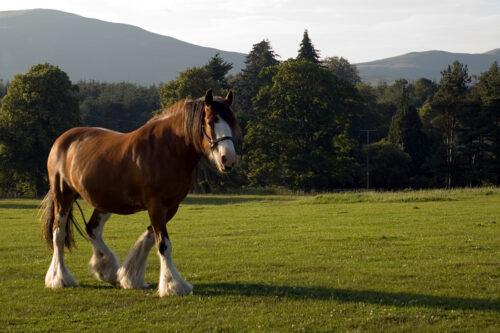
Quarter Horses are stock horses with relatively short stature and heavy muscular development. Most Quarter Horses are between 14 and 16 hands tall, with a typical weight of 900 to 1200 pounds.
Characteristic features of the American Quarter Horse include a short, wide head with small ears and a deep, broad chest. They are usually built more downhill than modern sport horses and have powerful, well-muscled hindquarters. [4]
Some Quarter Horse crosses, such as Appendix Quarter Horses, may have different physical characteristics depending on their breeding.
Colors
Common Quarter Horse colours include:
- Bay
- Black
- Chestnut
- Brown
- Roan
- Grullo
- Gray
- Palomino
- Cremello
- Buckskin
Temperament
Quarter Horses are renowned for their willingness and trainability. In general, these horses have good temperaments and a docile disposition. However, personalities can vary between individuals depending on bloodlines.
Compared to other breeds, Quarter Horses are not considered particularly spooky or hot to ride or handle. The breed was developed to be a reliable mount that could work all day and safely carry its rider through varied environments.
Still, several factors influence temperament. Correct handling and training are essential for promoting appropriate behaviour in all horses, even breeds that are known for their good natures.
Disciplines
Many Quarter Horses still work today as cow horses in modern ranching operations. Quarter Horses are known for having an innate “cow sense” bred into them by generations of cowboys.
Today, the Quarter Horse is the breed of choice for competitive disciplines involving cattle, such as cutting and roping. However, the heritage of the American Quarter Horse also makes them a popular choice for western disciplines, including:
- Reining
- Barrel racing
- Roping
- Western pleasure
- Cutting
- Team penning
Quarter Horse breeding programs often focus on producing horses suited to excel at one of these disciplines. However, the Quarter Horse is a versatile mount for many disciplines, thanks to its temperament and athleticism.
Quarter Horses compete in nearly every type of arena, from hunter classes and low-level dressage to halter and showmanship. In addition, many owners enjoy their Quarter Horses as pleasure mounts and dependable trail riding partners.
Quarter Horse Health
No matter what you use your Quarter Horse for, proper management is essential for keeping him happy and healthy.
Most Quarter Horses are bred for a sturdy conformation that promotes long-term soundness. But some Quarter Horse bloodlines carry equine genetic diseases.
These diseases don’t have a cure, but testing and management can help limit adverse effects. [5]
Genetic Diseases
Genetic diseases are caused by genes that horses inherit through their bloodlines. The AQHA has developed a five-panel disease test that allows horse owners to screen their horses for common genetic diseases in Quarter Horses.
These include glycogen branching enzyme deficiency (GBED), hereditary equine regional dermal asthenia (HERDA), hyperkalemic periodic paralysis (HYPP), malignant hyperthermia (MH), and polysaccharide storage myopathy (PSSM).
Glycogen Branching Enzyme Deficiency
GBED is an autosomal recessive disease caused by a mutation in the GBE1 gene. The mutation reduces the function of an enzyme involved in storing and mobilizing glycogen in the brain, liver, and muscle. [6]
Glycogen provides energy to the muscles, and impaired storage eventually leads to death. GBED usually results in stillbirths or abortions, and most foals that survive birth die within eight weeks. This disorder is always fatal. [6]
Hereditary Equine Regional Dermal Asthenia
Approximately 3.5% of Quarter Horses are carriers of HERDA, another autosomal recessive disease. In this disease, a mutation in the PPIB gene causes defective collagen formation. [7]
Collagen comprises connective tissues in the skin, bones, muscles, and cartilage. The defective collagen causes the outer layer of skin to split from the lower layers in horses with HERDA, sometimes leading to the entire skin sloughing off and leaving a raw wound. [7]
Young horses affected by this disease often have unusual cuts on the skin. Saddling these horses causes the skin to tear, and many horses with HERDA have to be euthanized due to slow-healing injuries. [7]
Hyperkalemic Periodic Paralysis
HYPP is an autosomal dominant disease that affects about 1.5% of all Quarter Horses. The disease traces back to the stallion Impressive, a famous bloodline in Quarter Horses bred for halter classes. [8]
HYPP horses have a mutation in the SCN4A gene that causes sodium ion channels to malfunction. These channels play a role in the electrical impulses responsible for muscle contraction. Disruptions to these impulses occur in horses with HYPP causing tremors, weakness and in some cases, abnormal respiratory noises. [8]
Severe cases of HYPP can cause collapse and sudden death. High levels of the electrolyte potassium triggers the sodium channels to malfunction, so HYPP horses need careful control of potassium intake to minimize the severity of clinical signs. [8]
Malignant Hyperthermia
Malignant Hyperthermia (MH) affects several horse breeds, including the American Quarter Horse. It is an autosomal dominant disease caused by a mutation in the RYR1 gene. This mutation causes the calcium release channel of the sarcoplasmic reticulum to malfunction in skeletal muscle. [9]
As a result of the malfunction, excessive calcium is released into the muscle cell, leading to a massive, uncontrolled contraction in the muscle which creates excess heat (hyperthermia). This condition can be fatal.
Stress, the anesthetic halothane, or the muscle relaxant succinylcholine trigger MH. Affected horses with MH may exhibit excessive sweating, abnormal heart rates, shallow breathing, hypertension, muscle breakdown, and fevers frequently exceeding 109 degrees F. [9] MH may also manifest as repeated bouts of tying-up with exercise.
Polysaccharide Storage Myopathy
While PSSM affects many breeds, it’s widespread in American Quarter Horses and affects 11% of the breed’s population. PSSM1 is an autosomal dominant disease caused by a mutation in the GYS1 gene and a common form of tying up. [10]
The mutation results in the abnormal synthesis of glycogen, leading to excessive glycogen with abnormal structure in muscle cells. PSSM can cause muscle pain, stiffness, weakness, sweating, and exercise intolerance. These horses tie up and are reluctant to move. [10]
While the GSY1 mutation is responsible for PSSM1, it’s not present in horses with PSSM2. Research is still ongoing to determine the cause of PSSM2. [10]
What's your top priority with your horse's health?

What's your top priority with your horse's health?
Health Problems
Other health conditions frequently affecting Quarter Horses include obesity and navicular syndrome.
The Quarter Horse is a stocky breed, but owners should not confuse excess body fat for the natural heavy musculature of the breed. With that being said, weight management is an important aspect of caretaking for all horses, as obesity can lead to limited mobility and osteoarthritis.
Navicular syndrome results in the inflammation and degeneration of the navicular bone in horses. While researchers are still exploring the causes of this disease, navicular syndrome is relatively common in Quarter Horses, and many believe genetics may play a role. [12]
This disease can also occur due to conformation and poor farrier care that increases loading on the navicular bone. [12]
Care and Management
Even if your Quarter Horse has good conformation, regular high-quality farrier care is necessary to lower the risk of navicular syndrome and other hoof problems. [12]
These horses are athletic and thrive with regular exercise. Provide your Quarter Horse with adequate turnout and consult your veterinarian about developing the best exercise program to maintain his weight and support healthy musculoskeletal function.
Even though most Quarter Horses have good temperaments, regular training and proper handling are essential for promoting desirable behaviours.
If you plan on breeding your Quarter Horse, consider genetic testing to prevent passing on harmful traits. Testing can also help determine if your horse needs a special diet to manage certain genetic conditions. [5]
Quarter Horse Nutrition
Even if your Quarter Horse doesn’t have a health condition, understanding the breed can help owners figure out what to feed. However, every horse is an individual. Always consult your veterinarian and equine nutritionist to find the best diet for your horse.
Weight Maintenance
Quarter Horses are usually easy keepers. This hardy breed can often maintain weight on less feed than other breeds. Owners should be careful not to overfeed grain to their Quarter Horses, especially if they’re used to managing Thoroughbreds or other hard keepers.
If your Quarter Horse struggles to maintain weight on a balanced diet, this could be a sign of an underlying digestive problem such as ulcers. Contact your veterinarian if your easy keeper Quarter Horse starts dropping weight. [13]
Learning how to score your horse’s body condition can help you determine if your horse is overweight so you can formulate an appropriate diet.
Diet for a Mature Quarter Horse in Light Work with Normal Body Condition
| Feed | Maintenance Diet |
|---|---|
| (Amount / Day) | |
| Mid-Quality hay (10% crude protein) | 11.5 kg (25 lb) |
| Salt | 30 g (2 tbsps) |
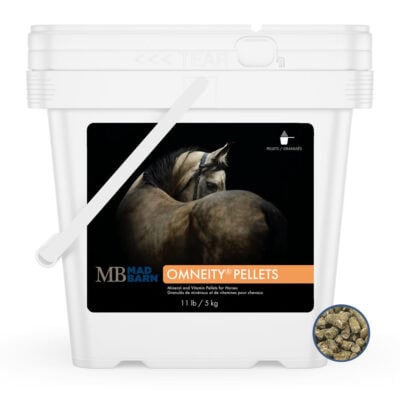
| Omneity® Pellets | 200 g (2 scoops) |
| Diet Analysis | |
| Digestible Energy (% of Req) | 101% |
| Protein (% of Req) | 145% |
| NSC (% Diet) | 8.9% |
For horses in light work, choose an average-quality hay (ie young grass hay or mixed hay) to allow free-choice access while avoiding excess calories. It is always important to monitor body condition and adjust the diet as needed.
Hay-only diets will not meet all the vitamin and mineral requirements and can increase the risk of hoof issues and poor joint health, weak topline and poor metabolic health. In this example, Mad Barn’s Omneity® and salt are added to fully balance the diet.

Additional Feeding Recommendations
Every horse needs a diet that provides adequate hydration, energy, protein, fibre, vitamins, and minerals. Horses are also grazing animals that evolved to eat small amounts continuously throughout the day.
The best way to support your Quarter horse’s health is by feeding a balanced, forage-based diet with appropriately selected hay or pasture turnout.
If your Quarter Horse is an easy keeper, a slow feeder and low-calorie hay can help manage his weight. However, working Quarter Horses and performance horses may need additional protein and energy sources.
Quarter Horses with HYPP need low-potassium diets to prevent excess potassium from causing muscle issues. Many horse feeds, such as alfalfa and soy, are high in potassium. Owners should analyze forage to maintain dietary levels of less than 1.5%. [14]
Alternatively, you can manage your horse’s potassium load by keeping the horse on pasture continuously. Grass has a high water content so the horse never gets too much potassium at one time.
Dietary management is also important for horses with PSSM. These horses should eat a low-starch diet and receive fat supplements to meet additional energy requirements. You can learn more about feeding the PSSM horse in this article. [15]
Nutritional Supplements
Quarter Horses on a forage-only diet need a vitamin and mineral supplement to fill nutritional gaps in their hay or pasture. Horses consuming forage alone are typically deficient in the following nutrients:
- Sodium
- Zinc
- Copper
- Selenium (depending on geographic location)
- Vitamin E (for horses consuming hay)
Mad Barn’s Omneity® is a comprehensive vitamin and mineral supplement formulated to balance the majority of equine diets without adding unnecessary calories from grain.
Available in a powdered or pelleted form, Omneity® supplies all of the nutrients required to support hoof health, coat quality, performance, immune health and more.
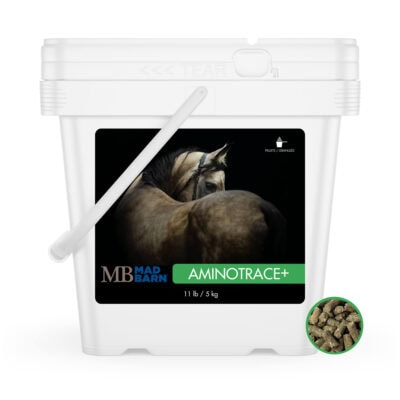
If your Quarter Horse is overweight or has metabolic problems related to PPID (Cushing’s), Mad Barn’s AminoTrace+ vitamin and mineral may be a better fit. This supplement is formulated with higher levels of magnesium and other nutrients that support insulin regulation in horses. [11]
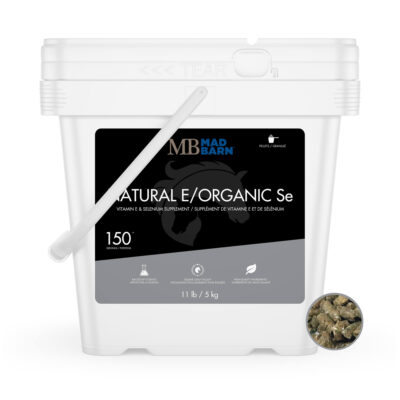
Quarter Horses with muscle disorders need higher levels of the antioxidants Vitamin E and Selenium to support muscle function and recovery. [16]
Frequently Asked Questions
Here are some frequently asked questions about American Quarter Horses:
The American Quarter Horse is a muscular, versatile horse breed developed in the United States and originally known for sprinting short distances. The breed earned its name from its success in quarter-mile races during Colonial America. As the country expanded westward, American Quarter Horses became essential ranch and cow horses valued for their speed, strength, and reliability. Today, they are widely recognized as dependable horses for both work and competition.
American Quarter Horses are unique for their compact, muscular build, calm temperament, and exceptional versatility. Their powerful hindquarters give them explosive speed over short distances, while their intelligence and agility make them highly effective working ranch horses. Selective breeding for cattle work also helped shape their confidence and responsiveness. These qualities make American Quarter Horses especially popular in western performance sports, ranch work, and pleasure riding.
American Quarter Horses are used for ranch work, western performance events, racing, and pleasure riding. They are especially popular in cattle events such as cutting, roping, and team penning, as well as reining, barrel racing, and western pleasure. Their athleticism and trainable nature also allow them to compete in halter, showmanship, hunter classes, and low-level dressage. Many owners also choose American Quarter Horses as dependable trail and family riding partners.
American Quarter Horses are known for several inherited health problems that occur more often in this breed than in many others. These include Hyperkalemic Periodic Paralysis (HYPP), Hereditary Equine Regional Dermal Asthenia (HERDA), Glycogen Branching Enzyme Deficiency (GBED), Malignant Hyperthermia (MH), and Polysaccharide Storage Myopathy (PSSM). In addition to genetic risks, some American Quarter Horses may also be prone to obesity and navicular-related issues depending on bloodlines, conformation, and management. Genetic testing, weight management, and regular veterinary and farrier care help reduce long-term health risks.
Yes, American Quarter Horses should ideally have AQHA five-panel testing before breeding. The AQHA five-panel test screens for five important inherited disorders and shows whether a horse is clear, a carrier, or affected. Those disorders are glycogen branching enzyme deficiency, hereditary equine regional dermal asthenia, hyperkalemic periodic paralysis, malignant hyperthermia, and polysaccharide storage myopathy. The test results help breeders avoid high-risk pairings and make better breeding decisions. It can also help owners better understand a horse’s genetic status and any related management considerations.
American Quarter Horses are known for having willing, trainable, and generally calm temperaments. Many are steady and practical horses that are easier to handle than more reactive breeds. Their history as dependable ranch horses selected for long days of work helped shape their reliable reputation. Individual temperament still varies with bloodlines, training, and management, so good handling remains important.
American Quarter Horses typically have a compact frame, deep body, heavy muscling, and powerful hindquarters. They usually have a short, broad head, a deep chest, strong shoulders, and a build that is often slightly more downhill than that of many modern sport horses. Their most recognizable feature is a well-muscled hind end designed for quick acceleration, stopping, and turning. The overall conformation of American Quarter Horses reflects their history as sprinting horses and agile working cow horses.
American Quarter Horses come in a wide range of coat colors. Common colors include bay, black, chestnut, brown, gray, roan, grullo, palomino, cremello, and buckskin. Markings and shade intensity can vary considerably from one horse to another. This color variety adds to the broad appeal of American Quarter Horses in both working and show settings.
Most American Quarter Horses stand between 14 and 16 hands high. This moderate height supports the sturdy, balanced build that helps the breed perform well in ranch work and western performance events. Although American Quarter Horses are usually not as tall as many warmbloods or Thoroughbreds, their muscling gives them an athletic and substantial appearance. Height can vary somewhat depending on bloodlines and type.
American Quarter Horses typically weigh between 900 and 1,200 pounds, depending on height, frame, muscling, and body condition. They are naturally sturdy horses, but their healthy muscle should not be confused with excess body fat. Because many American Quarter Horses are easy keepers, monitoring body condition is especially important. Good nutrition and regular exercise help maintain an appropriate weight for soundness and long-term health.
American Quarter Horses are often a good choice for beginners because they are generally willing, trainable, and dependable. Their calm disposition and practical nature make many individuals well suited to riders who are still building confidence and experience. The breed’s history as a reliable working mount also contributes to its reputation for steadiness. Still, the best beginner horse depends on the individual American Quarter Horse’s age, training, and temperament.
Summary
Many consider the American Quarter Horse the most widely registered horse breed, with more than six million horses recorded since 1940. The breed developed alongside American history and is now used in a broad range of disciplines, though it also has documented risks for genetic diseases that influence management and nutrition.
- Quarter Horses originated from crosses between early English horses and Cherokee and Chickasaw ponies, later shaped by Thoroughbred and Mustang influence
- The breed’s compact build, trainability, and inherited cow sense contribute to its widespread use in ranch work, western performance, and recreational riding
- Quarter Horses have known genetic conditions including HYPP, PSSM, GBED, MH, and HERDA, making testing and targeted care important
- Nutrition programs should emphasize balanced forage, careful calorie control for easy keepers, and specialized dietary adjustments for HYPP or PSSM horses
References
- Peterson, J. et al. The American Quarter Horse: Population Structure and Relationship to the Thoroughbred. J Hered. 2014. View Summary
- De Steiguer, E. Wild Horses of the West: History and Politics of America's Mustangs. Utah Hist Quart. 2012.
- Denhardt, R. Quarter Horses: A Story of Two Centuries. University of Oklahoma Press. 1967.
- AQHA. Official Handbook of Rules and Regulations.
- Tryon, R. et al. Evaluation of allele frequencies of inherited disease genes in subgroups of American Quarter Horses. J Am Vet Med Assoc. 2009. View Summary
- Wagner, M. et al. Allele Frequency and Likely Impact of the Glycogen Branching Enzyme Deficiency Gene in Quarter Horse and Paint Horse Populations. J Vet Intern Med. 2008. View Summary
- Rashmir-Raven, A. et al. Hereditary equine regional dermal asthenia (HERDA) in Quarter Horses: A review of clinical signs, genetics and research. Equine Vet Ed. 2015.
- Rudolph, J. et al. Periodic paralysis in Quarter Horses: a sodium channel mutation disseminated by selective breeding. Nature Genet. 1992.
- Aleman, M. et al. Malignant Hyperthermia Associated with Ryanodine Receptor 1 (C7360G) Mutation in Quarter Horses. J Vet Intern Med. 2009.View Summary
- Firshman, A. et al. Epidemiologic characteristics and management of polysaccharide storage myopathy in Quarter Horses. Am J Vet Res. 2003. View Summary
- Frank, N. et al. Equine Metabolic Syndrome. J Vet Intern Med. 2010.View Summary
- Turner. T. Diagnosis and Treatment of the Navicular Syndrome in Horses. Vet Clin North Am Equine Pract. 1989. View Summary
- Reese, R. et al. Nutrition and Dietary Management of Equine Gastric Ulcer Syndrome. Vet Clin North Am Equine Pract. 2009. View Summary
- Reynolds, J. et al. Genetic-diet interactions in the Hyperkalemic Periodic Paralysis syndrome in Quarter Horses fed varying amounts of potassium: I. Potassium and sodium balance, packed cell volume and plasma potassium and sodium concentrations. J Equine Vet Sci. 1998.
- Ribeiro, W. et al. The Effect of Varying Dietary Starch and Fat Content on Serum Creatine Kinase Activity and Substrate Availability in Equine Polysaccharide Storage Myopathy. J Vet Intern Med. 2008. View Summary
- Finno, C. et al. A Comparative Review of Vitamin E and Associated Equine Disorders. J Vet Intern Med. 2012. View Summary