English




The horse’s eyes are highly specialized organs that play an essential role in survival, communication, and performance. The equine eye is large and laterally positioned, offering a wide field of vision that allows horses to detect threats in their environment.
For the equine visual system to function, the cornea — the clear, dome-shaped outer layer of the eye — must remain transparent. Any disruption in corneal clarity can compromise vision, leading to disorientation, anxiety, or impaired performance.
Corneal edema, often described by horse owners as a cloudy eye, is one of the most recognizable signs of ocular disease. It occurs when excess fluid accumulates within the cornea, giving it a bluish-gray or milky appearance. Corneal edema indicates the delicate fluid balance in the outer eye has been disrupted, usually because of trauma, infection, inflammation, or increased intraocular pressure.
If your horse has signs of vision loss, it is considered a medical emergency. Prompt veterinary assessment provides the best chance of preserving vision. Underlying causes of cloudy eye can progress rapidly, resulting in permanent vision loss.
Read on to learn more about the anatomy of the equine cornea, the mechanisms that lead to cloudy eye or edema, the major causes, clinical presentation, diagnostic approaches, treatment strategies, and long-term management.
Anatomy of the Equine Cornea
The equine cornea is a transparent structure that forms the front part of the eye. The cornea is avascular, meaning it does not have its own blood supply. Its primary functions are to allow light to enter the eye and to provide a protective barrier. [1]
Despite being less than 1 mm thick, the cornea is composed of several highly specialized layers: [1][2]
- Epithelium: The outermost layer acts as the first line of defense against trauma, pathogens, and dehydration. It also provides a smooth optical surface.
- Bowman’s layer: This layer lies just beneath the epithelium and is composed of collagen protein fibers.
- Stroma: The middle layer makes up approximately 90% of the corneal tissue. It is composed of layered strands of collagen fibrils and keratocytes. This highly organized structure is responsible for corneal transparency.
- Descemet’s membrane: A thin but strong basement membrane that supports the innermost endothelial layer.
- Endothelium: A single layer of hexagonal cells lining the inner cornea. These cells actively pump excess fluid out of the stroma and maintain its relative dehydration, which is critical for transparency.

The cornea remains clear only if the epithelium and endothelium are intact. If either barrier is damaged, fluid accumulates in the stroma, scattering light and producing the cloudy or bluish appearance characteristic of edema.
Causes of Corneal Edema in Horses
Cloudy eye in horses occurs when the fluid balance in the cornea is disrupted, leading to disorganization of the stroma fibers. This results in opacity as light is no longer able to pass directly through the tissue to the lens. [1]
Fluid imbalances in the cornea can result from injury, infection, or increased intraocular pressure. [1]
Corneal Ulcers
Corneal ulcers are one of the leading causes of corneal edema in horses. [1][3] Because the equine cornea is large, convex, and exposed, it is highly vulnerable to trauma. Foreign bodies such as dust, sand, plant material, or shavings can scratch the surface, while blunt injuries may occur during turnout, transport, or handling.
Poorly fitted tack, harsh nosebands, or accidental contact with riding equipment can also compromise the corneal surface.
When the epithelial barrier is disrupted, fluid from the tear film penetrates the underlying stroma. This produces a localized zone of swelling and the characteristic bluish-white opacity of corneal edema. [3]
In uncomplicated superficial ulcers, corneal edema typically remains within the injured region. However, if the ulcer deepens or secondary infection develops, the swelling can spread, leading to diffuse edema throughout the entire cornea.
Both bacteria and fungi can invade injured cornea tissue easily, and fungal keratitis in particular is often aggressive, destructive, and difficult to treat. [4][5]
Left unchecked, corneal infections can result in: [4][5]
- Breakdown of the stroma
- Enlargement of the ulcer
- Perforation of the cornea
Infections that progress to severe corneal damage or perforation are a medical emergency and carry a guarded prognosis for preserving vision. [4][5]
Equine Recurrent Uveitis
Equine Recurrent Uveitis (ERU), also referred to as moon blindness, is among the leading causes of diffuse corneal edema in horses. Unlike trauma-induced swelling, uveitis-related edema stems from inflammation of the inner eye structures. This results in compromised endothelial cell function within the cornea. [1]
In a healthy eye, the corneal endothelial cells pump fluid out of the stroma. When their function is impaired by inflammatory mediators, fluid accumulates and produces a uniform, cloudy haze across the cornea. [6][7]
ERU may arise from a combination of autoimmune mechanisms, environmental triggers, genetic predispositions, and often a breach of the blood–ocular barrier that allows immune cells to incorrectly target ocular tissues. [7][8][9]
ERU is the most common cause of blindness in horses worldwide. Appaloosas, Warmbloods, and Icelandic horses have a breed predisposition to the condition. [7][9]
Because ERU is recurrent and typically progressive, it carries a guarded long-term prognosis, and often requires lifelong management. [6]
What's your top priority with your horse's health?

Enter your email to receive your store credit
Glaucoma
Glaucoma arises when the intraocular pressure (IOP) increases due to impaired drainage of aqueous humor from the anterior chamber. In horses, this rise in pressure directly damages the corneal endothelium, a delicate cell layer responsible for pumping excess fluid out of the stroma. [1][10]
Once these endothelial cells are compromised, the cornea loses its ability to remain clear, resulting in diffuse corneal edema. Alongside the characteristic cloudy appearance, affected horses may present with buphthalmos (enlargement of the globe), corneal vascularization, and in advanced stages, optic nerve degeneration. [10][11]
These changes reflect both acute damage from elevated IOP and chronic remodeling of the eye. In equines, glaucoma most often develops as a secondary complication of recurrent uveitis (ERU). Chronic inflammatory changes obstruct aqueous humor outflow, creating a persistent rise in pressure. [10][11]
Because clinical signs often go unnoticed until the disease is advanced, the prognosis for vision is generally poor once glaucoma is diagnosed. Even with aggressive therapy, many cases eventually progress to irreversible blindness, and long-term management may prioritize comfort rather than restoration of sight. [1][10][11]
Other Causes of Corneal Edema
While ulcers, uveitis, glaucoma, and endothelial degeneration account for most cases of corneal edema in horses, several additional factors can occasionally be involved.
Other causes of cloudy eye in horses include: [1][12][13]
- Neoplasia: Tumors affecting the eye or surrounding tissues can disrupt the integrity of the cornea or interfere with the endothelial layer. Squamous cell carcinoma is the most common equine ocular tumor in horses, and if it invades the cornea, secondary edema may occur.
- Congenital abnormalities: Although rare, some foals are born with developmental defects that affect the structure or function of the corneal endothelium. These congenital conditions may cause persistent corneal cloudiness from an early age, often accompanied by other ocular abnormalities.
- Chemical or toxic exposure: Accidental contact with caustic substances such as lime, fly sprays, or improperly diluted disinfectants can cause corneal burns and endothelial damage. Chemical injuries often result in sudden, severe edema and require rapid veterinary intervention and repeated eye lavage (flushing) to limit long-term damage.
- Post-Surgical complications: Ocular surgery carries a risk of corneal injury. Post-operative monitoring is essential to identify complications early and preserve corneal clarity.
Clinical Presentation
Corneal edema is often one of the most striking ocular abnormalities and is frequently the first sign noticed by owners. This condition disrupts the cornea’s transparency, giving the eye a cloudy or opaque appearance that is difficult to overlook.
Appearance
The cornea may develop a bluish, gray, or milky haze that varies in extent and severity. In mild cases, edema may appear as a localized halo surrounding a corneal ulcer, while more diffuse edema blankets the entire corneal surface. [1]
When severe, the cornea can become completely opaque, obscuring the iris and pupil from view. This can make it impossible to assess deeper ocular structures without a specialized examination. [1]
Associated Signs
Corneal edema is usually accompanied by clinical signs of ocular pain. Horses often exhibit excessive tearing (epiphora), squinting (blepharospasm), and swelling of the eyelids. Horses with the symptoms may rub, paw or scratch the affected eye, risking secondary trauma.
Photophobia refers to sensitivity or pain caused by light exposure. It is a common sign of ocular disease in horses. Affected animals may toss their heads, avoid bright light, or keep the eye tightly closed, especially when outdoors. [1]
In cases where vision is significantly impaired, behavioral changes may include: [1]
- Stumbling
- Spooking
- Reluctance to move confidently, even in familiar environments
Diagnosis
Corneal edema in horses is a clinical sign rather than a disease in itself. Identifying the underlying cause of fluid accumulation is essential to preserving vision and reducing the risk of long-term complications.
The diagnostic process begins with a thorough medical history. The treating veterinarian will ask for information about the onset, speed of progression, environmental risks, trauma, and history of eye issues to help narrow down the likely cause. [1]
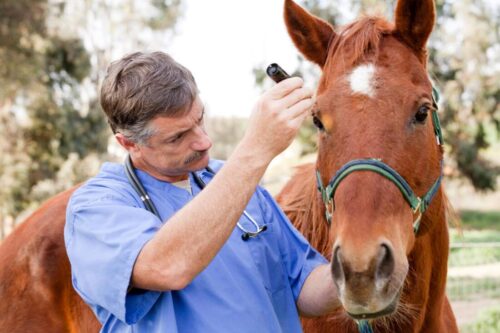
The veterinarian then performs a physical examination, with particular focus on the eyes. Under appropriate lighting, the veterinarian assesses whether the edema is focal or diffuse, its density, and whether additional abnormalities such as vascularization, ulcers, or foreign bodies are present.
Signs of ocular pain, squinting, tearing, or eyelid swelling, provide further clues about severity. [1]
Once the initial assessment is complete, further tests may be required to confirm the diagnosis and guide treatment. In some cases, referral to an ophthalmologist may be necessary.
Diagnostic tools for investigating symptoms of equine eye disease include: [1][14]
- Fluorescein staining: A specialized dye is dropped into the eye, then viewed under a blue light to highlight defects in the cornea.
- Tonometry: A tonometer is an ophthalmologic tool that measures intraocular pressure. Increased intraocular pressure suggests glaucoma, while abnormally low pressure may indicate uveitis.
- Slit-lamp biomicroscopy: A high-magnification microscope designed for viewing the ocular structures is used to inspect the corneal layers, anterior chamber, and iris, helping to pinpoint the source of cloudy eye.
- Ophthalmoscopy: If corneal clarity permits, a small magnifying device may be used to evaluate deeper structures such as the lens and retina.
- Cytology and culture: Swabs and corneal scrapings are indicated when infection is suspected. Microscopic evaluation can detect bacteria or fungi, while culture and sensitivity testing guide targeted therapy. This step is particularly important in horses, where fungal keratitis is both aggressive and resistant to many standard treatments.

Treatment
The treatment and management protocols for horses with cloudy eye depend on the underlying cause. Since equine eye disease can progress rapidly, interventions are often aggressive and urgent.
Corneal Ulcers
Treatment of equine corneal ulcers focuses on several key objectives: [1]
- Identify and manage underlying causes
- Control or eliminate infection
- Reduce ocular inflammation
- Protect the corneal surface during healing
- Provide effective pain relief
Because equine corneal ulcers can deteriorate rapidly, treatment is typically aggressive and prolonged, often requiring several weeks of therapy. Medical treatment focuses on controlling infection, reducing stromal breakdown, and managing secondary uveitis. [1][15]
Broad-spectrum topical antibiotics are prescribed based on cytology or culture results, and antifungal medications are added if fungal keratitis is suspected or confirmed. Surgical intervention is indicated when ulcers are deep, progressive, or unresponsive to medical therapy. [1][15]
Conjunctival grafting is a common procedure, providing both vascular supply and structural support to the weakened cornea. If surgical repair is not possible or the eye is irreversibly damaged, enucleation (surgical eye removal) may be recommended to eliminate pain. [1][15]
Equine Recurrent Uveitis
Management of equine recurrent uveitis (ERU) aims to control inflammation, relieve pain, and preserve vision for as long as possible. Treatment often involves a combination of medical and surgical strategies, tailored to the severity and recurrence pattern in each horse. [1][7]
In select cases, a vitrectomy offers the best chance of long-term relief. The procedure removes infectious organisms and inflammatory mediators from the vitreous cavity, reducing the frequency of flare-ups. Vitrectomy is a specialized procedure requiring advanced equipment and a qualified surgical team, and may not be available in all equine hospitals. [7][16][17]
Other surgical options include: [7][17]
- Injecting fibrinolytic drugs into the anterior chamber to dissolve blood clots
- Removing clots and diseased tissue when vision is threatened
Medical therapy focuses on suppressing immune-mediated inflammation and reducing the risk of recurrence. Systemic and topical nonsteroidal anti-inflammatory drugs (NSAIDs) are commonly used during acute ERU episodes. [7][17]
Ocular implants are a long-term management option for some horses. These implants slowly release immunomodulating medication into the eye, which may reduce the frequency and severity of flare-ups. [7][17]
Despite aggressive treatment, many horses with ERU eventually require enucleation, surgical removal of the affected eye, to alleviate pain and chronic inflammation. This procedure can be performed under general anesthesia or standing sedation and generally carries an excellent prognosis. [17][18]
Glaucoma
Equine glaucoma is managed by lowering intraocular pressure and minimizing damage to ocular tissues. Treatment options include topical medications or surgical procedures. In advanced cases, enucleation may be the only option to relieve pain. [1][10][11]
The therapeutic approach to managing glaucoma in horses is influenced by several factors: [1][10][11]
- The degree of vision that remains
- Presence of concurrent ocular conditions
- The horse’s age and intended use or workload
- Practicality of administering long-term topical medications
Topical medications reduce fluid production, improve drainage, and support blood flow within the eye. Despite these measures, long-term control with medication alone is often poor.
In addition, horses are particularly sensitive to handling around the eyes, which makes long-term administration of ocular medications challenging. As a result, many horses eventually require surgery. [1][10][11]
When vision is still present, surgery focuses on restoring normal intraocular pressure while preserving sight. Laser cyclophotocoagulation is the preferred technique, which uses a targeted laser to destroy part of the ciliary body and reduce fluid production. [1][10][11]
In blind, painful eyes, the goal shifts to pain relief rather than vision preservation. If pain cannot be controlled by other means, enucleation (eye removal) provides a definitive solution. [1][10][11]
Eye Injuries
Immediate action is critical when edema results from chemical or toxic exposure. Repeated, abundant rinsing (irrigation) of the eye helps remove the offending substance, followed by topical antibiotics and anti-inflammatories to prevent secondary infection and reduce inflammation. Pain relief is a key component of management in these cases. [1]
Physical trauma to the eye, such as corneal scratches or blunt impact, is typically managed with careful cleansing, topical antibiotics, and anti-inflammatories to control infection and swelling. Pain relief and, in some cases, protective bandaging or a mask may be recommended to prevent further damage. [1]
Post-surgical eye care focuses on controlling inflammation, preventing infection, and ensuring proper healing with topical antibiotics, anti-inflammatories, and analgesics. Close monitoring and regular follow-up exams are essential to detect complications early and support recovery. [1]
Supportive Care
Supportive strategies play an important role in recovery from corneal edema. Systemic NSAIDs provide pain relief, while protective devices such as fly masks, eye hoods, or even temporary tarsorrhaphy (partial eyelid closure) help shield the eye during healing. [1]
Environmental adjustments, including dust-free bedding, reduced exposure to sunlight, and strict insect control, can further reduce irritation and risk of secondary injury. [1]
Prognosis
The prognosis for horses with corneal edema depends on the underlying cause, severity, and how quickly treatment begins.
Superficial ulcers typically resolve with timely care and carry a favorable outlook. Uveitis can be managed long-term, but repeated episodes frequently result in eventual vision loss. [1]
Even when edema resolves, residual corneal scarring is common. For many horses, corneal scarring has minimal impact on day-to-day function.
Performance horses in competitive disciplines that require precise vision, scarring may have an impact on performance. [1]
Prevention
Not every case of corneal edema can be avoided, but thoughtful care, training, and management routines greatly reduce the risk of eye injuries and infections.
Since equine eyes are large and positioned laterally, they are particularly vulnerable to trauma. Given this, maintaining a safe living environment is one of the most effective ways to prevent eye injuries in horses.
Barns and paddocks should be inspected regularly for hazards such as:
- Sharp edges
- Protruding nails
- Splintered boards
- Overhanging branches
- Thorny vegetation
- Broken fencing
Fly and insect control is another cornerstone of preventing equine eye injuries and infections. Flies and other pests can irritate the eye directly, or carry infectious agents that cause keratitis. Regular manure removal, use of fly traps, and insect-repelling masks or sheets all help minimize exposure.
Tack and equipment can also pose a hazard to the horse’s eye. Bridles, nosebands, or training aids that sit too close to the eye can cause rubbing or pressure. Regular tack checks, particularly before exercise, ensure equipment does not create unnecessary risks.
Frequently Asked Questions
Here are some frequently asked questions about corneal edema and cloudy eyes in horses:
Yes, if the edema is mild and treated early, a horse's vision may return to normal. However, severe or prolonged edema often leaves residual scarring that may reduce vision permanently.
Yes, cloudy eye or changes in vision in horses are a medical emergency. Even if the horse does not seem to be in pain, cloudiness usually indicates damage or disease requiring prompt treatment. Delaying veterinary assessment risks permanent vision loss.
A horse with cloudy eye needs immediate veterinary attention. Eye problems in horses can worsen within hours. Veterinary examination should be arranged the same day.
Summary
Corneal edema in horses is a cloudy, bluish-gray appearance of the eye caused by fluid accumulation that prevents light from passing through the cornea. It signals underlying disease and requires prompt diagnosis and treatment to preserve vision and comfort.
- The cornea's clarity depends on intact epithelial and endothelial barriers that regulate fluid balance
- Causes include corneal ulcers, equine recurrent uveitis, and glaucoma
- Less common causes include tumors, congenital defects, toxins, and post-surgical issues
- Typical signs are a milky haze, tearing, squinting, eyelid swelling, light sensitivity, and behavioral changes from impaired vision
- Prognosis varies by cause and speed of care; prevention focuses on safe facilities, tack checks, dust and insect control, and prompt attention to eye injuries
References
- Gilger. B. C. Ed. Equine Ophthalmology. 1st ed. Wiley. 2022.
- Gelatt. K. N. Eye Structure and Function in Horses. Merck Veterinary Manual. 2025.
- Plummer. C. E. Corneal Response to Injury and Infection in the Horse. Veterinary Clinics of North America: Equine Practice. 2017. View Summary
- Gelatt. K. N. Disorders of the Cornea in Horses. Merck Veterinary Manual. 2019.
- Beuoy. C. Corneal Ulcers in Horses. Veterinary Medicine at Illinois. 2018.
- Young. A. et al. Equine Recurrent Uveitis. UC Davis School of Veterinary Medicine. 2020.
- Malalana. F. What’s New in Equine Recurrent Uveitis?. In Practice. 2020.
- Henriksen. M. de L. et al. Ocular Abnormalities in the Icelandic Horse with a Focus on Equine Recurrent Uveitis: 112 Icelandic Horses Living in Denmark and 26 Icelandic Horses Living in the United States. Veterinary Ophthalmology. 2022. View Summary
- Loving. N. S. Risk Factors for Equine Recurrent Uveitis. EquiManagement. 2023.
- Glaucoma in Horses. Merck Veterinary Manual. 2024.
- Wilkie. D. A. Equine Glaucoma: State of the Art. Equine Veterinary Journal. Supplement. 2010. View Summary
- Turner. A. G. Ocular Conditions of Neonatal Foals. Veterinary Clinics of North America: Equine Practice. 2004. View Summary
- Montgomery. K. W. Equine Ocular Neoplasia: A Review. Equine Veterinary Education. 2014.
- Monk. C. et al. How to Diagnose the Cloudy Eye. AAEP Annual Convention. 2013.
- Williams. L. B. and Pinard. C. L. Corneal Ulcers in Horses. Compend Contin Educ Vet. 2013.
- Fingerhut. L. et al. Neutrophil Extracellular Traps in the Pathogenesis of Equine Recurrent Uveitis (ERU). Cells. 2019. View Summary
- McMullen. R. J. and Fischer. B. M. Medical and Surgical Management of Equine Recurrent Uveitis. Veterinary Clinics of North America: Equine Practice. 2017. View Summary
- Michau. T. M. Equine Glaucoma. The Veterinary Clinics of North America. Equine Practice. 2017. View Summary