English






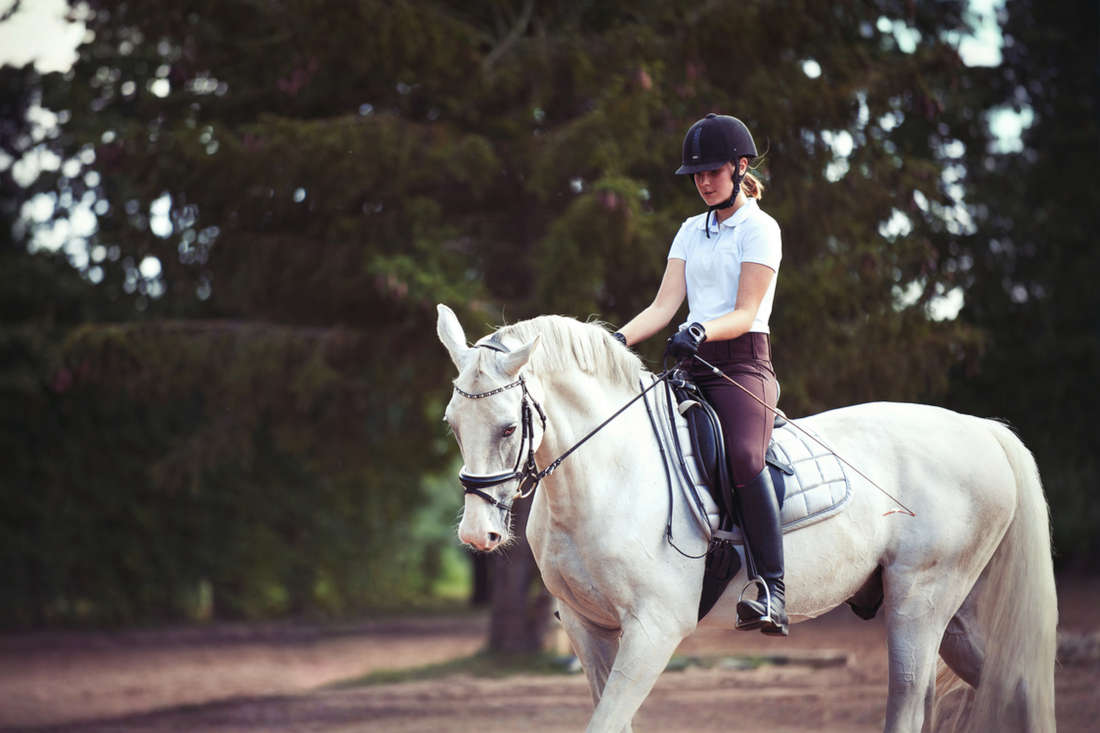
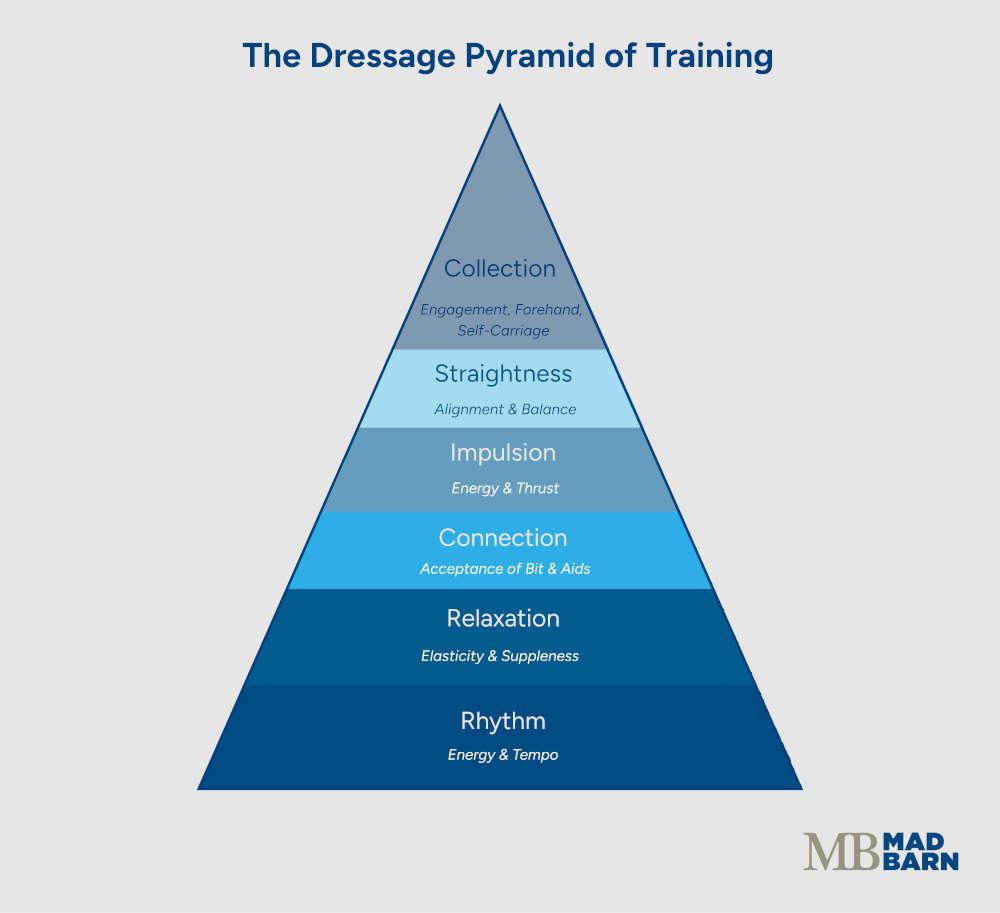
The Dressage Pyramid of Training is a systematic framework used to develop a horse’s balance, strength, and rideability through progressive, interconnected steps. Often referred to as the Training Scale, it outlines the ideal order of development: rhythm, suppleness, contact, impulsion, straightness, and collection.
Each level builds on the one before it. When gaps such as tension in collection or inconsistent contact appear, the solution is usually found by revisiting the foundational elements below.
Although rooted in classical dressage principles, the Pyramid applies to any discipline that prioritizes correct biomechanics and long-term soundness. Understanding how the training scale works allows riders to diagnose problems, structure rides more effectively, and develop horses in a way that promotes both performance and welfare.
Keep reading for a full breakdown of each layer of the Dressage Pyramid of Training, so you can use this system to diagnose problems, set goals, and make your rides more effective.
The Dressage Pyramid of Training
The Dressage Pyramid of Training is a widely used framework that clearly and concisely outlines fundamental training concepts for developing a dressage horse.
This training scale is typically depicted as a pyramid to illustrate how each step toward higher levels relies on a solid foundation of core fundamentals. These steps are also interconnected. The best riders return to the basics in every ride, even at the top of the sport.
While primarily used in dressage, these principles can help equestrians in every discipline develop a clearer roadmap for refining their training and improving their horses’ rideability.
The Dressage Pyramid of Training is a structured training scale used to systematically develop the horse, from the young horse learning to carry a rider to the advanced horse demonstrating collection. [1]
What's your top priority with your horse's health?

Enter your email to receive your store credit
Training Steps
The Dressage Pyramid of Training describes six steps:
- Rhythm: regularity and tempo
- Suppleness: elasticity and freedom from anxiety
- Contact: connection and acceptance of the bit through acceptance of the aids
- Impulsion: engagement and the desire of the horse to go forward
- Straightness: improved alignment and equal, lateral suppleness on both reins
- Collection: balance and lightness of the forehand from increased engagement
The journey up the training scale also involves both “physical development through progressive conditioning” and “increasing thoroughness and obedience.” [2]
German Training Scale
In North America, the United States Dressage Federation (USDF) publishes the official Pyramid of Training materials. USDF updated the Pyramid in 2019 to improve clarity, but the core principles have remained the same throughout the last century. [3]
The underlying structure traces back to the riding and training manuals of the German cavalry published in 1912. Germany’s national riding federation (FN) formalized the training scale in its official handbook. [4]
Classical Principles
Historically, horses were trained for military purposes. Developing training methods based on the nature and physiology of the horse allowed these animals to lead long, useful lives. The Greek general and horseman Xenophon wrote some of the earliest surviving works about these classical training methods. [5]
While horses are no longer used for military purposes, modern training systems still incorporate classical principles. The Dressage Pyramid of Training and the German training scale preserve these traditions in a step-by-step framework that now guides the proper training of sport horses.
Step 1) Rhythm: Regularity & Tempo
Rhythm is the foundation of the entire Dressage Pyramid. This term is used to describe the correct sequence of footfalls and timing in all gaits. [2]
Horses must perform a walk, trot, and canter with regularity while maintaining balance and self-carriage appropriate to their training level. The rhythm of gaits should be expressed with energy and a suitable, consistent tempo.
Why Rhythm Matters
Rhythm is the baseline for everything that follows. Without regularity, the horse cannot relax and swing through the back consistently, and contact becomes unstable.
Educational materials for judges emphasize rhythm as the starting point because it shapes gait quality. [1]
What Rhythm Looks Like
Rhythm should be observable and consistent, regardless of the exercise being ridden. It is not defined by speed, but by regularity of footfalls and a steady, appropriate tempo for the horse’s level of training.
Well-trained rhythm has the following characteristics:
- Consistent forward energy in each gait
- No rushing or slowing within gaits
- Clear, marching walk
- Regular tempo in trot
- Pure, three-beat canter
When rhythm is correct, the horse feels predictable and balanced under the rider. If tempo fluctuates or footfalls become irregular, the rider should return to simpler exercises to restore stability before progressing.
Common Rhythm Problems
Rhythm problems often appear subtle at first but can quickly affect the entire training scale. Identifying irregularities early helps prevent tension and imbalance from becoming ingrained patterns.
Some of the most common challenges related to rhythm include:
- Rushing: running on the forehand, often due to tension, imbalance, or confusion
- Behind the leg: insufficient forward intent, lack of energy, inattentive to the aids
- Lateral walk: legs on the same side move in unison, disrupting the four-beat walk sequence
- Four-beat canter: diagonal pairs land separately, disrupting the three-beat canter sequence
- Irregular trot: loss of symmetrical rhythm, often appearing as shorter steps on one side
Irregularity and rhythm issues can also indicate discomfort. Before implementing a training plan, work with your veterinarian and trainer to rule out external factors, such as tack fit or lameness.
Rhythm Exercises
Exercises that improve rhythm should prioritize stability over complexity. The goal is to reinforce regular footfalls and a consistent tempo without introducing unnecessary tension.
Specific exercises to develop correct rhythm include:
- Large figures: riding large circles and long lines helps stabilize tempo
- Frequent transitions: transitions between and within gaits keep attention on the rider while maintaining regular steps
- Ground poles: encourage consistent tempo and engagement with appropriate spacing
When working on rhythm, choose exercises that help the horse stay organized rather than reactive. If tempo begins to fluctuate, simplify the task until regularity is restored before adding difficulty.
Step 2) Suppleness: Elasticity & Freedom from Anxiety
Suppleness is closely linked with relaxation. Relaxation was previously considered the second step in the old training pyramid. The new terminology captures both the mental and physical aspects of developing a relaxed horse, which go hand in hand. [3]
A supple and elastic horse can stretch and contract the musculature smoothly. A relaxed horse has a calm mental state free from anxiety or nervousness. Effective training teaches the horse to accept the rider without becoming tense.
The absence of muscular tension allows the horse’s joints to move with flexibility and harmony, allowing the development of positive muscle tone and a swinging back. Suppleness allows the rider to bend the horse laterally and adjust the frame, which is essential for advancing. [2]
Why Suppleness Matters
When the horse is tense, the topline stiffens and movement becomes guarded. Instead of forcing the horse to bend, the real solution is to restore suppleness by focusing on relaxation.
Research on different head-and-neck positions, including sustained hyperflexion (rollkur), has found measurable changes in behavior, heart rate variability, and cortisol levels in horses trained in specific positions, highlighting the welfare implications of developing true suppleness using sound fundamentals. [6]
Suppleness is also essential for efficient training. A relaxed horse can build strength and coordination without unnecessary resistance.
What Suppleness Looks Like
Suppleness is visible in the way the horse moves through the topline and responds to the rider’s aids. It reflects both physical elasticity and a calm, attentive mental state.
Key characteristics of suppleness include:
- A swinging back and elastic stride
- A neck that can lengthen and shorten without tightness
- A jaw that appears soft without consistent clamping or gaping
- Willingness to bend and change direction without anxiety
- Naturally stretching when allowed to chew the reins out of the hands
When suppleness is present, the rider can influence the horse’s body without resistance. If stiffness, bracing, or tension appear, the focus should shift back to relaxation and mobility before asking for greater precision or power.
Common Suppleness Problems
Suppleness issues typically show up as tension, resistance, or guarded movement. These signs indicate the horse is unable to move freely through the topline or maintain a calm, focused mental state.
Signs of underdeveloped suppleness include:
- Tight back: hollowed back or restricted muscles leading to poor movement
- Spooking: excessive fear responses to the environment that could indicate anxiety
- Conflict behaviors: excessive tail swishing or gaping mouths could indicate stress
Ongoing suppleness or relaxation issues may be associated with an underlying health problem. Work with your veterinarian to ensure your horse is comfortable in training.
Suppleness Exercises
Suppleness exercises should encourage relaxation and mobility without forcing position. The focus is on allowing the horse to move elastically through the body while maintaining rhythm and balance.
Exercises to target suppleness include:
- Long-and-low: invite the horse to stretch into the contact while keeping rhythm
- Serpentines and shallow loops: promote mobility through the ribcage and joints
- Walk breaks: promote relaxation and reset after more challenging exercises
- Transitions within the gait: develop adjustability without compromising rhythm
- Rider check-in: horses mirror riders, so make sure you are relaxed and soft too
When working on suppleness, quality matters more than depth of bend or frame. If the horse becomes tense or resistant, reduce the demand and restore relaxation before progressing.
Step 3) Contact: Connection & Acceptance of the Bit
The rider’s driving aids generate energy in the hindquarters that must flow through the entire body of a supple horse moving at a consistent rhythm. That energy is received in the rider’s hands through the contact. [2]
Elastic and adjustable contact with the bit creates a fluent interaction between horse and rider. The contact does not hold the horse in the frame. It allows the rider to direct the energy into an adjustable outline.
Horses display acceptance of the bit by quietly chewing it, which activates the salivary glands. The mouth becomes moist, and saliva is visible. The tongue should remain relaxed under the bit.
The Science Behind Contact
Since rein tension is measurable, research provides valuable insights into the importance of proper contact.
In a study of professional riders during normal training sessions, rein tension varied significantly before, during, and after transitions. The study also found substantial variation between horse-rider combinations and left-right rein differences. [7]
These findings support a practical training takeaway that contact is dynamic. Quality depends on how the rider maintains elasticity, not a fixed tension.
What Correct Contact Looks Like
Correct contact is felt more than seen. It reflects a steady, elastic connection from the horse’s hindquarters through the back into the rider’s hands, without rigidity or pulling.
Well-developed contact feels like:
- Even, steady feel in both reins (not necessarily light, but elastic and consistent)
- The horse reaches forward into the bridle rather than hiding behind it
- Transitions do not cause sudden heavy leaning, bracing, or head tossing
Quality contact should remain consistent through transitions, turns, and changes of tempo. If the connection becomes heavy, uneven, or inconsistent, revisit rhythm and suppleness before attempting to refine the outline.
Common Contact Problems
Contact problems often reflect gaps in earlier stages of the training scale. When rhythm or suppleness are inconsistent, the connection between horse and rider becomes unstable or resistant.
Signs of underdeveloped contact include:
- Leaning/heavy: the horse leans on the bit and is heavy in the hand
- Behind the bit: the horse curls behind the vertical or does not take the contact
- Overbent/overflexed: the horse is crooked due to uneven contact
- Inconsistent connection: loss of contact due to incorrect rein length or fixed hands
Head position is not the only factor to consider when evaluating contact. Some horses are naturally heavier or lighter in hand, making them more likely to hold their head in front of or behind the vertical, even with elastic contact. As training, strength, and suppleness progress, self-carriage improves.
Exercises to Improve Contact
Contact exercises should reinforce elasticity rather than fixed rein pressure. The goal is to develop a steady connection that allows energy from the hindquarters to flow forward into soft, responsive hands.
Sample exercises that focus on contact and connection include:
- Transitions: prioritize smoothness and maintaining elastic contact through transitions
- Give-and-retake the reins: briefly soften rein contact to see if the horse maintains balance and self-carriage
- Leg yield to a steady outside rein: encourages the horse to step under and connect from inside leg to outside rein
- Corners and turns: practice corners and turns without pulling the inside rein back
When improving contact, avoid focusing solely on head position. If the connection becomes heavy, inconsistent, or hollow, revisit rhythm and suppleness to reestablish a balanced foundation.
Step 4) Impulsion: Engagement & Desire of the Horse to Go Forward
Impulsion is often misunderstood as speed. In the Pyramid, impulsion refers to the transmission of an eager and energetic, yet controlled thrust that propels the horse forward. This thrust is generated from the hindquarters into the athletic movement of the horse. [2]
In the trot and canter, impulsion creates a phase of suspension, a brief moment when all four of the horse’s hooves are off the ground simultaneously. A horse with good impulsion displays elastic steps, a supple back, engaged hindquarters, and a strong desire to go forward.
Impulsion is essential for developing medium gaits as horses progress through the levels. These gaits show the horse’s ability to lengthen stride and frame while maintaining rhythm and suppleness. At the top level of dressage, impulsion is a necessary ingredient of collection and extended gaits.
Why Impulsion Matters
Impulsion allows the rider to shape the horse’s movement and frame for the upper levels without losing the balance and correct basics developed at the lower levels. It also supports straightness, as horses often become crooked without sufficient activity behind.
This step of the training scale is closely interconnected with establishing effective contact. Impulsion is the energy generated by the hindquarters that contact allows riders to capture and direct.
What Impulsion Looks Like
Impulsion is felt as controlled energy that originates from the hindquarters and travels through a supple, elastic body. It should increase expression and power without disrupting rhythm or balance.
Riding a horse with strong impulsion feels like:
- The horse is responsive to the leg without rushing
- Trot develops more elasticity and suspension
- Canter has a clearer jump and uphill tendency
When impulsion is correct, the horse feels forward-thinking yet adjustable. If the gait becomes hurried, flat, or resistant, return to rhythm and contact to restore clarity before asking for more power.
Common Impulsion Problems
Impulsion problems usually stem from confusion between energy and speed. When the hindquarters are not stepping actively under the body, the horse may compensate by rushing or becoming unresponsive to the aids.
Examples of specific issues with impulsion include:
- Fast but flat: the horse runs away from the leg aid instead of stepping under
- Dull to the leg: unresponsive to the leg aids, resistant to moving forward
- Difficulty lengthening strides: the horse cannot maintain tempo and balance in medium and extended gaits
Reluctance to move forward and low energy are commonly linked to discomfort or underlying health problems. Work with your veterinarian to ensure external factors, such as diet or pain, are not affecting training.
Exercises to Develop Impulsion
Impulsion exercises should build strength and responsiveness without sacrificing rhythm or relaxation. The emphasis is on developing active hindquarters that step under the body while remaining adjustable.
Useful exercises that focus on impulsion include:
- Transitions within gaits: ride a few strides more forward, then return to working pace
- Canter, trot, canter transitions: build carrying power when done with balance
- Pole work: promotes hind-end activity when spaced correctly
As impulsion improves, the horse should feel more forward-thinking yet easier to rebalance. If energy becomes hurried or disconnected, return to simpler work to restore clarity before increasing intensity.
Step 5) Straightness: Alignment & Equal Suppleness on Both Reins
Straightness is the stage where the horse learns to direct power evenly through the body. Horses are straight when the footfalls of the front end and hind end are aligned, and their longitudinal axis is in line with the track on which they are ridden. [2]
Most horses are naturally crooked, with a hollow side and a stiff side. This crookedness causes horses to use one side of the body slightly differently from the other and can lead to uneven contact with the reins.
Straightness enables horses to bend equally on both sides. Gymnastic exercises develop symmetry over time, allowing the horse to engage both hind legs evenly. The process improves both lateral and longitudinal balance, which are essential for collection.
The Science of Straightness
Horses, like people, tend to have preferences and asymmetries. A review of laterality in horse training underscores why asymmetries should be accepted as innate and that training should focus on balance, coordination, and equal strength. [8]
A more recent review on defining laterality and asymmetry in horses reinforces that these concepts are complex and relevant to both training and clinical understanding. [9]
This research suggests straightness cannot be artificially forced and supports the importance of other foundational principles in the Dressage Pyramid of Training.
What Straightness Looks Like
Straightness becomes evident when the horse channels energy evenly through the body without drifting or compensating. It reflects improved balance, coordination, and equal strength on both sides.
The following characteristics point to well-developed straightness:
- The horse tracks evenly without drifting shoulders or swinging haunches
- The rider can ride a straight line without constant correction
- Contact feels balanced left to right, especially in transitions and lateral work
If straightness breaks down, the issue often traces back to uneven suppleness or insufficient impulsion. Rather than correcting with stronger rein aids, return to gymnastic exercises that promote symmetry and balance.
Common Straightness Problems
Straightness problems often become visible when the horse is asked to travel on curved lines, perform lateral work, or transition between movements. Crookedness can appear subtle, but even small asymmetries affect balance and contact.
Indications of under-developed straightness include:
- Falling in or out of circles: imbalance, insufficient outside rein support, weak inside hind
- Haunches trailing in lateral work: lack of engagement, unclear aids, stiffness
- One rein heavy, one rein empty: asymmetry, crookedness, rider imbalance
Many straightness struggles are related to strength and suppleness gaps. You cannot force a horse with natural asymmetries into artificial straightness. This highlights the importance of developing correct basics from lower down in the pyramid first.
Exercises to Improve Straightness
Straightness exercises aim to develop equal strength and coordination on both sides of the horse’s body. Rather than forcing alignment, these movements encourage the horse to carry weight evenly and channel energy in a straight line.
Specific exercises to target straightness include:
- Shoulder-fore: an effective exercise for working on alignment
- Leg yield to the wall: teaches the horse to move from the inside leg into the outside rein
- Counter canter: strengthens alignment and straightness at canter
Improving straightness takes time, as natural asymmetries must be strengthened progressively. If the horse becomes tense or resistant, revisit suppleness and impulsion to ensure the body can support correct alignment.
Step 6) Collection: Balance & Lightness of the Forehand
Collection sits at the top of the Pyramid because it is the result of years of correct training focused on solid fundamentals. In collection, the horse increases carrying power behind, lightens the forehand, and sustains self-carriage with energy and elasticity. [2]
Horses show collection when they lower and engage the hindquarters, shifting their center of mass backward and elevating the forehand. This advanced balance results in lightness and mobility of the forehand, making the horse feel uphill.
A raised, arched neck and shorter, but powerful, cadenced steps are hallmarks of a collected horse. Collection enhances self-carriage, allowing the horse to be ridden with more refined aids.
The Biomechanics of Collection
Biomechanical research comparing collected trot to lengthened trot has documented differences in limb kinematics, including greater fetlock joint extension in lengthened work compared with collected work. [10]
This research supports the principle that collected and lengthened work challenge the body differently, and both require progressive conditioning.
Research on head-and-neck position in elite dressage horses has examined kinematic effects at trot, contributing to ongoing discussions about how posture, balance, and movement interact in training. [11]
What Collection Looks Like
Collection is not simply a shorter stride. It is the visible result of increased carrying power behind, improved balance, and refined self-carriage developed through systematic training.
Horses that have achieved collection have the following characteristics:
- The horse feels more uphill and maneuverable
- Steps become shorter but more active (quicker hind legs, not slower tempo)
- Contact becomes lighter because the horse is carrying more of its own balance
True collection should feel lighter, not heavier, in the rider’s hands. If the horse becomes tense, slow, or loses impulsion, revisit straightness and impulsion to rebuild the balance required for correct collection.
Common Collection Problems
Collection problems typically arise when advanced balance is requested before the foundational elements are secure. Without sufficient impulsion, straightness, and suppleness, attempts at collection often result in tension or loss of energy.
The most common hallmarks of poor collection include:
- Slow or stuck: loss of impulsion, short steps without carrying power
- Tense back: collection asked for before suppleness and straightness are secure
- On the forehand: insufficient hindquarter engagement for collected movements
Collection is demanding to maintain. This level of balance results from progressive training at every step of the training scale. Advancing up the levels of dressage requires consistent attention to the basics.
Exercises to Improve Collection
Collection exercises should refine balance and carrying power without diminishing energy. The focus is on encouraging the hindquarters to step under the body while maintaining elasticity and clarity of rhythm.
- Half-halts: a momentary aid that rebalances the horse and shifts weight to the hindquarters
- Collected transitions: transitions between working and collected gaits build strength
- Lateral work: shoulder-in and other lateral exercises to engage the hindquarters
Collection develops gradually through systematic conditioning. If the horse becomes slow, tense, or heavy in the hand, revisit impulsion and straightness to rebuild the strength and balance required for correct collection.
Applying the Dressage Pyramid in Daily Training
The Dressage Pyramid of Training is not simply a checklist of skills to master. It is a framework for thinking about horse training as a progressive, interconnected system. When problems arise at higher levels, the solution is often found by returning to the foundational elements below.
Rhythm and suppleness create the physical and mental environment necessary for correct contact. Contact allows impulsion to be directed and shaped. Straightness refines that energy, and collection emerges only when the preceding steps are secure.
Rather than chasing advanced movements, successful riders continually evaluate which layer of the Pyramid needs attention on a given day. By prioritizing correct basics and respecting the horse’s natural biomechanics, the training scale supports long-term soundness, performance, and harmony.
Frequently Asked Questions
Here are some frequently asked questions about the Dressage Pyramid of Training:
The Dressage Pyramid of Training is a step-by-step framework for developing a dressage horse based on correct basic principles: rhythm, suppleness, contact, impulsion, straightness, and collection.
The six stages of training horses in the Dressage Pyramid are rhythm, suppleness, contact, impulsion, straightness, and collection. These stages build progressively, starting with regular tempo and relaxation, then developing elastic contact and forward energy, before refining straightness and ultimately achieving collection. Each stage depends on the strength and correctness of the steps below it.
No, you do not have to be a dressage rider to use the Dressage Pyramid of Training. It is a practical training roadmap that helps any rider improve rideability, balance, and communication across disciplines.
To know which step of the dressage training scale your horse needs, look for the lowest missing basic in the ride. If rhythm is inconsistent or the horse is tense, focus on rhythm and suppleness before asking for more. If contact feels unstable, revisit relaxation and forward energy. Straightness and collection can only be developed once rhythm, suppleness, contact, and impulsion are consistent.
Most horses show natural laterality and asymmetry. Training should focus on improving balance, coordination, and equal strength rather than forcing idealized straightness too quickly. A consistent program progressively develops the weaker side.
The exact timeline for developing collection depends on the horse's abilities, health, and training program. Collection develops as strength, balance, and coordination improve over time. Biomechanical research supports introducing collection progressively, with careful attention to quality fundamentals.
The correct order of the Dressage Training Scale is rhythm, suppleness (or relaxation), contact (or connection), impulsion, straightness, and collection. Each level builds on the previous one and should not be skipped.
Skipping levels in the Dressage Pyramid of Training often leads to tension, resistance, and gaps in performance. Each phase creates the physical and mental foundation required for the next stage.
Rhythm and suppleness create relaxation, elasticity, and correct muscle use. Without these basics, the horse cannot develop consistent contact, impulsion, straightness, or true collection.
Summary
The Dressage Pyramid of Training is a progressive system for developing balance, strength, and rideability through six interconnected stages: rhythm, suppleness, contact, impulsion, straightness, and collection.
- Rhythm establishes regular, balanced gaits with consistent tempo as the foundation for all further development
- Suppleness combines physical elasticity and mental relaxation, allowing the horse to move freely through the topline
- Contact creates an elastic, dynamic connection that channels energy from the hindquarters into the rider's hands
- Impulsion develops controlled, forward energy and engagement without sacrificing rhythm or balance
- Straightness improves alignment and equal strength on both sides, addressing natural asymmetries
- Collection emerges from correct basics, shifting weight to the hindquarters for greater lightness and self-carriage
References
- Pyramid of Training Brochure. United States Dressage Federation (USDF). 2006.
- New Pyramid of Training Brochure. United States Dressage Federation (USDF). 2019.
- Heath. M. The New Pyramid of Training. USDF Connection. 2019.
- Grundausbildung fur Reiter und Pferd (Richtlinien fur Reiten und Fahren, Band 1). Deutsche Reiterliche Vereinigung e.V. (FN). 2024.
- Boot. M. and McGreevy. P. The X files: Xenophon re-examined through the lens of equitation science. J Vet Behav. 2013.
- Smiet. E. et al. Effect of different head and neck positions on behaviour, heart rate variability and cortisol levels in lunged Royal Dutch Sport horses. The Vet J. 2014. View Summary
- Egenvall. A. et al. Rein tension in transitions and halts during equestrian dressage training. Animals. 2019. View Summary
- Krueger. K. et al. Laterality in horse training: psychological and physical balance, coordination and strength rather than "straightness". Animals. 2022.
- Haussler. K. K. et al. The challenge of defining laterality in horses. Animals. 2025. View Summary
- Walker. V. A. et al. Comparison of limb kinematics between collected and lengthened (medium/extended) trot in dressage horses on different surfaces. Equine Vet J. 2017. View Summary
- Rhodin. M. et al. The effect of different head and neck positions on the caudal back and hindlimb kinematics in the elite dressage horse at trot. Equine Vet J. 2009. View Summary