English









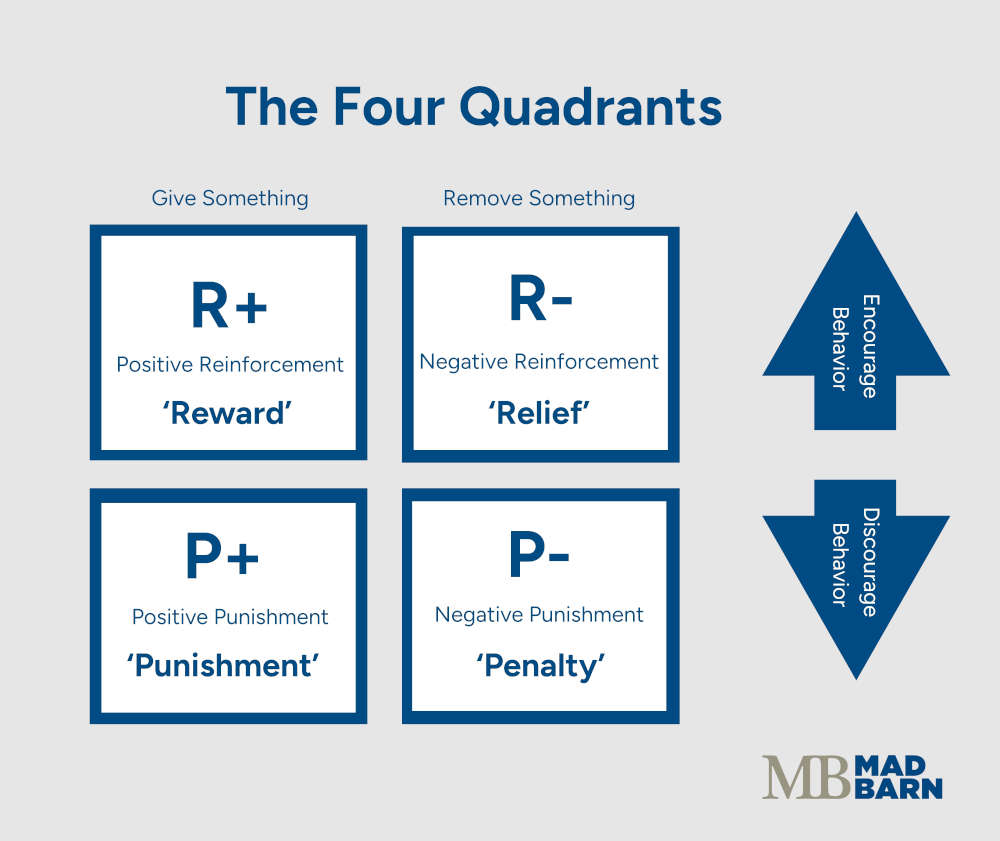
The four quadrants of horse training provide a framework for understanding how horses learn from consequences. As a form of operant conditioning, the quadrants help explain how outcomes influence whether a behavior becomes more or less likely to happen again.
Each time your horse performs a behavior and something happens immediately afterward, they learn from that outcome. Over time, these cause-and-effect relationships shape how horses respond to cues, interact with handlers, and navigate their environment.
Operant conditioning is divided into four categories: positive reinforcement (R+), negative reinforcement (R-), positive punishment (P+), and negative punishment (P-). These quadrants describe how behavior changes depending on whether a stimulus is added or removed, and whether the goal is to increase or decrease the behavior.
Rather than representing specific training methods, the four quadrants offer a practical way to understand how everyday interactions shape equine behavior. Recognizing how timing, consistency, and handler responses affect learning can help you communicate more clearly with your horse and support more effective training outcomes.
What Are the Four Quadrants in Horse Training?
Operant conditioning is a learning framework that can be used in horse training, in which handlers add or remove stimuli to influence specific behaviors. Over time, horses learn to associate their actions with outcomes, helping them understand which behaviors are more or less likely to lead to a desired result. [1][2]
Operant conditioning is explained using four quadrants of training, which describe how consequences affect behavior.
Because the four quadrants apply to everyday handling as well as formal training, understanding them can help horse owners respond more consistently and avoid reinforcing unwanted behavior.
These quadrants do not describe specific training styles, but rather a framework for understanding how consequences influence learning. The quadrants are defined by two factors:
- Addition or removal of a stimulus: Is something added to the horse’s environment or taken away (i.e. a consequence)?
- Reinforcement or punishment of a behavior: Does that consequence make the behavior more likely to happen again or less likely?
This creates four categories of learning commonly referred to as R+/R- and P+/P-:
- R+ (positive reinforcement): adding a stimulus to increase a behavior
- R- (negative reinforcement): removing a stimulus to increase a behavior
- P+ (positive punishment): adding a stimulus to decrease a behavior
- P- (negative punishment): removing a stimulus to decrease a behavior
In this context, positive and negative do not mean good or bad. They simply describe whether a stimulus is added or removed. Likewise, reinforcement means a behavior becomes more likely to occur again, while punishment means a behavior becomes less likely. These terms are defined by their effect on behavior, not the handler’s intent.
The two most common quadrants used in horse training are positive reinforcement and negative reinforcement, both of which are used to increase desired behaviors. Positive reinforcement works by adding something the horse wants, such as food or scratches, while negative reinforcement works by removing something the horse wants to avoid, such as pressure.
While the four quadrants explain how consequences shape behavior, horses also rely on signals that come before the behavior to understand what is being asked of them. These antecedents include training cues, the surrounding context, and the horse’s past learning experiences.
When used correctly, operant conditioning supports learning and gives horses some control over their environment. Handlers can add or remove stimuli to motivate or discourage behavior, but the horse’s perception of the situation determines how that consequence functions. A stimulus may include anything the horse notices or responds to, such as pressure, food, touch, attention, or the release of pressure.
In real training sessions, horses may experience more than one quadrant at different moments. The framework is most useful for understanding how consequences affect behavior, rather than assuming every interaction fits neatly into a single category.
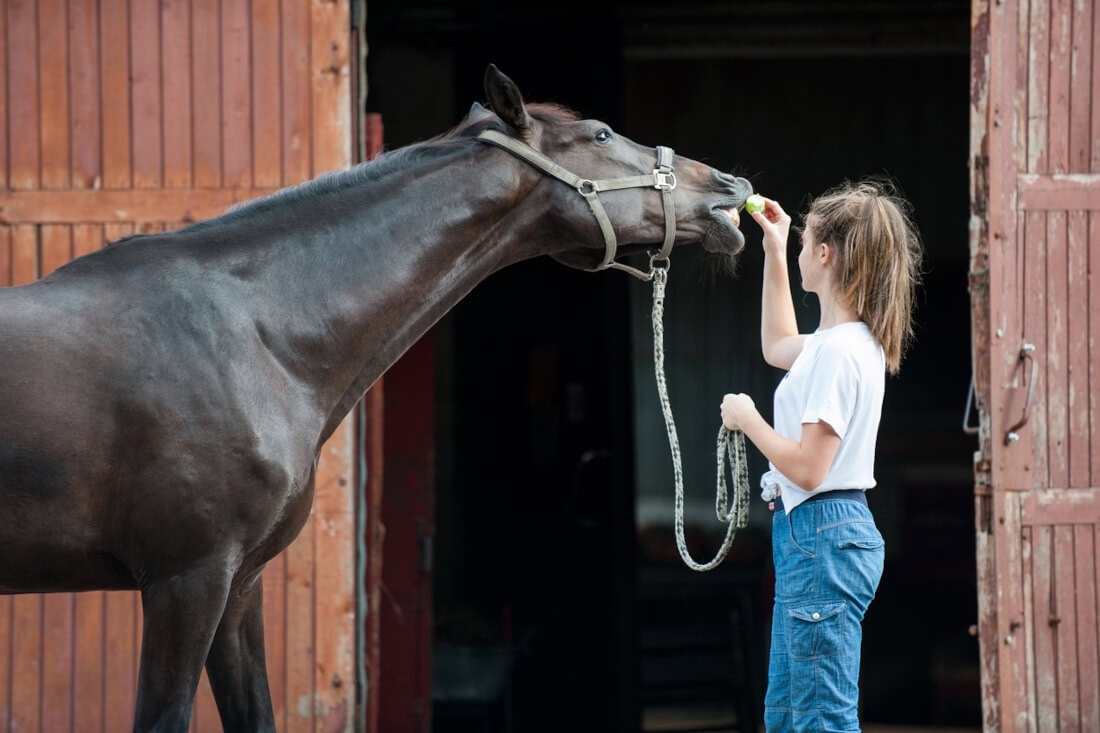
Using operant conditioning to change horse behavior works best when handler responses are consistent and timely. Offering a reward, such as a carrot, immediately after a desired behavior helps the horse form a clear association between action and outcome. Delayed or inconsistent responses can create uncertainty, weakening the connection between behavior and consequence. [2]
This training framework helps horses learn that specific actions can lead to predictable results. Consistency, timing, and an understanding of the four quadrants are all important for effective training, helping handlers communicate more clearly while supporting better outcomes for both horse and handler.
What's your top priority with your horse's health?

Enter your email to receive your store credit
Positive Reinforcement (R+)
Positive reinforcement training involves giving the horse a reward, such as a treat or scratches, when they perform a desired behavior. The horse associates the behavior with that rewarding outcome, making them more likely to perform it again in the future. [3]
Examples of positive reinforcement include:
- Providing a treat when the horse performs a desired behavior, like touching a target
- Giving a food reward after a horse loads onto the trailer
- Scratching the horse’s withers (assuming the horse finds scratches rewarding) when they stand quietly to be mounted
- Petting or scratching the horse after a successful performance
Positive reinforcement training often uses a marker signal, such as a clicker or a consistent verbal cue, to tell the horse the exact moment they performed the correct behavior. This is especially helpful when there is a short delay between the behavior and delivery of the reward.
In clicker training, the click becomes associated with the reward over time and helps improve clarity and timing during training sessions.
Research suggests that horses trained using positive reinforcement methods are more motivated to participate in training and perform more explorative, “trial and error” behaviors during training sessions. [3] They also show more active contact with the human trainer during training sessions. [3]
For a reinforcer to be effective, it must have enough value to motivate your horse. When using food rewards in training, the reward needs to be something your horse enjoys and is willing to work for. However, it should not be so exciting that your horse becomes anxious trying to acquire it.
More challenging tasks may require higher-value rewards, such as carrot pieces instead of hay pellets, and food motivation can vary considerably between individual horses. [4]
Successful R+ training also depends on timing, consistency, and thoughtful reinforcement delivery. If the reward is delayed any more than a few seconds, the horse may not connect it with the desired behavior. If rewards are delivered inconsistently or when the horse is showing another unwanted behavior, the trainer may accidentally reinforce an undesirable response.
For this reason, positive reinforcement works best when the desired behavior is clearly defined and the horse is set up to succeed through small, repeatable steps.
Negative Reinforcement (R-)
Negative reinforcement is commonly used in traditional horse training, often referred to as pressure and release. Pressure is applied through the reins, legs, lead rope, or body position to guide the horse toward a specific response.
Once the horse moves as desired, the pressure is removed. The horse learns to associate the release of pressure with their own action, making them more likely to perform that response in the future. In negative reinforcement, the release (i.e. the removal of an aversive stimulus or release of pressure) is the reinforcer. [3][5]
Examples of negative reinforcement include:
- Removing leg or rein pressure when the horse moves in a desired direction
- Applying pressure to the horse’s hindquarters or shoulders and releasing it once the horse moves away from pressure
- Applying pressure on the leadrope to ask the horse to back or step forward
For negative reinforcement to be effective, the horse must be able to clearly identify both the pressure and the moment of release. If the timing is poor or the release is delayed, the horse may become confused about which behavior produced the desired outcome. [5]
Similar to positive reinforcement, negative reinforcement is only effective if the added stimulus is sufficiently aversive to influence the horse’s behavior. For some horses, very light pressure may not trigger a response, while for others, excessive pressure may cause stress, fear, or resistance rather than learning.
This can lead to escalating pressure levels as the trainer seeks a change in behavior. Trainers using negative reinforcement must be mindful of pressure levels, apply cues as lightly as possible, and release pressure as soon as the horse offers the desired response. If increasing pressure is not producing clarity, the training plan may need to change to avoid frustration, conflict, or excessive force.
Positive Punishment (P+)
Positive punishment is may be used to correct unwanted behaviors. It involves adding an aversive stimulus immediately after a behavior with the intention of decreasing the likelihood of the horse performing that behavior again. In practice, this can include physical or verbal responses such as hitting the horse with a crop, slapping, or raising the voice.
Examples of positive punishment include:
- Yelling or growling at a horse pawing in the cross-ties
- Tapping the horse with a crop if they stopped moving forward
- Tapping or hitting the horse for crowding into a human
- Bumping or jerking the lead rope when the horse pulls or leans against the pressure
While positive punishment can suppress behavior, research suggests it does not effectively teach the horse what to do instead and may have unintended consequences, like inducing fear. [6] Horses trained using punishment-based methods may show increased fear, confusion, frustration, and anxiety. It can also reduce a horse’s willingness to explore or offer new behaviors, and may create negative associations with the handler. [7]
A key limitation of positive punishment is that it does not address the underlying cause of many behaviors, such as pain, fear, or stress. Instead, it may suppress outward signs of discomfort without resolving the root issue.
In some cases, repeated use of punishment can lead to learned helplessness, where the horse stops responding or communicating due to fear of negative consequences. This is most likely when punishment is not associated with specific behaviors or when it is not timed correctly with removal of aversive stimuli.
Learned helplessness is associated with reduced engagement during training, impaired emotional well-being, and decreased trust in humans. [2][8]

Negative Punishment (P-)
Negative punishment occurs when the trainer removes something the horse finds rewarding in response to the horse’s behavior. By removing the positive stimulus, the horse is less likely to perform that behavior in the future.
Negative punishment is difficult to use as a sole training method, so it is typically combined with training based on one of the other three quadrants.
Examples of negative punishment include:
- Withholding a food reward if the horse becomes pushy or nips at the trainer
- Withholding attention or food if the horse is restless or impatient when they are asked to stand quietly
- Stopping a training session if the horse displays unwanted behaviors, assuming the horse enjoys training
An important concept in negative punishment is that the consequence must occur immediately after the undesired behavior.
For example, some trainers punish horses after a poor training session by tying the horse’s head to prevent feed and water access. While this may be considered negative punishment, it is likely ineffective because there is a delay between the horse’s behaviour (e.g., a poor training session) and the experience of the punishment (e.g., feeling thirsty or hungry).
Due to this gap, horses cannot cognitively associate the punishment with their behaviour and are therefore unlikely to learn anything from this form of “negative punishment.”
When used with clear cues and accurate timing, negative punishment can help horses learn and understand cues and boundaries, particularly in training programs that rely heavily on rewards. However, it is generally most effective when combined with reinforcement of the desired behavior, so the horse understands which behaviors to avoid performing and which behaviors lead to positive outcomes.
Table 1. Summary of operant conditioning methods in horse training
| Method | Description | Example |
|---|---|---|
| Positive reinforcement (R+) | Adding something the horse finds rewarding to encourage desired behavior | A horse lifts its leg when cued by its owner and is rewarded with a food treat |
| Negative reinforcement (R-) | Removing aversive stimulus to reinforce desired behavior | The rider pulls on the reins to halt the horse, then releases the rein pressure once the horse halts |
| Positive punishment (P+) | Adding aversive stimulus to discourage undesired behavior | The handler hits the horse on the nose when it tries to get into their pocket |
| Negative punishment (P-) | Removing desired stimulus to discourage undesired behavior | Withholding a horse’s grain until they stop pawing during scheduled feeding time |
Operant Conditioning & Equine Welfare
Operant conditioning techniques can be very effective when used properly, but it’s important to understand how different methods affect a horse’s emotional state.
Handlers can facilitate operant conditioning by adding or removing stimuli from situations, but whether a horse actually learns a desired response depends on their perception of the situation and the handler or trainer’s ability to effectively communicate cues and signals.
Offering food rewards, for example, may be intended as positive reinforcement, but the trainer’s intention does not always match the horse’s experience. The horse’s emotional state, motivation, and prior learning can all affect how that consequence influences behavior.
Similarly, if the horse does not understand what behavior is being rewarded during a positive reinforcement task and an expected food reward is withheld, the situation may function as negative punishment, in which something the horse values is removed.
Positive punishment — such as using riding crops or otherwise striking a horse during training — can have an particularly negative effect on a horse’s behavior and emotional state. Research suggests that positive punishment increases fear, anxiety, and frustration in horses without necessarily teaching them desired behaviors. [6][9]
All equine behavior provides information about the horse’s internal state or response to its environment. When a horse is punished for biting or kicking, the behavior may decrease, but punishment does not address the underlying cause. In some cases, these behaviors may be associated with frustration, confusion, fear, pain, or discomfort rather than deliberate disobedience.
If horses are punished for displaying these signs, they may become less likely to express them in the future without the original issue being resolved. This can reduce visible signs of distress while allowing the underlying problem to persist. [6] When handlers do not identify and address the root cause, the horse’s welfare may be compromised, and unwanted behaviors may reappear in other forms. [9]
Being mindful of how operant conditioning is applied can help support a safer and more effective training environment. Avoiding practices that induce fear or confusion, like excessive positive punishment, may improve clarity, support learning, and promote the horse’s long-term well-being.
Here are some frequently asked questions about the four quadrants of operant conditioning in horse training:
The four quadrants of operant conditioning is a framework used to understand how animals learn through action and consequence. This framework may be used to influence a horse's behavior during training sessions. The four quadrants include positive reinforcement (R+), negative reinforcement (R-), positive punishment (P+), and negative punishment (P-). These categories explain whether a trainer adds or removes a stimulus and whether the goal is to increase or decrease a behavior.
In operant conditioning, the terms "positive" and "negative" do not mean good or bad. "Positive" means something is added after a behavior, while "negative" means something is removed. These terms simply describe how a consequence is applied during training.
Positive reinforcement occurs when a trainer adds something the horse finds rewarding after a desired behavior. Common examples include offering a food treat, scratching the horse’s withers, or providing verbal praise. These rewards make the behavior more likely to occur again in the future.
Negative reinforcement occurs when a trainer removes pressure after the horse performs the desired behavior. This method is commonly described as pressure and release. For example, a rider may apply leg pressure to ask the horse to move forward and release the pressure once the horse responds correctly.
No. Negative reinforcement increases a behavior because the horse learns how to remove pressure by responding correctly. Punishment, on the other hand, aims to decrease a behavior by adding an aversive stimulus after the horse performs an unwanted action to reduce the likelihood of the horse performing the behavior in the future.
Negative reinforcement is the most commonly used learning mechanism in traditional horse training. Many riding cues rely on applying pressure and releasing it once the horse performs the correct response.
Yes. Most real-world horse training involves a combination of operant conditioning principles. Trainers may reinforce correct responses while discouraging unwanted behaviors, meaning multiple quadrants can influence learning within the same training session.
Timing is critical because horses learn by linking their behavior with what happens immediately afterward. If reinforcement or punishment occurs too late, the horse may associate the consequence with an undesired behavior, which can create confusion during training.
Research suggests that positive punishment, such as hitting or yelling, can increase fear, anxiety, and frustration in horses. It may suppress behavior temporarily without addressing the underlying cause, such as pain, stress, or confusion.
Understanding operant conditioning helps horse owners recognize how their actions influence equine behavior. Clear cues, consistent responses, and appropriate reinforcement improve communication, helping horses learn desired behaviors more effectively and safely.
Summary
Operant conditioning explains how horses learn from consequences, using four quadrants that influence behavior through reinforcement or punishment.
- The four quadrants (R+, R-, P+, P-) describe how adding or removing stimuli increases or decreases behavior
- Positive reinforcement rewards desired behavior, while negative reinforcement relies on pressure and release
- Positive punishment can increase fear and stress, and does not address the root cause of behavior
- Negative punishment removes rewards to discourage behavior, but requires precise timing to be effective
- Consistency, timing, and clear cues are essential for effective learning and communication
- Thoughtful application of training methods supports better welfare and stronger horse-handler relationships
References
- McGreevy. P. et al. Equitation Science. 2nd ed. John Wiley & Sons Ltd. Chichester, West Sussex, UK. 2018.
- McLean. A. N. and Winther Christensen. J. The Application of Learning Theory in Horse Training. Applied Animal Behaviour Science. 2017.
- Innes. L. and McBride. S. Negative versus Positive Reinforcement: An Evaluation of Training Strategies for Rehabilitated Horses. Applied Animal Behaviour Science. 2008.
- Olczak. K. et al. Food Motivation in Horses Appears Stable across Different Test Situations. Applied Animal Behaviour Science. 2018.
- McLean. A. N. The Positive Aspects of Correct Negative Reinforcement. Anthrozoös. Routledge. 2005.
- International Society for Equitation Science (ISES), The Use of Aversive Stimuli in Horse Training. 2017.
- McGreevy. P. D. and McLean. A. N. Punishment in Horse-Training and the Concept of Ethical Equitation. Journal of Veterinary Behavior. 2009.
- Hall. C. et al. Is There Evidence of Learned Helplessness in Horses?. Journal of Applied Animal Welfare Science. Routledge. 2008.
- Warren-Smith. A. K. and McGreevy. P. D. The Use of Blended Positive and Negative Reinforcement in Shaping the Halt Response of Horses (Equus Caballus). Animal Welfare. 2007.