English










Sleep plays a critical role in equine health, yet it remains one of the least understood aspects of horse behavior. All horses depend on good-quality sleep to support normal metabolic function, tissue repair, and neurological health, but equine sleep patterns differ significantly from those of humans and other domestic animals.
Horses can actually sleep standing up, supported by the stay apparatus, and during lighter stages of sleep their eyes may remain open or only partially closed. These behaviors reflect the way equine sleep has evolved to balance physiological needs with vigilance and safety.
Horses are also polyphasic sleepers, meaning they divide their rest into many short intervals. Most rest occurs while standing, with only brief periods spent lying flat. However, deep REM sleep can occur only when they are in lateral recumbency, making it essential that horses have a safe, comfortable place to lie down.
Read on to learn more about the current scientific understanding of equine sleep, including sleep stages, posture, recumbency, and the risks associated with inadequate rest. Recognizing what normal sleep looks like and identifying when it is disrupted helps owners detect pain, stress, or emerging health concerns early.
How Do Horses Sleep?
Sleep is more than just a period of rest; it’s an active, regulated state where the body and brain engage in essential processes that cannot occur while awake.
In mammals, including horses, sleep involves altered brain activity, reduced responsiveness to the environment, and changes in muscle tone, metabolism, and hormone release. [1]
Despite decades of research, the exact reason why animals need sleep is not entirely understood. Currently, the leading theories explaining the purpose and survival value of sleep include: [1][2]
- Inactivity theory: Suggests sleep evolved to protect animals from harm. By reducing movement and visibility during vulnerable periods, animals may have been less likely to encounter predators or sustain injury.
- Energy conservation theory: Proposes sleep helps lower metabolic demands during times of reduced activity. During sleep, the body uses less energy, which may have offered a survival advantage, particularly when food was scarce.
- Restorative theory: Believes that sleep allows the body to repair itself. Cellular repair, muscle recovery, tissue growth, and hormone regulation all occur most efficiently during sleep.
- Brain plasticity theory: Focuses on the central nervous system. Sleep appears to play a role in memory consolidation, emotional regulation, and neural development, especially in young individuals; both foals and human infants sleep significantly more than their adult counterparts.
Research on the physiology and effects of sleep is ongoing, and current evidence suggests that multiple mechanisms likely contribute to its purpose. Rather than competing explanations, these theories may represent different pieces of a larger biological system.
What is clear is that sleep is a complex, multifaceted process with widespread effects on health and performance. In horses, as in humans, adequate sleep supports physical recovery, mental processing, and overall well-being.
What's your top priority with your horse's health?

Enter your email to receive your store credit
Phases of Sleep in Horses
The horse’s rest cycles and behaviors are shaped by evolutionary pressures, herd dynamics, and their unique physiology.
Horses are polyphasic sleepers, meaning they sleep in multiple short episodes over a 24-hour period rather than in one long, continuous stretch. These sleep bouts may last only a few minutes at a time and are spread across the entire day, including at night.
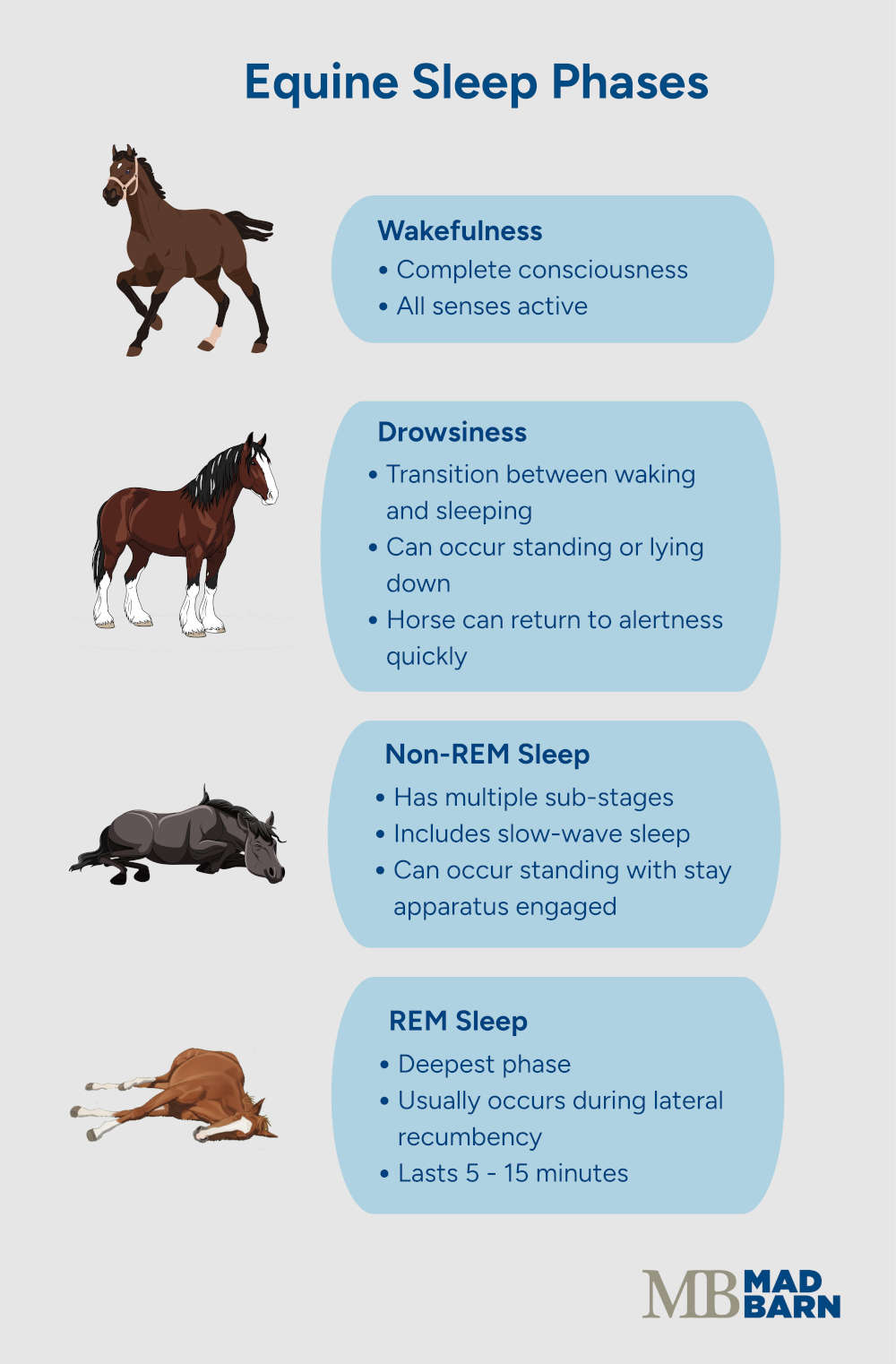
Sleep in horses consists of four stages: [3]
- Wakefulness
- Drowsiness
- Non-REM sleep (NREM)
- Rapid eye movement (REM) sleep
Horses shift fluidly between these states throughout the day and night. While humans often sleep in long uninterrupted blocks, horses experience rest in dozens of short episodes, each featuring a combination of these stages. [2]
During these stages, the horse’s brain activity changes. These changes can be measured as rhythmic electrical patterns called brain waves, which reflect the level of activity in the cerebral cortex.
Brain waves are detected using electroencephalography (EEG), a technique that records the brain’s electrical signals through small sensors placed on the scalp.
The frequency and amplitude of brain waves indicate different states of alertness and rest. Faster, low-amplitude waves such as beta and alpha are linked to wakefulness and drowsiness, while slower, high-amplitude theta and delta waves occur during progressively deeper stages of sleep. [1][3]
In horses, these shifts provide a measurable way to distinguish light dozing from deep, restorative rest.
Wakefulness
Wakefulness is the most alert and active state. The horse stands square, with the head and neck held high, ears scanning independently, and muscles fully engaged. All senses are active, and the horse is prepared to respond instantly to environmental stimuli. [3]
Drowsiness
Drowsiness is a light transitional state where brain activity begins to shift from beta to alpha and then to theta waves. The horse may stand with one hind leg resting, eyes half-lidded, ears relaxed, and head lowered. [3]
Though externally calm, the horse remains responsive and can wake quickly. [3]
Non-REM Sleep
Non-REM (NREM) Sleep includes multiple sub-stages: [3]
- N1 and N2: Lighter stages of sleep marked by theta wave activity
- N3 (slow-wave sleep): The deepest phase of NREM, where the brain activity slows to high-amplitude delta waves, muscle tension drops, and breathing deepens.
Horses may experience slow-wave sleep (SWS) while standing using the stay apparatus, though some lie down in sternal recumbency to achieve deeper rest. [3][4]
REM Sleep
REM Sleep is the most neurologically active and physically vulnerable sleep stage. It is characterized by rapid eye movement, complete muscle atonia, and brainwave patterns similar to wakefulness. [3]
Horses cannot enter REM sleep while standing. Typically, horses are in lateral recumbency, lying flat with legs extended to achieve this sleep phase. They can enter REM while in sternal recumbency, usually with their neck relaxed and muzzle resting on the ground. REM episodes typically last 5 to 15 minutes and are critical for emotional processing, memory consolidation, and neural health. [3]
Each sleep phase serves a distinct biological function. While horses spend most of their rest time in lighter sleep stages, REM sleep is essential for overall health. Horses who are unable to access it due to pain, stress, or management factors are at risk of cumulative sleep debt and related welfare issues. [3]
Sleep Requirements for Horses
Adult horses typically require between four and seven hours of total rest per day, divided into numerous short episodes. While the majority of this time is spent in drowsiness or slow-wave sleep, horses need around 30 to 60 minutes of REM sleep every 24 hours to maintain neurological and physiological balance. [3]
REM episodes occur in multiple brief segments, usually during the quietest parts of the day or night, when the horse feels secure enough to lie down. [3]
Foals need significantly more sleep, and spend much of it in recumbent positions. Their developing nervous systems and rapid growth demand longer and deeper rest. As the foal matures, sleep becomes shorter, more fragmented, and more similar to the adult pattern. [3]
Older horses may sleep more lightly and lie down less often due to discomfort, joint stiffness, or fear of not being able to rise. [5] This raises the risk of chronic REM deprivation, particularly in horses with arthritis or mobility issues.
It’s important to recognize that not all forms of rest are biologically equivalent. Standing and lying rest serve different functions. While many horses appear to rest adequately while standing, REM sleep cannot occur unless the horse is in lateral recumbency. [2][3]
Horses who avoid lying down, whether due to pain, stress, or environmental conditions, may accumulate a sleep deficit over time, with measurable effects on behavior, coordination, and welfare. [3]
Physiology of How Horses Sleep
Equine sleep differs from human sleep in several fundamental ways. Horses often remain standing while asleep, sometimes with their eyes open, and only lie down briefly each day. [6] These behaviors can make it difficult to tell whether a horse is truly resting, and if they are resting enough for their age and lifestyle.
The unique features of equine sleep reflect the horse’s evolutionary history, which adapted them for vigilance and mobility. As prey animals, horses have developed ways to rest without becoming fully vulnerable. The ability to enter light sleep while upright and to remain partially alert has clear survival advantages.
In domestic settings, these same adaptations can make signs of fatigue or sleep deprivation easy to miss. Understanding rest in horses often requires close observation of posture, context, and subtle changes in behavior.
Open Eyes
Horses are capable of sleeping with their eyes open, but only during certain stages of sleep. In the lighter phases, such as drowsiness and slow-wave sleep (SWS), the eyes may remain open, half-lidded, or only partially closed. This is most commonly observed when the horse is standing. [6]
During these stages, the nictitating membrane (third eyelid) may partially sweep across the eye. This can give the appearance of an open or glazed eye even though the horse is relaxed and not fully alert.
When horses sleep lightly with the eyes open, muscle tension is maintained, and the horse retains some awareness of their surroundings. This results in a deceptively alert appearance, even though the horse is resting. Appearing alert provides some security to the horse, helping deter potential predators who mistakenly think they are awake.
In contrast, REM sleep always involves fully closed eyes. This is the deepest and most physically vulnerable stage of equine sleep. Muscle tension disappears, awareness drops, and the horse must lie down completely.
Eye closure is closely tied to the physical and neurological shutdown required for REM, making it a reliable indicator of deeper rest. [6]
Standing Up
Horses often sleep while standing. This behavior is possible thanks to the stay apparatus, a system of tendons and ligaments that allows the horse to “lock” the stifle in position. When engaged, the stay apparatus supports the horse’s weight with minimal muscular effort, allowing light sleep without the risk of collapse. [4]
Standing sleep typically includes drowsiness and slow-wave sleep, phases where the horse remains partially aware of their surroundings. In these stages, the horse may lower the head, soften the ears, and close or half-close the eyes. One hind leg is often rested, and the body appears relaxed, but the horse can still respond quickly to stimuli. [4][5]
The stay apparatus provides a way for horses to conserve energy and catch up on essential rest without fully surrendering alertness. However, not all sleep can occur in an upright position. To enter deep sleep, horses must lie down. REM sleep involves complete muscle relaxation, which cannot occur while standing. [4][5]
Lying Down
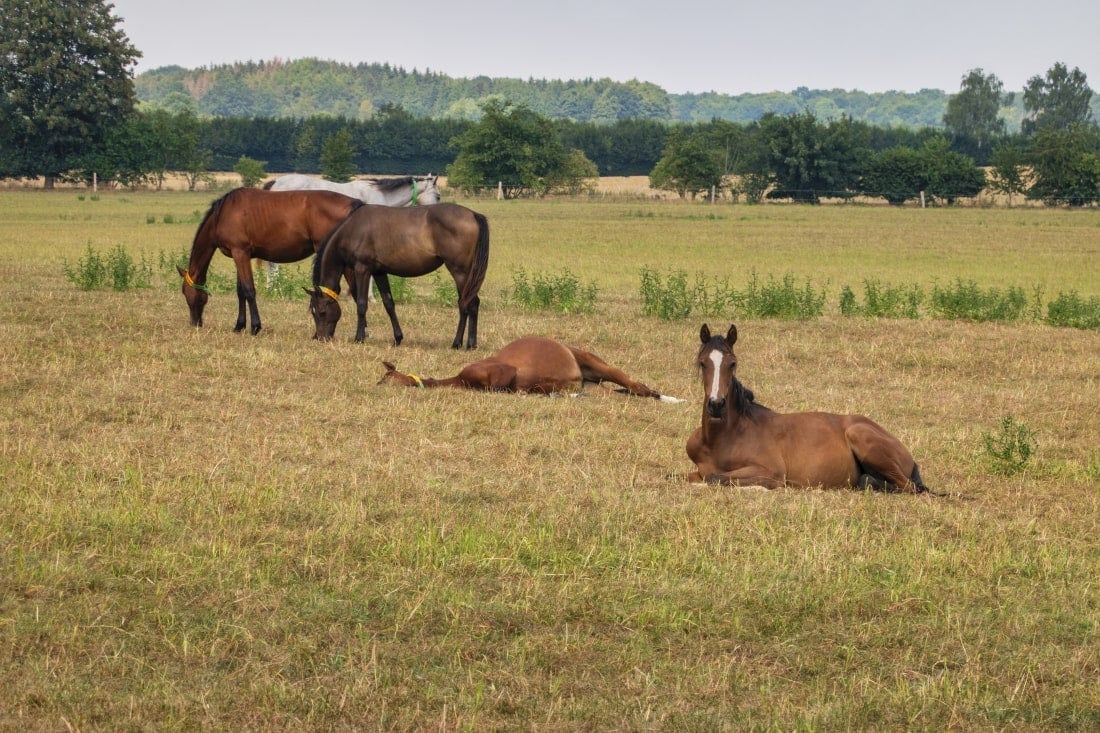
Horses adopt two lying positions: sternal and lateral recumbency.

In sternal recumbency, the horse rests on their chest with their legs folded beneath the body. The head and neck usually remain upright, allowing for quick re-engagement with the environment if needed. Horses can enter drowsiness and slow-wave sleep in this posture, and may even transition briefly into REM, though it is not ideal for sustained deep rest. [3][5]

“When horses stop lying down, it’s a red flag. Without that deep rest, their behaviour and balance can start to change. Work with your veterinarian if one of your horses doesn't seem to have enough rest.”
— Dr. Jennifer Skaggs, DVMEquine Veterinarian
Lateral recumbency, lying flat on one side with the head and legs extended, is usually the position for full REM sleep. In this position, the horse’s muscles are relaxed, and awareness of the environment is significantly reduced. [3][5]
Failure to lie down is not always a sign of disease, but it is a welfare concern.
Several factors can prevent horses from lying down, including: [3][5][7]
- Joint pain
- Uncomfortable footing
- Social insecurity, especially in groups where the horse remains vigilant
- Inadequate stall area
- Excessive noise
- Unfamiliar locations
- Frequent disruptions
Dreaming in Horses
Like other mammals, the brain and physical activity seen in horses during REM sleep suggests they have a dream state. [2]
During REM sleep, horses often show subtle but distinct physical cues of dreaming. Rapid flicking of the ears, twitching of facial muscles, small leg movements, and rhythmic shifts in the muzzle strongly resemble dream-related movements documented in dogs, cats, and humans. [2][8]
Research in humans shows that REM sleep is essential for integrating new experiences, regulating mood, and reinforcing learning. It is widely believed that dreaming is one aspect of this process.
Although direct studies on equine dreaming are limited, horses demonstrate similar REM-associated behaviors and exhibit comparable consequences when deprived of this sleep phase. [2][8]

Equine Sleep & Management
Sleep is a biological necessity, not a luxury, and management practices play a major role in ensuring horses get the rest they need. Unlike in the wild, where horses select their own rest areas and herd groups, domesticated horses rely on conditions created for them.
Small changes in housing, routine, or social dynamics can significantly impact sleep quality. Owners and caretakers can promote healthy equine sleep by addressing three core areas: environmental comfort, physical well being, and mental safety.
Management strategies to optimize your horse’s sleep include: [3][9]
- Provide clean, dry, and comfortable footing in stalls and turnout areas
- Ensure sufficient space to lie down, especially in group turnout or small stables
- Maintain stable herd structures to reduce social stress
- Minimize disruptions during nighttime hours, such as bright lights, loud equipment, or after-hours activity
- Monitor for signs of pain or stiffness, particularly in older horses or those recovering from injury
Finally, supporting overall health with balanced nutrition is a fundamental step in ensuring your horse is happy and healthy. By meeting your horse’s nutritional needs, you support muscle repair, energy balance, and the relaxation required for deep, restorative sleep.
Frequently Asked Questions
Here are some frequently asked questions about equine sleep:
Not necessarily. Some horses rest better in stables, while others prefer turnout. The ideal sleep environment depends on the individual horse's preferences, herd dynamics, and physical health. The key is to ensure a safe, dry, quiet space, indoors or out, where the horse feels comfortable enough to lie down.
Sleep-deprived horses may show signs of fatigue, irritability, or unsteadiness. They might yawn frequently, seem drowsy during the day, or stumble due to sudden sleep onset. Monitoring posture, lying behavior, and overnight activity can help identify rest issues early.
Like other mammals, horses likely dream during REM sleep. Subtle twitching of the ears, muzzle, or legs while lying flat indicates neurological activity similar to dreaming in humans and other mammals.
Yes. Horses can enter light sleep and even slow-wave sleep while standing using the stay apparatus, a system of tendons and ligaments that locks their joints. However, REM sleep typically occurs when lying flat in lateral recumbency.
Horses sometimes sleep with their eyes open or partially open. They have to close their eyes and lie down completely to reach the deepest sleep stages.
Yes, horses have to lie down sometimes to reach the deepest sleep stages. Sometimes they lie down partially in sternal recumbency, and sometimes they sleep standing up.
Summary
Equine sleep is unlike human sleep and includes several unique behaviors that reflect the horse's physiology and natural survival strategies.
- Like other mammals, horses experience both REM and non-REM sleep, and likely dream
- Horses can sleep standing up during lighter sleep stages, but need to lie down completely to achieve REM sleep
- Horses sometimes sleep with their eyes open or partially open during lighter sleep stages
- Sleeping standing up and with eyes partially open help horses maintain vigilance and deter predators
- Recognizing normal sleep patterns, identifying early signs of sleep disruption, and creating an environment where horses feel safe enough to rest fully are essential components of equine care
References
- Brinkman. J. E. et al. Physiology of Sleep. StatPearls. 2025.
- Siegel. J. M. Clues to the Functions of Mammalian Sleep. Nature. 2005.
- Greening. L. and McBride. S. A Review of Equine Sleep: Implications for Equine Welfare. Frontiers in Veterinary Science. 2022.
- Can horses sleep with their eyes open?. Argentina Polo Night. 2024.
- The Vital Role of the Equine Stay Apparatus: Active or Passive and Why It Matters. The Equine Institute. 2024.
- Kelemen. Z. et al. Recumbency as an Equine Welfare Indicator in Geriatric Horses and Horses with Chronic Orthopaedic Disease. Animals. 2021.
- Greening. L. et al. The Effect of Altering Routine Husbandry Factors on Sleep Duration and Memory Consolidation in the Horse. Applied Animal Behaviour Science. 2021.
- Manger. P. R. and Siegel. J. M. Do All Mammals Dream?. Journal of Comparative Neurology. 2020.
- Greening. L. Understanding Sleep-Related Behaviour (and Lack of) as a Measure of Welfare Using the Horse as Model. Hartpury University. 2018.