English




The Mustang is a feral horse breed from the Western United States, descended from equines brought to the Americas by Spanish explorers. Shaped by the rugged terrains of the western frontier, the Mustang now stands as an iconic breed, embodying the resilience required to survive its demanding environment.
Free-roaming Mustangs on public lands are now managed by the Bureau of Land Management’s Wild Horse and Burro Program. But these horses are also adopted and bred in private domestic homes.
There are several strains of Mustangs, including the Kiger Mustang and the Spanish Mustang, which retains the bloodlines of the original horses brought by Spanish settlers.
While controversy surrounds population control methods used in free-roaming herds, Mustangs are still a cherished symbol of the American West. Many adopted Mustangs go on to successful riding careers with appropriate care and training.
This breed profile will discuss the history, characteristics, health problems, and nutritional needs of the Mustang breed. Keep reading to learn more about feeding and caring for Mustang horses.
Mustang Horse History
The history of the American Mustang traces back over five centuries to the first Spanish conquistadors that travelled to the Americas.
Origin
Colonial Spanish Horses are the founding ancestors of the Mustang breed. Early horses were left behind or released from Spanish missions and settlements. Feral herds established themselves and eventually spread throughout the Wild West. [1]
Over time, many horse breeds influenced the development of the modern Mustang. Several breeding populations became genetically isolated in different geographic locations, resulting in various strains of Mustangs.
Some feral herds have distinct types that suggest the introduction of Thoroughbred or Quarter horse blood. A few have draft horse characteristics, but many still resemble the light-riding horse type of the original Spanish horses.
Mitochondrial DNA studies confirm the Iberian origin of the American Mustang, linking the breed to the Iberian Peninsula in Spain. Researchers have identified a high frequency of Iberian haplotypes (DNA sequences) in several strains of Mustangs. [2]
Historic Use
During his 1519 expedition, Hernán Cortés introduced the first Spanish horses to what is now mainland Mexico. That expedition is now infamous for causing the fall of the Aztec Empire. [3]
In the late 16th century, Juan de Onate brought 75 Spanish horses on his expedition across the Rio Grande. After establishing the province of Santa Fe de Nuevo México, the region’s horse population swiftly grew from this initial herd. [3]
Santa Fe became a significant trading center in the 17th century. Horses dispersed from Mexico throughout the American West. Some animals were traded to other settlers or indigenous people, while others wandered off to form feral herds. [4]
American settlers encountered large herds of Mustangs ranging from the Pacific Northwest to the Great Plains by the early 19th century. Round-ups captured thousands of these horses for use in the Spanish-American War and World War I.
Most remaining feral herds lived west of the Continental Divide on public lands. The United States Grazing Service began in 1934 to manage livestock grazing on these public lands until the Bureau of Land Management (BLM) was formed in 1946.
The BLM initially sought to remove feral horses from public lands. Controversy over capture methods led to the first horse protection laws in the 1950s. The Wild and Free-Roaming Horses and Burros Act of 1971 further increased the protection of American Mustangs. [5]
Breed Registry
The Bureau of Land Management monitors Mustang populations in established Herd Management Areas to prevent overpopulation. The bureau manages the population with off-range corrals and purchase centers that allow potential owners to adopt Mustangs. [5]
Several organizations, such as the Mustang Heritage Foundation, are dedicated to helping Mustangs find good homes and reducing the number of horses kept in long-term holding corrals.
Some breed registries also promote the preservation of the original Mustang. For example, the Spanish Mustang Registry only registers the offspring of registered Spanish Mustang parents.
| Breed Summary | |
|---|---|
| Breed Name | Mustang |
| Also Known As | American Mustang; Spanish Mustang |
| Breed Type | Feral |
| Origin | Western United States |
| Average Height | 14 – 15 hh |
| Average Weight | 800 lb (360 kg) |
| Common Coat Colors | All colors; appaloosa, paint, dun |
| Conformation | Small, light-riding type, flat or slightly convex profile, sloping shoulder, narrow chest, short strong back, deep heart girth, sturdy legs, thick-walled hooves |
| Common Uses | Reining, ranch work, barrel racing, trail riding, endurance |
| Temperament | Intelligent, independent, curious, quick-learning |
| Best For | Experienced owners seeking a hardy, versatile partner |
| Common Health Concerns | PSSM1, parasites, respiratory infections, club feet, limb deformities, gastric ulcers |
What's your top priority with your horse's health?

Enter your email to receive your store credit
Breed Characteristics
Modern Mustangs exhibit diverse body types, influenced by the ancestral lineage of horses from various geographic locations. But most Mustangs share characteristics that allow them to survive in the wild and thrive in new homes with appropriate training.
Conformation
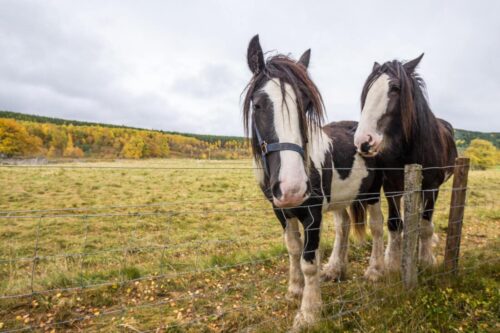
Most Mustangs are small horses with a height between 14 and 15 hands tall. Mustangs found in herd management areas overseen by the BLM generally have a light-riding horse type. Some still resemble the original Spanish Mustang, while others have less Spanish blood.
Their heads have flat or slightly convex profiles and broad foreheads that taper to a fine muzzle. Eyes are often set slightly higher on the face. A defined neck attaches smoothly to sloping shoulders. Chests are moderately narrow.
The ideal Mustang has a short, strong back and uphill build. Their deep heart girths and well-sprung ribs give extra lung and heart space. Hindquarters are smooth and round without excessive muscle. Their medium to low-set tails are carried in a relaxed position.
Mustangs should have straight, correct legs. These horses are known for having solid and durable hooves with thick walls. While their movement can vary, all Mustangs should have smooth, rhythmic gaits.
Colours
All coat colours can occur in Mustang horses, including appaloosa and paint patterns. However, the Spanish Mustang Registry excludes horses with tobiano colouring.
Dun colouring and primitive markings are common in Spanish-type horses.
Temperament
Most American Mustangs are intelligent horses with an innate sense of self-preservation. While independent, these horses are quick learners and often adjust well to domestic homes with enough time.
Adopted Mustangs may have a stronger fight-or-flight response than domesticated horses due to their survival instincts. However, many owners find Mustangs are less spooky than other breeds. These horses are naturally curious and can become destructive when bored.
If you are a new Mustang owner, work with an experienced trainer to help teach your horses how to be handled safely. Some behavioural problems can also arise from the stress of moving to a new environment. These horses need patience and good handling to set them up for success. [6]
Disciplines
Mustangs can learn to excel in many different disciplines when given the time and expert guidance they need. Several competitions, such as the Extreme Mustang Makeover, showcase the versatility and trainability of these horses.
Approved trainers spend roughly 100 days preparing feral Mustangs from BLM corrals to compete in this event. Mustangs compete in handling, pattern, trail, and freestyle classes to determine a champion. All are available for adoption after the competition.
Popular disciplines for adopted Mustangs include reining, ranch work, barrel racing, trail riding, and endurance racing. Mustangs are also commonly used in natural horsemanship.

Mustang Horse Health
While Mustangs have a reputation for hardiness, they are still susceptible to common health problems and infectious diseases found in other horses. However, Mustangs also have unique health challenges associated with their population management.
Genetic Diseases
Isolated Mustang herds are at risk of inbreeding and reduced heterozygosity, which refers to a decrease in the genetic variation within a population.
Reduced genetic diversity can increase the risk of inherited disease and result in inbreeding depression. This refers to the reduced biological fitness in a population due to the negative effects of breeding closely related individuals.
Management organizations regularly monitor the genetic characteristics of feral horse populations using hair, blood, and fecal samples. [7]
Management strategies that artificially reduce the population can contribute to a loss of genetic diversity. However, uncontrolled populations of Mustangs could lead to habitat degradation on public lands. [8]
Researchers suggest removal strategies that prioritize removing individuals based on relatedness could maintain higher levels of genetic diversity than random selection. [8]
DNA studies have identified the GYS1 allele responsible for PSSM Type 1 in Mustang Horses. This muscle disorder causes episodes of tying up associated with abnormal glycogen storage in muscles. [9]
Other genetic diseases found in Mustang lines vary depending on the ancestry of horses released in the region.
Health Problems
Veterinarians and managers oversee the health of feral Mustang horses living on range in BLM herds. The health issues these feral horses face differ slightly from those of typical domestic horses.
Club feet and limb deformities are the most common musculoskeletal problems. Unlike domestic horses, musculoskeletal problems are not usually the result of obesity. Feral Mustangs may have limited food resources and move constantly to graze. [10]
Horses removed from the range frequently have heavy burdens of internal parasites. In holding corrals, the high density of horses can also increase the risk of respiratory infections.
The most common diseases found in these horses include:
Capture technique can also contribute to mortality in feral Mustang horses. One study reported 368 mortalities in 2010 – 2019. Pre-existing conditions, such as structural deformations, blindness, and emaciation, can increase mortality risk during capture. [10]
Poor hoof care is a common welfare issue after adoption. Feral horses haven’t had their hooves handled before and often require training to pick their feet. Adopted Mustangs also have a high risk of developing gastric ulcers due to management changes and elevated stress. [11]
Care and Management
When new owners adopt a Mustang from the Bureau of Land Management, they become responsible for providing the horse with basic care. Although Mustangs attract all types of horse lovers, studies show adopters with previous horse experience have the highest success rates. [6]
Many Mustangs have minimal handling before they arrive at their new homes. Expert guidance is essential to ensure a safe loading, unloading, and adjustment process.
The BLM advocates initially housing adopted Mustangs separately in a secure corral with adequate shelter. Stress and exposure to large groups of horses can increase the risk of illness. Owners should monitor horses closely during this time for signs of health problems.
These horses often need training to be safe to handle for standard procedures, including vaccinations, deworming, dental exams, and farrier care. Work with your trainer, veterinarian, and hoof care professional to teach Mustangs to be comfortable with human handling.
Once Mustangs adjust to their new environment and regular handling, they often do better turned out in larger paddocks or dry lots. If your Mustang is healthy and adjusting well, consider turning them out with other horses to meet their social needs.
Mustang Horse Nutrition
The nutritional needs of your Mustang horse depends on their health, age, size, body condition, and activity level. Some Mustangs come off the range in poor condition and require careful feeding and management to reach a healthy weight. However, excessive feed can lead to metabolic disorders in the breed.
Weight Maintenance
Mustang horses are easy keepers, a trait which helped them survive in feral herds on the sparse vegetation of the American West. While obesity is rarely an issue in feral horses, domesticated Mustangs can gain excess weight when provided with high-calorie feeds.
However, recently adopted Mustangs are often underweight and need carefully formulated diets that support safe weight gain. Feeding programs for these horses should focus on high-quality forages, such as soft alfalfa hay or early growth grass hay. Supplemental feeds should provide soluble fibre, without adding excess sugar and starch, which can contribute to digestive upset and metabolic problems. [12]
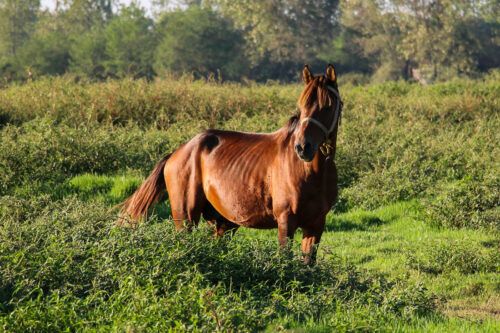
A healthy adult Mustang should have a Henneke body condition score of between 4 – 5 on the 9-point Henneke scale. Consult with your veterinarian if your underweight Mustang struggles to maintain condition on a balanced diet. Poor body condition and weight loss could indicate an underlying digestive health issue.
Sample Diet
The following sample diet is intended for an 800 pound (360 kg) Mustang with normal body condition at maintenance (not exercising).
| Feed | Amount per day |
|---|---|
| Mid-Quality Hay (8% crude protein) | Free-choice |
| Salt | 30 g (2 tbsps) |
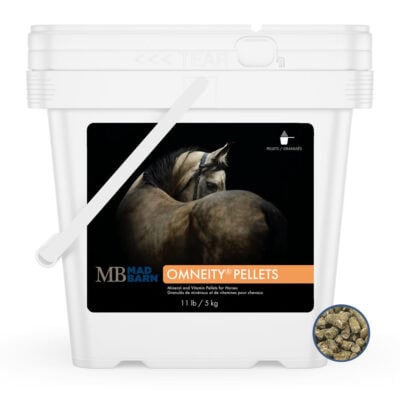
| Omneity® Pellets | 150 g (1.5 scoops) |
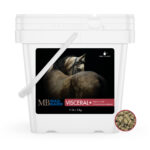
| Visceral+ | 40 g (1/2 scoop) |
| Diet Analysis | |
| Digestible Energy (% of Req) | 105% |
| Protein (% of Req) | 127% |
| HC (ESC + starch; % Diet) | 8.8% |
Feral Mustangs consume a varied diet of wild plants and forages. Feeding programs in domestic environments should mimic these forage-based diets to support expression of natural grazing behaviours and minimize the risk of digestive upset.
While forage may meet the energy requirements of most healthy Mustangs, these diets must be fortified with a vitamin and mineral supplement to provide nutrients commonly deficient in hay. [14][15]
Mad Barn’s Omneity® is a comprehensive vitamin and mineral supplement that is formulated to balance the majority of forage-based diets. This supplement provides 100% organic trace minerals, vitamins, amino acids, biotin, and yeast to support overall health and immunity in Mustangs.
Forage
Providing your Mustang with free-choice forage supports natural grazing behaviors and hindgut function. Minimizing time spent with an empty stomach is crucial for preventing gastric ulcers in these horses.
The amount of forage your Mustang horse needs per day depends on their body weight. Requirements are typically calculated at 2% of body weight per day.
An average 800-pound (360 kg) Mustang should consume approximately 16 pounds (7.2 kg) of grass hay daily. If your Mustang is overweight, consider using a slow feeder to limit forage consumption while ensuring continuous access to hay.
Alfalfa hay is commonly fed to feral Mustangs in holding pens because this legume forage is readily available in the Western United States. Consider feeding supplemental alfalfa to adopted Mustangs to minimize dietary changes as they transition to your feeding program.
Alfalfa is an excellent source of protein for Mustangs that need to gain body condition. The high calcium content in alfalfa also helps buffer stomach acid, reducing the risk of ulcers. However, because excessive alfalfa can unbalance mineral ratios, grass hay should remain the primary forage source. [13]
Lush grass in certain regions of North America has a starch and sugar content that’s too high for Mustangs. In such cases, consider using a dry lot for turnout with appropriate hay provided. [14]
Together starch and sugar (ESC) are called ‘hydrolyzable carbohydrates‘ (HC) as they are digested in the small intestine. These can trigger insulin secretion which is problematic for some horses. HC differs from non-structural carbohydrates (NSC) which have components that do not influence insulin levels.
Feeding Recommendations
Feral Mustangs do not naturally consume grains, and commercial feeds should be minimized or avoided in this breed. Introducing high-starch commercial concentrates to the diet can disrupt gut microbiome balance in these horses.
Instead of feeding a ration balancer, use a low-calorie vitamin and mineral supplement to balance your horse’s diet. Soaked hay pellets and beet pulp are good high-fibre alternatives if you need a supplement carrier.
Mustangs are often picky about new supplements and unnatural feeds. Pelleted supplements and oils are generally more palatable than powders. Start with smaller serving sizes to get your Mustang used to new tastes and textures, and introduce changes gradually.
Fat supplements are a safe source of concentrated calories for Mustangs that need to gain weight. Fats rich in omega-3 fatty acids also help support immune function, joint health and the respiratory system. [16]
Mustangs may be reluctant to eat feed out of a bucket. Provide daily rations in a shallow, wide pan. Small water buckets and automatic waterers can also scare Mustangs. Water troughs are more familiar to these horses; however, make sure they are stable enough to prevent them from getting accidentally tipped over.
Many Mustangs live in arid environments where water is scarce. However, all domestically managed horses should have constant access to fresh, clean water to meet their welfare needs. You can encourage your horse to drink more water by providing them with free-choice salt, which stimulates thirst.
Feeding 1 – 2 ounces of plain loose salt per day also helps ensure your Mustang gets enough sodium.
Nutritional Supplements
Formulating a balanced diet is the first step when developing a feeding program for a newly adopted Mustang horse. After your Mustang is accustomed to new feeds, you may consider adding nutritional supplements for extra support.
- W-3 Oil is an omega-3 fatty acid and energy supplement for horses. This oil contains microalgae-synthesized DHA, which provides additional anti-inflammatory benefits for Mustangs and is more palatable for horses than fish oil.
- Visceral+ is a gut health supplement that can be fed to Mustangs that need extra digestive support during stressful periods. This comprehensive formula contains yeast, probiotics, minerals, amino acids, and herbs that help maintain stomach and hindgut health, as well as support the immune system.
- Natural Vitamin E is an important antioxidant required in the equine diet. Many Mustangs can benefit from additional vitamin E supplementation to support muscles, neurological function and immune health.
Submit your Mustang horse’s diet online for a free nutrition consultation and get help with formulating a balanced diet from our team of experienced equine nutritionists.
Frequently Asked Questions
Here are some frequently asked questions about Mustang horses:
A Mustang horse is a feral horse from the Western United States descended largely from horses brought to the Americas by Spanish explorers. Over centuries, Mustang horses adapted to arid climates, rough terrain, and limited resources, which shaped their hardiness and strong survival instincts. Today, Mustangs live both as free-roaming horses on public lands and as domesticated horses in private homes.
The Mustang is generally considered a feral horse breed, but it is less standardized than many domestic breeds. Mustang horses come from diverse ancestral lines, so different herds can vary in type, size, and appearance. Some Mustang strains, such as the Spanish Mustang, retain strong ties to original Iberian horses.
Mustang horses are intelligent, hardy, sure-footed, and highly adaptable horses with a practical, athletic build. Most Mustang horses have a short, strong back, deep heart girth, well-sprung ribs, and durable legs and hooves, which give them a balanced, sturdy appearance. Rather than being bred for extreme movement or specialized show-ring type, Mustang horses are built for efficiency, endurance, and survival. Their conformation typically creates a plain but functional look that reflects strength, agility, and resilience in challenging environments.
Mustang horses are used for trail riding, ranch work, endurance riding, reining, barrel racing, and other versatile performance activities. With proper training, many Mustangs also do well in competitive trail, western pleasure, and natural horsemanship programs. Their soundness, stamina, and adaptability make them valuable long-term riding partners.
Most Mustang horses stand between 14 and 15 hands high, although height can vary by herd and ancestry. They are generally considered small to medium-sized riding horses rather than large sport horses or draft types, and their compact, balanced build lends itself to agility and endurance.
Adult Mustang horses typically weigh about 800 to 1,000 pounds (360 to 450 kg), depending on height, frame, and body condition. Most have a light to medium riding-horse build rather than a heavy body type. Good nutrition and appropriate management help domesticated Mustangs maintain a healthy body condition without becoming overweight.
Mustang horses are typically intelligent, curious, independent, and quick to learn. Because many horses of this breed have little early human handling, they may be initially more cautious or reactive than fully domesticated horses. With patient, consistent training, many Mustang horses become calm, reliable, and deeply bonded to their handlers.
Yes, Mustang horses can be very good riding horses when they receive appropriate training and handling. Their stamina, sure-footedness, and adaptability make them especially well suited for trail riding, ranch work, and endurance disciplines. Success depends on the individual horse’s background and the experience, patience, and skill of the handler.
Mustang horses are generally hardy, but they can still be affected by several health problems, including internal parasites, hoof-care challenges, and gastric ulcers. Some herds may have reduced genetic diversity, and certain Mustang bloodlines carry inherited conditions such as PSSM Type 1. Newly adopted Mustangs may also be more vulnerable to stress-related issues during the transition to domestic management.
Mustang horses do best on a forage-based diet centered on hay or pasture rather than grain. Because they evolved on sparse, fibrous forage, many domesticated Mustangs maintain condition well on grass hay fed free-choice or through slow feeders. A vitamin and mineral supplement is often recommended to balance hay-based diets without adding excess sugar, starch, or calories.
Mustang horses can come in every coat color and a range of patterns. Common colors include bay, chestnut, black, and dun, and some Mustang horses also display appaloosa or paint patterns. The Spanish Mustang Registry, however, excludes horses with tobiano coloring. Primitive markings are especially common in Spanish-type Mustangs.
Mustang horses are generally not the best choice for beginners, especially if they have had little handling or recent adoption from a feral environment. Many Mustang horses need patient, experienced training to adjust safely to domestic life and regular human contact. Beginner owners usually have the best results when working closely with an experienced trainer.
Summary
The Mustang is a feral-derived horse of the western United States with ancestry tracing back to horses introduced by Spanish explorers and settlers. Managed today through the Bureau of Land Management’s Wild Horse and Burro Program, Mustangs include multiple regional strains and can transition into successful domestic riding horses with appropriate handling and care.
- Mustangs descend primarily from Colonial Spanish horses, with later influence from other domestic breeds that contributed to distinct regional herd types
- Free-roaming herds are managed within BLM Herd Management Areas using removals, adoption programs, and fertility control to balance population size with habitat capacity
- Most Mustangs are compact (often ~14–15 hands) with durable hooves, efficient movement, and conformation that varies by herd history and geographic isolation
- Temperament is typically intelligent and self-preserving; recently adopted horses may have heightened flight responses and require patient, experienced training for safe handling
- Health considerations include infectious disease risk in holding facilities, parasite burdens in newly gathered horses, stress-related gastric ulcers after adoption, and genetic diversity concerns in isolated herds; some lines carry the PSSM1 (GYS1) mutation
References
- Conant, E. et al. A microsatellite analysis of five Colonial Spanish horse populations of the southeastern United States. Anim Genet. 2011. View Summary
- Luis, C. et al. Iberian Origins of New World Horse Breeds. J Heredity. 2006. View Summary
- Denhardt, R. The Horse in New Spain and the Borderlands. Ag History. 1951.
- Taylor, W. et al. Early dispersal of domestic horses into the Great Plains and northern Rockies. Science. 2023. View Summary
- Wild horse and burro program. Bureau of Land Management. Accessed October 20, 2023.
- Koncel, M. et al. Catching the Spirit: A Study of Bureau of Land Management Wild Horse Adopters in New England. J Appl Anim Welfare Sci. 2012.
- King, S. et al. Feral Horse Space Use and Genetic Characteristics from Fecal DNA.J Wildlife Manag. 2021.
- Zimmerman, S. et al. Simulation of genetic change under four removal strategies for a wild horse population. Bureau of Land Management. 2023.
- McCue, M. et al.Glycogen Synthase 1 (GYS1) Mutation in Diverse Breeds with Polysaccharide Storage Myopathy. J Vet Intern Med. 2008.View Summary
- Scasta, J. Mortality and Operational Attributes Relative to Feral Horse and Burro Capture Techniques Based on Publicly Available Data From 2010-2019. J Equine Vet Sci. 2020.View Summary
- Budzynska, M. Stress Reactivity and Coping in Horse Adaptation to Environment. J Equine Vet Sci. 2014.
- Frank, N. et al. Equine Metabolic Syndrome. J Vet Intern Med. 2010.View Summary
- Lybbert, T. et al.Feeding alfalfa hay to exercising horses reduces the severity of gastric squamous mucosal ulceration. Proceed AAEP. 2007.
- Watts, K. Forage and pasture management for laminitic horses. Clin Techniq Equine Pract. 2004.
- National Research Council. Nutrient Requirements of Horses. National Academies. 2007.
- Zeyner, A. et al. Effect of feeding exercised horses on high-starch or high-fat diets for 390 days. Equine Vet J. 2010.View Summary