English



Proximal Enteritis (also known as Anterior Enteritis) describes inflammation of the first two parts of the horse’s small intestine. Proximal Enteritis (PE) is a serious concern for horse owners, as it can block passage of food and water through the digestive system.
The causes of proximal enteritis are not yet fully understood, although its association with certain lifestyle and management factors is under investigation. These include the role of concentrates and pasture in the diet and exposure to bacterial agents and toxins.
The symptoms of proximal enteritis generally begin with mild or moderate colic that eases, followed by lethargy. Other symptoms include decreased mental alertness, heavy breathing, decreased stomach noises, and fever.
The inflammation caused by this condition can have serious repercussions for many other systems in the body including the hooves, lungs, liver, pancreas, and other organs involved in digestion.
The survival rate for horses with proximal enteritis is between 25 and 94%, with improvement usually seen by three days after starting treatment. Horses that develop laminitis or other disorders have a lower chance of survival. Prompt veterinary intervention provides the best chance of recovery.
Proximal Enteritis in Horses
Proximal enteritis is a serious inflammatory condition in which the first two parts of the horse’s small intestine, the duodenum and the jejunum, swell with fluids, effectively sealing off the passage of food and water through the digestive system. [1][2][3]
In severe cases, the pylorus, stomach and esophagus become inflamed as well. [4] The inflammatory fluid stretches the tissues, which is very painful for the horse. [1]
This condition is known by many names including: [2][3][4]
- Anterior enteritis
- Enteritis
- Duodenitis-proximal jejunitis
- Duodenitis
- Acute ileus syndrome
- Acute gastric dilation
- Cranial enteritis
- Fibrinonecrotic duodenitis
- Jejunitis
- Gastroduodenitis
- Hemorrhagic fibrinonecrotic duodenitis-proximal enteritis
- Hemorrhagic enteritis
Risk Factors
The risk factors for proximal enteritis are not fully understood at this time. [4] Studies show that proximal enteritis is more likely in horses being fed large quantities of concentrate or those who are grazing pasture. [1][4]
Changes in routine, particularly in diet, are also considered risk factors. [4]
There also appears to be geographic factors at play, with more reported incidences of proximal enteritis in Europe and North and South America, while there are fewer cases elsewhere in the world. [4][5]
The age range of affected horses is between five and ten years of age, with some exceptions reported. [4] It appears that mares are more at risk than geldings and stallions. [4] Stress, such as recent foaling also increases a horse’s susceptibility to proximal enteritis. [6]
There is some evidence that rates of occurrence are higher on individual farms. This suggests that once one member of a herd has had PE, the entire herd may be at risk of another occurrence. [6]
Causes
The causes of proximal enteritis in horses are not fully understood at this time. [4][7] Although there is an obvious inflammatory response involved in the disease, no specific agent has been identified in all cases. [8][9] Many theories are being tested. [4]
It is likely that PE is multifactorial, meaning there are multiple interactions and agents involved in the disease process, but the scope of these is not yet fully understood. [4]
Epidemiological data shows there are higher rates of incidence within the herd on individual farms. [6] This trend suggests that horses within the same herd are exposed to the same causal agent, which is consistent with the theory that lifestyle and management factors are at play.
The signs and physiological changes associated with PE suggest an infectious cause, but the presence of potentially infectious bacteria found in the intestines of healthy horses makes it difficult to prove any of these species are the causative pathogen.
The Role of Diet
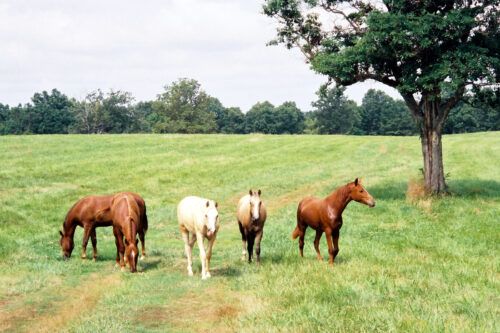
One promising line of inquiry relates to dietary considerations. [3] Research shows that feeding large amounts of concentrate or providing access to pasture are associated with proximal enteritis, although the specific contribution of these factors to the disease has not been studied. [9]
Researchers speculate that toxin exposure while grazing, or management factors related to grazing may contribute to the development of proximal enteritis. [9]
Bacteria and Fungi
Two bacteria, Salmonella spp. and Clostridium spp., have been identified in the gastric juices from horses with proximal enteritis, which gives rise to questions about their association with the disease. [8] Evidence supporting Salmonella as a potential cause is weak. [4]
Newer research into the role of Clostridium difficile, a type of bacteria which was found in every case of proximal enteritis in one study, is more promising, although a causal link is far from being confirmed. [10]
Mycotoxins are another possible agent involved in proximal enteritis. [4] Mycotoxins are toxic compounds produced by certain types of fungi that grow on grains, nuts, grasses, or seeds. [1]
Further investigation into the link between this agent and proximal enteritis is required to confirm or eliminate it as a cause. [4]
Calcium Fluctuations
Hypocalcemia, a reduction in circulating levels of calcium in the blood, is common with proximal enteritis and likely contributes to poor gut motility. It is caused by large losses of chloride in refluxed stomach fluid. This causes a compensatory increase in bicarbonate, which binds to ionized calcium, making it unavailable. [10]
What's your top priority with your horse's health?

Enter your email to receive your store credit
Symptoms
The symptoms of proximal enteritis vary widely in severity and in extreme cases can lead to death of the horse. [7]
The symptoms are also vague and non-specific, meaning no one symptom confirms a diagnosis of proximal enteritis, and all of the symptoms point to other possible conditions. [3]
This makes it challenging to differentiate proximal enteritis from other intestinal disorders that are caused by mechanical obstructions such as blockages caused by food getting stuck in the digestive system (impaction), or by the strangulation of the small intestine by a lipoma. [2]
Colic Signs
The first sign of proximal enteritis is typically mild or moderate colic (pain in the abdomen) that recedes, followed by depression or lethargy. [8]
The signs of colic in a horse include (listed in order of increasing severity): [2]
- Staring at the flank
- Pawing at the ground
- Kicking at the abdomen
- Lying down
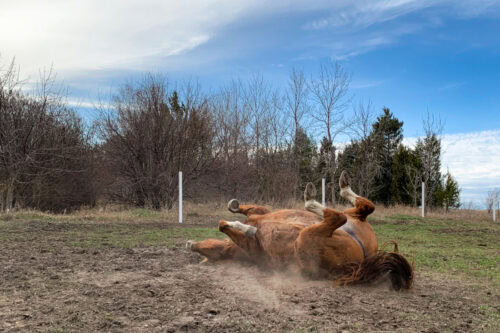
- Intermittent rolling
- Persistent rolling
Severe Signs
As the disease progresses, more severe symptoms develop, including: [1][2][8]
- Decrease in mental alertness
- Decrease in responsiveness
- Fever
- Signs of dehydration including sunken eyes, loss of skin elasticity, decreased urination, dry feces, and tacky gums
- Decreased stomach noises
- Increased heart rate
- Heavy breathing or panting
- Lack of appetite
- Small speckles or bruises on the skin or mucous membranes
- Diarrhea
- Pale or blue gums
- Chilly ears or limbs
Complications of Proximal Enteritis
The inflammation associated with proximal enteritis disturbs nutrient absorption from the intestine into the horse’s bloodstream. [4] This can have serious repercussions for many physiological systems. [4]
Disorders that are associated with proximal enteritis include: [2][3][8]
- Pneumonia
- Blood clots (thrombophlebitis)
- Liver disorders
- Pancreatitis
- Laminitis
- Cardiac issues
- Gastritis (inflammation of the stomach lining)
- Ileitis (inflammation of the ileum)
- Typhlitis (inflammation of the cecum)
- Colitis (inflammation of the colon)
Diagnosis
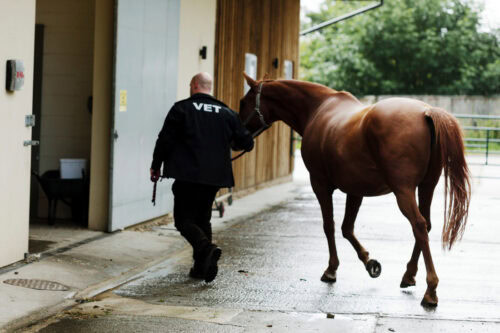
Horses with symptoms of proximal enteritis require immediate veterinary care and hospitalization. [2][3][8]
The main challenge with diagnosing proximal enteritis is differentiating this disease from mechanical obstructions such as strangulating lipoma or gastric impaction, which have a wide overlap in symptoms. [1][3]
Diagnosis is based on physical examination, bloodwork, ultrasound, nasogastric decompression, abdominocentesis (withdrawing fluid from the abdomen with a syringe for study), and possibly exploratory surgery. [1]
The disease’s characteristic clinical finding is copious amounts of fluid upon gastric decompression. In this procedure, a veterinarian inserts a tube through the horse’s nostril into the stomach to release its contents. [3]
Confirmation of diagnosis is typically made by postmortem examination, surgical exploration, or by the easing of symptoms with nasogastric decompression. [5]

Treatment
Nasogastric decompression is used in both diagnosis and treatment of proximal enteritis. [1] During the procedure, the veterinarian inserts a tube through the nostril of the horse into the stomach to release gastric reflux (fluid from the stomach). [1]
The volume of reflux that is produced during this procedure is used as a criterion to diagnose proximal enteritis. Other conditions do not usually result in such a large volume of liquid in the horse’s body. [4]
The liquid retrieved is malodourous and typically reddish or orange-brown. [1] Horses with proximal enteritis also show relief from pain upon decompression, which differentiates this condition from mechanical obstructions where the horse does not show improvement. [6]
As a treatment, nasogastric decompression is typically required every two hours until signs begin to improve. [6] To facilitate treatment, your veterinarian may place a temporary indwelling nasogastric tube. [6]
Medical Management
Other treatments are aimed at supporting the horse’s overall health while the proximal enteritis resolves, including: [1]
- Intravenous fluids
- Electrolyte supplementation
- Nonsteroidal anti-inflammatory drugs
- Medications to increase gut motility
Horses with proximal enteritis typically require advanced monitoring of blood pressure and repeated abdominal ultrasounds to track the disease’s progress and monitor overall health. [1]
Surgical Intervention
There are some cases of PE where surgical intervention is necessary, including those where: [2]
- Medical management is not successful
- It is impossible to differentiate the diagnosis from other causes, such as intestinal obstruction
- The risk of waiting for the condition to resolve is high
The most common surgical procedure for treating PE is intestinal bypass, which redirects the excess fluid produced in the intestine into the cecum and colon. [3] This surgery relieves the painful pressure build-up caused by the fluid, but does not treat the underlying cause of disease. [3]
Supporting Gut Health
Aftercare for a horse recovering from proximal enteritis requires feeding a balanced, forage-based diet that supports optimal gut health. Work with an equine nutritionist to formulate a feeding program that helps maintain a healthy digestive system and minimizes the risk of recurrence.
- Feed good quality forage: High quality forages are usually more palatable for horses, which can improve appetite after a bout of enteritis. High quality forage is also usually more digestible, which may provide more readily available nutrients for the recovering tract.
- Feed frequent small meals: To avoid overloading the healing digestive tract, feed several small meals throughout the day.
- Limit grain-based concentrates: Reduce reliance on grain-based commercial feeds in the diet to minimize the risk of colic and hindgut disruptions.
- Provide fresh water: Ensure access to clean water at all times to prevent dehydration and support gut motility. Feed salt to increase water intake.
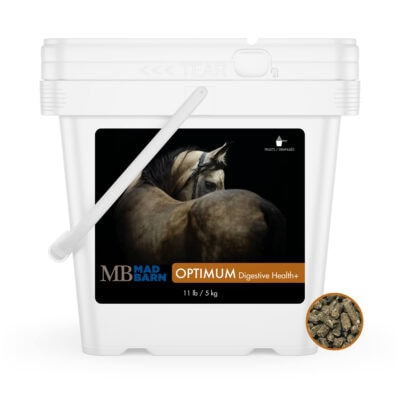
- Feed a digestive health supplement: To support nutrient absorption and hindgut function, provide a gut supplement that contains yeast, probiotics, digestive enzymes and toxin binders, such as Mad Barn’s Optimum Digestive Health.
Prognosis
Reported survival rates for horses with proximal enteritis vary between 25 and 94%. [2] Horses typically improve within 3 days of medical intervention, with more severe cases requiring care for a week or more. [6]
Horses that develop laminitis or other complications due to proximal enteritis have a lower chance of survival. [3]
The chance of recurrence once the horse has recovered is low. [3] Since the cause of PE is not well understood, there are no proven preventive measures available at this time.
Frequently Asked Questions
Here are some frequently asked questions about proximal enteritis in horses:
Proximal enteritis in horses is an inflammatory disease of the duodenum and jejunum (the first two sections of the small intestine) that causes fluid build-up, severe gastric reflux, and a functional blockage of feed and water moving through the gut. Pain often starts as mild-to-moderate colic that eases, followed by lethargy, fever, reduced gut sounds, and rapid breathing.
Proximal enteritis differs from colic in that proximal enteritis is a specific disease that can cause colic (belly pain), whereas colic is a symptom with many possible causes. Signs that point toward proximal enteritis include a horse that starts with mild colic then becomes dull or feverish. Because these signs can overlap with other problems, a veterinarian’s exam and simple tests are usually needed to confirm the cause.
Feeding practices and pasture access influence proximal enteritis when horses receive large grain meals, undergo abrupt diet changes, or graze on lush spring pasture, all of which can disrupt gut function and raise disease risk. Moldy or spoiled feed may further damage the intestinal lining. Risk is lowered by limiting high-starch feeds, making dietary changes gradually, and providing clean, good-quality forage.
Complications of proximal enteritis that owners should watch for can reach beyond the gut, with problems such as laminitis, aspiration pneumonia, and vein inflammation sometimes developing during treatment and recovery. The liver and pancreas may become strained, heart rhythm can change, and heavy fluid losses can upset electrolytes. Owners should watch for practical warning signs like new heat in the feet or stronger digital pulses, coughing or fever, swelling along a limb vein, yellowed gums or eyes, dark urine, diarrhea, dullness, or reduced urination—any of which call for prompt veterinary attention.
Summary
Proximal enteritis is a serious inflammation of the small intestine where swelling seals off the passage of food and water through the horse's digestive system. Immediate veterinary care and hospitalization are required for horses suspected of having proximal enteritis.
- The risk factors and causes of PE are not well understood but may include diet, bacterial agents, or toxins.
- Initial symptoms include mild to moderate colic followed by lethargy and depression. Other symptoms include fever, rapid heart rate, rapid breathing, dehydration, decreased appetite, decreased stomach noises, and decreased responsiveness.
- Proximal enteritis is often associated with other serious issues including laminitis, pneumonia, blood clots, and inflammation of other parts of the digestive system.
- Diagnosis is based on the volume and appearance of gastric reflux as well as bloodwork, ultrasound, abdominocentesis, and physical examination. Treatment includes ongoing gastric decompression, supportive care such as IV fluids and anti-inflammatory drugs, and in some cases, surgery.
- Survival rates vary, with horses that develop laminitis or other complications having a lower chance of survival.
References
- Feary, D. J., & Hassel, D. M. Enteritis and Colitis in Horses. Veterinary Clinics of North America: Equine Practice. 2006.View Summary
- Underwood, C. et al. Complications and Survival Associated with Surgical Compared with Medical Management of Horses with Duodenitis‐proximal Jejunitis. Equine Veterinary Journal. 2008.View Summary
- Reed, S. M. et al. Equine Internal Medicine. 3rd ed. Saunders Elsevier, St. Louis, Mo. 2010.
- Arroyo, L. G. et al. Equine Duodenitis-Proximal Jejunitis: A Review. The Canadian Veterinary Journal. 2018.View Summary
- Edwards, G. B. Duodenitis‐proximal Jejunitis Anterior Enteritis as a Surgical Problem. Equine Veterinary Education. 2010.
- Freeman, D. E. Duodenitis‐proximal Jejunitis. Equine Veterinary Education. 2000.
- Steward, S. K. T. Geographic Disparities in Clinical Characteristics of Duodenitis-Proximal Jejunitis in Horses in the United States. Journal of Equine Veterinary Science. 2020.View Summary
- Blikslager, A. T. et al., Eds. The Equine Acute Abdomen. Third edition. Wiley, Blackwell, Hoboken, NJ. 2017.
- Cohen, N. D. et al. Are Feeding Practices Associated with Duodenitis‐proximal Jejunitis. Equine Veterinary Journal. 2006.
- Arroyo, L. G. et al. Potential Role of Clostridium Difficile as a Cause of Duodenitis-Proximal Jejunitis in Horses. Journal of Medical Microbiology. 2006.View Summary