English







Turnout is one of the most important parts of your horse’s daily routine. Adequate turnout supports musculoskeletal health, digestive function, and natural social behaviors.
However, many facilities struggle to provide horses with adequate turnout during the winter, when conditions may be icy, muddy, or frozen. This can lead to increased time spent in the stall despite caretakers’ best efforts.
Preparing horses for safe winter turnout involves more than simply adding a blanket. It requires assessing shelter, footing, herd dynamics, access to forage and unfrozen water, and day-to-day monitoring. Thoughtful preparation can make the difference between a season of content, fuzzy-coated horses and one filled with preventable injuries or illness.
Keep reading to learn more about the unique risks associated with winter turnout and how to keep your horse comfortable and safe in cold weather. From blanketing approaches to managing icy paddocks, you’ll learn how to support your horse through the coldest months of the year.
Winter Turnout for Horses
Daily movement is an important part of horse health. Feral horses cover approximately 15 km (9 mi) per day as they travel between food and water sources. [1] Conversely, horses kept in stalls travel only 1 km (0.6 mi) per day on average. [2]
This reduction in movement can have significant impacts on equine health, such as increasing the risk of colic and behavioral problems. Additionally, long-term stabling can reduce fitness and bone mineral content in horses. [3]
For these reasons, maximizing turnout is in the best interest of horses and their owners. However, winter turnout options may be limited depending on where and how your horse is housed.
Factors to consider when planning for winter turnout include:
- Footing
- Temperature and wind chill
- Water access
- Feed availability
- Herd dynamics
- Shelter
What's your top priority with your horse's health?

Enter your email to receive your store credit
Footing in Turnout Area
Footing is one of the key factors that facility owners consider when making turnout decisions. Icy, frozen, or muddy conditions can increase the risk of soft tissue injuries in horses from slipping and sliding.
Additionally, turnout during these conditions may damage the pasture ecosystem by tearing up grass roots.
Muddy Ground
Muddy conditions frequently develop in areas with wet winters or during the early spring snow melt. Mud can make it difficult for horses to navigate the terrain, causing slipping, overstepping, and potentially loss of shoes. These factors can contribute to soft tissue injuries or damage to the hooves.
Standing in mud can also increase the horse’s risk of developing skin or hoof issues, including thrush and scratches (pastern dermatitis). [4]
Managing mud on horse properties is difficult. Horse owners typically rely on a combination of permanent and temporary solutions to mitigate mud development.
For high-traffic areas, permanent solutions are ideal, as these locations carry the greatest risk of mud development. Examples of long-term mud-management strategies include: [4]
- Installing a “high-traffic” pad of packed crushed gravel
- Placing grid systems that help stabilize topsoil
- Installing drainage pipes under the ground
- Grading the area to promote water run-off
While permanent changes are ideal for high-traffic areas, they are not always immediately feasible. In these cases, temporary strategies can help reduce mud accumulation and protect footing until long-term solutions are in place.
Temporary solutions include: [4]
- Placing gravel, sand or wood-based products on top of a muddy area
- Using temporary fencing to restrict access until the area can dry
Property owners should also consider rain and snow management strategies. For example, installing gutters on buildings can help direct rain into drainage systems or ditches.
Piling snow in pre-designated areas with good drainage can also help ensure spring melt does not flood high-traffic areas of the property. [4]
Icy Areas
Ice creates one of the most dangerous footing conditions for horses during turnout. As a result, horse owners and barn managers may choose to limit or avoid turnout altogether when icy conditions are present, even when horses would otherwise benefit from time outdoors.
Slippery surfaces significantly increase the risk of falls and traumatic injury. Slip-and-fall incidents can lead to health conditions such as: [5]
- Limb nerve injury
- Pulled groin muscles
- Rupture of the peroneus tertius tendon
- Bruising, scrapes, or cuts
- Head injuries
- Limb or pelvic fractures
Although most horses avoid icy areas, in some cases ice forms near critical resources like feed or water. This makes crossing the ice unavoidable for the horse, increasing their chances of falling.
Strategies to reduce ice buildup or provide traction include: [6]
- Scraping the area with a plough to roughen the surface or break up ice
- Moving feeders and waterers away from icy areas
- Applying sand, shavings, non-clumping cat litter, or woodchips on top of the ice
- Using pet-friendly “salt” products to melt the ice
Another important factor to consider is horse behavior during turnout. Horses who are turned out more frequently are less likely to trot, canter, and buck when turned out. [6] This may reduce the risk of slip-and-fall injuries.
Consider turning out in paddocks with deep snow or an indoor arena so the horse can acclimate to turnout safely before moving them to their typical paddock.
Snow Accumulation
Snow is typically not a problem for horses. However, deep snow increases the effort of movement, which requires additional calories for the horse to maintain a balanced energy intake.
Horses regularly turned out in deep snow may require additional feed to maintain body condition. If no new snow falls, horses tend to establish compacted walking trails through deep snow that help limit their energy consumption.
The main concern associated with turnout on snow is snow packing in the horse’s hooves. Standing on these snow accumulations within the hoof can strain tendons and ligaments or lead to bruising of the hoof sole.
These snow balls are most common in horses wearing shoes, as the shoe provides a grooved surface for snow to accumulate on. Bare feet flex more readily with each step, which helps pop out accumulating snow. [7]
Strategies to reduce the risk of snowballs in horse hooves include: [7]
- Petroleum jelly or cooking spray applied to the bottom of the hoof
- Snow pads, which pop out snow as the horse walks
- Routinely removing accumulated snow using a hoof pick or claw hammer
- Using hoof boots to prevent buildup and provide additional traction
Shelter
Providing adequate shelter in turnout areas is an important part of ensuring your horse’s comfort and welfare, particularly during cold, windy, wet, or snowy weather. While horses are generally hardy and adapted to tolerate low temperatures, access to shelter helps them reduce heat loss, conserve energy, and avoid prolonged exposure to wind, sleet, and snow.
Shelters can take several forms, from three-sided run-in sheds placed within paddocks or pastures to natural windbreaks such as tree lines or terrain features. They should be large enough for the number of horses using them, provide protection from prevailing winds, and be located where footing remains safe and dry.

Turnout in Cold Temperatures & Windy Conditions
Horses have a relatively low thermoneutral zone, which is the temperature range where they do not need to spend additional energy to maintain their body temperature.
Estimates suggest the lower range of the critical temperature, which marks the lower boundary of the thermoneutral zone for winter-acclimated horses, is -15°C (5°F). [8] This is significantly lower than for clothed humans, which is around 15°C (60°F). [9] This means that even though owners are cold, their horses are often comfortable.
As temperatures (or wind chill temperatures) drop below -15°C (5°F), the horse’s body activates heat production mechanisms to help raise their body temperature.
Mechanisms to increase body temperature include: [10]
- Shivering
- Consuming more forage to increase heat production by the gastrointestinal tract
- Increasing their metabolic rate to burn more calories per hour
- Raising the coat hairs (piloerection) to increase insulation
Management strategies to increase your horse’s body temperature below -15°C (5°F) can help reduce their caloric expenditure.
Strategies include: [10]
- Blanketing to increase the horse’s insulation
- Providing a windbreak or shelter, which reduces the effect of windchill
- Providing suitable bedding which helps insulate the horse from the ground when lying down
It’s important to note this estimated thermoneutral zone does not apply to clipped horses. Clipping removes one of the horse’s thermoregulatory mechanisms: raising their hairs for insulation.
Clipped horses turned out in cold temperatures require a blanket to replace their natural insulation. Horses acclimated to 15 – 20°C (59°F – 68°F) have a lower critical temperature of around 5°C (41°F), which provides a reasonable estimate for when a clipped horse requires blanketing. [11]
These thermoneutral zone temperatures also do not apply to horses who are wet from sleet or snowfall. Moisture compresses the horse’s haircoat, reducing its insulation capacity. Providing shelter or a suitable blanket is recommended during any type of precipitation in the winter.
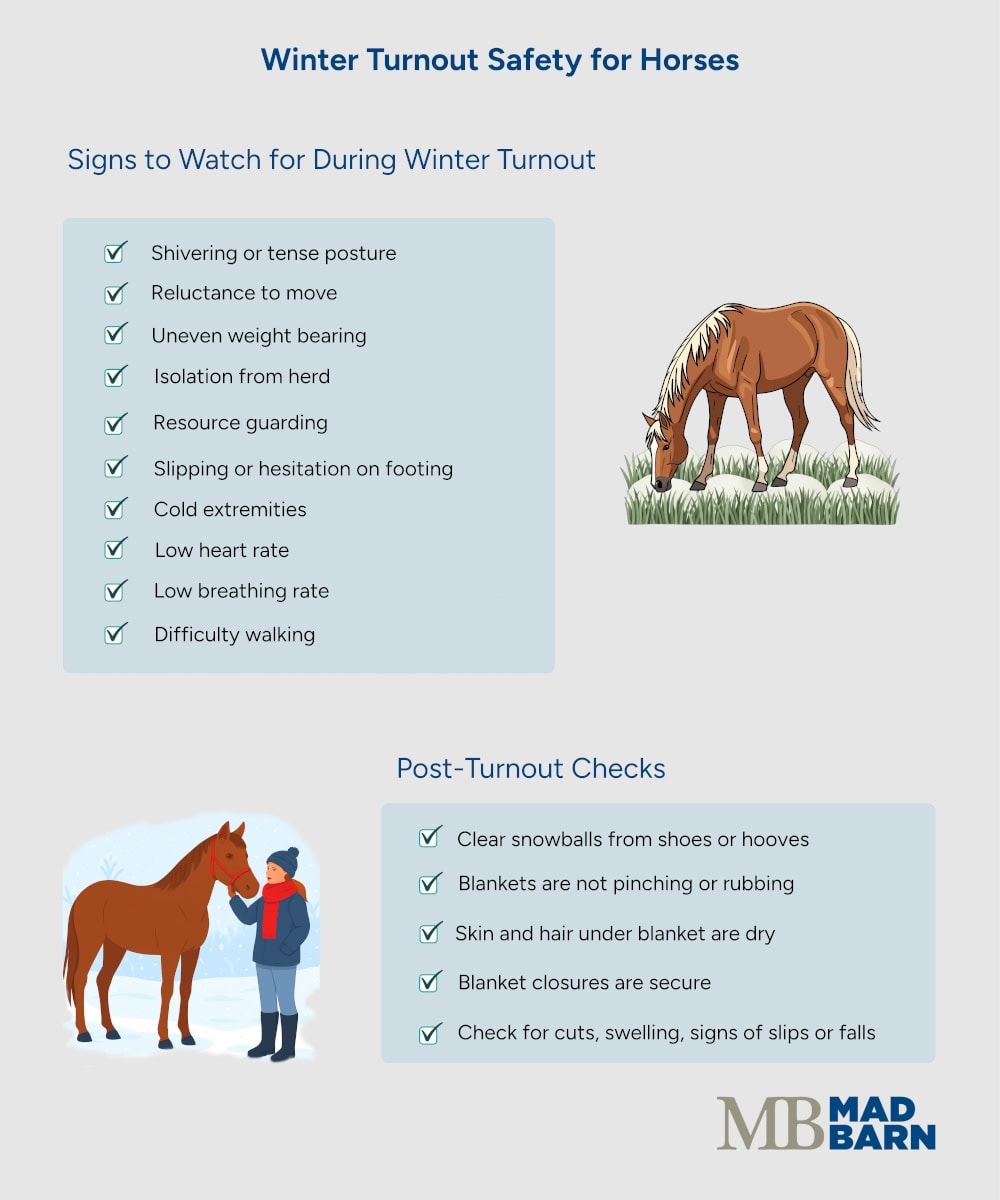
When to Avoid Turnout
Cold temperatures alone are rarely a reason to eliminate turnout for healthy, winter-acclimated horses. Most adult horses tolerate cold well when they have adequate forage, shelter from wind, and dry footing. [8] However, turnout may be unsafe or inappropriate when cold weather is combined with other risk factors. [11]
Turnout should be limited or avoided when extreme cold coincides with high winds, freezing rain, sleet, or wet snow, as moisture and wind rapidly reduce the insulating properties of the hair coat and increase heat loss.
Horses that are clipped, underweight, elderly, ill, or unable to access shelter are also at greater risk of cold stress and may require modified turnout plans or additional protection.
In these conditions, it’s important to prioritize:
- Dry shelter
- Adequate bedding
- Sufficient forage intake
- Regular monitoring
Shortened turnout periods or delaying turnout until weather conditions improve can help reduce the risk of hypothermia and cold-related injury.
Turnout Alternatives in Cold Weather
When winter conditions make turnout unsafe or impractical, controlled exercise can help meet your horse’s need for movement and enrichment.
Hand-walking, riding, or other forms of supervised movement support circulation, joint mobility, and gastrointestinal motility when horses are spending more time in the stall.
Exercise plans should be adjusted to weather, footing, and the individual horse. Indoor arenas, covered walkways, or plowed lanes may provide safer options during icy or deeply frozen conditions.
Monitoring for Hypothermia
Hypothermia occurs when a horse’s core body temperature drops below normal, usually due to prolonged exposure to cold, wind, or wet conditions. While horses are generally well-adapted to winter weather, factors such as inadequate shelter, poor body condition, or wet hair can overwhelm their ability to stay warm.
Hypothermia is a concern during winter turnout because it affects the entire body, impairing normal physiological function and increasing the risk of serious illness if cold stress is not properly managed.
Signs of hypothermia in horses include: [12]
- Shivering stops despite continued exposure to cold
- Cold extremities, such as the feet and ears
- Slow heart rate
- Slow breathing
- Collapse
Water Access During Turnout
Continuous access to fresh, abundant water is critically important for horses, as it helps maintain hydration and healthy gastrointestinal motility. This reduces the risk of impaction colic by ensuring feed materials move smoothly within the large intestine.
Horses require between 37 – 45 L (10 – 12 gal) of water per day to maintain adequate hydration. [13] Research also shows horses drink more if the water temperature is slightly above freezing. [14]
Strategies to ensure consistent fresh water access during winter turnout include:
- Add a water heater to the water trough
- Insulate the water trough to help maintain water temperature after filling
- Break ice frequently to ensure access to liquid water
- Make sure the area around the water source has safe footing
Snow is primarily composed of air and horses cannot realistically consume it at a sufficient rate to meet hydration needs. For this reason, snow is not considered a suitable substitute for fresh water. [13]
Roughly 25 cm (10 in) of snow is equal to 2 cm (1 in) of liquid water. To replace a typical daily water intake using snow after 5 cm (2 in) of snowfall, a horse would have to eat enough snow to cover more than four football fields. [13]
Additionally, the horse must burn additional calories when consuming snow, since taking in cold snow lowers body temperature.
Feed Availability During Turnout
One of the primary contributors to heat production in horses is fermentation in the gastrointestinal tract. Increasing access to fiber sources promotes fermentation, which helps boost the horse’s body temperature.
Additionally, the horse’s body increases its metabolic activity during cold temperatures to help maintain a stable body temperature. Estimates from controlled studies suggest metabolic energy needs increase in horses at maintenance by approximately 1534 kJ per day for every 1°C (1.8°F) below −15°C (5°F). [8]
For these reasons, providing ample access to good quality forage is key in cold temperatures. Consuming forage helps boost the horse’s heat production and provides additional calories to support their increased metabolism. Free choice hay during turnout is ideal.
For horses on a restricted diet, consider:
- Using hay nets to slow access to feed, but provide consistent fiber for fermentation
- Using a lower quality hay with less digestible energy
- Feeding frequent, small meals to prolong access to fiber
This increased energy demand is often met through higher forage intake. For an average horse at maintenance, forage needs rise by approximately 1 kg (2 lb) of hay for every 5°C (9°F) drop below −15°C (5°F). [15] This figure should be used as a rough planning guideline and adjusted based on body condition and individual response.
Can Horses Eat Grass in Snow?
Many new horse owners wonder whether horses can still graze when pasture is covered in snow or if additional forage needs to be provided.
Snow-covered pasture rarely provides enough forage to meet a horse’s nutritional needs during winter turnout. While horses may paw through light snow to access grass, snow accumulation on pastures requires increased energy to graze and reduces overall forage intake. [16]
As snow depth increases or becomes crusted or icy, pasture grazing becomes increasingly inefficient or impossible for horses to penetrate, and the quality of pasture below the snow decreases significantly. [17][18]
Given this, it’s important to provide horses with ample hay during winter conditions to meet their increased energy needs. Adequate forage intake is especially important in cold weather, as fermentation of fiber in the hindgut is a primary source of internal heat production. [8]
When pasture access is limited by snow, horses need sufficient hay to maintain body condition and support thermoregulation.
Snow is not a reliable source of nutrition or hydration. Even when pasture is visible beneath snow, intake is inconsistent and difficult to monitor.
Winter-dormant grasses are typically lower in digestible energy and protein than actively growing pasture because plant growth has slowed or stopped. During dormancy, grasses often contain more structural fiber (such as cellulose and lignin) and less protein.
As fiber content increases, digestibility declines, meaning horses extract fewer usable calories and amino acids from each bite compared with fresh, growing forage.
Offering free-choice hay during turnout helps ensure horses consume enough fiber and calories when grazing opportunities are limited. Body condition should be assessed regularly, as weight loss can be difficult to detect under winter coats.
Herd Dynamics During Winter Turnout
Herd dynamics can play an important role in horse health year-round, but are particularly important during the winter.
Poorly matched herd groupings during turnout can result in:
- Injuries from fighting
- Inadequate feed and water intake due to competition, bullying or resource guarding
- Increased contact with the fence from being chased or pushed
- Increased movement, including bucking or galloping, due to play behaviors or aggression
During winter months, these factors can become even more dangerous. For example, increased bucking or galloping increases the risk of a slip and fall, which may result in injury.
Consider each herd carefully and make changes in the fall, before winter sets in. The ideal herd dynamic allows all horses to access feed and water comfortably without other horses displaying aggression. Particularly playful horses may benefit from winter turnout with a quieter, less playful buddy, rather than other spirited horses.
Avoid introducing new horses into a herd during winter, as play and aggression behaviors are often highest during this period.
If a new horse must be introduced, consider placing the horse in an adjacent pasture or paddock for several weeks, and allow the horses to visit over the fenceline. This can help reduce dramatic behavior once the new horse enters the herd.
Here are some frequently asked questions about winter turnout for horses:
Most healthy, unclipped adult horses tolerate cold weather well, especially with shelter and access to forage. The lower critical temperature is around -15°C (5°F), but wind, moisture, coat length, age, and health status all influence tolerance. Wet and windy conditions are more stressful than dry cold.
Not all horses require blanketing. Horses with full winter coats, good body condition, and shelter often remain comfortable without one. Blankets are most appropriate for clipped horses, seniors, thin horses, or during wet and windy weather. Blanket fit and skin condition should be checked regularly.
Traction can be improved by removing ice from high-traffic areas, relocating feeders and water sources, adding sand or gravel, and avoiding turnout on glare ice. Regular hoof care and managing snow buildup in hooves also reduce slipping risk.
Yes. Horses expend more energy to maintain body temperature in cold conditions. Free-choice forage supports heat production through fermentation. Body condition should be monitored under winter coats, with dietary adjustments made gradually as needed.
No. Snow does not provide adequate hydration and increases the risk of dehydration and impaction colic. Horses should always have access to fresh, unfrozen water during winter turnout.
Yes, horses may graze small amounts of pasture grass when snow is light and grass remains accessible. However, snow-covered pasture should not be relied on as a primary forage source. Intake may be inconsistent, as horses need to dig through snow to reach the grass, and dormant winter grasses are lower in digestible energy and protein, and snow does not provide adequate hydration. Horses turned out in snowy conditions should always have access to sufficient hay and fresh, unfrozen water.
In most cases, horses can be safely turned out in snow. Horses are well adapted to cold climates, using dense winter coats, increased metabolic heat from forage fermentation, and natural movement to help maintain body temperature. Regular turnout during snowy conditions supports circulation, digestion, and mental well-being, provided footing is safe and horses have access to shelter, adequate forage, and fresh, unfrozen water. Turnout should be limited or modified during extreme weather, icy conditions, or when snow cover prevents safe movement or reliable access to feed and water.
Wild horses survive winter by relying on continuous foraging, increased movement, and physiological adaptations to cold. They spend many hours grazing on available grasses, shrubs, and other vegetation, generating body heat through hindgut fermentation of fiber. Their winter coats provide insulation, and they adjust movement patterns to locate forage, water, and shelter from wind and severe weather. Body condition often declines over winter as forage quality and availability decrease and fat reserves are used to meet energy demands. Weight and condition are typically regained during spring and summer when forage becomes more abundant and nutrient-dense.
Summary
Maintaining turnout during winter supports horse health and welfare, but it requires thoughtful planning to keep horses safe, comfortable, and well nourished in cold conditions.
- Ensure horses have access to wind- and weather-protected shelter, with enough space for all herd members
- Provide horses with free-choice forage and unfrozen water to support heat production and hydration
- Monitor blanket fit, body condition, and behavior regularly, especially for seniors, clipped, or thin horses
- Reduce injury risk during winter turnout by improving icy footing, managing herd, and checking hooves for packed snow/ice
- Watch for red flags such as shivering, decreased appetite, lethargy, or sudden weight loss, and contact your veterinarian when concerns arise
References
- Hampson. B. A. et al. Distances Travelled by Feral Horses in ‘Outback’ Australia. Equine Veterinary Journal. 2010.
- Hampson. B. et al. Monitoring Distances Travelled by Horses Using GPS Tracking Collars. Australian Veterinary Journal. 2010. View Summary
- Graham-Thiers. P. M. and Bowen. L. K. Improved Ability to Maintain Fitness in Horses During Large Pasture Turnout. Journal of Equine Veterinary Science. 2013.
- Jaqueth. A. Managing Mud on Horse Farms. University of Minnesota Extension.
- Freckleton. M. and Barakat. C. Slip and Fall Injuries in Horses. Equus Magazine. 2018.
- Skelly. C. Horse Owners Use Caution - Icy Conditions Ahead!. Michigan State University. 2019.
- Kauffmann. S. Preventing Snowballs. Horse Canada. 2018.
- McBride. G. E. et al. Metabolic Rate and Plasma Thyroid Hormone Concentrations of Mature Horses in Response to Changes in Ambient Temperature. Canadian Journal of Animal Science. NRC Research Press. 1985.
- Kingma. B. R. et al. Beyond the Classic Thermoneutral Zone. Temperature: Multidisciplinary Biomedical Journal. 2014.
- Mejdell. C. M. et al. Caring for the Horse in a Cold Climate—Reviewing Principles for Thermoregulation and Horse Preferences. Applied Animal Behaviour Science. 2020.
- Morgan. K. Thermoneutral Zone and Critical Temperatures of Horses. Journal of Thermal Biology. 1998.
- Orsini. J. A. and Divers. T. J. Eds. Equine Emergencies: Treatment and Procedures. Fourth edition. Elsevier/Saunders, St. Louis, MO. 2014.
- Bellamy-Zions. J. Horses and H20: The Importance of Winter Water. Horse Canada. 2021.
- Kristula. M. A. and McDonnell. S. M. Drinking Water Temperature Affects Consumption of Water during Cold Weather in Ponies. Applied Animal Behaviour Science. 1994.
- Feeding Horses During Winter. Government of Saskatchewan.
- Cymbaluk. N. F. and Christison. G. I. Environmental Effects on Thermoregulation and Nutrition of Horses. Veterinary Clinics of North America: Equine Practice. 1990.
- Shang. Z. H. et al. Effect of Snow Disasters on Livestock Farming in Some Rangeland Regions of China and Mitigation Strategies – a Review. The Rangeland Journal. 2012.
- Liu. H. et al. Winter Snow Cover Influences Growing-Season Vegetation Productivity Non-Uniformly in the Northern Hemisphere. Communications Earth & Environment. 2023.