Glanders is one of the oldest diseases known to affect horses. It is a highly contagious and fatal disease that affects horses, donkeys, and mules, caused by the bacterium Burkholderia mallei. It poses a significant zoonotic threat, as it can...
The horse's gastrointestinal system is evolved for processing forage and fiber. Domestic feeding and management strategies often challenge the horse's natural digestive process. Significant disruptions can lead to bloating - a condition where gas accumulates in the gut, causing abdominal...
During fetal development, the testicles form near the kidneys and gradually descend into the scrotum through a passage called the inguinal canal. In some cases, this descent is incomplete, resulting in one or both testicles being retained within the abdomen...
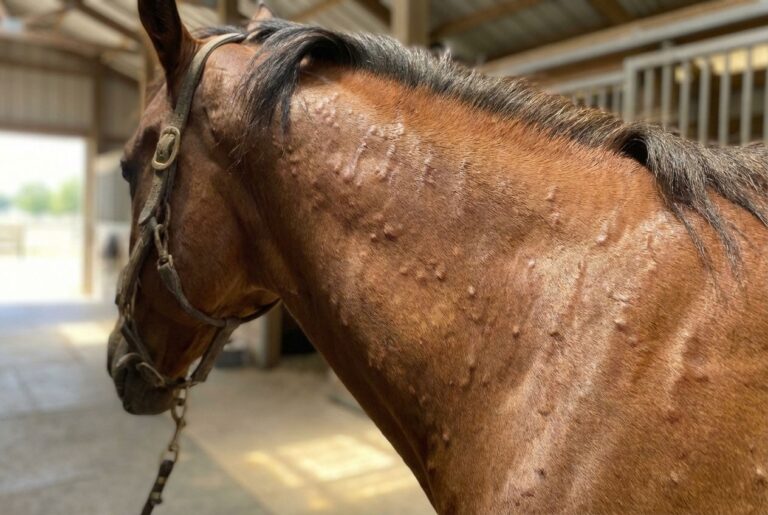
Hives, also known as urticaria, are a common skin reaction in horses characterized by the sudden appearance of raised, swollen wheals on the skin. These wheals can vary in size, and may be accompanied by itching or discomfort. Hives in...
Parasites are organisms that live in or on the horse, and rely on the horse for sustenance while often causing harm or disease. These include worms like roundworms, tapeworms, and bots, as well as external parasites such as ticks and...
Ringworm, or dermatophytosis, is a common fungal skin infection. Despite its name, ringworm isn't caused by a worm but rather by various fungi, or dermatophytes, that infect the skin. This fungal infection presents circular hair loss patches with crusty, scaly...
Hereditary Equine Regional Dermal Asthenia (HERDA), or Hyperelastosis Cutis (HC), is a genetic degenerative skin disease that primarily affects Quarter Horses. It's characterized by a collagen deficiency, a crucial protein responsible for maintaining the strength and elasticity of the skin....
When a horse lies down for extended periods, especially with long-heeled horseshoes or on shallow bedding, prolonged pressure and "squishing" from the hoof on the elbow can occur, leading to a condition known as shoe boil. Shoe boils, otherwise known...
The overo pattern is one of three coat patterns in American Paint Horses (APHs) recognized by the American Paint Horse Association (APHA), along with Tobiano and Tovero. Among Overo variations, the frame overo subtype stands out for its distinctive markings....
Exertional Rhabdomyolysis (ER), commonly known as tying-up or azoturia, is an exercise-induced condition in horses characterized by the excessive breakdown of muscle tissue. This results in muscle spasms, pain and impaired performance following bouts of exercise. [1] In severe cases,...
Melanomas are a type of skin tumor most commonly observed in aging grey horses. Up to 80% of gray horses aged 15 or older develop melanomas during their lifetime. Melanomas in gray horses often appear as benign blemishes and remain...
Lavender Foal Syndrome (LFS), or coat colour dilution lethal (CCDL), is a rare and lethal disorder in Arabian horses and crossbreeds. Foals with LFS are born with neurological problems and a lightened coat colour. Lavender Foal Syndrome is a genetic...
Epistaxis is a common condition in horses that refers to bleeding from the nostrils. Nosebleeds can range in severity and may result from trauma, underlying health conditions or exercise. The majority of nosebleeds in horses are caused by minor trauma...
Ivermectin is an over-the-counter medication used to control internal parasites in horses and other animals. It is macrocyclic lactone medication and is one of the most widely used dewormers or anthelmintics in the equine industry. Ivermectin is effective against a...
Equine piroplasmosis (EP), or babesiosis, is an infectious tick-borne disease that affects all equid species, including horses*, mules, donkeys and zebras. It is caused by protozoan parasites that are transferred to the horse via tick bite. The protozoan parasites, Theileria...
Ringbone is a degenerative condition that affects the bones and joints in the horse’s lower limbs. It is characterized by the inflammation of surrounding connective tissue, triggering the formation of bony growths around the affected joints. [ref n="2"][ref n="5"] These...
Strongyles are considered the most significant internal parasite that affects horses. It is estimated that these parasites affect between 80 – 99% of equids worldwide. There are two main types of strongyles: large strongyles and small strongyles. Both types can...
Bone bruising is a common condition often seen in young racehorses, such as Thoroughbreds or Standardbreds. It typically arises from repetitive stress, trauma, or microfractures affecting the subchondral bone, which is the layer of bone located beneath the joint’s cartilage....
A hoof or sole bruise is a common injury in horses, occurring when there is trauma to the sensitive tissues within the hoof. This trauma leads to localized bleeding and subsequent bruising. Hoof bruises can cause mild to severe discomfort...
Pergolide mesylate (Prascend®) is a medication used to treat horses with pituitary pars intermedia dysfunction (PPID), previously referred to as Equine Cushing’s disease. This common endocrine disorder, typically observed in older horses, can cause tendon and ligament breakdown, abdominal wall...
Bleeding disorders can significantly affect your horse’s performance and overall health. These conditions can be present from birth or develop later in life and are characterized by abnormal bleeding or hemorrhage. Some bleeding disorders, such as exercise-induced pulmonary hemorrhage (EIPH),...
Cellulitis refers to bacterial infection and inflammation that affects tissues under the skin anywhere in the body. In horses, this severe condition typically occurs in the hindlimbs. It is characterized by a sudden onset with significant swelling and intense pain.
A heart arrhythmia, or irregular heartbeat, is a performance-limiting condition commonly seen in athletic horses. While some arrhythmias are benign, others may indicate cardiac disease or another underlying health condition. The horse is a supreme athlete with a powerful heart...
Equine pinworms, or Oxyuris equi, are common parasites that inhabit the horse's colon. Female pinworms lay their eggs on the perianal skin (around the anus), which can cause intense itching and irritation for the horse. Pinworm infections are most common...
The horse’s tendons are prone to strain injuries, especially when participating in disciplines, such as racing, jumping and eventing. Tendons are fibrous connective tissues that attach muscle to bone and allow the limbs to move. Tendons serve as a mechanical...
Eastern equine encephalitis (EEE), otherwise known as Triple E or sleeping sickness, is a rare and lethal virus in horses that causes inflammation of the brain. EEE is transmitted through mosquito bites and attacks the central nervous system (CNS). It...
A hunter’s bump, or sacroiliac subluxation, is a hump on the horse’s lower back that develops above the croup. It is most apparent when viewing a horse in motion from behind.
Heat stress occurs when the horse’s internal cooling mechanisms stop working efficiently and the ability to maintain a normal body temperature is affected. This is common and in hot and humid conditions, or following vigorous exercise. Without intervention, heat stress...
Shivers, or shivering, in horses is a progressive neuromuscular condition characterized by an abnormal, jerky gait while backing up. Horses affected by Shivers exhibit muscle tremors in the pelvic limbs when forced to back up. Clinical signs typically appear in...
Bowed tendon in horses is defined as acute or chronic inflammation of a tendon. This condition is also known as tendinitis, tendonitis or tendinopathy. This injury usually occurs when the tendon is strained beyond its limit, resulting in torn collagen...