English










Congenital myotonia in horses is a rare inherited disorder that causes the muscles to stay tense for too long after they contract. Instead of relaxing normally, the muscles release slowly, which leads to episodes of stiffness, especially when the horse first starts moving after rest. [1][2][3]
Affected horses may appear rigid, hesitant, or awkward when asked to move, but the stiffness often improves as they continue walking or exercising. This pattern reflects delayed muscle relaxation, which is the defining feature of the condition. Similar disorders have also been described in other species, including humans and fainting goats. [4][5]
Recognizing the characteristic signs of congenital myotonia is important for accurate diagnosis and informed breeding decisions. Because the condition begins early in life and can resemble other causes of muscle stiffness, careful evaluation is needed to distinguish it from other neuromuscular disorders.
Congenital Myotonia in Horses
Congenital myotonia in horses is a neuromuscular disorder in which muscles do not relax normally after contraction, leading to temporary stiffness.
Muscle contraction and relaxation are controlled by the movement of ions — such as sodium and chloride — across muscle cell membranes. These signals allow muscles to contract and then quickly return to a relaxed state. [2]
In affected horses, this process is disrupted. Dysfunction in ion channels causes muscle fibers to remain active longer than normal, delaying relaxation. [3]
Affected muscles may also be overly responsive, meaning even light touch or movement can trigger a contraction that takes longer than expected to resolve. [1]
As a result, affected horses may: [1][3]
- Appear stiff when first moving after rest
- Take short, hesitant steps
- Become more coordinated after a brief period of activity
Clinical signs are often first recognized in young horses and tend to remain stable over time. Importantly, congenital myotonia does not involve ongoing muscle degeneration. This distinguishes it from myotonia dystrophica, a more severe condition that causes progressive muscle damage and additional systemic abnormalities. [3][6]
What's your top priority with your horse's health?

Enter your email to receive your store credit
Causes
Congenital myotonia is an inherited condition that affects how muscle cells regulate electrical signals. In some horses, the disorder has been linked to a mutation in the CLCN1 gene, which is required for normal muscle relaxation. [7][8][9]
A specific genetic variant has been identified in New Forest Ponies. In affected ponies, this mutation disrupts chloride channel function in muscle cells, making it harder for the muscles to return to a resting state after contraction. The result is prolonged muscle contraction and delayed relaxation. [10][11]
This form of congenital myotonia is inherited in an autosomal recessive pattern, meaning a horse must inherit two copies of the variant, one from each parent, to be affected. Horses with only one copy appear normal but can carry and pass the trait to their offspring. [3][12]
Mutations in the same gene are well-documented in humans and other species, including goats, where congenital myotonia has been studied more extensively and genetic testing is widely available. This evidence suggests the condition has a similar underlying mechanism across species. [1][8][13][14]
To date, this specific variant has only been confirmed in New Forest Ponies and has not been widely detected in other horse breeds. However, similar genetic causes are suspected in other cases.
Breeding Considerations
Congenital myotonia can be passed from parents to offspring. In New Forest Ponies, where the causative mutation has been identified, the condition is inherited in an autosomal recessive pattern. This means an affected foal must inherit two copies of the variant, one from each parent, and two clinically normal carriers can still produce an affected foal. [7]
Genetic testing helps identify carrier and affected horses, allowing breeders to make more informed mating decisions and reduce the risk of producing affected foals.
Symptoms
Congenital myotonia mainly affects movement by causing stiffness when the horse first begins to move after rest. Clinical signs are usually apparent early in life. [3][10][14]
- Stiffness when first moving, particularly after standing still
- Short, hesitant steps that become more fluid with continued movement
- A “warm-up effect,” where movement improves within a few minutes
- Well-developed or firm-looking muscles, especially in the hindquarters
- Temporary muscle dimpling or prolonged tightening when the muscle is tapped
A key identifying feature of this condition is that stiffness improves with movement rather than worsening.
In some horses, even light stimulation of muscles, such as tapping or pressure, can trigger a contraction that lingers longer than expected before gradually relaxing. [1]
Affected foals may appear stiff when they first stand or begin to walk. As they get older, the condition often becomes less obvious but can still be seen after periods of inactivity. Unlike many muscle disorders, these signs typically do not worsen over time. [11]
When to Call a Veterinarian
Veterinary evaluation is recommended when signs of stiffness are first observed, particularly in young horses.
A veterinarian should be consulted if:
- A foal appears stiff when standing or moving
- Movement remains abnormal after rest
- Signs worsen or are unclear
- Another muscle disorder is suspected
Early assessment helps rule out more serious neurological conditions and guides appropriate management.
Diagnosis
Congenital myotonia in horses is diagnosed by recognizing its characteristic pattern of muscle stiffness, especially signs that begin early in life and improve with movement.
Because the condition is rare and can resemble other neuromuscular or musculoskeletal disorders, diagnosis relies mainly on clinical evaluation. Additional testing may be used to rule out other causes of stiffness and support the diagnosis when needed.
Clinical Examination
A veterinarian begins by assessing the horse’s movement, particularly after a period of rest. Horses with congenital myotonia are often stiff when they first start walking, but the stiffness improves after a short period of movement. This warm-up effect is a characteristic feature of the condition. [3][14]
The veterinarian may also examine how the muscles respond to stimulation. In some horses, tapping a muscle triggers a localized contraction that relaxes more slowly than normal, sometimes causing a visible dimple or ridge in the muscle.
The horse’s history is also important. Congenital myotonia is present from an early age, and the signs usually remain relatively stable over time rather than progressively worsening. This pattern helps distinguish it from other muscle disorders with a more progressive course. [3][7][14]
Diagnostic Testing
If further confirmation is needed, electromyography (EMG) can be used to evaluate muscle activity.
Figure 1: Normal equine electromyographic findings
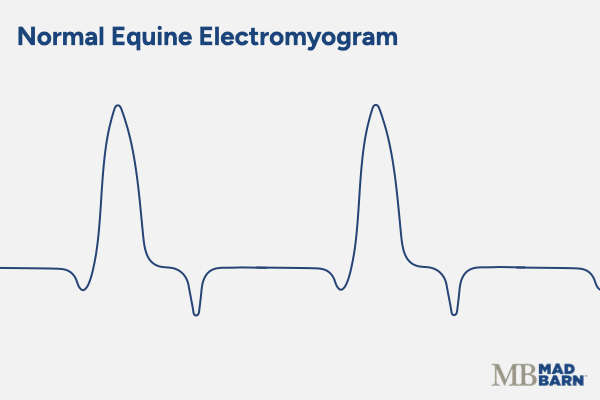 Diagram:
Horses with myotonia show a characteristic pattern of rapid, repetitive electrical discharges on EMG. This activity often produces a distinctive sound, sometimes described as a “dive-bomber” noise, which is highly suggestive of the condition. [1][10][14][15]
Figure 2: Electromyographic findings in cases of equine congenital myotonia
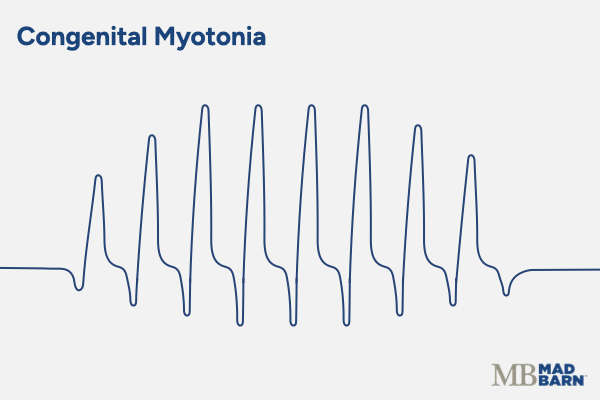 Diagram:
 In some cases, muscle biopsy may be used to rule out conditions such as myotonia dystrophica, which involves structural muscle changes not seen in congenital myotonia. [3][6]
In certain breeds, such as New Forest Ponies, genetic testing is available to identify affected horses and carriers. Similar testing approaches are well established in humans and other species, although availability in horses remains limited. [7]
Differential Diagnosis
Several conditions can cause stiffness or abnormal muscle function in horses and should be considered when evaluating suspected congenital myotonia: [16]
- Polysaccharide Storage Myopathy (PSSM): Causes stiffness and reluctance to move, often with muscle pain and tying-up episodes rather than delayed relaxation.
- Hyperkalemic Periodic Paralysis (HYPP): A genetic disorder causing intermittent muscle stiffness, tremors, and weakness, typically in episodes rather than consistently.
- Stiff Horse Syndrome: Leads to persistent muscle rigidity and spasms that do not improve with movement.
- Myotonia dystrophica: A progressive condition involving both stiffness and muscle degeneration, often with additional systemic abnormalities.
- Recurrent Exertional Rhabdomyolysis (RER): Causes muscle stiffness during or after exercise, usually accompanied by pain, sweating, and reluctance to move.
- Tetanus: Causes severe, generalized muscle stiffness with a rapid onset and characteristic signs such as a rigid stance and sensitivity to stimuli.

Treatment
There is no cure for congenital myotonia, so management focuses on supporting movement and minimizing stiffness. In more severe cases, veterinary-guided treatment may be considered, but most horses can be managed successfully through consistent routine and handling.
Regular exercise is one of the most effective strategies, as horses typically move more comfortably once active. Gradual warm-ups are especially important, and long periods of inactivity should be avoided.
Turnout is generally beneficial, allowing for continuous low-level movement throughout the day. Horses may require extra time to start moving, and sudden or forced movement after rest should be minimized. [14]
Nutrition Considerations
Although congenital myotonia is not caused by diet, proper nutrition is still important for supporting muscle function and overall health.
A balanced diet that meets energy, protein, vitamin, and mineral requirements is essential. Nutrients involved in normal muscle and nerve function, including vitamin E and selenium, as well as minerals such as magnesium, should be supplied in appropriate amounts.
Feeding a comprehensive vitamin and mineral supplement, such as Mad Barn’s Omneity® Pellets, can help ensure baseline nutritional requirements are met without adding excess calories.

Electrolyte balance is also important for normal muscle function. Adding 2 tablespoons of loose salt to the horse’s daily ration helps meet sodium requirements and encourage adequate water intake.
For horses in work or in hot conditions, additional electrolyte support such as Mad Barn’s Performance XL Electrolytes can help maintain fluid balance and support normal muscle function.

Prognosis
Prognosis for horses with congenital myotonia is variable and can be difficult to predict because the condition is rare and only a limited number of cases have been described.
Congenital myotonia is generally considered stable and non-progressive, meaning the condition does not usually worsen over time. However, affected horses can still have persistent stiffness that interferes with comfort, mobility, and athletic function. In some horses, the stiffness is mild enough that they can be used for light riding or companionship, while in others it is severe enough to limit or prevent regular work. [14]
Management focuses on maintaining comfort and mobility through consistent exercise, predictable handling, and appropriate daily care. Some horses improve with regular movement, while others remain significantly affected despite management.
Overall, the prognosis is guarded because long-term function depends on the severity of clinical signs in the individual horse.
Here are some frequently asked questions about congenital myotonia in horses:
Congenital myotonia is not typically associated with muscle damage or significant pain. However, affected horses may experience stiffness and difficulty relaxing their muscles, which can impact comfort and ease of movement, especially when first starting to move.
Common signs of congenital myotonia in horses include muscle stiffness, delayed relaxation after movement, a stiff or "locked" gait, and difficulty initiating movement. Signs are often most noticeable after rest and may improve as the horse continues to move.
There is no cure for equine congenital myotonia. Management focuses on reducing stiffness through consistent exercise, regular turnout, and maintaining a predictable routine to support normal muscle function.
No congenital myotonia and tying-up are separate conditions. Tying-up (exertional rhabdomyolysis) involves muscle damage, pain, and elevated muscle enzymes, while congenital myotonia is a genetic condition that affects muscle relaxation without causing ongoing muscle damage.
Some horses with congenital myotonia can perform light to moderate work, particularly with proper warm-up and consistent management. Determining an appropriate workload depends on the severity of the condition and the individual horse.
Congenital myotonia is believed to be a genetic condition, although the exact mutation in horses are not fully defined. The condition follows an autosomal recessive pattern, meaning a horse must receive one copy of the gene from both parents to be affected. Horses with one copy of the gene do not have symptoms, but are carriers who can pass the condition to their offspring. Given this, affected horses should not be used for breeding, and breeders should use genetic testing to identify carriers before making breeding decisions.
Diagnosis of congential myotonia is typically based on clinical signs and veterinary evaluation. In some cases, additional testing such as electromyography or muscle biopsy may be used to confirm the condition and rule out other neuromuscular disorders.
Congenital myotonia is generally a stable condition rather than a progressive disease. Signs may remain consistent over time, although management practices can influence how noticeable the stiffness is in daily use.
Stiffness is often most noticeable after periods of rest or inactivity. Cold weather, inconsistent exercise routines, or sudden changes in activity level may also make symptoms more apparent.
Management typically includes regular exercise, consistent daily routines, adequate warm-up before work, and minimizing long periods of confinement. These strategies help reduce stiffness and support more comfortable movement.
Summary
Congenital myotonia is a rare, inherited neuromuscular disorder that causes delayed muscle relaxation and stiffness in horses
- Affected horses are typically stiff after rest but move more freely after a short period of activity
- Signs are usually present early in life and remain stable rather than progressively worsening
- Diagnosis is based on clinical signs and may be confirmed with electromyography (EMG)
- There is no cure, but consistent exercise, turnout, and routine management can help reduce stiffness
- Proper nutrition and electrolyte balance support muscle function, while affected horses should not be used for breeding
References
- Steinberg. S. and Botelho. S. Myotonia in a Horse. Science. American Association for the Advancement of Science. 1962. View Summary
- Wohlfart. G. Dystrophia Myotonica and Myotonia Congenita; Histopathologic Studies with Special Reference to Changes in the Muscles. Journal of Neuropathology and Experimental Neurology. 1951.
- Valberg. S. J. Myotonic Disorders in Horses - Musculoskeletal System. Merck Veterinary Manual.
- Hegyeli. A. Progressive Muskeldystrophie Myotonie · Myasthenie. Springer. 1966.
- Clark. S. L. et al. A FORM OF CONGENITAL MYOTONIA IN GOATS. The Journal of Nervous and Mental Disease. 1939.
- Ludvikova. E. et al. Histopathological Features in Subsequent Muscle Biopsies in a Warmblood Mare with Myotonic Dystrophy. Veterinary Quarterly. Taylor & Francis. 2012.
- Gershony. L. New Test Available: Congenital Myotonia (CM) in the New Forest Pony. UCL Davis Veterinary Genetics Laboratory. 2024.
- Wijnberg. I. D. et al. A Missense Mutation in the Skeletal Muscle Chloride Channel 1 (CLCN1) as Candidate Causal Mutation for Congenital Myotonia in a New Forest Pony. Neuromuscular disorders: NMD. 2012. View Summary
- Forouzanfar. E. S. et al. Myotonia Congenita. StatPearls. 2026.
- Dorotea. T. et al. Congenital Pseudo-Myotonia in Chianina and Romagnola Cattle and Congenital Myotonia in a New Forest Pony: Genetic Homologs of Human Muscular Diseases. European Journal of Translational Myology/Basic Applied Myology. 2013.
- Aleman. M. Disorders of Muscle Mass and Tone. Veterinary Clinics: Equine Practice. 2025. View Summary
- Borges. A. S. et al. Clinical and Molecular Study of a New Form of Hereditary Myotonia in Murrah Water Buffalo. Neuromuscular Disorders. 2013.
- Brown. G. L. and Harvey. A. M. CONGENITAL MYOTONIA IN THE GOAT. Oxford Academic. 1939.
- Jamison. J. M. et al. A Congenital Form of Myotonia with Dystrophic Changes in a Quarterhorse. Equine Veterinary Journal. 1987. View Summary
- Quitt. P. R. et al. Myotonia Congenita in a Labrador Retriever with Truncated CLCN1. Neuromuscular Disorders. 2018.
- Manning. L. K. et al. Myotonia Congenita in Australian Merino Sheep with a Missense Variant in CLCN1. Animals. 2024.