English



Equine Protozoal Myeloencephalitis (EPM) is an infectious disease of the horse’s central nervous system.
It is one of the most difficult diseases for veterinarians to diagnose because it often mimics other conditions and has a wide range of symptoms that affect multiple parts of the horse’s body.
Horses affected by EPM may show a lack of coordination in their movements, usually worse on one side of the body. Affected horses may also exhibit lameness, muscle loss, weakness, or drooping facial features.
EPM was first recognized in 1964 by a veterinarian in Kentucky. In the 1970s, researchers identified that a protozoa were the cause of EPM. Since that time, research has been ongoing to better understand this often-devastating neurological illness.
Researchers have found that EPM tends to occur sporadically, seldom involving more than one horse at a farm. [5] There are several FDA-approved treatments available that are effective if administered early.
This disease should never be taken lightly as it can be life-threatening. If you suspect that your horse has EPM, it’s important to have him examined by a veterinarian immediately.
Causes of EPM in Horses
Equine Protozoal Myeloencephalitis is caused by an infectious protozoa (a type of single celled organism). It is most commonly caused by Sarcocystis neurona and – more rarely – Neospora hughesi.
Both of these protozoa are carried by opossums. These animals pick up the protozoa by feeding on cat, raccoon, skunk, or armadillo carcasses, all of which act as intermediate hosts.
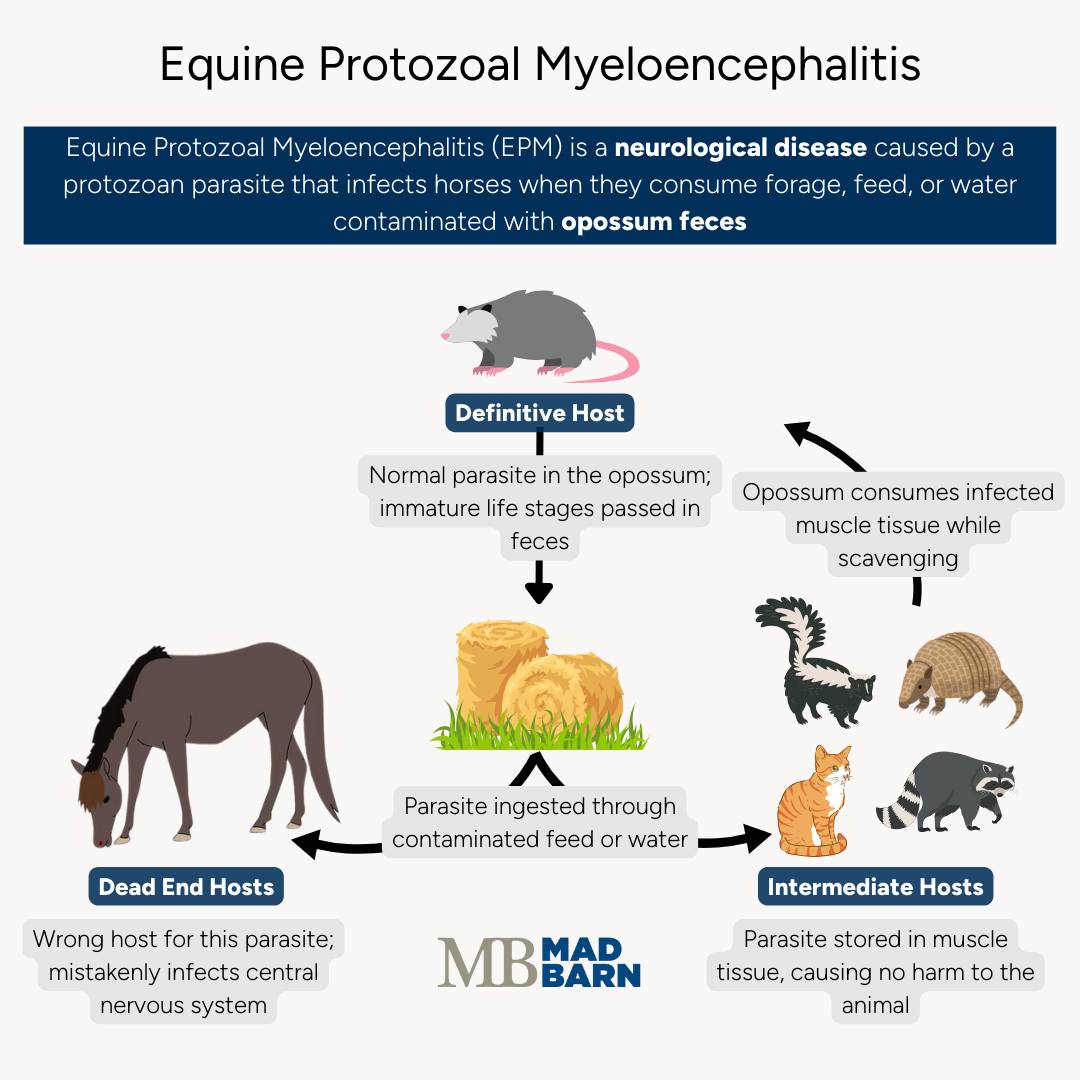
The protozoa are transmitted to horses when they consume forage, feed, or water that is contaminated by opossum feces containing the infective sporocysts.
Researchers aren’t quite sure how the protozoa gets into the horse’s central nervous system (CNS), but they suspect it enters the bloodstream and then crosses the blood-brain barrier to infect the brain and spinal cord. [9]
Once these sporocysts enter the CNS, they begin to attack the nervous system, causing one or several of many possible symptoms.
Risk Factors
Horses in certain geographic locations – such as the eastern U.S. – are more likely to develop Equine Protozoal Myeloencephalitis.
Most EPM cases occur in the following states:
- Kentucky
- Michigan
- Missouri
- New Jersey
- New York
- Ohio
- Pennsylvania
- Tennessee
These areas are at greater risk because they have higher opossum populations and protozoa are better able to survive in the environment. [2][6]
Younger horses are also at higher risk of this condition and male horses are twice as likely to develop EPM compared to female horses.
Researchers have also found a higher incidence of EPM among certain breeds including standardbreds, Tennessee Walking Horses, Thoroughbreds, Warmbloods, and stallions. Quarter horses, other breeds, ponies, and drafts seem to have a lower incidence rate. [9]
Prevalence
It is estimated that as many as 50% of horses have been exposed to the sporocysts that cause EPM. However, only a very small percentage actually develop the clinical disease.
According to one study, only 14 in 10,000 horses will develop EPM symptoms. [1]
Why do some horses exposed to sporocysts develop EPM while others do not? Researchers believe this has to do with immune function. Horses with weakened immune systems are at a higher risk of this condition.
There is also a strong association between stressful events (such as heavy exercise, transport, injury, surgery, or parturition) and EPM. Stress can suppress immune function and increase EPM risk.
Studies also show that race and show horses have a higher risk of EPM compared to breeding and pleasure horses. [5] This may be explained by the increased stress that equine athletes experience.
What's your top priority with your horse's health?

Enter your email to receive your store credit
Signs of EPM in Horses
Most horses with suspected EPM appear normal, bright, and alert; although some are thin and mildly depressed.
Neurological examination can reveal a variety of clinical signs, affecting nearly any part of the horse’s body and ranging from mild to severe.
The following are a list of possible symptoms affecting the horse’s head:
- Droopy lip
- Facial twitch
- Dropping feed
- Facial paralysis
- Trouble swallowing
- Head tilt
- Drooping ear
Symptoms that can affect the rest of the body include:
- Uncoordinated movement (ataxia) of the rear feet, worse on one side
- Stiff, stilted movements
- Lameness that comes and goes, often switching sides
- Changes in gait
- Lethargy
- Hind-end weakness
- Problems balancing when a hoof is lifted
- Circling, slipping, or falling while walking
- Muscle atrophy, often over the rump or shoulders
- Leaning on a stall wall for balance
- Dragging a hoof, especially while turning
- Sore back
- Seizures or collapsing
- Unusual sweating patterns
- Carrying the tail to one side, or away from the body
Affected horses may have a gradual progression in severity of symptoms. They may rapidly decline, or they may stabilize, only to relapse days or weeks later. [5]
Diagnosing EPM
A definitive diagnosis of EPM can only be made through postmortem detection of S. neurona or N. hughesi infection in the central nervous system.
Your veterinarian may make a suspected diagnosis using the following parameters:
- The presence of neurologic signs compatible with EPM
- Ruling out other neurologic disorders
- Detection of specific antibodies to either S. neurona or N. hughesi in serum and cerebrospinal fluid (CSF)
Clinical signs can vary from acute to chronic and may involve the brain, brainstem, or spinal cord. A comprehensive neurological examination is often the first step in diagnosing any horse. [1]
Additionally, a positive therapeutic response to the medications diclazuril or toltrazuril sulfone is very strong evidence in support of a diagnosis of EPM.
Your veterinarian will also need to rule out other diseases and conditions with similar symptoms to EPM, including:
- Wobblers
- Rabies
- Eastern or Western Equine Encephalitis
- Equine Herpes Virus 1
- Lyme Disease
- West Nile Virus
- Cushing’s disease
- Selenium deficiency or toxicity
- Other lameness issues
EPM Treatment
If EPM is suspected, treatment should be started right away to improve the chance of recovery. If left untreated, EPM can result in permanent damage to the central nervous system and possibly death.
There are currently three FDA-approved conventional treatments for EPM. They include:
- Ponzauril (marketed as Marquis) administered once daily for 28 days
- Diclazuril (marketed as Protazil), a pelleted, alfalfa-based top-dressing fed for 28 days
- Sulfadiazine and pyrimethamine (marketed as Re-Balance), an oral suspension administered once daily for as long as 120 days
According to one study which surveyed veterinarians treating EPM in horses, the most commonly used drug is ponazuril. [10]
These medications work by limiting the reproduction of the protozoa or killing them outright. All three of the above treatments have shown similar clinical improvement rates in studies, ranging from 57-62%.
However, none of the three above drugs will kill 100% of the protozoa. Instead, they reduce the numbers so the horse’s immune system can hopefully take care of the rest.
There is also a non-FDA approved combination of decoquinate and levamisole, marketed as Orogin, that some veterinarians may recommend. [1]
Dosage Regimen
The duration of treatment is often difficult to determine. Therefore, horses should be re-evaluated after one month of treatment.
If improvement is seen but clinical signs remain, another month of treatment is recommended. However, if the horse appears clinically normal, treatment can be discontinued. [6]
Veterinarians may recommend starting severely affected horses with a loading dose of the drug at up to seven times the recommended amount before beginning the normal drug regimen.
Consult with your veterinarian to determine the appropriate treatment plan and dosage regimen for your horse.
Side Effects
It should be noted that some EPM drugs may cause anemia, so your veterinarian will need to periodically check for that during treatment. Also watch horses for other side effects, including acute diarrhea. [7]
Re-Balance (Sulfadiazine and pyrimethamine) carries a higher potential for adverse reactions, including anorexia, intestinal disturbances, urticaria (hives), and bone marrow suppression. [1]
Risk of Relapse
One concern with EPM is a relapse of symptoms. It is estimated that 10% of horses successfully treated with one of the above FDA-approved treatments will relapse within 1-3 years after discontinuation of treatment.
The reasons for relapse are unknown, but may be linked to failure to achieve therapeutic concentrations of treatment drugs, which could result from poor blood-brain-barrier penetration, or poor immune function. [1]
Additional Therapies
Because EPM is an inflammatory disease, the use of anti-inflammatory medications can also be helpful. Flunixin meglumine (banamine) is commonly given to moderately or severely affected horses during the first 3-7 days of therapy.
If the horse is showing severe signs and is in danger of becoming recumbent, corticosteroid therapy may also be prescribed.
Other treatments may include oral or intravenous DMSO and vitamin E supplementation to help heal nerve tissue. [7]
What's your top priority with your horse's health?
Alternative Treatments
Several alternative treatments may be helpful in improving immune function for horses with EPM.
In most cases, alternative treatments do not have research available to evaluate their therapeutic use. The use of these treatments is based on anecdotal reports of efficacy and historical practice.
These therapies can be used in conjunction with the FDA approved drugs, if desired. Some of these alternative treatments include:
- Chinese herbal supplements
- Acupuncture
- Autogenous vaccination (injecting horse with his own blood at specific acu-points)
Most of the above alternative treatments can be performed or prescribed by holistic or Traditional Chinese Veterinary Medicine (TCVM) veterinarians.
Immune Support
It is important to support your horse’s immune function, both during and after treatment for EPM. This will help to limit clinical severity and reduce the risk of relapse.
The best way to support the equine immune system is to feed a natural diet of primarily grass forage (fed at 2-3% of the horse’s body weight).
Eliminate grains and processed feeds as much as possible. These types of feed can promote inflammation and cause metabolic issues.
You can also provide immune support for your horse in the following ways:
- Ensure that you feed a balanced vitamin and mineral supplement that provides antioxidant support (vitamin E, selenium, vitamin C)
- Feed herbs such as Astragalus, Siberian Ginseng, Feverfew, Nettle, Yarrow, Cleavers, Dandelion Leaf, Calendula, Boneset, or Pau d’arco
- Provide regular acupuncture and/or massage sessions
- Limit the unnecessary use of chemical dewormers and antibiotics
- Reducing your horse’s stress level (allowing horse to live with other horses, limit hauling, reduce intense exercise, etc.)

Prevention
It is not always possible to prevent your horse from developing Equine Protozoal Myeloencephalitis, but you can take measures to reduce the risk at your farm.
The most important step is to support your horse’s general health and well-being by feeding a balanced, forage-based diet and reducing stress.
It is also important to minimize exposure to opossum fecal matter. Some of the following tips can help reduce the risk of exposure:
- Avoid feeding horses on the ground
- Implement safe storage of concentrated feeds (using rodent proof containers)
- Provide sources of fresh water
- Use wood products such as shavings, chips, or sawdust for stall bedding as opposed to straw or corn stalks to deter opossums from entering the barn [6]
Finally, intermittent use of anti-protozoal agents may help to prevent EPM. Using these medications may reduce symptoms and decrease antibody response. [1]
Talk to your veterinarian if you live in an area with opossums and if your horse has other risk factors for contracting this disease.
Frequently Asked Questions
Here are some frequently asked questions about Equine Protozoal Myeloencephalitis (EPM) in horses:
EPM in horses is an infectious disease that affects the central nervous system. A protozoal parasite, most commonly Sarcocystis neurona and less often Neospora hughesi, can damage the brain and spinal cord after a horse consumes contaminated feed, forage, or water. Similar signs can occur with other neurological problems, so a veterinarian often needs to evaluate the whole picture.
Signs that can indicate your horse has EPM often involve neurological changes that can look uneven from side to side. A horse may show coordination problems that look worse on one side, along with weakness, difficulty balancing, lameness that comes and goes, or muscle loss over the rump or shoulders. Facial changes such as a droopy lip, head tilt, or trouble swallowing can also appear, and the pattern can shift over time with periods of decline, stabilization, or relapse.
Triggers or factors that can lead to EPM in your horse start with exposure to parasites shed in opossum feces. Infection can occur when a horse consumes feed, forage, or water contaminated by opossum fecal material that contains infective sporocysts. Risk is higher in certain geographic areas with larger opossum populations, and added risk is associated with young age, male horses, certain breeds, and stressful events that can suppress immune function.
Factors that might complicate treatment for EPM include delayed therapy, since early treatment improves the chance of recovery and permanent nervous system damage becomes more likely over time. Medication monitoring can also complicate the process, since some drugs may contribute to anemia or digestive upset and may require periodic checks. Treatment length can be difficult to determine and may need re-evaluation and additional time if signs remain. Relapse can complicate recovery as well, since some horses show returning symptoms months or years after treatment ends.
Summary
Equine Protozoal Myeloencephalitis (EPM) is a complex neurological disease in horses caused by protozoa transmitted through opossum feces, leading to a wide range of symptoms that can mimic other conditions.
- Risk factors for EPM in horses include living in the eastern U.S., younger age, male sex, high stress, and certain breeds such as Standardbreds, Thoroughbreds, Warmbloods, and Tennessee Walkers
- Clinical signs vary widely and may include ataxia, lameness, muscle atrophy, hind-end weakness, facial paralysis, and shifting or relapsing symptoms
- Diagnosis is challenging, relying on neurological exams, antibody testing, and ruling out other diseases, with definitive confirmation only possible postmortem
- Treatment with FDA-approved drugs (ponazuril, diclazuril, or sulfadiazine/pyrimethamine) can improve outcomes, but relapse is possible; prevention focuses on minimizing opossum exposure, reducing stress, and supporting immune health
References
- Pusterla, N. and Thomas, T. Therapeutics for Equine Protozoal Myeloencephalitis. Vet Clin North Am Equine Pract. 2017. View Summary
- Morley, P.S. et al. Risk Factors for Owner-Reported Occurrence of Equine Protozoal Myeloencephalitis in the US Equine Population. J Vet Intern Med. 2008. View Summary
- Mittelman, M.S. et al. Utility of C-reactive protein and serum amyloid A in the diagnosis of equine protozoal myeloencephalitis. J Vet Intern Med. 2018. View Summary
- Schale, S. et al. Protozoal coinfection in horses with equine protozoal myeloencephalitis in the eastern United States. J Vet Intern Med. 2018. View Summary
- MacKay, R.J., et al. Equine Protozoal Myeloencephalitis. Vet Clin North Am Equine Pract. 2000.
- Dubey, J.P. et al. An update on Sarcocystis neurona infections in animals and equine protozoal myeloencephalitis (EPM). Vet Parasitol. 2015. View Summary
- EPM: Understanding this Debilitating Disease. AAEP. 2018.
- Colahan, P. et al. Effect of Sulfadiazine and Pyrimethamine on Selected Physiologic and Performance Parameters in Athletically Conditioned Thoroughbred Horses During an Incremental Exercise Stress Test. Vet There. 2002. View Summary
- Church, S. Update: EPM in Horses. The Horse.
- Church, S. Current EPM Rates Show Better Diagnostic, Treatment Options. The Horse. 2018.