English







Trimethoprim sulfadiazine, brand name Equisul-SDT®, is a combination antibiotic widely used in equine medicine for the treatment of bacterial infections.
This medication combines two antimicrobial drugs that work together to stop bacteria from growing and multiplying, making it effective against a broad range of pathogens that affect horses.
Veterinarians commonly prescribe trimethoprim sulfadiazine to treat infections involving the respiratory tract, skin and wounds, urinary tract, and other bacterial diseases. The drug is typically administered orally as tablets or powder mixed with feed, which allows for convenient treatment outside of a hospital setting.
Like all antibiotics, trimethoprim sulfadiazine should only be used under veterinary guidance to ensure appropriate dosing, treatment duration, and monitoring for potential side effects. This guide explains how the medication works, what conditions it is used to treat, how it is administered, and important safety considerations for horse owners and caretakers.
Trimethoprim Sulfadiazine for Horses
Bacterial infections are a common health concern in horses and can affect many different body systems, including the respiratory tract, skin, urinary tract, and soft tissues. When these infections occur, prompt and appropriate antibiotic treatment is often necessary to prevent complications and support recovery.
One of the most widely used oral antibiotics in equine medicine is trimethoprim sulfadiazine (TMS), a combination medication that provides broad-spectrum activity against many common bacterial pathogens affecting horses.
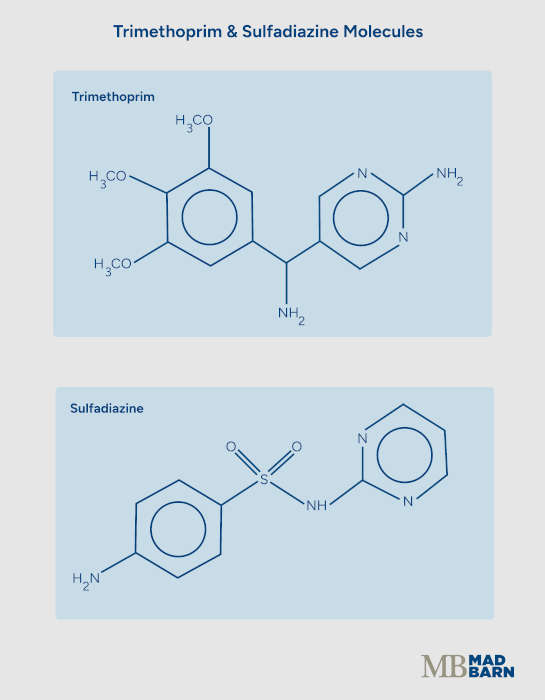
Trimethoprim sulfadiazine combines two antimicrobial drugs that work together to inhibit bacterial growth. [1]
Trimethoprim sulfadiazine comes in oral formulations that are easy for owners to administer on their own. This drug is a combination of two antibiotics: trimethoprim and sulfadiazine. Combining these medications improves their efficacy and allows them to target a broader range of bacterial species. [1]
Available Forms
TMS is available in oral suspension (liquid), oral powder, oral paste and injectable (intravenous) forms for horses.
Brand names include: [2]
- Equisul-SDT®
- Di-Trim®
- Tribrissen®
- Tucoprim®
- Uniprim®
What's your top priority with your horse's health?

Enter your email to receive your store credit
Drug Class: Potentiated Sulfonamides
Potentiated sulfonamides are a combination of a sulfonamide and a diaminopyrimidine. [1][3] Sulfonamides on their own are bacteriostatic, meaning they prevent replication of bacteria but do not kill the microbes directly.
By combining them with a diaminopyrimidine antibiotic, they can become bactericidal and directly kill target bacteria. [1]
There are several potentiated sulfonamides available in veterinary medicine, however trimethoprim sulfadiazine is the only one approved by the Food and Drug Administration and Health Canada for use in horses. [1]
Other combinations available for use in other species include: [3]
- Trimethoprim-sulfamethoxazole
- Trimethoprim-sulfadoxine
- Ormetoprim-sulfadimethoxine
Mechanism of Action
Potentiated sulfonamides are a combination of two antibiotics that block the folic acid synthesis pathway in bacteria. [3] Bacteria rely on this pathway to make proteins, carry out metabolism, and reproduce.
Sulfonamides closely resemble para-aminobenzoic acid (PABA), a substance bacteria normally use to produce dihydrofolic acid (DFA). DFA is an important precursor needed to make folic acid. [3]
Because sulfonamides have a similar structure to PABA, they can bind to the enzyme dihydropteroate synthetase (DPS), which normally converts PABA into DFA. When sulfonamides bind to this enzyme, they block the normal reaction. As a result, little DFA is produced, making it difficult for the bacteria to reproduce. [3]
On their own, sulfonamides typically have a bacteriostatic effect, meaning they stop bacterial growth but do not kill the bacteria outright. Diaminopyrimidines such as trimethoprim act on a later step in the same pathway by inhibiting the enzyme dihydrofolate reductase. This enzyme converts DFA into folic acid. [1]
When sulfonamides and trimethoprim are used together, they block two steps in folic acid production. Without folic acid, bacteria cannot replicate or carry out essential metabolic functions.
Because the pathway is blocked at multiple points, the combination produces a bactericidal effect, meaning it can kill bacteria rather than simply stopping their growth.
TMS Uses in Horses
TMS is approved for treating several conditions in horses, including: [1]
- Strangles
- Respiratory tract infections, including infections caused by Streptococcus equi zooepidemicus
- Urogenital infections
- Wound infections
- Abscesses
Antibiotic Spectrum
Potentiated sulfonamides have a broad spectrum of activity, meaning they can target many different bacterial species. [1]
Veterinarians typically use potentiated sulfonamides when they suspect infections caused by: [1]
- Streptococcus species
- Staphylococcus species
- Nocardia
- Enteric gram-negative bacteria like E. coli and Salmonella
Some bacterial species are resistant to potentiated sulfonamides. Additionally, some strains of bacteria can mutate and develop TMS resistance. Usually these mutations change the bacteria’s reliance on the enzymes that TMS targets, allowing them to use alternative pathways to produce folic acid. [3]
Some infections can also be resistant to TMS treatment, as inflammatory debris and pus releases PABA. [3]
If there is abundant PABA available for the bacteria to bind to, the chances of the enzyme DPS binding to PABA instead of the sulfonamide increases. This can result in production of sufficient folic acid for the bacteria to replicate and survive. [3]
Off-Label Use
Veterinarians can use TMS to treat many types of infections beyond what is listed by the manufacturer, which is considered off-label use. Off-label means the veterinarian is prescribing the drug for a purpose other than what is specifically mentioned on the label.
Veterinarians may also prescribe TMS empirically (based on logic rather than diagnostic testing) while they wait for bacterial culture and antibiotic sensitivity results from a diagnostic laboratory.
Off-label use is a valid practice performed at the veterinarian’s discretion if they suspect an infection is caused by a bacteria species that is susceptible to this antibiotic.
Administration Routes
The oral formulation of TMS is most commonly used in horses, although there are intravenous formulations available. [1]
Horses receiving TMS should have access to drinking water at all times, as the drug is primarily excreted in the urine. [3]
Dosage
The dosing guideline for oral ranges depending on the formulation. Powdered formulations are typically given at a rate of 75 mg per kg body weight, while liquid Equisul-SDT® is usually prescribed at a rate of 24 mg/kg. [1] The frequency of dosing also ranges from once to twice daily and must be determined by the treating veterinarian.
When using the oral formulation, shake the medication bottle before drawing up the horse’s dose. Ideally, give the medication on an empty stomach in a small amount of feed. [1]
Storage
Keep TMS at room temperature in a tightly sealed container. If using a liquid formulation, shake the suspension before use. Protect the medication from freezing. [1]
Safety Warnings & Precautions
TMS is a widely used drug that is considered safe when administered under the guidance of a veterinarian. Follow your veterinarian’s instructions for dose and administration closely.
The injectable formulation of TMS is for intravenous (IV) administration only and should never be injected into the muscle. [1] When administering TMS intravenously, there is a risk of tissue irritation and swelling if extravasation (injection outside of the vessel) occurs. [1]
Monitoring
Horses are highly sensitive to oral antibiotics due to the rich microbial population in their hindgut. A major concern of TMS administration is antibiotic-associated hindgut dysbiosis. [1]
One study showed that loose feces is the most common side effect of TMS administration. [4] Most horses recover uneventfully after treatment stops.
However, in some horses, hindgut dysbiosis results in fatal dehydration due to diarrhea. [1] Owners should monitor horses on TMS closely for any signs of diarrhea or changes in fecal consistency. [1] If changes are observed, contact your veterinarian immediately.
Horse owners should also monitor the horse’s water intake and urine output if possible. [3] Sulfadiazines can form urine crystals in dehydrated animals that may result in obstructions in rare cases. [1] Ensure horses have constant access to water and notify your veterinarian if their water intake or urine output changes.
Contraindications
Contraindications refer to circumstances where a drug is to be avoided or only used with caution.
TMS should not be used in animals with any of the following pre-existing conditions: [1]
- Liver damage
- Kidney damage
- Blood disorders
- A history of sulfonamide or trimethoprim sensitivity
TMS cannot be used in horses intended for food. [1]
Trimethoprim and sulfonamides both cross the placenta to the developing fetus. The effect of TMS on fetal development is unknown in horses. [1] In other species, like rats, rabbits, and humans, TMS may cause teratogenesis (improper development of the fetus). [1] For this reason, TMS is avoided early in pregnancy, but it is used routinely late in pregnancy in cases of placentitis.
TMS also enters the milk in lactating animals. The effect of TMS on suckling foals is unknown, but it is routinely used to manage multiple illnesses in neonatal foals. [1]
Side Effects
Hypersensitivity (allergic) reactions are common with sulfa-based drugs in all species. In horses, these reactions typically present as severe itchiness that resolves within a few days. [1]
Some horses develop more severe reactions including: [1]
- Neurologic disorders, including incoordination and behavior changes
- Inflammation and tissue death of the vessels within the skin
- Anemia
- Thrombocytopenia (low blood platelets)
- Leukopenia (low white blood cells)
Acute Toxicity (Overdose)
Of the two drugs, sulfonamides have the highest risk of causing overdose and toxicosis. In contrast, up to 10 times the recommended dose of trimethoprim has been administered to animals with no effect. [3]
Overdose of sulfonamides can cause: [1]
- Diarrhea
- Neurologic abnormalities such as behavior changes
- Facial swelling
- Colic
- Elevated liver enzymes, indicative of liver damage
- High blood potassium, which can cause potentially fatal heart arrhythmias
- Low platelets, preventing the horse’s blood from clotting
Contact your veterinarian immediately if you suspect a TMS overdose. If a single, excessive dose of TMS was recently administered, your veterinarian can perform a gastrointestinal decontamination procedure to remove the excess dose before it is absorbed in the horse’s stomach. [1]
If clinical signs of toxicosis develop, they can provide supportive care until the horse’s body can flush the antibiotic on its own.

Drug Interactions
Trimethoprim and some sulfonamides can inhibit enzymes in the liver responsible for drug detoxification and processing. This means combining TMS with other drugs may affect the body’s ability to process either medication.
Drugs that may reduce metabolism of TMS, or vice versa, include: [1]
- Amiodarone
- Leucovorin
- Rifampin
- Tricyclic antidepressants
Combining TMS with other medications may worsen the side effects or adverse reactions caused by either TMS or the other drug. Example reactions include: [1]
- Angiotensin II receptor blockers like telmisartan
- Angiotensin-converting enzyme inhibitors like benazepril or enalapril
- Azathioprine
- Cyclosporine
- Metformin
- Methotrexate
- Other antibiotics
- Potassium supplements
- Pyrimethamine
- Spironolactone
- Thiazide diuretics
- Warfarin
Other potential interactions include: [1]
- Anesthetic agents like lidocaine: May inhibit the effect of sulfonamide
- Antacids: Administering orally alongside TMS may prevent sulfonamide absorption
- Detomidine: Concurrent use has caused fatal arrhythmias in horses
- Digoxin: TMS may increase digoxin concentrations in the body
- Methenamine: May form an insoluble precipitate in the urine when used with TMS
- Phenothiazines like acepromazine: Contraindicated based on the drug label
Regulatory Status & Legal Considerations
Trimethoprim sulfadiazine is available in FDA and Health Canada-approved formulations for horses not intended for food. [1]
Veterinarians can use TMS on-label for treating strangles, respiratory tract infections, urogenital infections, wound infections, and abscesses. [1]
For other types of infections, TMS may be used off-label if the veterinarian suspects an infection is susceptible to TMS.
Status in Competition
Antimicrobials are not listed as part of the Fédération Equestre Internationale (FEI) list of Prohibited Substances. [5]
However, some national federations governing horse sport have included antibiotics on their prohibited substance lists for animal welfare reasons. [6]
This helps ensure that horses with infections can rest appropriately and reduces the risk of an infected horse spreading disease at competitions. [6]
Always check with your competition governing authority before competing your horse while they are taking TMS.
Frequently Asked Questions
Here are some frequently asked questions about trimethoprim sulfadiazine for horses:
Trimethoprim sulfadiazine (TMS) is a commonly prescribed antibiotic used to treat bacterial infections in horses. Veterinarians may prescribe it for respiratory infections, wound infections, urinary tract infections, skin infections, and certain systemic bacterial diseases. They may prescribe it off-label if they suspect an infection is susceptible to TMS.
Trimethoprim and sulfadiazine work together to block two steps in bacterial folic acid metabolism. This dual action prevents bacteria from producing essential compounds needed for growth and replication, helping stop the infection from spreading.
Trimethoprim sulfadiazine is most commonly administered orally as tablets or powder mixed with feed. In some cases it may be provided as an oral liquid or intravenous injectable formulation. The exact dose and treatment schedule should always be determined by a veterinarian.
Some horses begin to show improvement within a few days of starting treatment, depending on the infection being treated. Even if clinical signs improve quickly, the full course of antibiotics should be completed as prescribed to help ensure the infection is fully resolved.
Treatment duration varies depending on the type and severity of infection. Some bacterial infections may require only a few days of therapy, while others may require treatment for several weeks. Your veterinarian will determine the appropriate treatment length.
Yes. This medication is often mixed with feed to make administration easier. However, some horses may refuse medicated feed because of the taste. If this occurs, a veterinarian may recommend alternative methods such as tablets administered directly or another formulation.
Most horses tolerate this medication well, but side effects can occur. Possible reactions include diarrhea, decreased appetite, or mild colic signs. Rarely, allergic reactions such as fever, hives, or swelling may occur. Contact a veterinarian if unusual symptoms develop during treatment.
Trimethoprim sulfadiazine may be used in foals when prescribed by a veterinarian. Foals can be more sensitive to dehydration and gastrointestinal disturbances, so careful dosing and veterinary supervision are important.
Yes. Trimethoprim sulfadiazine is a prescription antibiotic and should only be used under veterinary guidance. Proper diagnosis, dosing, and treatment duration are necessary to ensure effective therapy and responsible antibiotic use.
If a dose is missed, it is usually given as soon as possible unless it is close to the next scheduled dose. In that case, the missed dose may be skipped and the regular dosing schedule resumed. Do not double the next dose without veterinary guidance.
Summary
Trimethoprim sulfadiazine (TMS) is a commonly prescribed antibiotic combination used in horses to treat a wide range of bacterial infections.
- TMS is commonly prescribed for respiratory infections, skin infections, abscesses, and wound infections
- TMS works by blocking two steps in bacterial folic acid production, preventing bacteria from multiplying
- This medication is usually administered orally as tablets, powder, or paste mixed with feed
- Most horses tolerate the medication well, but mild digestive upset can occur in some cases
- This drug requires a veterinary prescription and should only be used as directed by a veterinarian
References
- Plumb. D. C. Plumb's Veterinary Drug Handbook: Desk. John Wiley & Sons. 2018.
- Sulfadiazine; Trimethoprim. PubChem.
- Mercer. M. Sulfonamides and Sulfonamide Combinations Use in Animals. Merck Veterinary Manual. 2022.
- Reinemeyer. C. et al. A Controlled Safety Study of Elevated Dosages of Trimethoprim Plus Sulfadiazine in Mature Horses. Journal of Equine Veterinary Science. 2014.
- 2026 Prohibited Substances List. FEI. 2026.
- Schenk. I. et al. Control of a Sulfadoxine/Trimethoprim Combination in the Competition Horse: Elimination, Metabolism and Detection Following an Intravenous Administration. Drug Testing and Analysis. 2023.