English
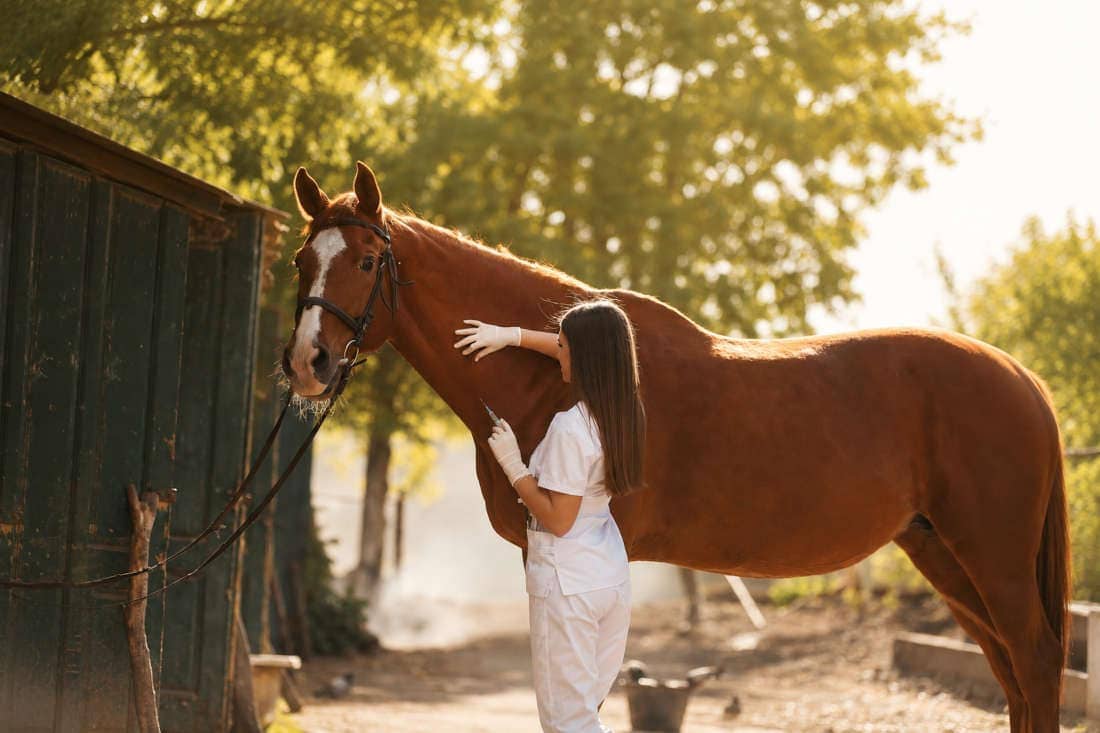
Learning how to give a horse an injection can help owners safely administer certain veterinarian-prescribed medications and vaccines at home. Proper training is essential, as the injection route, medication instructions, and handling technique all affect the safety of the procedure.
Intramuscular (IM) and subcutaneous (SQ) injections may be performed by owners under veterinary guidance, while intravenous (IV) injections require specialized instruction due to their greater risks.
Sterile equipment, accurate injection-site selection, and careful monitoring can reduce the risk of complications. Keep reading to learn about injection routes in horses, the supplies and preparation required, and the steps for administering IM and SQ injections safely.
Injectable Medication & Horse Care
Giving your horse an injection can seem intimidating at first, but it is a routine part of horse ownership for many people. Whether you are administering a veterinarian-prescribed medication or giving a vaccine, knowing how to prepare safely and confidently can make the experience less stressful for both you and your horse.
With proper training and guidance from your veterinarian, many intramuscular (IM) and subcutaneous (SQ) injections can be performed safely at home. However, administering an injection involves more than simply inserting a needle.
Choosing the correct injection route, using sterile equipment, handling medications properly, and recognizing potential complications are all essential to protecting your horse’s health.
Giving a medication by the wrong route or using poor injection technique can lead to serious problems, including injection-site infections, muscle damage, medication failure, or adverse reactions.
This guide explains the most common types of injections horse owners may encounter, including intramuscular and subcutaneous injections. You will learn which supplies you need, how to prepare and give an injection, and how to identify common injection sites.
Whether you are giving your first injection or refreshing your knowledge, understanding safe injection practices can help you care for your horse and recognize when to seek veterinary assistance.
What's your top priority with your horse's health?

What's your top priority with your horse's health?
Types of Injections
There are three main routes for administering injectable medications to horses:
- Intramuscular (IM): Into the muscle
- Subcutaneous (SQ): Under the skin
- Intravenous (IV): Into a blood vessel
Each route affects how the medication is absorbed and carries different handling and safety considerations.
Table 1. Horse injection routes at-a-glance
| Injection Route | Where It Is Given | Common Uses | Key Considerations |
|---|---|---|---|
| Intramuscular (IM) |
|
|
|
| Subcutaneous (SQ) |
|
|
|
| Intravenous (IV) |
|
|
|
Intramuscular
Intramuscular (IM) injections are given into a muscle. This route allows for slower medication absorption than intravenous administration because the medication must diffuse into the bloodstream before taking effect.
Intramuscular injections are the type most commonly given by horse owners. A veterinary team member can demonstrate the technique and observe you performing the procedure to help ensure that you can give the injection correctly.
The most common intramuscular injection site for horses is the musculature along the neck. Alternatively, IM injections may be given in the pectoral muscles or hamstrings. [1]
Medications commonly given by intramuscular injection include: [2]
- Vaccines
- Sedatives
- Antibiotics
- Anti-inflammatory medications
- Medications used to regulate reproductive hormones in mares
Subcutaneous
Subcutaneous injections deliver medication into the tissue immediately beneath the skin. Like intramuscular injections, they generally take longer to produce an effect than intravenous injections because the medication must diffuse into the bloodstream.
Most subcutaneous injections are given in the skin over the horse’s neck. In some cases, this route may be used at another location to deliver medication to a specific area, such as a local anesthetic used to numb a wound or biopsy site. [1]
Subcutaneous injections are uncommon in horses but may be used for certain medications, including sedatives and local anesthetics. [1][2] Always confirm the prescribed route before giving any injection.
Intravenous
Intravenous injections deliver medication directly into the bloodstream, allowing for rapid effects. This route is commonly used by veterinary professionals. The jugular vein in the horse’s neck is the most accessible blood vessel for intravenous injection. [1]
Medications delivered intravenously may include: [1]
- Antibiotics
- Sedatives and anesthetics
- Anti-inflammatory medications
- Hormones
- Cardiac medications
- Pain medications, including opioids
Horse owners must receive training from a veterinary team member before administering intravenous medications. This route requires specific instruction and approval because of the following risks:
- Accidental arterial injection, which can lead to seizures, collapse, or death
- Greater sterility concerns because the medication is injected into the bloodstream
- Greater difficulty accessing a blood vessel than other injection sites
- Hemorrhage or hematoma formation after injection
- Air embolism, in which air enters a blood vessel and may block blood flow
How to Give Intramuscular Injections
Giving an intramuscular injection may seem intimidating, but most owners can learn to do it confidently with training and practice.
Your veterinary team can guide you through the process, observe your technique, and ensure that you have the appropriate supplies.
Step 1: Gather Your Materials
Start by gathering the supplies needed for the injection: [1]
- Syringe
- Needle
- Medication
- Approved sharps container
Ensure that you have the correct medication for the correct horse. Confirm that the veterinarian’s instructions on the label specify intramuscular injection, sometimes abbreviated as “IM.” [1] Verify the prescribed dose and frequency, and review any other instructions your veterinarian provided.
Check the needle size. Most intramuscular injections for horses use an 18-, 20-, or 22-gauge needle that is 1 to 1.5 inches long. [1]
Step 2: Draw Up the Dose
Select a syringe that is appropriately sized for the volume you need to inject. Double-check the prescribed volume against the label. Open the needle by peeling the sterile package from the top. Avoid touching the needle to any surfaces, including your fingers.
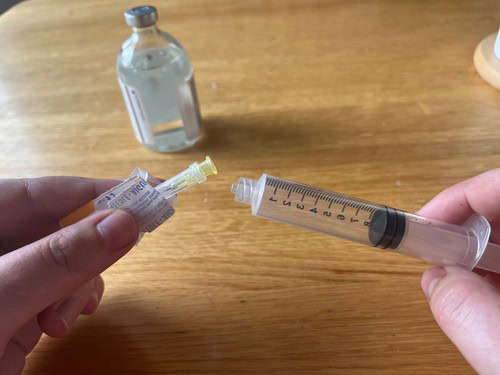
Attach the needle to the syringe. Most syringes have a “luer-lock” hub that attaches to the needle by twisting clockwise. Some styles have a “slip-click” fitting that attaches using pressure only. Your veterinary team can train you on assembling the syringes they have supplied for your horse’s medication.
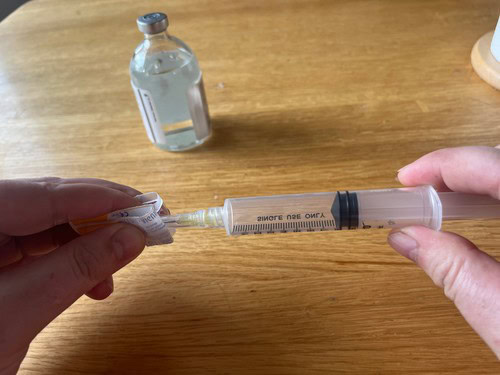
Depress the plunger all the way to clear as much air from the syringe as possible. Uncap the needle and insert it through the medication bottle’s rubber stopper.
To avoid needle sticks when uncapping, it’s best to hold the syringe parallel to your body and grip the cap with your thumb pointing in the direction you are pulling the cap towards. Remove the cap in one smooth, firm motion, avoiding recoil in both hands.
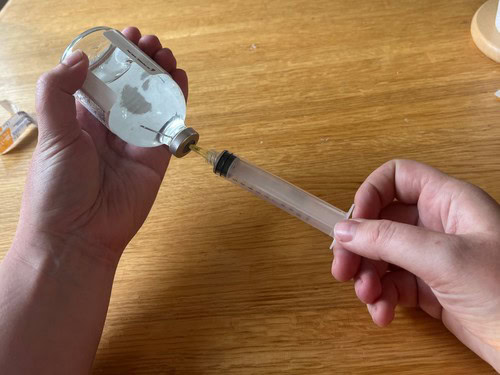
Draw up the required volume of medication by pulling the syringe plunger away from the vial. Hold the vial firmly and do not overfill the syringe.
Ideally, the dose should be less than half of the capacity of the syringe to avoid overfill and spillage. Work with your veterinarian to source appropriate syringe sizes for your horse’s medications.
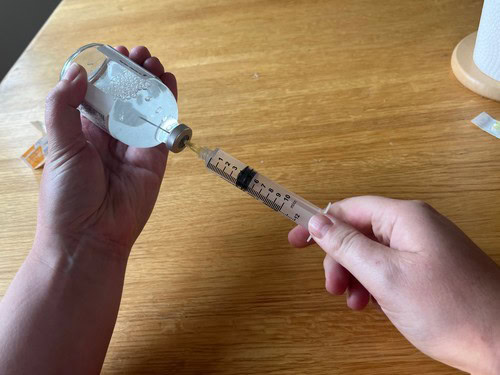
When reading a syringe, ensure that the top of the rubber stopper is aligned with the correct volume gradation on the syringe barrel. Depending on the type of syringe, the rubber stopper may have a sloping peak or flat bottom. Always use the top black line of the rubber stopper as your measurement reference point.
Hold the syringe perpendicular to the ground at eye level to read the dose. If you are unsure how to read the syringe size required for your horse’s dose, your veterinary team can place a dose marker on the syringe barrel for you.
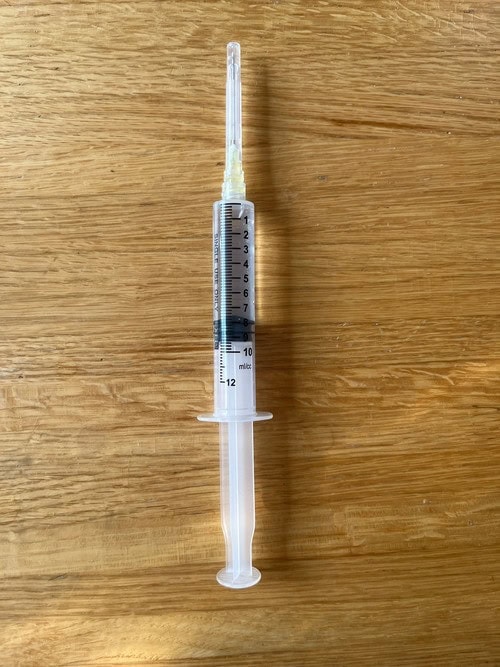
If you have over-drawn liquid into the syringe, do not dispense the excess back into the container. The contents of the container are sterile and must remain uncontaminated for safety. Put the excess liquid into another container and dispose.
In some cases, there may be small air bubbles in the syringe from the drawing up process. Hold the uncapped syringe perpendicular to the ground to allow the bubbles to float to the top of the syringe housing. Flick the syringe body gently to encourage the air bubbles to coalesce at the needle tip.
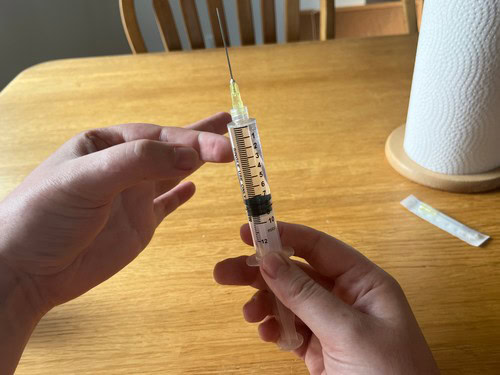
Apply gentle pressure to the syringe plunger to push the air bubbles out until liquid appears at the needle tip. Re-verify you have the appropriate amount of medication in the syringe.
To recap the needle, place the needle cap on a table or other flat surface. Insert the tip of the needle into the cap, then scoop the cap onto the needle in one smooth movement. This helps avoid accidental needle pokes from attempting to recap the needle using your hands.
Once the cap is loosely over top of the needle, use your non-dominant hand to click it into place and secure it.
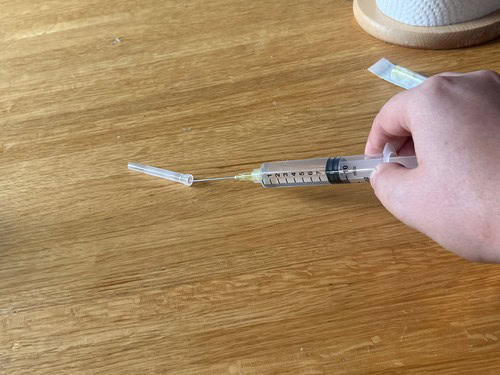
Before giving the injection, replace the needle with a new one. Passing the needle through the rubber stopper can dull it slightly, which may make the injection more painful for the horse. [1]
Do not reuse needles to draw up medication, give multiple injections to the same horse, or share needles between multiple horses. Any type of needle re-use compromises sterility, increases the risk of contaminating your medication bottle, and increases the risk of blood-borne pathogen transfer between animals.
Dispose of the used needle into a designated sharps container. You can get sharps containers from your local pharmacy or your veterinarian may provide you with one. Follow any directions on the sharps container for disposal once the container is full.
After replacing the needle, remove air bubbles again and re-verify the volume before dispensing the dose.
What to Do if You Stick Yourself
If you accidentally poke yourself with the needle, do not panic. Recap the needle safely and wash the affected area with soap and water. Contact your healthcare provider for further guidance.
Inform them of the type of medication you were administering so they can assess risk. Even a small amount of medication or vaccine can pose a health risk due to immune system reactivity to the injection. In addition, some horse medications are dangerous for humans. These risks underscore the importance of proper training, careful needle handling, and safe disposal of sharps and medication vials.
Many doctors are concerned about infectious disease transmission in cases of needlestick injuries. There are very few zoonotic (animal to human) diseases that spread from horses to humans. Potential diseases that could be transmitted via a needlestick include: [3]
- Rabies
- Anthrax
- Equine encephalitis viruses
- Leptospirosis
- Certain bacterial infections
While the risk of disease transmission from needle sticks during medication administration is low, safe sharps handling and disposal are fundamental to protecting human and animal health. Your physician can help assess the risk if you have stuck yourself with a used needle or syringe that contains equine medication.
Step 3: Identify the Landmarks
Intramuscular injections are usually given in the side of the neck. However, your veterinarian may recommend an alternative site, such as the pectoral muscles or hamstrings. Correctly identifying the injection area is critical. If needed, use bandage tape or a livestock paint marker to outline the appropriate area.
Neck
For a neck injection, identify the triangular area bordered by: [1]
- The cervical vertebrae along the lower neck
- The front edge of the shoulder blade
- The crest at the top of the neck
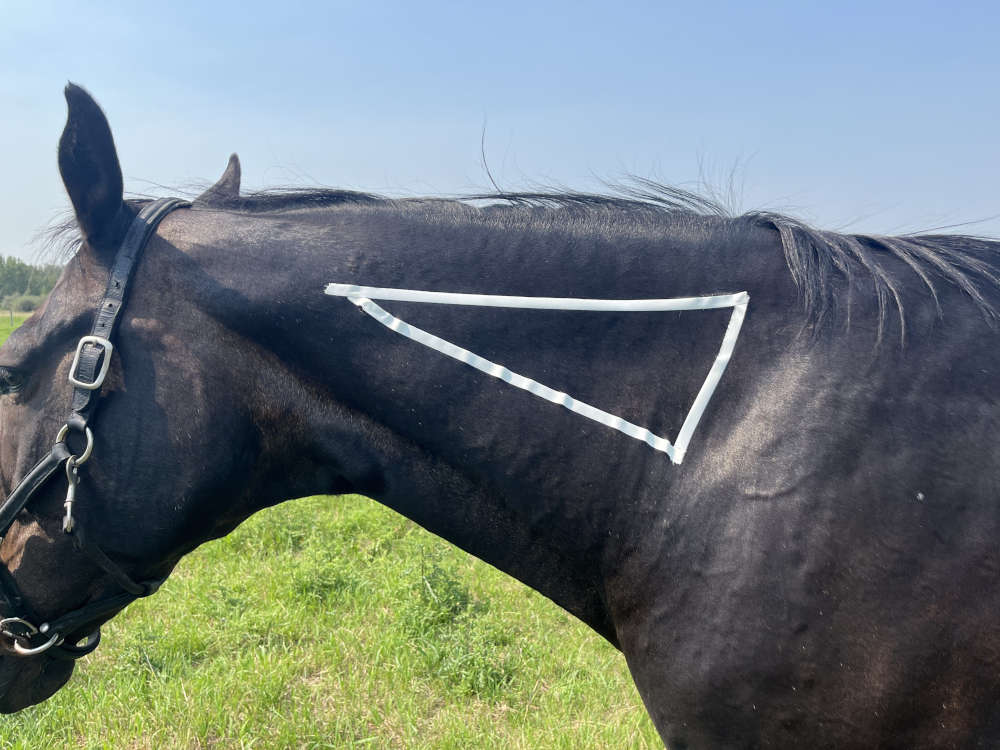
Palpate the bony borders of the shoulder blade and cervical vertebrae. The injection site must be at least four inches from these landmarks. [1]
Then palpate the top of the horse’s neck to locate the thick, rope-like nuchal ligament within the crest. The injection site must be at least four inches below this ligament. Any location within the resulting triangle is suitable for an intramuscular injection.
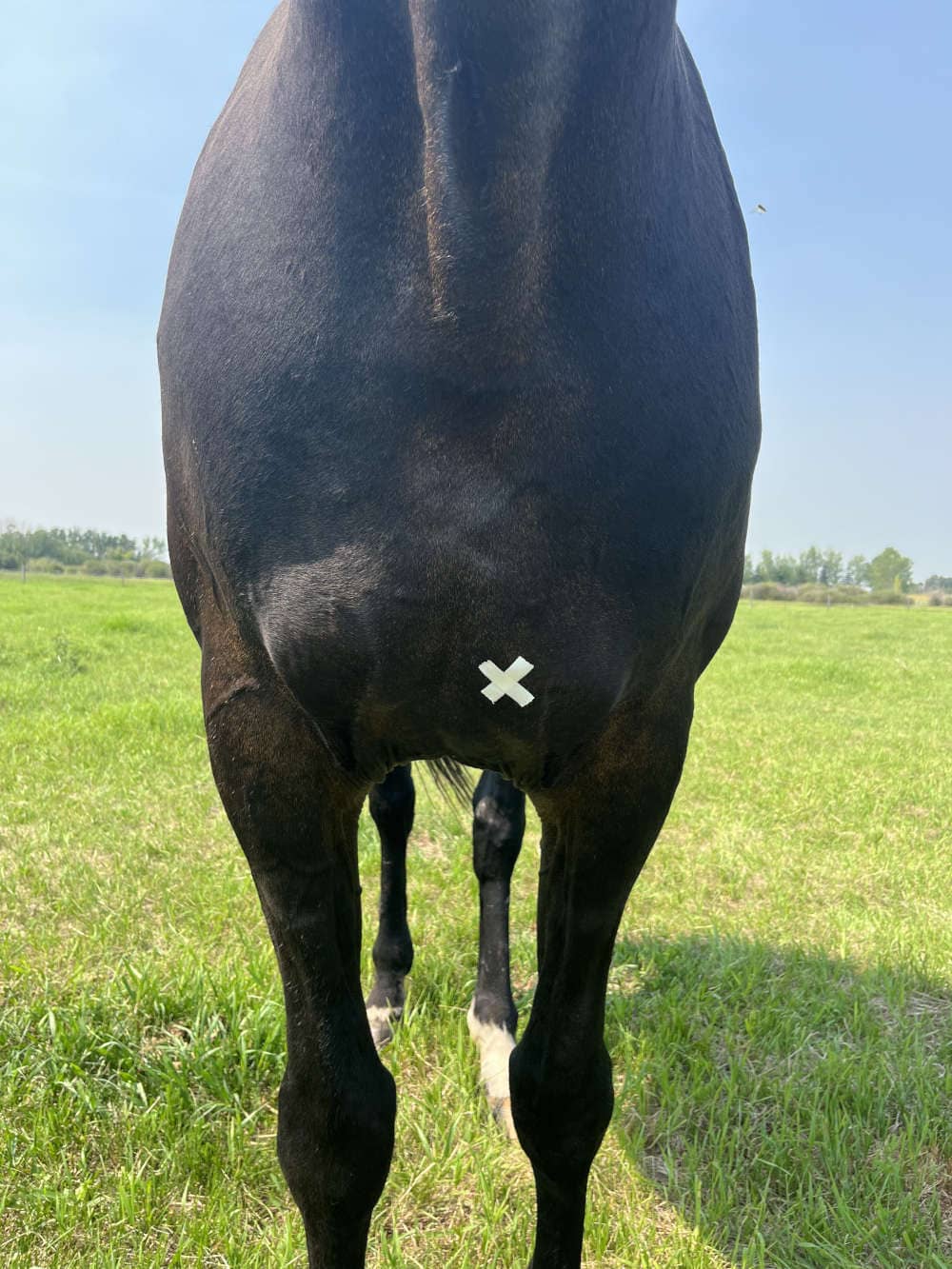
Pectorals
The pectorals are the two large muscles on the horse’s chest. Inject into the thickest part of one muscle, to one side of the body’s midline.
Hamstrings
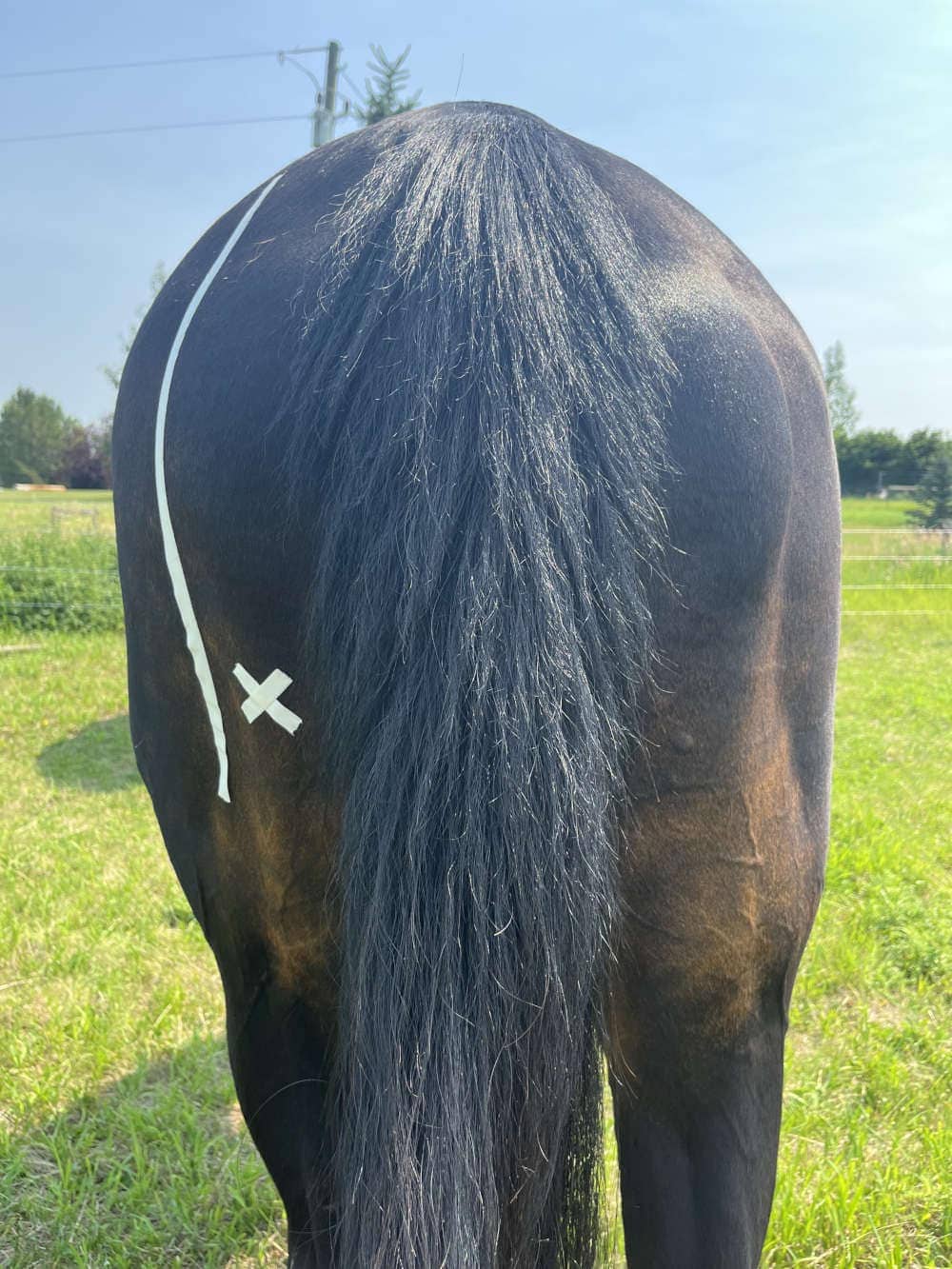
The hamstrings run alongside the horse’s tail, below the point of the buttock. Avoid the sciatic groove, which runs from the top of the pelvis into the hind limb and is visible when viewing the horse from behind. [1]
Step 4: Give the Injection
Have an experienced handler restrain the horse. Follow safe handling practices, and confirm the injection-site landmarks before proceeding.
Using your nondominant hand, pinch the skin near the desired injection site to form a “tent.” This can distract the horse and prepare it for the injection. [1] Tenting is not possible when using the hamstrings. Maintain the tent until the injection is complete.
Detach the needle from the syringe. Insert the needle into the muscle at a 90-degree angle to the skin, advancing it until the hub rests against the skin. [1]
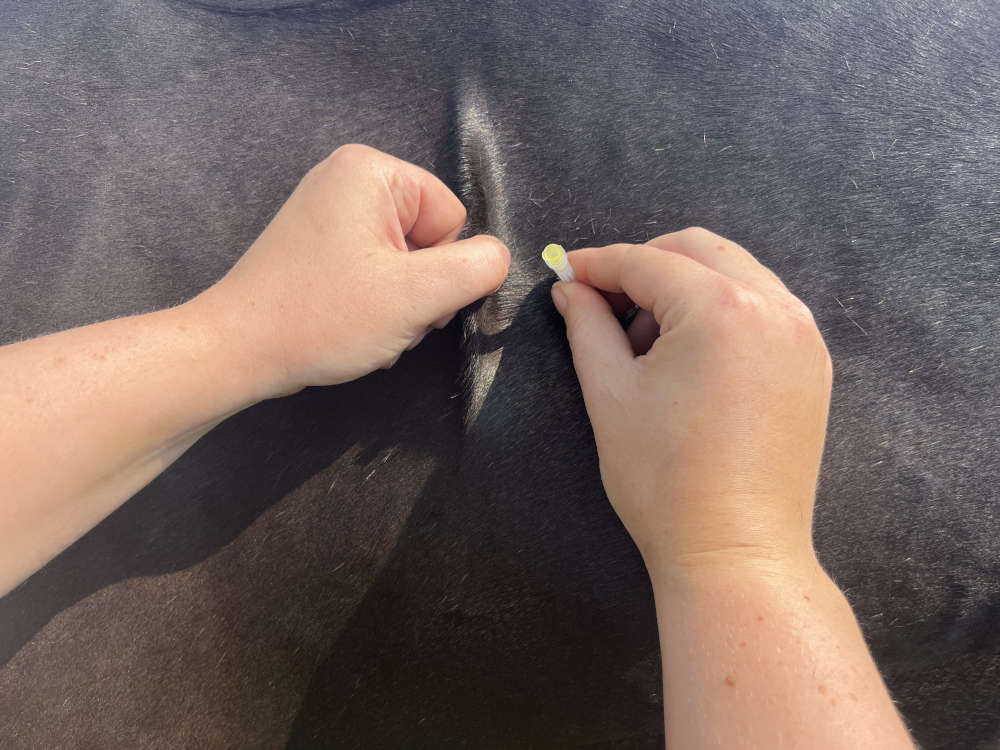
Photo: Dr. Madison Ricard, DVM, PhD, DACVP, PAS
The needle in this image is capped for demonstration purposes
Attach the syringe to the needle and pull back on the plunger. You should feel a vacuum that draws the plunger back into place when you release it. No blood should enter the needle or syringe when you pull back. [1]
After confirming that there is no blood, inject the medication slowly. Withdraw the needle and release the skin tent. Place the used needle and syringe in an approved sharps container, following your veterinarian’s disposal instructions.
If you see blood in the needle hub or syringe, do not panic. Remove the syringe from the injection site, safely recap the needle as described above, and change out the needle for a new one. Try giving the injection in a different location. When in doubt, dispose of the entire dose and start with a fresh needle and syringe.
Over the following days, monitor the injection site for swelling, pain, heat, or other changes. Report any concerns to your veterinarian promptly.
How to Give Subcutaneous Injections
Subcutaneous injections are less common in horses than in other veterinary species. However, they may be used for certain medications and can be administered by horse owners after appropriate instruction.
Step 1: Gather Your Materials
Preparation for a subcutaneous injection is similar to preparation for an intramuscular injection. Confirm that the medication is prescribed for subcutaneous use, which may be abbreviated as “SQ.”
A 21-gauge needle that is 1 to 1.5 inches long is typically used for a subcutaneous injection. [4] Shorter needles are often preferred to reduce the risk of passing through the subcutaneous tissue into deeper structures.
Step 2: Draw Up the Dose
Follow the same steps to draw up the dose as described for intramuscular injection.
Step 3: Identify the Landmarks
Most subcutaneous injections are given in the loose skin on the side of the neck. Although several locations are possible, many veterinarians recommend using the same landmarks as for an intramuscular neck injection. [4] Review the neck landmarks above before selecting the site.
Step 4: Give the Injection
Have an experienced handler restrain the horse, and confirm the injection site and landmarks before proceeding.
Using your nondominant hand, pinch the skin to form a tent. With the needle attached to the syringe, insert the needle into the base of the skin tent. Check that the needle tip has not passed through the skin and emerged on the opposite side.
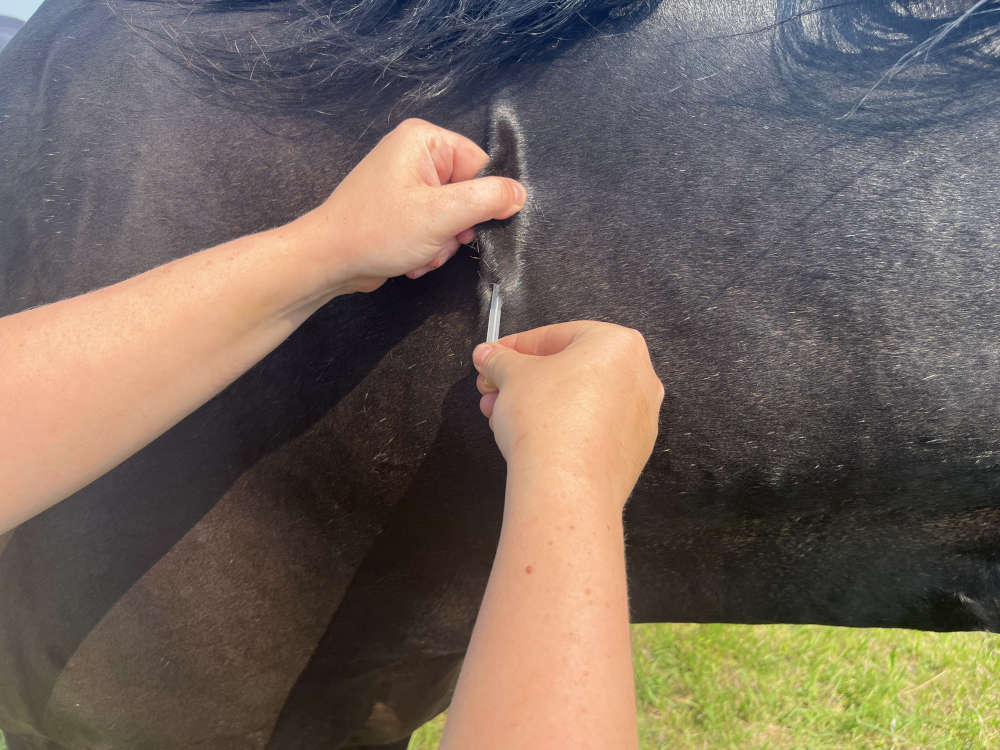
Photo: Dr. Madison Ricard, DVM, PhD, DACVP, PAS
The needle in this image is capped for demonstration purposes
Pull back on the syringe plunger. You should feel a vacuum that draws the plunger back into place when you release it. No blood should enter the needle or syringe when you pull back. [1]
After confirming that there is no blood, inject the medication slowly. Withdraw the needle and release the skin tent. A small raised area of medication should be visible beneath the skin. Place the used needle and syringe in an approved sharps container, following your veterinarian’s disposal instructions.
Over the following days, monitor the injection site for swelling, pain, heat, or other changes. Report any concerns to your veterinarian promptly.
Giving Horse Injections Safely
Giving your horse an injection safely begins with veterinary guidance. Before administering any medication, confirm the correct horse, medication, dose, injection route, and schedule.
Intramuscular and subcutaneous injections can often be given by horse owners after appropriate training, while intravenous injections require specialized training because errors can have severe consequences.
Careful preparation helps protect both you and your horse. Use sterile needles and syringes, select the equipment recommended for the medication and injection route, and identify the anatomical landmarks before beginning. Never give an injection if the medication label, prescribed route, dose, or injection site is unclear.
After administering the medication, dispose of the needle and syringe immediately in an approved sharps container. Monitor the horse and injection site over the following days for pain, heat, swelling, or other unexpected changes. Contact your veterinarian promptly if you notice a reaction or have concerns about how the horse is responding.
Confidence develops through correct instruction and careful practice. By following the prescribed route, maintaining sterility, using accurate landmarks, and monitoring the horse afterward, you can make necessary injections safer and less stressful for everyone involved.
Frequently Asked Questions
Here are some frequently asked questions about giving injections to horses:
Horse owners can give certain injections themselves after receiving proper instruction from a veterinarian. Intramuscular and subcutaneous injections are the routes most likely to be administered at home, but the veterinarian must confirm that the medication and route are appropriate. Owners should also understand the prescribed dose, storage requirements, injection technique, and possible adverse effects before proceeding.
Horses can receive intramuscular, subcutaneous, or intravenous injections. Intramuscular injections deliver medication into a muscle, while subcutaneous injections place it in the tissue beneath the skin. Intravenous injections deliver medication directly into the bloodstream and require specific veterinary training and approval because mistakes can cause severe complications.
The difference between intramuscular, subcutaneous, and intravenous injections is where the medication is deposited and how quickly it takes effect. Intramuscular and subcutaneous medications must diffuse into the bloodstream, so they are generally absorbed more slowly than intravenous medications. Intravenous injections produce rapid effects because the medication enters the bloodstream directly, but this route also carries greater risks.
Using the correct injection route is important because medications are formulated for specific methods of administration. Giving a medication by the wrong route can reduce its effectiveness or cause tissue damage, infection, or other serious complications. Never change the prescribed route without guidance from the veterinarian treating the horse.
Intramuscular injections in horses are usually given in the neck, although the pectoral muscles or hamstrings may also be used. The neck is commonly preferred because its anatomical landmarks help identify a suitable injection area. A veterinarian can recommend the safest site based on the medication, injection volume, and the horse's temperament.
The correct area for an intramuscular neck injection is a triangle bordered by the cervical vertebrae, the front edge of the shoulder blade, and the nuchal ligament within the crest. The site should be at least four inches from the shoulder blade and cervical vertebrae and at least four inches below the nuchal ligament. A veterinary team member should demonstrate how to locate these landmarks before an owner gives an injection independently.
Not all medications can be given intramuscularly because many injectable products are intended for only one administration route. Vaccines, sedatives, antibiotics, anti-inflammatory medications, and certain reproductive medications may be given intramuscularly when prescribed that way. Always confirm the route on the medication label and follow the veterinarian's instructions.
The equipment needed to give a horse an injection generally includes the prescribed medication, an appropriately sized sterile syringe, a sterile needle, and an approved sharps container. Before beginning, confirm the correct medication, horse, dose, frequency, and administration route. Keep the needle sterile by avoiding contact with hands or other surfaces.
An intramuscular injection in a horse commonly uses an 18-, 20-, or 22-gauge needle that is 1 to 1.5 inches long. The appropriate needle and syringe depend on the medication and the volume being administered. A veterinarian should confirm which equipment is suitable for the prescribed injection.
A subcutaneous injection in a horse typically uses a 21-gauge needle that is 1 to 1.5 inches long. A shorter needle may be preferred to reduce the risk of passing through the subcutaneous tissue into deeper structures. Confirm the correct needle size and injection technique with the prescribing veterinarian.
The needle should generally be changed after drawing medication from a bottle. Passing a needle through the rubber stopper can dull it slightly, which may make the injection more uncomfortable for the horse. Replacing it also provides a fresh needle for administering the medication.
Needles and syringes used for horse injections should not be reused because disposable equipment is intended for a single use. Reuse can increase the risk of contamination, infection, inaccurate dosing, and discomfort from a dull needle. Place the used equipment in an approved sharps container immediately after the injection.
Pulling back on the syringe plunger helps check whether blood enters the needle or syringe before the medication is administered. With an intramuscular or subcutaneous injection, the plunger should encounter a vacuum and no blood should appear. The medication should only be injected after confirming that no blood has entered the syringe.
Subcutaneous injections are given by pinching loose skin to form a tent and inserting the needle into the base of that tent. The needle tip must not pass through the skin and emerge on the opposite side. After the medication is injected slowly, a small raised area may be visible beneath the skin.
If a horse moves during an injection, stay calm, stop the procedure, and prioritize the safety of the horse and handlers. Allow the horse to settle before attempting to continue, and never stand where you could be kicked or pinned. Horses that repeatedly resist injections may need help from a veterinarian or a structured plan to help them stand for veterinary care.
Injections can be less stressful for a horse when they are performed in a calm environment with consistent handling and appropriate restraint. An experienced handler, good timing, and positive reinforcement may help the horse tolerate the procedure. Severe needle aversion may require a behavior modification plan developed with a veterinarian.
Problems to watch for after a horse receives an injection include swelling, heat, pain, lameness, fever, or other unusual changes. Monitor both the injection site and the horse's general condition over the following days. Report significant, worsening, or otherwise concerning signs to a veterinarian promptly.
Used horse injection needles and syringes should be placed in an approved sharps container immediately after use. Loose needles should never be placed in household garbage or recycling because they can injure people and expose them to contaminated material. A veterinarian or local pharmacy can provide information about sharps disposal programs in the area.
A veterinarian should give guidance if the medication, dose, route, or injection technique is unclear or if the horse cannot be restrained safely. Veterinary help is also needed if the medication appears expired or contaminated or the horse has a history of severe vaccine or medication reactions. Contact the veterinarian promptly if the horse develops significant swelling, fever, lameness, pain, or other concerning signs after an injection.
Horse owners should only give intravenous injections after receiving specific training and approval from a veterinary team member. Accidental arterial injection can cause seizures, collapse, or death, and other risks include hemorrhage, hematoma formation, contamination, and air embolism. Intravenous administration should not be attempted without the necessary instruction and supervision.
Summary
Giving your horse an injection can be safe and straightforward when you use the correct technique and sterile equipment and follow your veterinarian's instructions.
- Some horse owners can safely administer intramuscular and subcutaneous injections after receiving veterinary instruction
- Use the injection route and medication exactly as prescribed by your veterinarian
- Proper hygiene and sterile equipment help reduce the risk of infection and injection-site complications
- Correct injection-site selection makes the procedure safer for both the handler and the horse
- Monitor your horse for swelling, pain, allergic reactions, or other adverse effects after an injection
- Contact your veterinarian if you are unsure about a medication or injection technique or if your horse develops concerning signs after treatment
References
- Costa. L. R. R. Ed. and Paradis. M. R. Ed. Manual of Clinical Procedures in the Horse. Wiley-Blackwell. 2017.
- Britt. B. and Byars. T. D. Hagyard-Davidson-McGee Formulary Tables. Proceedings of the Annual Convention of the American Association of Equine Practitioners. 1997.
- Sack. A. et al. Zoonotic Diseases from Horses: A Systematic Review. Vector-Borne and Zoonotic Diseases. 2020.
- Equine Intramuscular and Subcutaneous Injections. University of Bristol. 2025.