English


Quinidine is an antiarrhythmic medication used in horses for the treatment of atrial fibrillation (AF), the most common type of cardiac arrhythmia that warrants medical intervention. Atrial fibrillation in horses occurs when the upper chambers of the heart (the atria) beat in a rapid, uncoordinated manner, leading to an irregular heart rhythm.
Classified as a Class IA antiarrhythmic drug, quinidine works primarily by blocking sodium channels in cardiac muscle cells. By slowing electrical conduction through the atria and prolonging the refractory period of cardiac tissue, quinidine can interrupt the abnormal electrical circuits responsible for atrial fibrillation.
Despite its effectiveness, quinidine must be used with caution. It has a relatively narrow therapeutic index, meaning the margin between effective and toxic doses can be small.
Potential side effects include gastrointestinal upset, colic, nasal edema, hypotension, and the development of other arrhythmias. Because of these risks, treatment is typically performed under close veterinary supervision, often in a hospital setting with continuous electrocardiographic monitoring.
Quinidine remains a cornerstone therapy for atrial fibrillation in horses, particularly in performance animals where restoration of normal cardiac rhythm is essential for safety and athletic function. Careful case selection, monitoring, and follow-up are key to maximizing success while minimizing complications.
Quinidine Sulfate for Horses
Quinidine is a Class I anti-arrhythmic, also called a sodium channel blocker. Veterinarians use this medication in horses to treat cardiac arrhythmias like atrial fibrillation and tachyarrhythmias (very fast heart rate).
The most common form of quinidine is quinidine sulfate, but there is also research supporting the use of quinidine gluconate as an alternative option. [1]
Quinidine is an alkaloid derived from the bark of the cinchona tree and is the dextrorotatory stereoisomer of quinine, a compound historically used to treat malaria.
Pharmacologically, quinidine is classified as a Class IA antiarrhythmic under the Vaughan-Williams system. In addition to blocking fast sodium channels, it also has moderate potassium channel–blocking activity, which prolongs repolarization and increases the effective refractory period of cardiac tissue.
In horses, quinidine is primarily used to achieve cardioversion, meaning restoration of a normal sinus rhythm from atrial fibrillation.
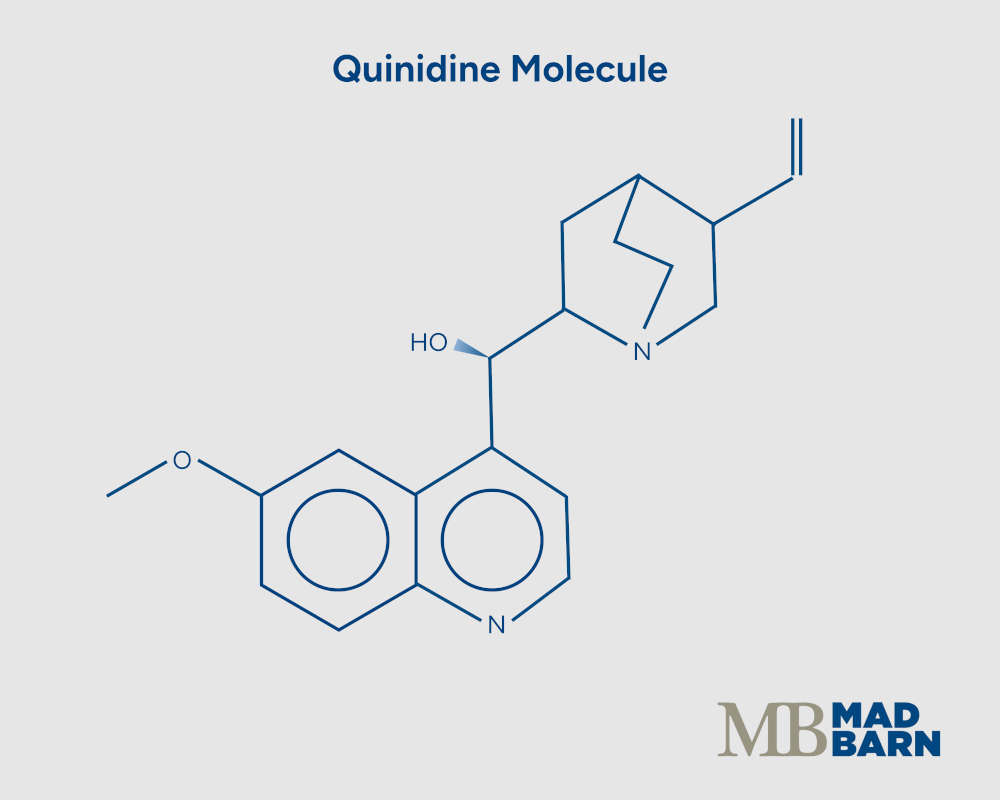
Available Forms
There are currently no equine-labeled formulations of quinidine. Veterinarians use human formulations in an off-label manner.
Common salt forms include:
- Quinidine sulfate (most commonly used in horses)
- Quinidine gluconate (less commonly used)
In human medicine, quinidine has historically been marketed under trade names such as:
- Quinaglute®
- Cardioquin®
- Quinidex®
Many of these products have been discontinued or are rarely used today due to the development of newer antiarrhythmic drugs. However, compounding pharmacies or hospital sources may still supply quinidine sulfate for veterinary use.
Drug Class: Sodium Channel Blockers
Quinidine is a type of sodium channel blocker, a class of medications used to treat tachyarrhythmias. These drugs work by slowing electrical conduction in cardiac tissue, preventing heartbeats from firing in rapid succession.
Other sodium channel blockers used in horses include: [1]
- Procainamide
- Lidocaine
- Phenytoin
- Flecainide
- Propafenone
Each heartbeat depends on a steady, coordinated electrical signal arising from the sinoatrial node. To produce this electrical signal, the heart relies on sodium channels allowing ions to escape from the heart cells. The movement of sodium ions produces electricity. [2]
Blocking these sodium channels prevents sodium ions from leaving the cells, reducing the electrical signal.[2]
Mechanism of Action
Quinidine is a sodium channel blocker that acts on fast sodium channels in the heart. These channels are responsible for depolarization, the electrical activity that triggers muscle contraction. By obstructing these sodium channels, the drug lengthens depolarization time. [1]
Cardiomyocytes (heart muscle cells) can only produce one contraction per depolarization event. By lengthening the time depolarization takes, the rate of muscle contraction slows and heart rate decreases.
Quinidine also has effects on potassium channels and the sympathetic nervous system. The additional activity of this medication is the reason it is a Class Ia antiarrhythmic agent. [1]
Quinidine reduces potassium channel activity, which prevents cardiomyocytes from repolarizing.
Repolarization is a necessary step in the muscle contraction process that restores the muscle to a resting state, allowing it to produce another heartbeat.
By blocking potassium channel activity, quinidine slows down repolarization time. This increases the effective refractory period, or the time required before the heart can produce the next heartbeat. [3]
This medication can also stimulate the sympathetic nervous system. The sympathetic nervous system is responsible for the “fight or flight” response. Activation of this system can cause side effects during drug treatment, such as tachycardia (increased heart rate). [4]
Tachycardia is an undesirable outcome when treating atrial fibrillation, so treatment is usually stopped or slowed if tachycardia develops. [4]
What's your top priority with your horse's health?

Enter your email to receive your store credit
Uses in Horses
Quinidine is primarily used to treat atrial fibrillation in horses, although it can help treat other cardiac arrhythmias as well. [1]
Atrial fibrillation is the most common arrhythmia found in athletic performance horses. [5] It develops when the atria, large chambers at the top of the heart, produce abnormal electrical signals causing rapid atrial contractions or “fluttering”. [6]
The difference between normal cardiac rhythm and atrial fibrillation can be visualized on an electrocardiogram (ECG), which records the electrical activity of the heart.
In a normal equine ECG, electrical impulses follow a regular, organized pattern. Each heartbeat produces consistent waveforms representing coordinated atrial and ventricular depolarization.
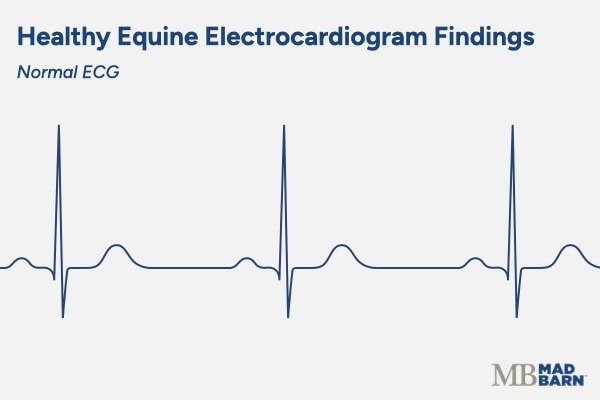 Illustration: Dr. Madison Ricard, DVM, PhD, DACVP, PAS
In contrast, atrial fibrillation produces a chaotic electrical pattern. The atria fire rapidly and irregularly, resulting in an absence of organized P waves and an irregular rhythm on ECG.
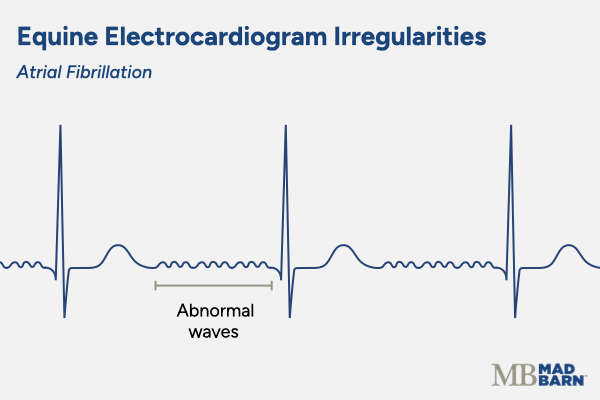 Illustration: Dr. Madison Ricard, DVM, PhD, DACVP, PAS
Normally, the atria push blood into the ventricles (chambers at the bottom of the heart) for delivery to the lungs or the rest of the body. During atrial fibrillation, the atrial contractions are inefficient and may not deliver enough blood to the ventricles. [6]
This can result in clinical signs such as: [6]
- Poor performance
- Exercise intolerance
- Difficulty breathing
- Swelling of the lower jaw and abdomen
- Collapse
- Sudden death
Risk Factors of Atrial Fibrillation
Horses are predisposed to atrial fibrillation compared to other species due to the large size of their heart. They also have naturally high parasympathetic activity, the “rest and digest” component of the nervous system. [6]
Activation of this system may predispose them to re-entry arrhythmias, where electrical activity within a cardiomyocyte never comes to a complete stop, which creates a looping system with constant reactivation of the same cell. [6]
This results in atrial contractions every time the electricity loops, producing a fluttering or fibrillating cell.
Other equine risk factors for developing atrial fibrillation include: [6]
- Low blood potassium
- Anesthetic medications
- Infections
- Low red blood cells (anemia)
- Low blood oxygen (hypoxia)
- Colic
- Pre-existing heart damage or abnormalities
Administration Routes
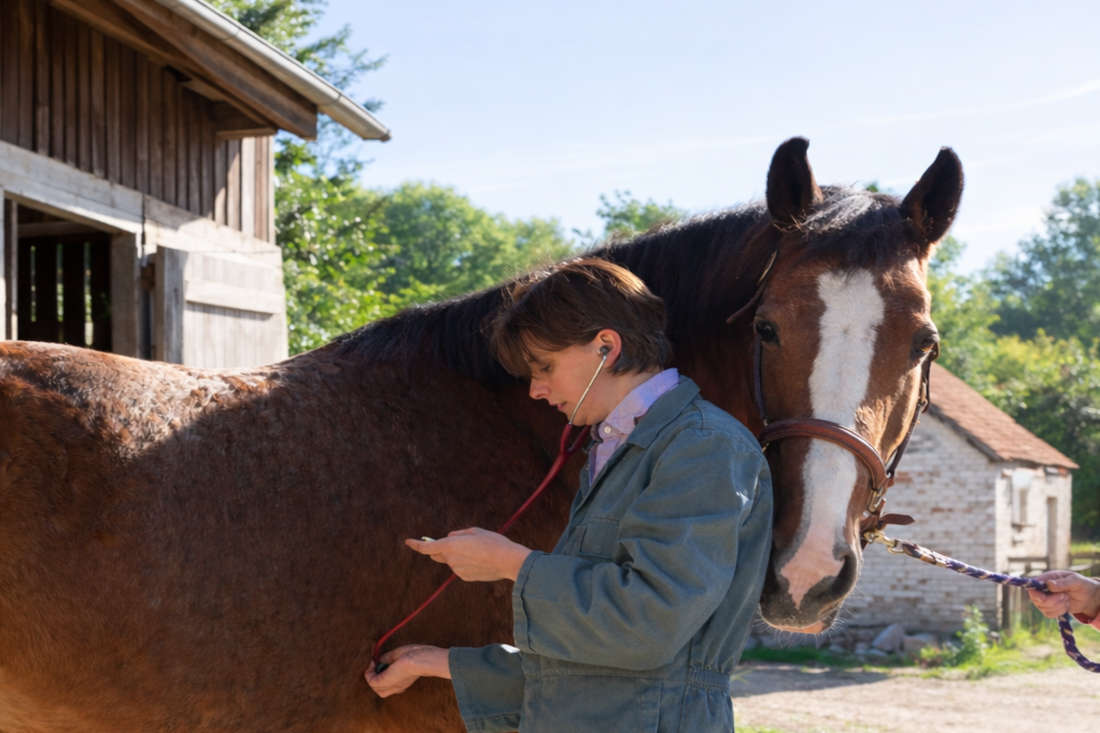
Only a veterinarian can administer quinidine to a horse, and treatment typically takes place in a hospital where the horse can be closely monitored after administration.
Quinidine sulfate is given orally through a nasogastric tube (a tube passed through the horse’s nose into their stomach). [4] Quinidine should not be placed directly into the mouth or given in the feed, as it is an irritating substance. [3]
Typically, the dosing regimen involves administering quinidine every 2 hours, with a maximum of 4 doses. [4] Dosing usually continues until cardioversion (conversion to a normal heart rhythm) occurs or until signs of quinidine toxicosis develop. [4]
Throughout treatment, the horse’s heart rhythm is continuously monitored using electrocardiography (ECG), and vital parameters such as heart rate, respiratory rate, and blood pressure are closely observed.
Since the dose required for cardioversion and the dose that causes toxicosis can be very similar, careful monitoring is necessary during the entire treatment process.
This intensive monitoring is why quinidine administration is typically performed in a clinic, where immediate veterinary intervention and supportive care are available if complications arise.
Storage
Quinidine is stored at room temperature, and it is sensitive to light exposure. Therefore, all quinidine products should be kept in light-resistant, closed containers. [3]
After light exposure, the salts darken and the product develops a brown tint. Only colorless solutions should be used for treatment. [3]
Safety Warnings & Precautions
Quinidine must be administered with caution in horses due to its narrow therapeutic index and potential for serious side effects and complications.
Treatment should only be performed under close veterinary supervision, ideally in a hospital setting with continuous ECG monitoring and frequent assessment of heart rate, rhythm, blood pressure, and gastrointestinal function.
Monitoring
Quinidine treatment in horses requires ongoing monitoring, as there are several adverse reactions that can develop from this medication’s use. [3]
During treatment, the horse should be kept in a quiet, minimally stimulating environment. [4] In addition, an ECG should be placed on the horse and monitored for: [3]
- Heart rates over 80 bpm
- Abnormal ventricular complexes
- Difficulty breathing
- Signs of colic
- Diarrhea
- Uncoordinated movement (ataxia)
Side Effects
Quinidine treatment can cause appetite loss and lethargy as minor side effects. [3]
Other potential side effects of quinidine in horses include: [”3″]
- Tachycardia (rapid heartbeat)
- Other cardiac arrhythmias
- Collapse
- Sudden death
Careful monitoring is key for preventing complications during treatment. In many patients, quinidine is administered until signs of toxicosis develop or the horse’s atrial fibrillation resolves.
Veterinarians follow this dosing protocol because the therapeutic index, or the concentration of drug required to effectively treat atrial fibrillation, is very close to the toxic dose. Signs of toxicosis are not considered an adverse reaction, as they are known consequences of administering the drug at high doses.
Signs of quinidine toxicosis in horses include: [3]
- Swelling of the mucosa within the nostrils
- Difficulty breathing
- Uncoordinated movement (ataxia)
- Diarrhea
- Colic
- Laminitis
- Urticaria (hives)
- Collapse
Developing these clinical signs prompts the veterinary team to stop medication administration. For horses with allergic responses, like swelling of the nasal mucosa and hives, corticosteroids may be necessary to help reduce the immune response. [3]
In severe cases of respiratory obstruction, placing a tracheostomy (temporary hole in the windpipe) or an endotracheal tube (tube through the nostril into the windpipe) may be necessary to help the horse breathe. [3]
Acute Toxicity (Overdose)
Quinidine is only administered under direct veterinary supervision, as the therapeutic index is very narrow. The veterinary team monitors the horse closely for signs of toxicosis as treatment progresses. Treatment typically takes between 6 to 8 hours, with repeated doses of quinidine every 2 hours. [3]
Early signs of overdose are typically only detectable on an ECG, and include changes like tachycardia or abnormal wave patterns. These signs develop due to the cardiac effects of the drug, and are known outcomes of quinidine treatment. In some cases, other drugs, like digoxin, can be used to mitigate these effects, allowing treatment to continue. [3]
If more severe signs of toxicosis (poisoning) develop, the veterinary team stops treatment immediately. If atrial fibrillation persists, the veterinarian may recommend a second quinidine dosing regime or alternative treatment options like transvenous electrical cardioversion (TVEC). [3]
Some horses develop allergic reactions to quinidine and show signs like difficulty breathing, swelling of the mucosa within the airways, and hives. If these symptoms develop, treatment stops and an alternative treatment method for atrial fibrillation is scheduled. [3]
Contraindications
Contraindications refer to circumstances where a drug is to be avoided or only used with caution.
Quinidine has several contraindications for use in horses, including: [3]
- Previous allergic reactions to the medication
- Myasthenia gravis
- Arrhythmias affecting conduction through the ventricles or atrioventricular node
- Low blood potassium
- Acid-base imbalances
- Low blood oxygen
- Hepatic or renal disease
- Congestive heart failure
The existence of these contraindications underscores the importance of having veterinary oversight for horses on a course of quinidine. Without having the full medical context of a horse’s condition, quinidine administration may result in serious complications.
Drug Interactions
Quinidine has several potential drug interactions identified from previous reports and from theoretical physiologic conflicts. Its interactions with other cardiovascular-affecting medications have the highest significance, as these may increase the risk of cardiac damage, arrhythmias, or other electrical abnormalities.
Drugs that may increase the risk of cardiac damage, arrhythmias, or other electrical abnormalities when used with quinidine include: [3]
- Amiodarone
- Azole antifungals
- Cisapride
- Hydroxyzine
- Fluoroquinolone antibiotics
- Lidocaine
- Macrolide antibiotics
- Mexiletine
- Methadone
- Metronidazole
- Ondansetron
- Phenothiazines
- Procainamide
- Sotalol
- Trazodone
- Tricyclic antidepressants
Quinidine may increase the concentrations or effects of these drugs when given concurrently: [3]
- Colchicine
- Digoxin
- Doxorubicin
- Morphine
- Neuromuscular blocking agents
- Tricyclic antidepressants
- Vincristine
Drugs reducing the absorption and clearance (processing and excretion) of quinidine include: [3]
- Acetazolamide
- Antacids
- Dexamethasone
- Diltiazem
- Phenobarbital
- Primidone
- Rifampin
- Urinary alkalizers
- Verapamil
Other possible interactions include: [3]
- Anticholinesterases: May be antagonized by quinidine, reducing their efficacy
- Antihypertensive agents: May increase risk of low blood pressure
- Cimetidine: May increase concentration or effect of quinidine when given concurrently
- Urinary acidifiers: May increase clearance of quinidine
- Warfarin: May increase risk of bleeding problems
Regulatory Status & Legal Considerations
There are currently no equine-approved formulations of quinidine available. [3] Veterinarians use human formulations in an off-label manner. This means that drug companies cannot guarantee the safety and efficacy of the product in horses and are unlikely to warranty the product in the case of adverse reactions.
Off-label use is permitted under veterinary prescribing regulations when no approved equine alternative is available. In these cases, veterinarians rely on published research, clinical experience, and established treatment protocols to determine appropriate dosing and monitoring.
Quinidine has been used for decades in equine medicine for the management of atrial fibrillation, and its risks and benefits are well-documented in the veterinary literature.
If your veterinarian recommends quinidine, it’s appropriate to ask about the expected benefits, potential risks, monitoring plan, and alternative treatment options.
Because this medication requires intensive supervision and carries a risk of serious side effects, treatment decisions are made on a case-by-case basis, weighing the horse’s overall health status, performance goals, and likelihood of successful cardioversion.

Status in Competition
Quinidine treatment is regulated by most competitive organizations, including the Fédération Equestre Internationale (FEI), which governs international disciplines such as dressage, show jumping, eventing, endurance, driving, vaulting, and para-equestrian sport. [7]
Under FEI rules, substances are classified as either banned or as controlled medications. Quinidine is considered a controlled medication, meaning it is a therapeutic drug permitted out of competition but prohibited in-competition unless properly declared. However, no official detection time is listed for this medication.
The serum half-life for quinidine is around 8.1 hours in horses. [7] “Half-life” is the time required for drug concentrations to reduce by half. It typically takes 4 – 5 half-lives for a drug to be below detectable limits.
Work with your veterinarian to determine how much time your horse needs to return to competition after a course of quinidine. Always check the regulations for your sport before starting a new medication for your horse.
Frequently Asked Questions
Here are some frequently asked questions about quinidine use in horses:
Quinidine is primarily used to treat atrial fibrillation (AF), a common cardiac arrhythmia in horses. The goal of treatment is to restore a normal heart rhythm (sinus rhythm), especially in performance horses where an irregular rhythm can affect safety and athletic ability.
Quinidine is a Class IA antiarrhythmic drug that blocks sodium channels in heart muscle cells. This slows abnormal electrical activity in the atria and helps interrupt the erratic rhythm responsible for atrial fibrillation, allowing the heart to return to a coordinated beat.
In horses, quinidine is most commonly given orally as quinidine sulfate via a nasogastric tube at scheduled intervals. Treatment is usually performed in a hospital setting so the horse can be closely monitored with electrocardiography (ECG) and frequent physical examinations.
In horses, quinidine has a narrow therapeutic margin, meaning careful dosing and monitoring are essential. Possible side effects include colic, diarrhea, nasal swelling, depression, low blood pressure, and the development of other arrhythmias. In rare cases, complications can be serious.
Success rates are generally good in appropriately selected horses, particularly those with recent-onset atrial fibrillation and no structural heart disease. However, not all horses convert to normal rhythm during treatment, and recurrence can occur.
Yes, there are alternative equine treatments available. Transvenous electrical cardioversion (TVEC) is another effective option, particularly for horses that do not respond to quinidine or have experienced adverse effects. Your veterinarian will recommend the most appropriate treatment based on your horse’s individual case.
Summary
Quinidine is a human antiarrhythmic medication commonly used in horses for the treatment of atrial fibrillation, helping restore normal heart rhythm.
- Quinidine is primarily used to convert horses with atrial fibrillation back to normal sinus rhythm
- It works by blocking sodium channels and slowing abnormal electrical activity in the heart
- Treatment is typically performed in a hospital setting with continuous ECG monitoring
- Quinidine has a narrow therapeutic index and can cause gastrointestinal, cardiovascular, or rhythm-related side effects
References
- Redpath. A. and Bowen. M. Cardiac Therapeutics in Horses. Veterinary Clinics: Equine Practice. Elsevier. 2019.
- Equine Pharmacology. 1st ed. John Wiley & Sons, Ltd. 2014.
- Quinidine. Plumb’s Veterinary Drugs. 2022.
- Sleeper. M. M. Equine Cardiovascular Therapeutics. Veterinary Clinics of North America: Equine Practice. 2017.
- Decloedt. A. et al. Atrial Fibrillation in Horses Part 2: Diagnosis, Treatment and Prognosis. The Veterinary Journal. 2021.
- Reed. S. M. et al. Equine Internal Medicine. 3rd ed. Saunders Elsevier, St. Louis, Mo. 2010.
- 2026 Prohibited Substances List. FEI. 2026.