English

Sharon Buffitt’s para dressage career has taken her to the highest levels of the sport, including representing Canada at the World Equestrian Games, ranking 12th in the world, and receiving eligibility at multiple Paralympic Games.
Today, Sharon is building the next chapter of her career with L’Etoile, a young mare known at the barn as Lilly. In their first full year competing together, the pair ranked second in Canada, became the highest-scoring Grade II combination nationally, and earned top para rider honors in Quebec.
As Sharon works toward her goal of qualifying for the 2028 Paralympic Games, every part of Lilly’s care matters. Nutrition, management, soundness, and comfort all play a role in helping her current mount stay healthy and prepared for the demands of high-level para dressage.
Keep reading to learn more about Sharon’s journey, her partnership with Lilly, and the nutrition and management strategies supporting their road to the 2028 Paralympics.
A Different Path to Equestrian Sports
Unlike many riders competing at the upper levels of equestrian sport, Sharon Buffitt did not grow up taking riding lessons from an early age.
Sharon was born with Charcot-Marie-Tooth disease, or CMT, a group of inherited neurological disorders that damage the peripheral nerves. The condition can cause progressive muscle weakness, loss of sensation, and physical changes, most often affecting the arms, legs, hands, and feet.
When Sharon was younger, her CMT symptoms were less limiting. But the condition progressed as she got older, and certain aspects of riding became increasingly difficult.
“Because of my physical disability, jumping eventually became harder,” Sharon says. “Since I had to brace through my legs to stay on, I was hitting the jumps instead of going over them with the horse.”

“I started riding later in life. I had always loved horses, but I didn't take lessons until I was 16. Like a lot of kids, I started out doing hunter-jumpers.”
— Sharon BuffittMad Barn High Performance Athlete
The Transition to Dressage & the World Equestrian Games
By the time Sharon was 18, she transitioned to dressage, a shift that would ultimately lead to success at the Paralympic level.
“When I switched to dressage, it opened more doors for me in the competitive world,” Sharon says. “I started at the regional level, moved up to nationals, and eventually got my own horse so I could compete more.”
Sharon spent roughly 15 years steadily building from regional to national, then ultimately international competition. “I was on the national ranking list for years, and I was part of the Canadian team for a little while,” Sharon says. “I found good coaches and rode good horses at the time, and I qualified.”

Her hard work eventually paid off with one of the biggest milestones of her career: representing Canada at the 2010 World Equestrian Games (WEG).
“I competed in Belgium to qualify for the World Games, and I was on borrowed horses at the time,” she says. “I was there for two weeks, and I was only able to train on that horse for about a week before competition.”
Her path to the Games also required adaptability, persistence, and the ability to perform under pressure on borrowed horses.
“That was probably my biggest accomplishment thus far. To be able to go to the World Equestrian Games and finish 12th in the world was huge for me.”
— Sharon BuffittMad Barn High Performance Athlete
Qualifying for the Paralympic Games
After the 2010 World Equestrian Games, Sharon continued competing internationally and earned eligibility to compete at multiple Paralympic Games.
Although she was unable to complete the final qualification process for the Paralympics, earning eligibility was a significant accomplishment given the training, consistency, and high-level scores required.
“At the international level, you have to achieve a certain percentage in the dressage test to be eligible to compete at a Games,” Sharon explains.
“At that time, it was 60 percent, and now it’s about 65 percent. Then you also have to meet Canadian criteria. To go to the World Games, for example, you had to achieve six scores of 69 percent or higher.”
In para sport, riders are classified into grades based on the impact of their disability, with Grade I representing the most impaired riders and Grade V representing the least impaired. Each grade allows specific adaptations so riders can compete safely and effectively.
“I’m a Grade II rider,” Sharon says. “For me, my legs are strapped into the saddle. I would not be able to ride without these accommodations. My feet are attached to the stirrup irons with elastic, and then my stirrup irons are attached to the girth. Being able to strap my legs in stabilizes me more on the horse and allows me to compete at the level I compete at.”
Sharon’s main challenge was adjusting the accommodations to match her body and riding style.
“The harder part was deciding how long to attach the stirrup leather to the girth. Did I want more mobility in my leg so I could squeeze more or bring my leg back? That was the more difficult part to adapt to.”
— Sharon BuffittMad Barn High Performance Athlete
Sharon and her first horse, L’Elektra II, built an impressive record over their 10-year partnership.
The pair earned eligibility for two Paralympic Games and won numerous championships, accomplishments that led to L’Elektra II receiving the Canadian Warmblood Horse Breeders Association’s Lifetime Achievement Award before her passing in 2022.
What's your top priority with your horse's health?

What's your top priority with your horse's health?
From Early Setbacks to Ranked Number Two in Canada
After L’Elektra II passed, Sharon stepped away from competition for years. Her return to the show ring came with a young mare named L’Etoile, known in the barn as Lilly.
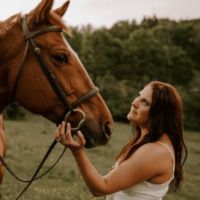
Sharon tried Lilly and was immediately drawn to her quality. “Her movement was spectacular, and she was such a pretty mare,” Sharon says. “The owner decided to sell her to me, and I’ve had her for about three years now.”
“I originally went to try a different horse. But the seller said, 'Oh, you're a para rider? Forget it. This horse isn't for you.' But she had another horse, a six-year-old mare, although she wasn't sure she wanted to sell her.”
— Sharon BuffittMad Barn High Performance Athlete
Early in the partnership, Sharon faced significant health challenges with Lilly. During the first year she owned her, Lilly struggled with painful cystic ovaries, stayed in heat for a year despite being on Regu-Mate®, and began losing weight and muscle.
“She was still trying her hardest to please, but with the pain she was in, she just wasn’t a happy girl,” Sharon says. “She had a lot of anxiety. We found she had over 30 anovulatory cysts in one ovary, which was the source of her pain.”

Sharon and Lilly were still able to train lightly during that time, but Lilly’s high anxiety made competing difficult. Though the pair only competed in one competition that season, they still earned a place on the ranking list. After surgery, Lilly needed about three months of recovery before returning to training.
Sharon brought Lilly home to Montreal to train more consistently and began working with a coach, Victoria Druelle, who helped prepare the partnership for the next level. “She helped us rank number two in Canada and number one in the province,” Sharon says.

Facing Challenges with Resilience
2025 brought major progress for Sharon and Lilly, along with another setback. The pair traveled to Florida to pursue qualifying scores for the World Championships while Sharon was balancing competition with her work as a high school teacher in Montreal.
“I had to stay in Montreal and go down on weekends to Florida to train,” Sharon says. “It wasn’t ideal, and the judging was tough, but it was worth it.”
During their first international competition back in Canada, the pair earned a promising opening score before an unexpected injury interrupted their qualifying plans.
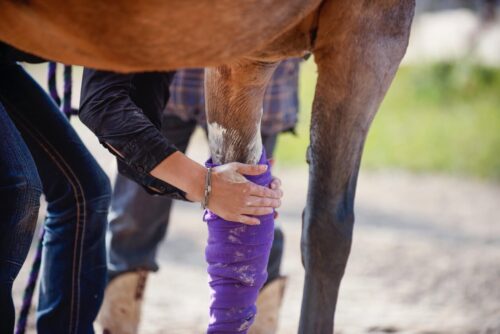
“We got one class in, and I got a personal-best score the first day,” Sharon says. “But then Lilly popped a splint at the international, and that put a damper on qualifying for the World Championships.”
Finding the Best Strategy
Although the setback was disappointing, Sharon remained focused on Lilly’s long-term future. Sharon knew qualifying for the World Championships would be ambitious for a relatively new partnership.
“Last year was a great year,” Sharon says. “This year has been a little bit rough, but we’re still hoping we can compete in another international next month if the splint heals okay. Our sights were set on the World Championships, but our biggest goal is the next Paralympics in 2028.”
Getting there will require enough exposure at the international level and enough qualifying opportunities in competition, especially in Canada. With that in mind, Sharon is already planning strategically to make their 2028 Paralympic qualification goals a reality.

“In Canada, getting to competitions from one side of the country to the other is very difficult,” Sharon says. “In the East, we really only have one competition, and that’s not enough to qualify. So either we go to Florida again, or we have to go out to B.C. to try to qualify.”
Beyond sorting out competition schedules, Sharon is also focused on the day-to-day preparation that will make future qualification possible. The goal right now is to give Lilly the confidence and experience she needs in the ring.
“This year is about training and getting Lilly the exposure she needs,” Sharon says. “National competitions don’t qualify you for major Games, but they show your progression and whether you’re ready to compete internationally. The judges are looking for accuracy, and I would say that is probably one of my biggest challenges right now, especially with a young horse.”
Qualifying also depends on the team around them. Sharon knows that success at the highest level requires a full support system, with each person playing a role in Lilly’s physical health, mental well being, and readiness to compete.
“Qualifying for the Olympics or Paralympics is not just about the horse and rider. It takes the coach, the farrier, the vet, the nutritionist, and everybody at the barn to make sure the horse is happy both physically and mentally.”
— Sharon BuffittMad Barn High Performance Athlete
Expert Nutrition for a Paralympic Horse
Nutrition is important for any performance horse, but feeding is even more nuanced for para dressage horses.
For Sharon, keeping Lilly feeling her best means supporting muscle, body condition, soundness, and rideability as they work toward major goals like the Paralympic Games.
“Nutrition is extremely important. We want the horse to have the muscle, strength, and ideal body condition they need to help prevent injuries and stay sound.”
— Sharon BuffittMad Barn High Performance Athlete
Managing a para dressage horse also means balancing nutrition, fitness, muscle, and energy levels to meet the sport’s specific demands.
While Lilly needs the strength and conditioning of a high-level performance horse, Sharon also has to consider how that fitness affects rideability in the ring.

“With para horses, we want them fit just like an able-bodied rider’s horse, but we also have to consider how fit we want them,” Sharon says.
“If they’re too fit, are we able to ride them with that much power and energy? We want Lilly fit enough to do the work, but not too hot or reactive. It’s a tricky balance for any performance horse, and it’s even trickier for a para horse.”
Laying the Foundation for Performance
Lilly’s diet is simple yet targeted, designed to keep her comfortable while providing the vitamins, minerals, fat, and fiber she needs to perform and feel her best.
“My horse is an easy keeper,” Sharon says. “The foundation of her diet is hay, and then we supplement with the vitamins and minerals that may be missing from a forage-based diet. We also add fat and fiber to help support her body condition while keeping her energy levels just right. That’s where Mad Barn comes into play for us.”
Sharon started using Mad Barn products within the first six months of owning Lilly. Although Lilly did not have ulcers, she did have acid splash and showed signs of gastric sensitivity.
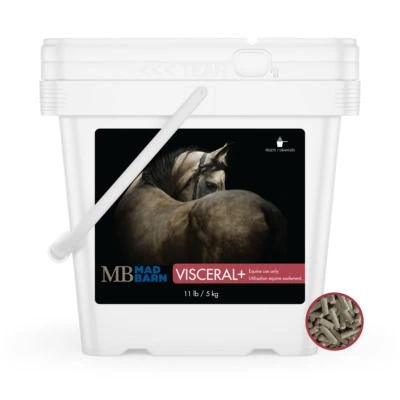
“The first thing I started her on was Visceral+. That made a huge difference because she was a little bit girthy and sensitive to being brushed. Within a couple of months, she was no longer girthy and no longer flinching every time I brushed her.”
— Sharon BuffittMad Barn High Performance Athlete
Visceral+ is Mad Barn’s comprehensive gastric and hindgut support supplement, trusted by elite athletes in every discipline of equestrian sport.
Visceral+ is formulated to help maintain stomach comfort, support the gastric lining, and promote a balanced hindgut environment in horses facing stressors such as training, competition, travel, changes in routine, or limited turnout.
More recently, Sharon met with one of Mad Barn’s expert equine nutritionists in Florida for a full diet analysis.
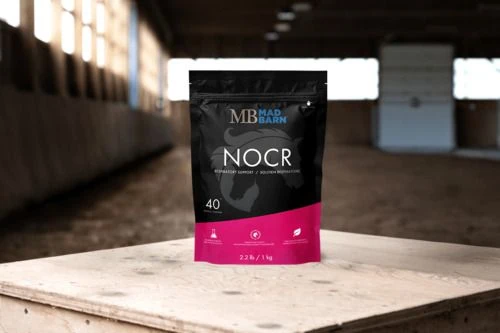
After reviewing Lilly’s nutrition program, they decided to switch her from selenium and vitamin E alone to Omneity® Pellets.
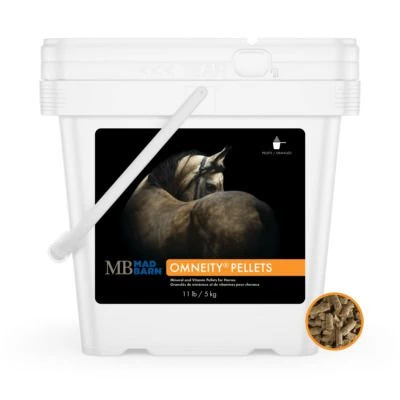
“From grain alone, we don’t necessarily get balanced nutrients,” Sharon says. “We decided to switch Lilly to Omneity® to make sure she was getting what she needed, since she was deficient in certain minerals.”
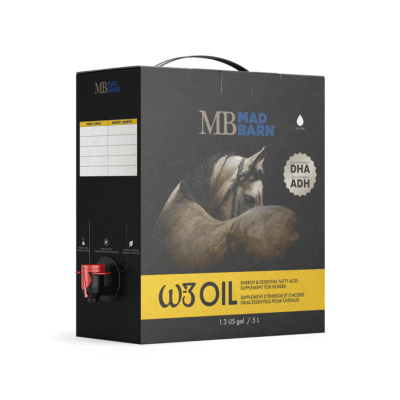
“I also use w-3 Oil to add fat for cool energy and help support her joints and coat, and Performance XL Electrolytes to replace electrolytes lost in sweat during intense exercise. These products seem to be really working for her.”
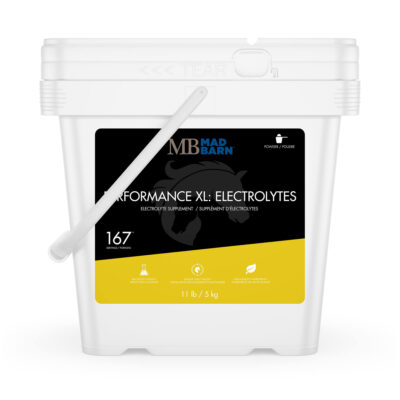
Mad Barn’s support has become an important part of keeping Lilly’s nutrition program aligned with her training, competition schedule, and long-term goals. As Lilly’s needs change, Sharon continues to adjust her program with guidance from Mad Barn.
Sharon also does bloodwork every six months to monitor Lilly’s levels, then uses that information to make more informed nutrition decisions.
“It’s so handy being able to have Mad Barn there to keep an eye on her nutrition,” Sharon says. “I do blood tests to make sure Lilly’s levels are good, and then I can talk to Mad Barn about the findings and ask what we should change in her diet.”
“Mad Barn products are amazing, and they've been helping me with Lilly's diet from the beginning. We're still modifying part of her diet and will probably add a few other supplements to help with her joint health, but Mad Barn makes that process really easy.”
— Sharon BuffittMad Barn High Performance Athlete
On the Road to 2028
As the horse Sharon is building her 2028 Paralympic dreams around, every part of Lilly’s care and nutrition matters. While some riders have a string of competition horses, Sharon’s path to success depends on keeping one horse healthy, comfortable, and progressing. That makes nutrition and management especially important.
Lilly’s program reflects the balance required for a high-performance para dressage horse: enough support to meet the demands of training and competition, but without overcomplicating the diet or compromising comfort. Regular monitoring, thoughtful adjustments, and targeted supplementation help Sharon stay responsive to Lilly’s changing needs as their partnership develops.
Mad Barn’s role is not only to provide products, but to help make nutrition decisions easier and more informed. For Sharon, that support adds confidence as she manages Lilly’s body condition, digestive comfort, mineral status, recovery, and long-term soundness with the goal of keeping her mare feeling and performing her best.
“When you’re trying to get to the Games and you only have one horse, you have to make sure that horse is getting everything they need,” Sharon says. “Having Mad Barn as part of that process has given me another layer of support to keep Lilly feeling her best through training, competition, and the long road toward the 2028 Paralympics.”