English
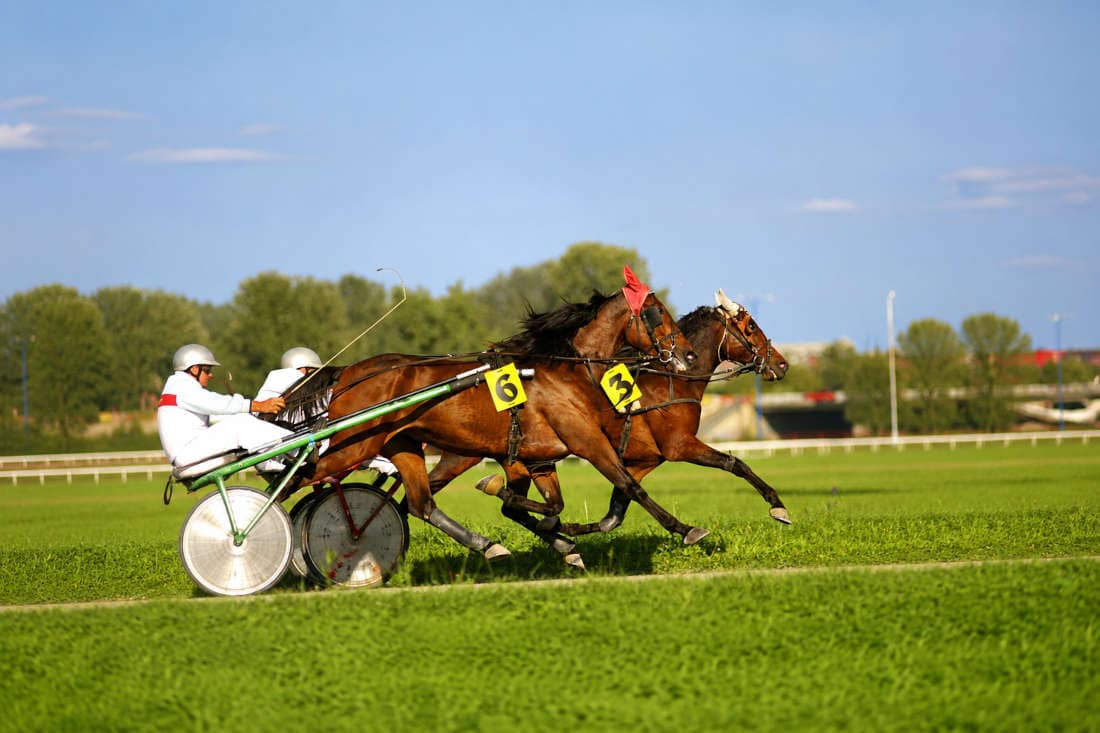
Standardbred pacers and trotters compete in the same harness racing sport, but their gaits determine how they move, train, race, and transition into careers after the track.
Trotters move in diagonal pairs, while pacers move laterally with both legs on one side reaching forward together. These two-beat gaits may look similar at speed, but they reflect important differences in movement mechanics, equipment use, racing divisions, and performance demands.
The differences between pacers and trotters are influenced by genetics, breeding, training, and harness racing tradition. These differences can also affect injury patterns, retraining needs, and what owners should expect from retired Standardbreds entering new riding careers.
Keep reading to learn how pacing and trotting differ, why some Standardbreds are more likely to perform one gait than the other, and what these differences mean for racing, management, and life beyond the track.
Standardbred Pacers & Trotters
Pacers and trotters are not separate breeds. Both are Standardbred horses developed in the United States specifically for harness racing. The difference between them is the gait they use while racing.
- A trotter moves the front leg on one side of the body together with the hind leg on the opposite side. The right front and left hind legs move forward together, followed by the left front and right hind legs.
- A pacer moves both legs on the same side of the body together. The right front and right hind legs move forward at the same time, followed by the two left legs. [1]
Both gaits have two beats, meaning two feet land at roughly the same time on each beat. However, pacers are generally faster than trotters. These differences affect how the horses are raced, trained, and later retrained for other types of work. [1][2]
In harness racing, pacers and trotters compete in separate divisions because each gait involves a different pattern of movement.
Horses must maintain the correct gait throughout the race. If a horse breaks into a canter or gallop, the driver must bring the horse back into the correct gait. The horse may lose ground or receive a penalty, depending on the rules of the race.
The distinction also matters after a horse retires from racing. A retired trotter may find it easier to perform a regular trot under saddle because the movement is already familiar. A retired pacer may need more time to learn to move in diagonal pairs at the trot and maintain a balanced canter.
These differences do not mean one type is better than the other. They simply affect the horse’s starting point for retraining and future work.
What's your top priority with your horse's health?

What's your top priority with your horse's health?
History of Trotters & Pacers
The Standardbred’s story is closely tied to the history of harness racing in America.
What began as informal road races between neighbors became a regulated sport with its own breed registry, eventually leading to two distinct harness racing divisions: trotting and pacing.
Standardbred Foundation Bloodlines
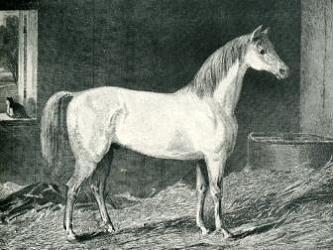
Nearly every Standardbred alive today traces back to one horse. Messenger, a gray Thoroughbred stallion, was imported to the United States in 1788.
His great-grandson, Hambletonian 10, foaled in 1849, became the foundation sire of the breed. [3]
Hambletonian 10’s descendants were crossed with other breeds known for speed and stamina, including the Morgan, the Canadian Pacer, and the Norfolk Trotter. That mix of bloodlines produced horses capable of both trotting and pacing at speed. [3]
The Standardbred Name
The Standardbred’s name has nothing to do with the breed’s appearance. Early trotters had to meet a required time, or “standard,” to be entered into the studbook.
Wallace’s American Trotting Register, first published in 1871 and formally acknowledged in 1879, recorded horses that could trot a mile in two and a half minutes or better. [2][5]
Modern Standardbreds have left that original standard far behind. Today’s fastest horses, pacers and trotters alike, cover a mile in well under two minutes, a dramatic improvement from the breed’s founding requirement.
Trotters & Pacers Today
Pacing became the dominant gait in North American harness racing over time, partly because it is faster and partly because pacers are less likely to break stride during a race.
Legendary pacers such as Dan Patch and Bret Hanover helped build the sport’s popularity in North America during the 20th century. [6]
In continental Europe, trotting remains the primary gait for harness racing.
How the Trotting & Pacing Gaits Differ
At racing speed, trotting and pacing can be difficult to tell apart at first. The clearest difference is the pattern of the horse’s leg movement, since each gait is defined by which legs move together.
The Trotting Gait
Trotting is a gait almost every horse can perform naturally, Standardbred or not. Diagonal leg pairs move as a unit. When the right front leg swings forward, so does the left hind leg, at the same instant.
That diagonal gait is the same trot most riders already know under saddle, just performed at far higher speed with a harness driver instead of a rider.
The Pacing Gait
Pacing is a lateral gait. The two legs on the same side of the horse move together instead of diagonally. The right front and right hind swing forward as a pair, followed by the left front and left hind.
The gait traces back to bloodlines such as the Narragansett Pacer and Canadian Pacer, early contributors to the Standardbred. Under saddle, pacing tends to feel rolling or side to side.
Speed Differences
Pacers still hold a slight speed edge over trotters at the top level of the sport today, though both gaits have become considerably faster since the breed’s early days.
Table 1. Standardbred pacer vs. trotter: key differences
| Key Differences | Standardbred pacer | Standardbred trotter |
|---|---|---|
| Leg movement |
|
|
| Gait type |
|
|
| Racing speed |
|
|
| Common equipment |
|
|
| Racing division |
|
|
| Gait influences |
|
|
| Retraining under saddle |
|
|
Hopples & Other Gait-Assist Equipment
Watch a harness race closely, and you will often notice loops of material connecting a horse’s legs. This equipment helps keep horses locked into their racing gait, and it looks different depending on whether the horse is a pacer or a trotter.
Why Pacers Wear Hopples
Hopples are straps that connect a horse’s front and hind leg on the same side, reinforcing the lateral movement that defines the pace. Most pacers race in hopples because breaking stride into a gallop can cause a horse to be set back in the standings or disqualified. [7]
A small number of pacers race without hopples at all. These free-legged pacers maintain the gait through training and natural tendency alone. Some of the sport’s most famous pacers, including American Standardbred pacer Dan Patch, raced free-legged.
Trotting Hopples
Trotters can wear hopples too, though it is far less common. The equipment is also configured differently to reinforce the diagonal gait instead of the lateral one.
Not every pacer wears hopples, and not every horse in hopples is a pacer. The equipment is a training aid tailored to the individual horse, not a strict marker of one gait or the other.
Gait Genetics & Harness Performance
For a long time, the difference between a natural pacer and a natural trotter was attributed to bloodlines and instinct. Genetic research has since confirmed this, identifying a specific mutation that explains much of what horsemen had already observed for generations.
DMRT3 is a gene involved in building the spinal cord circuits that coordinate limb movement. A mutation in this gene affects how the nervous system coordinates the limbs and is strongly associated with alternate gaits, including the pace. [8]
Horses inherit two copies of the DMRT3 gene, one from each parent. In the original discovery study, having two copies of the mutated version was strongly associated with pacing ability in Icelandic horses. However, both Standardbred pacers and trotters usually have two copies, which indicates the DMRT3 mutation alone does not determine which gait a Standardbred uses in racing. [8]
Follow-up research on Standardbreds and Nordic trotters found that horses with two copies of the DMRT3 mutation generally had better racing performance than horses with the wild-type allele. [9]
Similar patterns have turned up in other gaited breeds. A study of Icelandic horses found that horses with two copies of the mutation showed a stronger ability to perform pace and other alternate gaits. [10]
Genetic Testing & Modern Breeding
Because the DMRT3 variant is now identifiable with a simple DNA test, breeders no longer have to guess at a young horse’s gait potential. Commercial tests, including the version commonly accessed through the UC Davis Veterinary Genetics Laboratory, screen for the mutation directly. [11]
For breeders working to produce pacers or trotters specifically, DMRT3 testing alone has limited value, since the mutation does not distinguish the two gaits
Racing Performance, Training & Injury Risk
Gait affects more than how a horse moves. It also shapes the physical demands placed on the horse’s limbs and joints over a racing career.
Trainability in Pacers & Trotters
Among trainers, trotters are considered the more technically demanding half of the sport. A trotting horse has to maintain a clean, even diagonal gait at speed without breaking into a canter. Drivers often need more finesse to keep a trotter balanced through a race.
Pacers, especially those wearing hopples, tend to be more mechanically stable at high speed. That stability is part of why pacing became the dominant gait in North American harness racing, even though trotting still carries more prestige in some circles.
Injury Patterns in Pacers & Trotters
Musculoskeletal injuries can interrupt training and affect performance in both pacers and trotters. Studies of harness-racing horses provide insight into when these injuries occur and which parts of the limbs are most often affected. However, the available research does not directly compare pacers with trotters.
A 12-month study of Standardbreds in training recorded 17 new injuries, all in pacers. These injuries included soft-tissue, bone, and joint problems, with soft-tissue injuries reported most often. [12]
Overall, 23% of the pacers were injured during the study, and slightly more than half of the injuries occurred during training. Possible risk factors included faster training speeds, previous injuries, and offset knees. However, the small study size means these findings require careful interpretation. [12]
A separate four-year study followed 356 racing trotters and recorded injuries that kept horses out of training for at least 15 days. Suspensory ligament and superficial digital flexor tendon injuries were the most common, accounting for more than one-third of all recorded injuries. [13]
Compared with findings from Thoroughbred racehorses, the racing trotters had fewer stress fractures but more tendon and suspensory ligament injuries. Differences in gait, speed, and how the limbs absorb force may help explain these patterns. [13]
These two studies suggest that factors such as workload, previous injury, conformation, and training intensity can influence injury risk in individual Standardbreds. [12][13]
Neither gait is risk-free. However, injury type, recovery time, and long-term soundness can vary depending on which gait a horse races. A thoughtful injury rehabilitation plan should account for the individual horse’s history, soundness, and future workload.

Retraining Pacers & Trotters as Riding Horses
Many retired Standardbreds go on to second careers well beyond the racetrack. Retraining a pacer and retraining a trotter both involve teaching the horse to carry a rider instead of pull a cart, but the starting point looks a little different for each.
Do Pacers & Trotters Retrain Differently?
A trotter’s racing gait already resembles the trot a rider will ask for under saddle, so that transition is often more direct.
A pacer typically needs more focused groundwork and early riding sessions to re-establish a clean, diagonal trot and a balanced canter, since neither movement is what the horse raced in.
This transition is a well-established, teachable process, even though the exact adjustment period varies from horse to horse.
What to Expect Under Saddle
Early rides on an off-track Standardbred can involve some unsteadiness or gait confusion as the horse adjusts to a rider’s aids instead of a driver’s lines and voice commands. That is a normal part of the transition.
Standardbreds are generally known for a willing, people-oriented temperament, which tends to work in their favor during retraining. Most adapt well once they understand what is being asked of them in this new context.
Setting Up a Standardbred for Success
As with any off-track horse, a veterinary soundness exam and appropriate recovery time before starting retraining help set a Standardbred up for success.
Groundwork is a useful first step for building communication before asking the horse to carry a rider’s weight and respond to leg and rein cues.
Many off-track racehorse retraining principles also apply to Standardbreds as they transition into other riding careers.
Training Pacers to Trot
One of the most persistent myths about Standardbreds is that pacers cannot trot, or that trotters cannot pace. In practice, gait is far more flexible outside the racetrack than the terms pacer and trotter suggest.
Many pacers can trot naturally when turned out in a pasture, free of hopples and a driver’s cues. Some trotters can also show pacing or other lateral movement patterns. A horse’s racing gait reflects a combination of genetics, training, and equipment, not a hard physical limit on what its body can do.
This flexibility matters for anyone considering a retired Standardbred for a new career. A horse labeled a pacer for racing purposes is not necessarily locked into that gait for life.
Understanding Pacers & Trotters Beyond the Track
Pacers and trotters share the same Standardbred breed background, but their racing gaits shape how they move, train, compete, and transition into new careers. Trotters race in a diagonal two-beat gait, while pacers race in a lateral two-beat gait that is generally faster and more mechanically stable at speed.
These differences influence racing divisions, equipment choices, training demands, and the way each horse may feel under saddle after leaving the track.
Genetics also play an important role. The DMRT3 mutation has helped explain why some Standardbreds are more likely to pace, maintain alternate gaits, or perform well in harness racing.
However, gait expression is not determined by genetics alone. Training, equipment, handling, conditioning, soundness, and individual temperament all influence how a horse moves and performs.
For owners, trainers, and adopters, the most important takeaway is that the labels “pacer” and “trotter” describe a horse’s racing gait, not their full potential.
Many retired Standardbreds can adapt successfully to riding careers with appropriate veterinary care, groundwork, conditioning, and patient retraining.
Understanding the differences between pacers and trotters helps set realistic expectations and gives each horse a better chance at long-term soundness, comfort, and success beyond the track.
Frequently Asked Questions
Here are some frequently asked questions about Standardbred pacers and trotters:
The difference between a Standardbred pacer and a trotter is the gait each horse uses in harness racing. Trotters move diagonal leg pairs together, with the right front and left hind moving forward as a pair, followed by the opposite pair. Pacers move laterally, with the front and hind legs on the same side moving forward at nearly the same time. Both are Standardbreds, but they race in separate divisions because the two gaits are mechanically different.
Pacers and trotters are not different breeds. Both are Standardbreds, a breed developed in the United States for harness racing. The terms pacer and trotter describe the gait a horse uses to race, not separate breed categories. However, pacing and trotting lines may be selected somewhat differently within the same breed registry.
Pacers are usually faster than trotters because the pacing gait is more mechanically stable and efficient at high speed. The lateral movement pattern creates a smoother, more economical stride and makes pacers somewhat less likely to break into a gallop under exertion. This speed advantage helped pacing become the dominant gait in North American harness racing. Trotters can still be extremely fast, but pacers generally hold the top speed edge.
Pacers wear hopples to help reinforce the lateral pacing gait during training and racing. Hopples connect the front and hind leg on the same side of the horse, encouraging the legs on that side to move together. This reduces the chance that the horse will break stride into a gallop, which can lead to being set back or disqualified in a race. Some pacers race without hopples, but most use them as a gait-assist aid.
Trotters can wear hopples too, although it is much less common than in pacers. Trotting hopples are configured differently because they are designed to support a diagonal gait rather than a lateral gait. This means hopples are not a guaranteed sign that a horse is a pacer. They are a training aid selected for the individual horse and the gait it needs to maintain.
The DMRT3 gene (doublesex and mab-3 related transcription factor 3) has an important role in coordinating locomotion. A nonsense mutation in this gene facilitates alternate gaits and the ability to maintain trot or pace at high speed without breaking into a gallop. However, the mutation is highly prevalent in both American Standardbred pacers and trotters, so DMRT3 genotype alone does not determine which gait a Standardbred will use in racing. Other genetic modifiers, along with breeding and training, influence preferred gait.
A pacer can often trot naturally, especially when turned out without racing equipment or driver cues. Many pacers use a trot freely outside the racetrack, even if they raced at the pace. The label pacer describes the gait the horse competed in, not a permanent physical limit. This is important for owners considering a retired pacer for riding or another second career.
A trotter may be able to pace, but pacing is less commonly observed in trotters than trotting is in pacers. A horse's racing gait reflects genetics, training, equipment, and the division it was prepared for. Some horses are naturally more flexible in their movement patterns than others. In racing, however, trotters and pacers are trained and entered according to their specific gait.
Trotters are often considered harder to train than pacers because they must maintain a clean diagonal gait at high speed. Staying balanced at the trot requires precision, and drivers may need more finesse to prevent a trotter from breaking stride. Pacers, especially those wearing hopples, tend to be more mechanically stable at racing speed. This does not mean pacers are easy to train, but the pacing gait is generally more forgiving in harness racing.
Pacers and trotters are both at risk of musculoskeletal injury during training and racing. Studies have documented tendon, ligament, bone, and joint injuries in Standardbreds, but current evidence is insufficient to clearly establish how injury risk differs between the two.
Standardbred pacers can become riding horses with patient retraining. A pacer usually needs focused groundwork and early riding sessions to re-establish a clear diagonal trot and develop a balanced canter. This process is well established, but the adjustment period varies from horse to horse. A veterinary soundness exam and appropriate recovery time help set an off-track pacer up for a successful transition.
Trotters may be easier than pacers to retrain under saddle because their racing gait already resembles the trot used in riding. A trotter still has to learn to carry a rider, respond to leg and rein cues, and adjust from a driver's voice and lines to ridden aids. Pacers often need more time to clarify the trot and canter because those were not the gaits they raced in. Both types can make useful riding horses with consistent, patient training.
An off-track Standardbred under saddle may feel unsteady at first as the horse learns a new job. Some horses show gait confusion while adjusting from harness work to ridden cues, especially pacers learning to trot and canter clearly. Standardbreds are generally known for a willing, people-oriented temperament, which can make retraining smoother. Groundwork before riding helps build communication and confidence.
Retired Standardbreds can go on to many second careers, including trail riding, pleasure driving, eventing, and general riding work. Their harness racing background often gives them valuable handling experience and comfort with routine, equipment, and human direction. The best discipline depends on the horse's soundness, temperament, training history, and movement. With a thoughtful transition, both pacers and trotters can become versatile post-racing partners.
Summary
Standardbred pacers and trotters compete in harness racing using different two-beat gaits that affect speed, equipment, training, and retraining after the track. Pacers move laterally, while trotters move in diagonal pairs, but both can transition successfully into second careers with appropriate management.
- Pacers and trotters are not separate breeds; both are Standardbreds bred for harness racing
- Trotters move diagonal leg pairs together, while pacers move the front and hind legs on the same side together
- Pacers are generally faster and more mechanically stable at racing speed
- Injury risk can vary with workload, conformation, previous injury, training speed, and the physical demands of each racing gait
- Retired pacers often need focused retraining to establish a clean trot and balanced canter under saddle
References
- Standardbred & Harness Racing Glossary. Standardbred Canada.
- New to Racing: History of the Standardbred. Standardbred Canada.
- What Is Harness Racing? United States Trotting Association.
- Stubbs. G. British Racehorse "Messenger". Public Domain via Wikimedia Commons.
- Harness Racing Museum & Hall of Fame. John Wallace. Harness Racing Museum & Hall of Fame.
- USTA. A History of Harness Racing. United States Trotting Association. n.d.
- 2026 US Trotting Rule Book. United States Trotting Association. 2026.
- Andersson. L. S. et al. Mutations in DMRT3 affect locomotion in horses and spinal circuit function in mice. Nature. 2012.
- Jäderkvist. K. et al. The DMRT3 'Gait keeper' mutation affects performance of Nordic and Standardbred trotters. J Anim Sci. 2014.
- Kristjansson. T. et al. The effect of the 'Gait keeper' mutation in the DMRT3 gene on gaiting ability in Icelandic horses. J Anim Breed Genet. 2014.
- UC Davis. SynchroGait (DMRT3). Veterinary Genetics Laboratory, University of California, Davis. n.d.
- Rouette. J. et al. Musculoskeletal injuries in Standardbred racehorses on Prince Edward Island. Can Vet J. 2021.
- Bertuglia. A. et al. Epidemiology of musculoskeletal injuries in a population of harness Standardbred racehorses in training. BMC Vet Res. 2014.