English

Harness racing tests the speed of Standardbred horses as they pull drivers in lightweight, two-wheeled carts called sulkies around an oval track. Unlike mounted horse racing, the driver sits behind the horse and guides it from the sulky.
The sport has two gait-based divisions: trotting and pacing. Trotters move their legs in diagonal pairs, while pacers move the legs on the same side of the body together. This distinction influences nearly every aspect of the sport, from breeding and training to the specialized equipment horses wear on the track.
Harness racing has deep roots in North America, evolving from informal road races between neighbors into a structured international sport with breed registries, governing bodies, and prestigious championship races.
Keep reading to explore the history and rules of harness racing, along with Standardbred training, equipment, health, and nutrition.
What is Harness Racing?
Harness racing is a form of horse racing in which a horse pulls a driver in a lightweight, two-wheeled cart rather than carrying a rider. Races are held at either the trot or the pace, typically over one mile on an oval track. [1][2]
The sport predominantly involves Standardbred horses, an American breed developed specifically for speed and stamina in harness. Standardbreds get their name from the standard mile time horses once had to meet to qualify for the breed registry. [3][4][2]
Trotters and pacers compete separately. Pacing is generally the faster of the two gaits, and most modern Standardbreds are bred and trained from an early age to specialize in one gait. [1][2]
What's your top priority with your horse's health?

What's your top priority with your horse's health?
History of Harness Racing
The roots of American harness racing trace back to colonial times, when settlers raced trotting horses informally along country roads and village streets.
Origins of Harness Racing
County fairs began hosting organized trotting races as early as 1825, well before the sport had formal rules or a governing body. Dedicated racetracks followed in the mid-1800s, transforming harness racing from an informal pastime into an organized sport with prize money at stake. [3]
Hambletonian 10, foaled in 1849, became the foundation sire of the Standardbred breed. Nearly all modern Standardbreds trace their bloodlines to him. [3]
The equipment used in the sport evolved as dramatically as its organization. Early racing carts weighed approximately 125 pounds, but breeders and engineers steadily reduced that weight throughout the 19th century, reaching roughly 46 pounds by the 1870s. [1][3]
The introduction of bicycle wheels and pneumatic tires in the 1880s and 1890s helped produce the lightweight, high-speed sulkies still recognizable on racetracks today. [3]
Rising Popularity of Harness Racing
The sport reached a milestone in 1903, when the trotter Lou Dillon became the first Standardbred to complete a mile in under two minutes. Her sulky weighed only 25 pounds, a fraction of the weight of carts used a century earlier. [1]
Harness racing expanded well beyond North America during the 19th and 20th centuries. Trotting races were established in France in 1836, and Standardbred bloodstock was exported to trotting nations across Europe, Australia, and New Zealand as American breeding stock gained an international reputation. [1]
Golden Era of Harness Racing
Harness racing experienced its greatest surge in popularity after the Second World War. During the 25 years following 1948, attendance nearly tripled and purses grew nearly tenfold, a period often remembered as the sport’s golden era. [1]
The pacer Bret Hanover became one of the defining horses of this period, winning 62 of 68 career starts between 1964 and 1966 and earning three Horse of the Year titles. An earlier star, Dan Patch, had already helped raise the sport’s profile by becoming one of the most famous athletes in America, human or equine. [3]
Sport Organizations
Several organizations oversee harness racing in North America and abroad, with responsibilities ranging from breed registration to the administration of prestigious races.
United States Trotting Association
The United States Trotting Association (USTA) serves as the primary governing body for harness racing in the United States. Founded in 1939, the organization licenses drivers and trainers, maintains the Standardbred breed registry, and establishes rules for racing nationwide. [4]
The USTA has been headquartered in Columbus, Ohio, since 1948. State racing commissions assumed many day-to-day regulatory duties in the 1960s, but the USTA continues to play a central role in registration, licensing, and record-keeping within the sport. [4]
International Governance
Harness racing extends well beyond the United States. Standardbred Canada oversees the sport in Canada, which is home to major races such as the North America Cup at Woodbine Mohawk Park. Harness Racing Australia and various European trotting associations regulate the sport in their respective countries. [5][6]
Trotting breeds native to Europe, including the French Trotter and Scandinavian Coldblood Trotter, compete under their own regional rules while sharing ancestry with the American Standardbred.
This global network of registries allows leading bloodlines to move between countries while maintaining consistent standards for competition.
Racing & Competition
Harness racing follows a distinct set of rules centered on maintaining a horse’s assigned gait throughout the race. Structured classifications also determine which horses compete against each other.
Trotters & Pacers
Trotters move their legs in diagonal pairs. The right front and left hind legs strike the ground together, followed by the left front and right hind. [2] Pacers move their legs on the same side of the body together. This lateral gait tends to produce faster race times than trotting. [2]
The pacing gait is less naturally stable for most horses, so pacers typically wear hopples, a set of straps that loop around the front and hind legs on each side to help maintain lateral rhythm at speed. [1][2]
Trotters generally race without hopples, relying on training, conformation, and gait purity to maintain a clean diagonal stride. [1][2]
If a horse breaks from its assigned gait into a gallop, the driver must slow the horse and correct its stride before continuing at full speed. A horse that breaks gait and interferes with other competitors may be disqualified. [1][4]
Race Day
Harness races begin with a rolling start behind a mobile starting gate, a vehicle fitted with extended wings that accelerates down the track ahead of the field. [1][2] As the vehicle reaches the starting line, it pulls away and the wings fold back, releasing the horses to race at full speed from a moving start rather than a standing start. [1]
Horses are assigned post positions that determine their starting places relative to the rail. Over a one-mile race, an inside post generally offers a slight tactical advantage. [1]
Before racing for purse money, horses typically must complete qualifying races that demonstrate they can compete safely and maintain their gait at the required speed. [1]
Rules & Classifications
Racing officials monitor each race for gait violations, interference, and other rule breaches. They may fine, suspend, or disqualify drivers and trainers for infractions identified during post-race review. [1][4]
Harness races are divided into classifications similar to those used in other forms of horse racing. [1]
- Claiming races allow horses to be purchased for a set price immediately after the race.
- Conditioned races group horses according to factors such as qualifying times and career earnings.
- Stakes races offer the largest purses and attract the sport’s leading competitors. [1]
Major Races
The Hambletonian is the most prestigious race for three-year-old trotters. The Little Brown Jug holds similar status for three-year-old pacers and has been held annually at the Delaware County Fairgrounds in Ohio since 1946. [3]
The Meadowlands Pace and North America Cup rank among the sport’s premier events for three-year-old pacers, while the Breeders Crown brings together champions from every age and gait division each fall. [7][8][9]
Harness Racing Training
Standardbred training begins earlier than training for most other equestrian disciplines. Horses are typically introduced to the harness and cart as yearlings, with formal training beginning around 18 months of age so they are ready to race at age two. [10]
Early training focuses on teaching young horses to accept the harness, pull the sulky calmly, and maintain a clean gait at increasing speeds. Trainers devote considerable time to developing gait purity at this stage because a horse that breaks stride under pressure cannot compete effectively. [1][2]
Horses generally progress from jogging at a slow warm-up pace to more structured training miles as their fitness improves. Conditioning programs balance speed work with longer, steadier training miles to build cardiovascular fitness and muscular endurance over a racing season. [11][12]
Research on Standardbreds in training has examined changes in muscle glucose transporter expression in response to this type of conditioning, offering insight into how the body adapts at a cellular level to the demands of harness training. [11]
Before becoming eligible to compete for purse money, horses typically must complete qualifying races. These races allow trainers and officials to confirm that a horse is fit, sound, and able to maintain its gait under racing conditions. [1]

Harness Racing Equipment
Harness racing equipment differs substantially from the tack used in most riding disciplines, reflecting the unique demands of driving a horse rather than riding under saddle.
The Sulky
The sulky, also called a bike, is a lightweight, two-wheeled cart attached to the horse’s harness by a pair of shafts. Modern sulkies weigh a fraction of their 19th-century predecessors and are built from lightweight materials that minimize the load a horse must pull at speed. [1]
Harness & Hopples
The harness connects the horse to the sulky shafts and distributes the pulling load across the horse’s body. [2]
Pacers typically wear hopples, adjustable straps connecting the front and hind legs on each side. These straps help reinforce the lateral pacing gait and reduce the likelihood of breaking stride. [1][2]
Many horses also wear equipment such as blinkers or an overcheck to help them remain focused and balanced during a race. [1]
Shoeing
Shoeing choices have a particularly important influence in harness racing because contact with the track surface directly affects gait and speed. [13]
Research comparing shoeing conditions in Standardbred trotters found that racing barefoot or with shoes significantly affected both race times and the risk of galloping or disqualification.
Horses shod only on the hind hooves showed a performance advantage over fully shod horses without the additional risk associated with racing fully barefoot. [13]
Driver Attire
Drivers wear colored silks representing the horse’s owner, along with a helmet and protective vest, which are required at most sanctioned tracks.
Racing gloves and goggles are also common, helping drivers maintain their grip and visibility while seated low in the sulky at speed. [1][2]
Harness Racing Horses
The Standardbred is the predominant breed in harness racing worldwide, selectively bred over generations for speed, stamina, and gait purity at the trot or pace.
Standardbred Breed
Standardbreds trace their lineage to Hambletonian 10. Related trotting breeds, including the French Trotter and Scandinavian Coldblood Trotter, share ancestry with the Standardbred but developed under separate regional breed registries over the past two centuries. [3][4]
Like Thoroughbreds, Standardbreds were developed for athletic performance. The breed’s calm, willing temperament can support a successful second career after retirement from racing. [2]
Managing Harness Horses
Harness Standardbreds face a documented risk of musculoskeletal injury during training. These injuries tend to affect the joints and soft tissues that absorb repetitive loads at speed. [14]
Repetitive work on the track places consistent stress on the lower limbs, making ongoing monitoring an important part of managing harness horses. Raceday incident reporting systems used in harness racing help track gait breaks, interference, injuries, and other on-track events as part of routine stewarding and veterinary oversight. [14][15]
Research measuring pacers through racetrack turns found that horses can show natural stride asymmetry at racing speed. For trainers and veterinarians, this highlights the importance of interpreting gait changes in context rather than assuming every asymmetry reflects lameness or poor track design. [16]
Young Standardbreds in training may have early joint findings on X-rays even when they move normally and show no obvious lameness. One study of nonlame yearling Standardbreds found small bony changes around the lower hock in about one-quarter of the horses examined.
These findings were usually incidental, but they still highlight the necessity of routine soundness checks and veterinary monitoring when managing young harness horses in training. [17]
Related research on the third carpal bone in racing Standardbreds has linked repetitive trauma to early degenerative changes in cartilage and the underlying subchondral bone. [18]
Exercise-induced pulmonary hemorrhage (EIPH) is another significant concern in racing Standardbreds. In one endoscopic survey, 87 percent of the Standardbred racehorses examined showed some evidence of bleeding after racing, making ongoing respiratory monitoring essential for these athletes. [19]
Routine farrier care and consistent veterinary monitoring can help identify developing concerns before they affect performance or soundness. Regular turnout and time away from the track also support physical recovery and mental well-being in horses following an intensive racing schedule.
Feeding Harness Racehorses
Racing places high energy demands on Standardbreds. Most harness racehorses are fed grain or other concentrate feeds alongside forage to provide enough calories to support intensive training, racing, recovery, and maintenance of body condition.
Because large grain meals can provide substantial amounts of starch and sugar, feeding practices should aim to meet energy requirements while minimizing unnecessary digestive stress. High-concentrate diets and intensive training are both associated with an increased risk of gastric ulcers and digestive upset.
A forage-first approach can help support gastrointestinal health without eliminating the concentrates needed by many racehorses. Providing consistent access to good-quality forage, avoiding long periods without feed, and dividing grain into multiple smaller meals can help reduce digestive stress while maintaining adequate calorie intake.
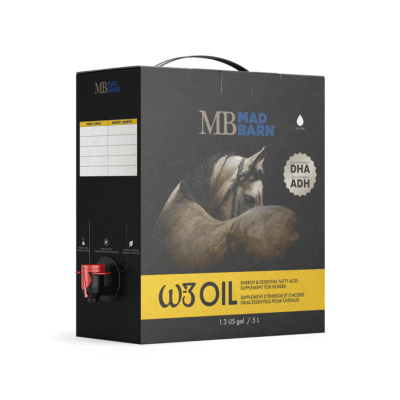
Adding fat to the ration is another way to increase calorie density while reducing reliance on starch and sugar for energy. For horses with high energy demands, w-3 Oil provides a palatable source of concentrated calories enriched with the omega-3 fatty acid DHA and natural vitamin E.
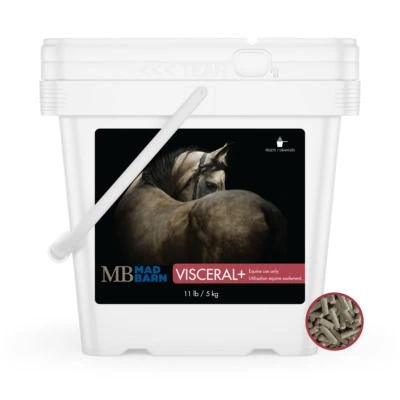
For harness racehorses in intensive training, targeted digestive support may also complement a well-managed feeding program. Visceral+ is a competition-safe formula designed to support gastric and hindgut health, maintain a healthy intestinal lining, and provide probiotics and prebiotics that nourish the microbiome.
The right diet for a harness racehorse depends on the horse’s age, workload, racing schedule, body condition, appetite, and individual health history. Submit your horse’s diet for a free evaluation and work with Mad Barn’s equine nutritionists to develop a feeding program that meets the demands of training and racing while supporting digestive health and long-term performance.
Frequently Asked Questions
Here are some frequently asked questions about harness racing:
Harness racing is a form of horse racing in which a horse pulls a driver in a lightweight, two-wheeled cart called a sulky. Horses compete on oval tracks at either the trot or the pace rather than racing under saddle. Most harness races are held over a distance of one mile.
The difference between a trotter and a pacer is the way the horse moves its legs. Trotters move their legs in diagonal pairs, while pacers move the front and hind legs on the same side of the body together. Pacing generally produces faster race times, and trotters and pacers compete in separate races.
The Standardbred is the primary horse breed used in harness racing worldwide. Standardbreds were selectively developed for speed, stamina, and the ability to maintain a clean trot or pace. The breed takes its name from the standard mile time horses once had to meet to qualify for registration.
Hambletonian 10 is important to harness racing because he became the foundation sire of the Standardbred breed. Foaled in 1849, he had a major influence on the development of modern harness racing bloodlines. Nearly every Standardbred racing today can trace its ancestry back to him.
A harness race starts with the horses moving behind a mobile starting gate. The gate's extended wings line up the field as the vehicle accelerates toward the starting line. At the start, the vehicle pulls away and folds its wings, releasing the horses from a rolling start.
If a harness racehorse breaks stride and begins to gallop, the driver must slow the horse and restore its assigned gait before returning to full speed. Racing officials monitor gait violations and interference throughout the race. A horse that breaks stride and interferes with another competitor may be disqualified.
The main types of harness races include claiming races, conditioned races, and stakes races. Claiming races allow entered horses to be purchased for a set price after the race, while conditioned races group horses according to factors such as qualifying times and career earnings. Stakes races typically offer the largest purses and attract the highest-level competitors.
The biggest harness races include the Hambletonian for three-year-old trotters and the Little Brown Jug for three-year-old pacers. The Meadowlands Pace and North America Cup are also premier events for pacers. The Breeders Crown brings together leading horses from different age and gait divisions each fall.
A sulky is the lightweight, two-wheeled cart pulled by a harness racehorse. It attaches to the horse's harness through a pair of shafts, with the driver seated behind the horse. Modern sulkies use lightweight materials to minimize the load the horse must pull at racing speed.
Hopples are adjustable straps that connect the front and hind legs on each side of a pacer's body. They help reinforce the lateral pacing rhythm and reduce the likelihood that the horse will break into a gallop. Trotters generally race without hopples and rely on training, conformation, and gait purity to maintain their diagonal stride.
Standardbred horses typically begin learning to accept the harness and cart as yearlings, with formal training starting at around 18 months of age. Early training emphasizes calm pulling, gait control, and gradual increases in speed and fitness. This preparation can allow horses to begin racing at two years old.
Before racing for purse money, a Standardbred typically must complete qualifying races. These races allow trainers and officials to assess whether the horse is fit, sound, and able to maintain its assigned gait under race conditions. Qualifying also helps confirm that the horse can compete safely with a full field.
Common health problems in harness racehorses include musculoskeletal injuries, joint changes, soft-tissue strain, and exercise-induced pulmonary hemorrhage. Repetitive training at speed places substantial stress on the lower limbs, and some young Standardbreds develop joint changes before visible lameness appears. Routine veterinary monitoring, farrier care, turnout, and adequate recovery time can help identify or manage developing concerns.
Feeding a harness racehorse requires balancing the high energy demands of training with digestive health. Grain-based feeds can help supply energy, but heavy reliance on them may increase the risk of digestive upset and gastric ulcers. A forage-based diet that accounts for the horse's age, workload, racing schedule, and health history provides a practical foundation, with individualized guidance used to address additional needs.
Standardbreds can have successful second careers after retiring from harness racing. Their calm, willing temperament often helps them adapt to new equestrian activities and pleasure riding. Each retired racehorse should still be evaluated individually for soundness, training history, and suitability for its intended new role.
Summary
Harness racing is a competitive equine sport in which Standardbreds pull drivers in lightweight sulkies while racing at the trot or pace. Training, equipment, health monitoring, and appropriate nutrition all support performance and long-term soundness.
- Trotters use a diagonal gait, while pacers move their legs laterally and typically wear hopples to maintain their stride
- Most races are held over one mile and begin from a rolling start behind a mobile starting gate
- Young Standardbreds are introduced to the harness and cart early, with formal training often beginning around 18 months of age
- Routine veterinary, farrier, gait, and respiratory monitoring can help identify concerns associated with intensive training and racing
- A balanced, forage-based diet should meet the horse's energy requirements while supporting gastric and hindgut health
References
- 2026 US Trotting Rule Book. United States Trotting Association. 2026.
- What Is Harness Racing?. United States Trotting Association.
- A History of Harness Racing. United States Trotting Association.
- About Us. United States Trotting Association.
- About Standardbred Canada. Standardbred Canada.
- About Us - HRA. Harness Racing Australia.
- Where to Watch the 2023 Breeders Crown Live from Harrah’s Hoosier Park. Hambletonian Society.
- It’s Pace & Love This Weekend at the Meadowlands Racetrack. Meadowlands Racing & Entertainment. 2025.
- Instant Classic: Louprint Wins Pepsi North America Cup Thriller. Woodbine Entertainment. 2025.
- Ringmark. Sara. et al. Growth, Training Response and Health in Standardbred Yearlings Fed a Forage-Only Diet. Animal. 2013.
- Vidal Moreno de Vega. C. et al. Dynamics of Training and Acute Exercise-Induced Shifts in Muscular Glucose Transporter (GLUT) 4, 8, and 12 Expression in Locomotion Versus Posture Muscles in Healthy Horses. Frontiers in Physiology. 2023.
- Hamlin. M. J. and Hopkins. W. G. Retrospective Trainer-Reported Incidence and Predictors of Health and Training-Related Problems in Standardbred Racehorses. Journal of Equine Veterinary Science. 2003.
- Solé. M. et al. Benefits and Risks of Barefoot Harness Racing in Standardbred Trotters. Animal Science Journal. 2020.
- Bertuglia. A. et al. Epidemiology of Musculoskeletal Injuries in a Population of Harness Standardbred Racehorses in Training. BMC Veterinary Research. 2014.
- Gibson. M. J. et al. Race-Level Reporting of Incidents Using the New Online System During Two Seasons (2019/2020-2020/2021) of Harness Racing in New Zealand. Journal of Equine Veterinary Science. 2022.
- Crawford. W. H. and Leach. D. H. The Effect of Racetrack Design on Gait Symmetry of the Pacer. Canadian Journal of Comparative Medicine. 1984.
- McCoy. A. M. and Scolman. K. N. Impact of Periarticular Osteophytes of the Distal Tarsus Diagnosed in Nonlame Yearling Standardbred Horses on Racing Performance. Veterinary Surgery. 2023.
- Lacourt. M. et al. Relationship Between Cartilage and Subchondral Bone Lesions in Repetitive Impact Trauma-Induced Equine Osteoarthritis. Osteoarthritis and Cartilage. 2012.
- Lapointe. J. M. et al. A Survey of Exercise-Induced Pulmonary Haemorrhage in Quebec Standardbred Racehorses. Equine Veterinary Journal. 1994.