English
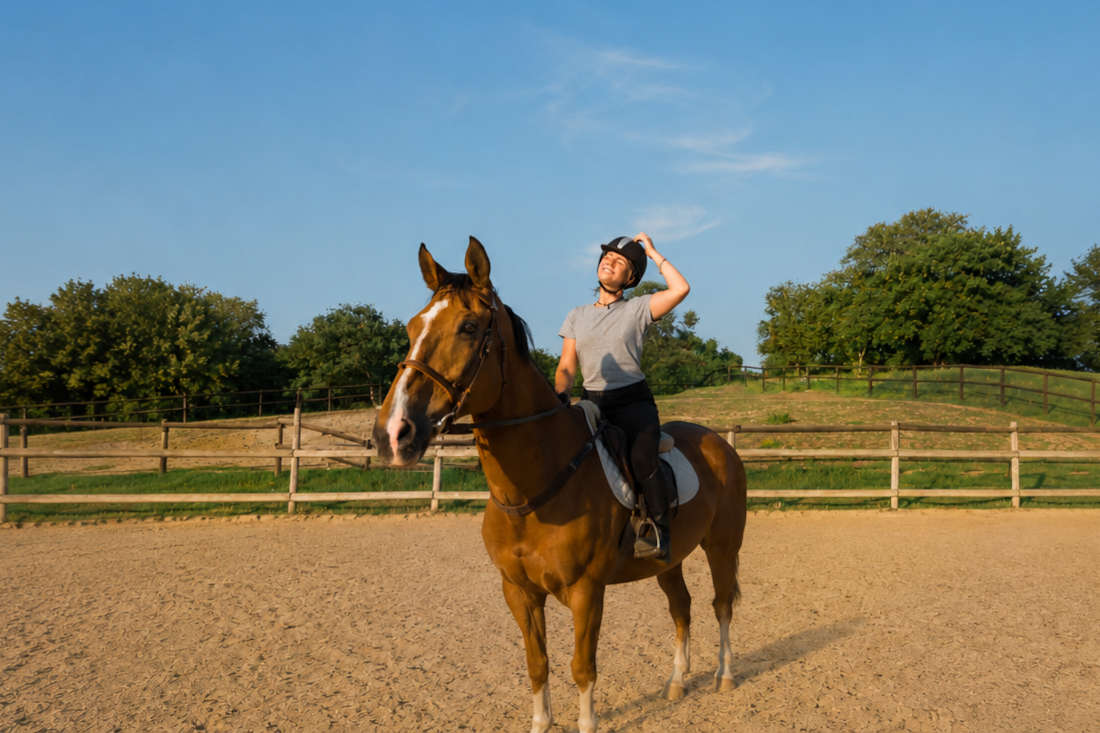
Rider confidence after a fall or setback can feel hard to regain, even when the rider is physically ready to get back in the saddle.
A stop at a fence, a difficult ride, a painful fall, or a disappointing competition round can change how a rider feels before they mount, approach a jump, or enter the ring. The horse may be capable, the rider may understand what to do, but fear and hesitation can still interfere with timing, balance, and communication.
Getting back in the saddle and rebuilding confidence is not just a matter of “getting over it.” Rider anxiety has real psychological and physical effects, and horses can respond to the tension, uncertainty, and changes in the aids that come with it. A thoughtful return to riding means addressing both the rider’s anxiety and the training environment that supports progress.
Keep reading to learn why riders lose confidence, how fear can affect performance and the horse-rider relationship, and which practical strategies can help riders rebuild trust in themselves and their horses.
Why Riders Lose Confidence After a Fall
Rider confidence can change quickly after a fall, refusal, or difficult ride. In some cases, the effect is immediate. In others, confidence declines gradually after several negative experiences.
Maybe it was the fall that sent the rider to the ground, the fence their horse stopped at three times in a row, or the competition round that unraveled when it mattered most. These experiences can leave a mark that lasts long after any physical injury has healed.
For many riders, the path back to confidence is slower and less obvious than physical recovery. Some push through too quickly and find that anxiety deepens. Others wait until they feel fully ready, only to discover that the feeling never quite arrives. Understanding what triggered the loss is the starting point for meaningful recovery.
1) Falls & Physical Incidents
Falls are the most common and most visible trigger for confidence loss in equestrian sport.
Research consistently shows that horseback riding carries a higher risk of serious injury requiring hospital admission than football, motor racing, and skiing. [1]
For many riders, the accident is only the beginning. The psychological impact often outlasts the healing of physical injury. A rider who falls and gets back on the same day can still develop lasting anxiety after a riding injury. The severity of the injury is not always a reliable indicator of the psychological aftermath.
The effect of minimizing a fall because there was no injury is often overlooked. Riders who dismiss what happened, or who feel pressure from others to move on, may find that anxiety resurfaces later.
2) Refusals & Jumping Setbacks
For jumpers and eventers, a refusal or run-out can become its own kind of confidence event. The fence does not have to be big. One stop at the wrong moment can change how the rider feels on the next approach.
This is where the confidence cycle often starts. The rider expects another stop, so they may hold their breath, brace, tip forward, pull back, or hesitate with the leg. The horse feels that uncertainty and may become less committed to the fence. If the horse stops again, the rider’s fear is confirmed, and the pattern becomes harder to interrupt.
The issue is not always fear of falling. Sometimes the rider loses trust in their own timing, their ability to see a distance, or their ability to keep the horse in front of the leg. That loss of trust can make each approach feel more complicated than it needs to be.
Competition rounds that go wrong can carry similar mental strain. A rail down, a missed distance, an elimination, or a mistake at a critical moment can leave an impression that accumulates into a loss of confidence over time.
Rebuilding confidence after a stop requires restoration of clear, consistent communication between horse and rider before the next question is asked.
3) Criticism & Comparison
Not every confidence crisis begins with a dramatic incident. Many riders also struggle with criticism and comparison that gradually erode confidence.
A comparison to a barn mate who seems to be progressing faster can feel destabilizing. A period of poor performance can compound until the rider questions their basic abilities.
Riders in equitation disciplines face an additional layer of vulnerability because the quality of their own position and style is explicitly judged. A poor score or negative comment from a judge can take on an outsized meaning when confidence is already fragile.
What's your top priority with your horse's health?

What's your top priority with your horse's health?
The Psychology of Riding Confidence
Confidence has measurable psychological and physiological roots that sport science has studied across disciplines. Understanding what happens in the body and brain during a confidence crisis can help riders approach recovery more deliberately.
Fear, Stress Hormones & the Body in the Saddle
Fear activates the body’s fight-or-flight response, triggering the release of cortisol and adrenaline. Heart rate rises, attention narrows, and the brain shifts toward threat detection rather than the fine timing and body awareness that riding requires. [2]
In the saddle, this can change how the rider communicates. A tense rider may brace through the hip flexors, lock the lower back, grip with the knee, hold their breath, or become fixed in the hand. The aids, which depend on softness and timing, become rigid or inconsistent.
For jumping riders, these changes often appear on the approach to a fence. The rider may stop following the motion, collapse forward, pull back unintentionally, or hesitate with the leg. Even small changes can make the horse less certain about the question being asked.
Riders often describe this as going blank, freezing, or getting in their own way. These reactions are not a lack of commitment. They are signs of a nervous system under perceived threat, and they can be improved with the right mental skills and training structure.
Building Confidence Through Self-Efficacy
Self-efficacy is the term sport psychologists use to describe a person’s belief in their own capacity to perform specific actions successfully.
Unlike general self-confidence, self-efficacy is task- and context-specific and, critically, not fixed. Research consistently shows a positive relationship between pre-event self-efficacy and athletic performance across a wide range of sports. [3]
The foundational work in this field identifies four main sources from which self-efficacy grows: [4]
- Mastery experiences
- Vicarious experiences
- Verbal persuasion
- Physiological states
Mastery experiences are past performances where you succeeded at the task. These experiences build the deepest belief that you can succeed again. Vicarious experiences involve watching others successfully complete the challenge you are working toward.
Verbal persuasion from coaches, trainers, and trusted peers also supports self-efficacy. So do physiological states where riders feel physically ready, strong, and balanced.
This framework is directly useful for riders rebuilding after a setback because it maps onto a practical plan. Every small riding success is a mastery experience. Watching riders you admire succeed is a vicarious experience.
A trainer who narrates what the rider is doing well is providing verbal persuasion, while rider fitness and physical preparation shape physiological readiness.
Research on resilience and performance strategies in show jumping specifically found that higher-level riders who regularly use mental performance strategies demonstrate stronger connections across multiple psychological skills. [5]
How Rider Anxiety Affects Horses
Horses are highly sensitive to the emotional and physiological state of their riders.
A landmark study recorded the heart rates of horses and the people leading or riding them as each pair approached a potentially startling stimulus. When humans received information that made them anxious, their heart rate rose, and the horse’s heart rate rose in response. [6]
Despite nothing changing in the environment, the horse responded to the human’s state rather than to any real threat.
For jumping riders, this has a direct and practical implication. An anxious approach to a fence, where the rider is bracing, holding their breath, or collapsing forward in anticipation of a problem, communicates uncertainty to the horse.
The horse that was perfectly capable of jumping the fence becomes unsure what the rider wants. A refusal, in many cases, is the horse responding accurately to a rider who was not confident enough to ask clearly.
This connection between horse and rider demonstrates the importance of addressing rider anxiety directly. By working on themselves, riders are also improving the horse’s ability to perform and supporting the welfare of both partners in the relationship. [7]
Mental Toolkit for Riding Confidence
Sport psychology provides a range of evidence-supported mental skills for athletes recovering from setbacks. Any rider can develop these practical tools, which cost nothing to practice and can have a real effect on the anxiety and self-efficacy that shape the return to riding.
Goal-Setting After a Setback
After a confidence setback, outcome goals, such as winning a class or jumping a particular height, can become counterproductive. They focus the rider on a result that feels distant and uncertain, which may increase anxiety rather than reduce it.
Process goals are a more effective tool at this stage. A process goal focuses on the quality of something the rider controls directly. Examples include:
- Keeping the leg on at every fence
- Maintaining rhythm on the turn to a combination
- Softening the rein in the final stride
Process goals generate micro-successes throughout a schooling session, regardless of how the horse goes. Each of those micro-successes is a mastery experience and, over time, helps rebuild self-efficacy from the ground up.
Writing goals down creates a reference point for sessions. Written goals also help prevent the common trap of unconsciously raising the bar as things begin to improve, which can put the rider back into territory where anxiety is more likely.
Celebrate small wins without qualification. They become the evidence that the nervous system draws on when rebuilding confidence.
Visualization & Mental Imagery
Mental imagery refers to the practice of vividly rehearsing an experience in the mind without physically performing it.
Research demonstrates that imagery activates many of the same neural pathways as physical practice, and that athletes who use systematic imagery show improvements in motor skill execution, reduction in performance anxiety, and maintenance of self-efficacy after setbacks. [8]
Motivational-general mastery imagery, the mental rehearsal of coping effectively in challenging situations rather than only imagining perfect performances, has been linked to reduced return-to-sport anxiety and stronger confidence in the ability to perform at previous levels. [9]
Before entering the arena, ride the course mentally in real time. Crucially, include what happens if something goes slightly wrong. Mental rehearsal that includes recovery from imperfection builds more robust confidence than rehearsal of an ideal round alone.
Practice visualization at home, away from the barn, when there is no pressure attached. Even ten minutes of focused imagery before sleep builds the neural familiarity that makes real performance feel less unfamiliar.
Breathwork & Nervous System Regulation
Controlled breathing is the most immediately accessible tool a rider has for interrupting the fight-or-flight response.
The research support for controlled breathing as an anxiety management strategy in sport is well established. Slow, intentional exhalations activate the parasympathetic nervous system, lower heart rate, reduce muscle tension, and restore cognitive clarity. [10]
Box breathing is one of the simplest protocols to learn. It involves inhaling for four counts, holding for four, exhaling for four, holding for four, and repeating. Practiced before mounting, it shifts the nervous system out of the elevated arousal state that leads to defensive riding.
In the schooling ring, breath is also a training cue. Many jumping riders unconsciously hold their breath as they approach a fence, which increases muscle tension at exactly the wrong moment. Developing the habit of exhaling deliberately in the final strides is a concrete, trainable skill.
Positive Self-Talk & Reframing Setbacks
Internal narrative shapes behavior in ways that are not always visible from the outside.
A rider who replays a refusal as evidence that they cannot jump is reinforcing avoidance behavior. A rider who treats the same refusal as information about pace, line, or the quality of their leg aid is building back. The event is the same, but the riding consequences are different.
Research on mental skills training in equestrian riders shows that a six-week program incorporating goal-setting, relaxation techniques, self-talk, and imagery improved competitive performance scores in non-elite dressage riders. [11]
Reframing is not the same as pretending a problem did not happen. Before a rider can constructively reframe a setback, they need to analyze it honestly.
Determine what actually happened, what contributed to it, and what they would do differently. That honest assessment turns the experience into useful information rather than a source of shame.
Instructional self-talk, or short cue words focused on what to do rather than what to avoid, tends to be more effective than general motivational self-talk for technical sports. These cues give the brain a constructive task in the moment that fear would otherwise fill with noise.
Table 1. Mental skills for rebuilding riding confidence
| Mental skill | Best used for | How to practice it | Confidence benefit |
|---|---|---|---|
| Process goals |
|
|
|
| Visualization |
|
|
|
| Breathwork |
|
|
|
| Positive self-talk |
|
|
|
| Reframing |
|
|
|
| Riding journal |
|
|
|
Rebuilding Confidence Through Training
Mental preparation creates the conditions for recovery, but confidence ultimately comes from accumulating enough successful experiences that the horse and the fence no longer register as threats. For riders, the structure of those early training sessions matters enormously.
Starting Below Your Comfort Level
The instinct after a confidence setback is often to return to the height or fence type that caused the problem and push through it. That approach is frequently counterproductive.
When anxiety becomes too high, the rider leaves the learning zone. Attention narrows, physical tension increases, and the rider has fewer mental resources available for timing, balance, and decision-making.
Riders who approach a fence in this state may be reinforcing the association between jumping and threat, even if they get over the fence. Rebuilding confidence requires the opposite pattern: repeated experiences where the rider feels organized, the horse understands the question, and the effort ends well.
That means starting where success is highly likely. Lower the jumps, simplify the exercise, slow the pace, and stay below the rider’s current confidence threshold. Each successful repetition becomes a mastery experience that helps rebuild self-efficacy.
The goal is not to stay small forever. It is to create enough clear, positive evidence that the rider can move up again without carrying the same fear into the next attempt.
Grid Work & Gymnastics as Confidence Tools
Gymnastic exercises eliminate many of the decisions that cause anxiety when jumping. When the pace is set, the distances are measured, and the bounce grid carries the horse through, the rider does not have to manufacture a distance or manage a line.
The rider’s only job is to feel what is happening and follow it. For a rider whose confidence has been eroded by refusals or by the anticipation of a difficult approach, gymnastic exercises and gridwork give the brain a brief rest from the fear of getting it wrong.
To get the most out of these exercises, end every session on a clear success. The nervous system stores the emotional tone of the last thing that happened, and finishing a session after chasing a feeling that did not arrive can leave the rider in a worse position for the next ride.
The Right Horse & Trainer
Not every horse is suitable for helping a rider rebuild confidence. A horse that stops frequently, reacts strongly to rider tension, or requires very precise riding under pressure may not be the right match for a rider working through anxiety.
A reliable schoolmaster can help interrupt the refusal-anxiety cycle. This type of horse has jumped many courses, understands the job, and can stay committed even when the rider is still rebuilding timing, balance, or confidence.
The rider gets to feel what a successful fence feels like when the horse is clear about the task. That experience helps rebuild the kinesthetic memory and mastery-based self-efficacy that recovery depends on.
The trainer’s role is equally important. A trainer who adjusts exercises when needed, builds sessions around achievable challenges, and explains what the rider is doing well provides the verbal persuasion and supportive environment that sport psychology identifies as important for rebuilding confidence.
A good trainer also helps separate useful challenge from unnecessary pressure. The goal is not to avoid difficulty forever, but to choose exercises that ask enough of the rider to build confidence without pushing them back into the anxiety zone.
Telling a trainer where you actually are mentally is a skill many riders struggle with. The pressure to seem competent and composed in the saddle is real, and it often prevents riders from asking for the modifications they need.
A brief, direct conversation before a lesson can help. A rider might explain that they are working on confidence after a stop or setback, and ask to start lower than their usual height. That gives the trainer the information they need to set up the session effectively.

Returning to Competition
Returning to competition is often the moment that feels most loaded with expectations and anxiety. Many riders wait until they feel ready, which can mean waiting indefinitely.
A more useful benchmark is whether home schooling sessions have reached a consistent, comfortable standard that meets or exceeds the competition’s requirements. When that benchmark is met, the next step is determining how to set the rider up for success.
Step down in class or level for the first few outings. Treat the show ring as an extension of schooling, not as a performance test. A hunter rider who has been schooling comfortably over 2’6″ might enter a 2’3″ class at the first show back. A jumper rider might enter a division at a height one level below their usual level.
The goal is to create another mastery experience in a competitive environment, not to demonstrate full recovery on the first day.
Develop a consistent pre-show routine that incorporates the mental skills practiced at home, such as visualization the evening before, breathwork before mounting, and a clear set of process goals written down before leaving for the grounds.
Practice your routine at home. Familiarity with the mental preparation routine reduces the likelihood that the competition environment will overwhelm it. Walking the course with a deliberate plan can also help riders return to the ring with clearer expectations.
After the competition, debrief on the process rather than the result. A riding journal that tracks what felt better than last time, what specific riding choices worked, and what to focus on next builds a record of progress that is visible and concrete. Progress in confidence rarely feels linear from the inside, but a written record makes it measurable.
Table 2. Step-by-step plan for rebuilding riding confidence
| Stage | Goal | Example exercise | Signs you are ready to progress | What to avoid |
|---|---|---|---|---|
| Start below the confidence threshold |
|
|
|
|
| Build repeatable micro-successes |
|
|
|
|
| Use gridwork or gymnastics |
|
|
|
|
| Ride the right horse |
|
|
|
|
| Work with a supportive trainer |
|
|
|
|
| Return to competition gradually |
|
|
|
|
When to Seek Additional Support
Some riders who lose confidence after a fall or setback can rebuild through a combination of structured mental skills and progressive training. For others, the anxiety that follows a significant incident crosses into territory that benefits from professional support.
Persistent intrusive thoughts or flashbacks related to a specific incident, avoidance of riding that has lasted more than a few weeks, physical symptoms of anxiety that do not respond to breathwork or other self-regulation tools, or a sense that fear is interfering significantly with daily life beyond the barn are all signs that additional support may be necessary.
Seeking this support is not a sign that the problem is too big to solve. Mental performance coaching is a legitimate and increasingly common part of equestrian sport at all levels. [12]
Frequently Asked Questions
Here are some frequently asked questions about rebuilding riding confidence after a fall or stop:
Riders often lose confidence after a fall because the psychological impact can last longer than the physical injury. Fear activates the body's stress response, increasing heart rate, narrowing attention, and making it harder to ride with timing, balance, and softness. Even a fall that does not cause serious injury can leave the rider's nervous system expecting danger the next time they get on. Recovery usually requires both mental skills and carefully structured riding experiences that rebuild trust.
Riding anxiety can develop even if the fall or incident did not cause a serious injury. The severity of the injury does not always predict how strongly the rider's confidence is affected afterward. Dismissing the incident or feeling pressured to move on too quickly can allow anxiety to resurface later. Riders should take the psychological response seriously, even when the body appears to have recovered.
Refusals and run-outs can affect rider confidence because they interrupt the rider's trust in their timing, aids, and ability to get the horse to the fence. After one stop, a rider may expect another and begin bracing, holding their breath, tipping forward, pulling back, or hesitating with the leg. The horse can feel that uncertainty and may become less committed, which can repeat the same problem. Rebuilding confidence after a stop means restoring clear communication before asking the next bigger question.
Fear changes the way a rider sits and uses the aids by increasing tension and reducing fine body control. A tense rider may grip with the knee, lock the lower back, brace through the hip flexors, hold the breath, or become fixed in the hand. These changes make the aids less soft, consistent, and well-timed. In jumping, even small changes on the approach can make the horse less certain about what is being asked.
Rider anxiety can make a horse more likely to stop because horses are highly sensitive to the emotional and physical state of the person handling or riding them. Research shows that when a human becomes anxious, the horse's heart rate can rise in response, even when nothing in the environment has changed. [6] On the approach to a fence, bracing, breath-holding, or collapsing forward can communicate uncertainty to the horse. A horse that is capable of jumping may hesitate or refuse if the rider is not asking clearly.
Self-efficacy in riding confidence is the belief that you can successfully perform a specific riding task in a specific situation. It is different from general confidence because it is task-specific and can be rebuilt through practice. Research links higher pre-event self-efficacy with better athletic performance across sports. [3] For riders, self-efficacy grows through repeated successful experiences, supportive coaching, watching capable riders, and feeling physically prepared.
The best way to start rebuilding confidence after a riding setback is to begin below your current confidence threshold. Lower the jumps, simplify the exercise, slow the pace, or choose a situation where success is highly likely. Each organized, positive ride creates a mastery experience that helps retrain the nervous system. The goal is not to stay at an easier level forever, but to collect enough good evidence that moving forward feels possible again.
Pushing through fear after a fall or bad ride is not always the most effective way to rebuild confidence. If anxiety is too high, the rider may leave the learning zone and reinforce the association between riding and threat. A better approach is to choose a challenge that feels manageable enough for the rider to stay organized and responsive. Confidence grows more reliably from repeated successful rides than from forcing a rider through a situation they are not ready to process.
Goal-setting can help a rider regain confidence by shifting attention toward specific actions the rider can control. After a setback, outcome goals such as winning a class or jumping a certain height may feel too distant and increase anxiety. Process goals, such as keeping the leg on, maintaining rhythm, or softening the rein, create small wins throughout the ride. Writing these goals down also helps riders track progress without unconsciously raising the bar too soon.
Visualization can help with riding confidence by mentally rehearsing the skills, choices, and recovery strategies needed in the saddle. Research shows that mental imagery activates many of the same neural pathways as physical practice and can support motor skills, anxiety reduction, and self-efficacy. [8] Riders should not only imagine perfect rounds; they should also rehearse calmly correcting small mistakes. This makes real performance feel more familiar and less threatening.
Breathing exercises can help nervous riders by interrupting the fight-or-flight response before it takes over the body. Slow, intentional breathing can lower heart rate, reduce muscle tension, and restore mental clarity. [10] Box breathing before mounting is one simple option, using four counts to inhale, hold, exhale, and hold again. In the saddle, deliberately exhaling before a fence can reduce bracing at the moment the rider most needs softness and follow-through.
Gridwork and gymnastics are useful for rebuilding jumping confidence because they reduce the number of decisions the rider has to make on approach. When the distances are set and the exercise carries the horse forward, the rider can focus on balance, feel, and following the motion. This can help riders who have become anxious about seeing a distance or getting a horse to the fence. Ending these sessions on a clear success is especially important because the last experience often shapes how the next ride feels.
The best type of horse for rebuilding rider confidence is a reliable, experienced horse that understands the job and can stay committed while the rider is regaining timing and trust. A horse that stops frequently, reacts strongly to tension, or needs very precise riding may not be the right match during early confidence work. A schoolmaster can help the rider feel successful jumps again without adding unnecessary pressure. Those positive experiences rebuild the rider's physical memory of what a good effort feels like.
A trainer can help a rider regain confidence by choosing exercises that are achievable, adjusting the plan when anxiety rises, and giving clear feedback about what the rider is doing well. Supportive coaching provides verbal persuasion, one of the sources of self-efficacy identified in sport psychology. [4] A good trainer also separates useful challenge from pressure that overwhelms the rider. Riders should be honest about where they are mentally so the trainer can set up the session appropriately.
You should return to competition after losing confidence when home schooling feels consistent, comfortable, and strong enough to meet or exceed the demands of the show. Feeling completely ready may never arrive, so the better benchmark is whether the work at home has become reliable. The first outings back should usually be treated as schooling opportunities rather than performance tests. Stepping down a level can help create a successful competition experience without asking too much too soon.
Competing at a lower level can be a smart choice when coming back from a setback because it reduces pressure and increases the likelihood of a successful round. A rider schooling comfortably at home over one height may choose a slightly lower class for the first show back. The purpose is to build a mastery experience in the competition environment, not to prove full recovery immediately. This approach helps rebuild confidence while keeping the horse and rider organized.
Riders should evaluate progress after a difficult ride or show by focusing on process rather than only the result. A useful debrief looks at what felt better than last time, which choices worked, and what should be the next focus. Keeping a riding journal can make confidence gains more visible, especially because progress does not always feel linear from the inside. Written notes also help prevent one disappointing moment from outweighing several real improvements.
A rider should seek extra support for fear after a fall when anxiety persists, interferes with daily life, or prevents them from returning to riding for more than a few weeks. Intrusive thoughts, flashbacks, strong physical anxiety symptoms, or avoidance that does not improve with gradual exposure and self-regulation tools are signs that additional help may be needed. Mental performance coaching is a legitimate part of equestrian sport and can support riders at many levels. [12] Seeking help is not a failure; it is a practical step when fear is limiting safety, enjoyment, or progress.
Summary
Rider confidence after a fall or setback can be rebuilt through a combination of mental skills, supportive training, and gradual return-to-ride strategies. The key is creating repeated successful experiences that restore trust between horse and rider.
- Falls, refusals, criticism, comparison, and poor competition rounds can all undermine rider confidence in different ways
- Fear can change a rider's breathing, focus, balance, timing, and use of the aids in the saddle
- Horses may respond to rider tension and uncertainty, especially when approaching fences or difficult exercises
- Process goals help riders focus on controllable skills and build confidence through repeated mastery experiences
- Visualization, breathwork, positive self-talk, and reframing can help riders manage anxiety before and during rides
- Gradual training with appropriate exercises, a reliable horse, and a supportive trainer can make the return more productive
References
- Mutore. K. T. et al. Hearing hoofbeats? Think head and neck trauma: a 10-year NTDB analysis of equestrian-related trauma in the USA. Trauma Surg Acute Care Open. 2021. View Summary
- Iungano. H. M. et al. Relationship between performance strategies, resilience qualities, riding experience and competitive performance of show jumping riders. Comp Exerc Physiol. 2019.
- Lochbaum. M. et al. Pre-event self-efficacy and sports performance: a systematic review with meta-analysis. Sports. 2023.
- Bandura. A. Self-efficacy: toward a unifying theory of behavioral change. Psychol Rev. 1977.
- Wolframm. I. A. and Micklewright. D. Effects of trait anxiety and direction of pre-competitive arousal on performance in the equestrian disciplines of dressage, showjumping and eventing. Comp Exerc Physiol. 2011.
- Keeling. L. J. et al. Investigating horse-human interactions: the effect of a nervous human. Vet J. 2009. View Summary
- Balog. O. et al. A narrative review of factors influencing rider performance and horse welfare in equestrian activities. Front Sports Act Living. 2026. View Summary
- Volgemute. K. et al. The benefits of guided imagery on athletic performance: a mixed-methods approach. Front Psychol. 2025.
- Monsma. E. et al. Keeping your head in the game: sport-specific imagery and anxiety among injured athletes. J Athl Train. 2009.
- Wolframm. I. A. and Micklewright. D. Pre-competitive levels of arousal and self-confidence among elite and non-elite equestrian riders. Comp Exerc Physiol. 2008.
- Wolframm. I. A. and Micklewright. D. The effect of a mental training program on state anxiety and competitive dressage performance. J Vet Behav. 2011.
- Wolframm. I. A. et al. A preliminary investigation into pre-competitive mood states of advanced and novice equestrian dressage riders. J Appl Sport Psychol. 2010.