English
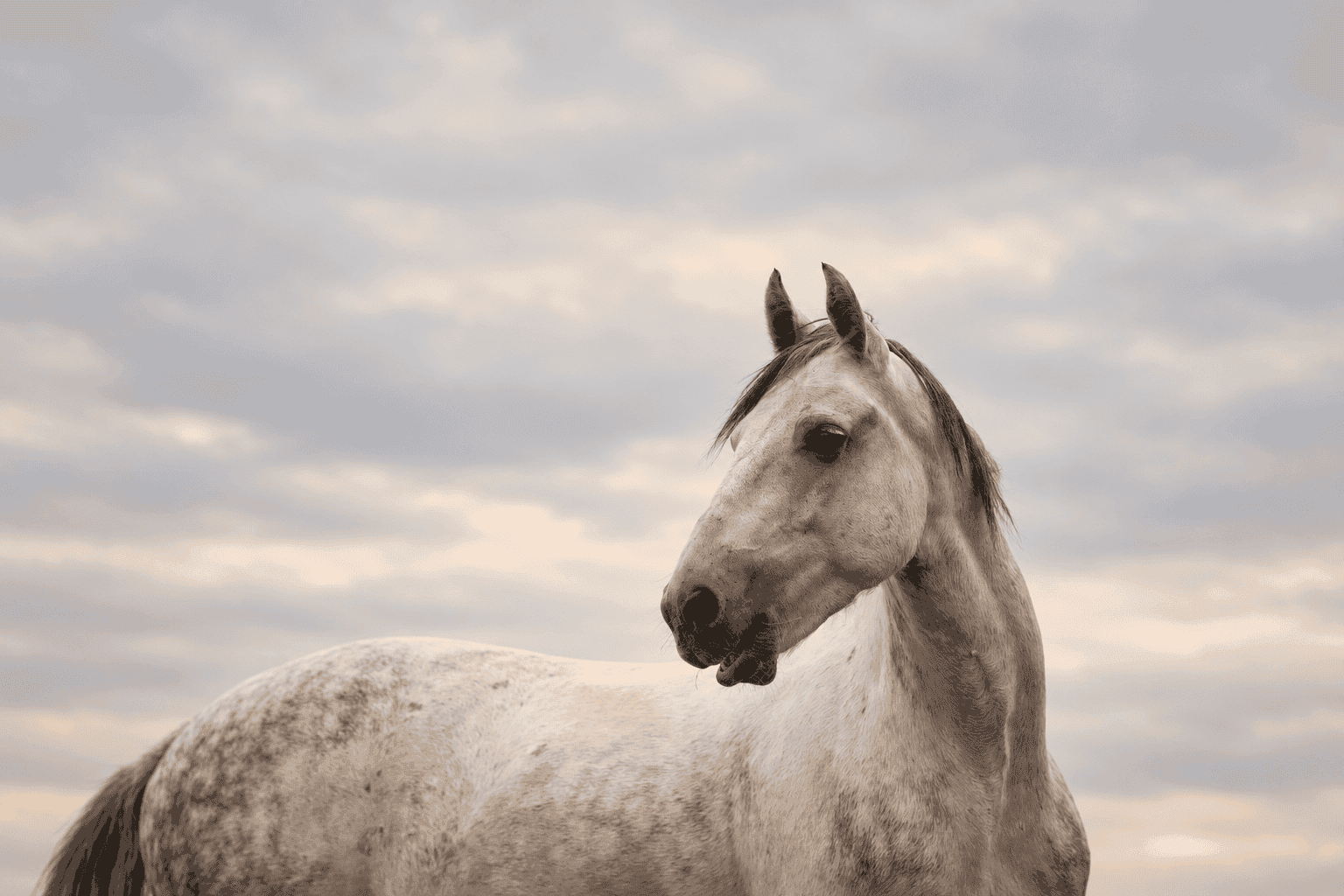
Grass glands in horses can appear suddenly during pasture turnout, creating noticeable swelling around the upper jaw and throat latch. The enlargement may develop within hours and can look dramatic, but uncomplicated cases are usually painless and do not affect the horse’s general health.
The exact cause of this swelling is unknown, although episodes are strongly associated with pasture turnout. Some horses develop grass glands repeatedly in a particular field, and the swelling often subsides quickly once they are removed from the pasture.
Although grass glands are typically harmless, other conditions can also cause swelling around the jaw and throatlatch and may require veterinary attention. Fever, pain, nasal discharge, difficulty swallowing, or swelling that does not improve warrant veterinary assessment.
What Are Grass Glands in Horses?
Grass glands are temporary swellings of the salivary glands in horses, usually affecting the parotid glands just below the ears and behind the jaw. The enlargement can develop suddenly and may be pronounced enough to change the appearance of the horse’s head. [1][2]
The condition is also called grass mumps, idiopathic parotiditis, or idiopathic parotitis. The term “idiopathic” means the exact cause is unknown. The condition is relatively common in Europe and Australia, but is reported less frequently in the United States. [2]
The sudden appearance of swelling can be concerning, particularly because strangles, a contagious bacterial infection, is associated with similar swelling around the jaw. However, the two conditions affect different structures and carry different implications for the horse’s health. [1][2][3]
Recognizing the typical appearance of grass glands, along with symptoms that suggest another cause, can help guide decisions about veterinary assessment.
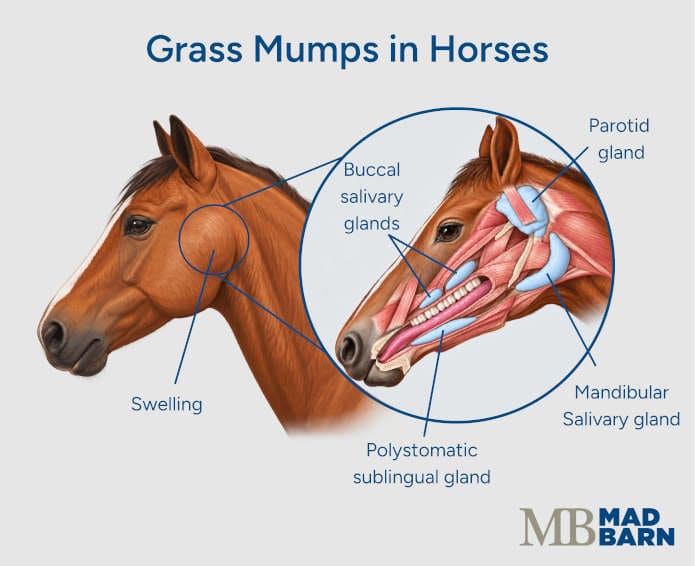
The parotid salivary glands are most commonly affected by grass glands. Located near the base of the ear and along the back of the jaw, these glands produce saliva that travels through the parotid ducts into the mouth. [2][4]
Pasture-associated swelling can also involve other salivary glands, including those located beneath the jaw. In some horses, more than one pair of salivary glands may swell at the same time. [2][4]
Table 1. Grass glands in horses at-a-glance
| Category | Key Information |
|---|---|
| Definition |
|
| Primary Cause |
|
| Onset |
|
| Symptoms |
|
| Severity |
|
| Risk Factors |
|
| Diagnosis |
|
| Treatment |
|
| Recovery Time |
|
| Prognosis |
|
| Prevention |
|
Grass Glands vs. Strangles in Horses
Grass glands and strangles both cause swelling around a horse’s jaw, but they affect different structures and have completely different root causes and possible outcomes. [2][3][5]
Grass glands involve temporary swelling of the salivary glands and are not contagious. [2][4] In contrast, strangles is a highly contagious bacterial infection caused by Streptococcus equi that typically affects the lymph nodes beneath and behind the jaw. [3][5]
Strangles may also cause difficulty swallowing, reduced appetite, and abscesses that eventually rupture and release pus. These symptoms are not characteristic of uncomplicated grass glands. [2][3][4][5]
Grass glands and strangles cannot be distinguished by outward appearance, and the absence of fever or nasal discharge does not completely rule out infection. [2][3]
A veterinarian should assess unexplained swelling around a horse’s jaw, particularly when accompanied by:
- Fever
- Pain
- Nasal discharge
- Difficulty swallowing
Any horse with a suspected case of strangles should be quarantined until they receive veterinary assessment. Following robust biosecurity measures limits the risk of a herd-level outbreak.
Table 2. Key differences between grass glands and strangles
| Feature | Grass glands | Strangles |
|---|---|---|
| Affected structures | Salivary glands | Lymph nodes |
| Swelling | Usually firm and painless | Often painful; abscesses may develop |
| Fever | Not typical | Common |
| Nasal discharge | Not typical | Common |
| Association with grazing | Often appears during pasture turnout | No specific association |
| Contagious | No | Yes |
| Course | Often improves rapidly after removal from pasture | Requires veterinary assessment and infection-control measures |
Symptoms of Grass Glands in Horses
The characteristic symptom of grass glands is swelling on both sides of the horse’s head, just below the ears and behind the jaw. The swelling usually develops quickly, sometimes within a few hours of being turned out onto pasture. [1][2][4]
The affected glands typically feel firm but are not painful when touched. In some horses, the enlargement is substantial, with occasional fluid buildup in the surrounding tissues near the back of the lower jaw. Excessive saliva production is not a typical symptom of the condition. [2][4]
What's your top priority with your horse's health?

What's your top priority with your horse's health?
When to Call the Veterinarian
Uncomplicated grass glands are typically painless, do not affect the horse’s general health, and improve after the horse is removed from the associated pasture. Veterinary assessment is warranted when the swelling does not follow this typical pattern. [1][2]
Contact your veterinarian if swelling around the jaw or throat latch is accompanied by: [2][3][5]
- Fever
- Pain or tenderness
- Nasal discharge
- Difficulty swallowing or eating
- Reduced appetite
- Drainage, abscess formation, or an open tract
- Swelling that persists, increases in size, or fails to improve after removal from pasture
If strangles is suspected, separate the horse from other horses while waiting for veterinary assessment.
Causes of Grass Glands in Horses
The exact cause of grass glands in horses is unknown, but the condition is strongly associated with grazing. [1][2][4]
Certain pastures appear to be associated with grass glands, although the reason for this connection has not been established. Exposure to an unidentified substance in pasture plants has been suggested as a possible cause, but no specific toxin has been confirmed. [2][4]
Grass glands can affect a single horse or several horses grazing together. The condition may also occur repeatedly in the same horse following pasture turnout. [2][4]
Other Causes of Swelling Under a Horse’s Jaw
The salivary glands, lymph nodes, and other structures around the jaw lie close together, making it difficult to identify the source of swelling from appearance alone. [1][2]
Unlike uncomplicated grass glands, some forms of swelling in this region develop because of: [1][2][4]
- Infection
- Obstruction
- Injury
- Other underlying disease
The location, consistency, duration, and associated symptoms can help veterinarians determine which structures are involved.
Blocked Salivary Ducts
A sialolith, or salivary stone, is a hardened deposit that develops within a salivary duct or gland. In horses, these stones most commonly involve the parotid salivary system and can interfere with the normal flow of saliva into the mouth. [2][6]
Depending on its location, a stone may be felt as a firm swelling along the course of the duct or cause more generalized swelling of the affected salivary gland. [2][6]
Facial swelling is one of the most common presenting signs. Stones located closer to the parotid gland are also associated with complications such as inflammation of the gland and draining tracts. Ultrasonography can identify the location of a suspected stone, especially when it is not detected with radiographs. [6]
Salivary Gland Infections
Sialadenitis refers to inflammation of a salivary gland. When bacteria are involved, affected horses develop noticeable gland enlargement along with pain and discomfort. [2][7]
Septic sialadenitis is uncommon in horses, but it can produce salivary gland swelling that resembles grass glands. Unlike uncomplicated grass glands, septic sialadenitis involves infection and requires veterinary treatment, especially when swelling is painful or accompanied by difficulty eating or swallowing. [2][7]
Affected horses may also show reduced appetite or difficulty swallowing because inflammation makes movement around the mouth and throat uncomfortable. Veterinary investigation can include examination of the mouth, ultrasonography, and testing of material from the affected area when infection is suspected. [7]
Salivary Cysts
Damage to a salivary gland or duct can allow saliva to escape into surrounding tissues instead of flowing normally into the mouth. The resulting accumulation can produce a soft, fluid-filled swelling around the jaw or other structures associated with the affected salivary gland. [1][2][4]
These swellings differ from grass glands because they result from disruption of the salivary system rather than temporary enlargement of otherwise functional glands.
Salivary cysts may involve trauma or damage to a salivary duct, and veterinary examination is needed to distinguish a saliva-filled swelling from an abscess, enlarged lymph node, or other mass in the same region. [1][2][4]
Dental Infections
Dental infections lead to swelling when infection involving a tooth root or surrounding tissues extends into the bones or soft tissues of the face and jaw. The location of the swelling provides clues about which tooth or surrounding structure may be involved. [1][2][4]
Dental disease may also produce other signs, such as: [2][8]
- Difficulty chewing
- Changes in eating behavior
- Oral discomfort
- Drainage from an affected area
Because structures within the equine head overlap on conventional X-rays, veterinarians use CT scans to define the location and extent of dental and surrounding bone disease when further imaging is required. [2][8]
Guttural Pouch Disease
The guttural pouches are air-filled structures located deep within the head near the throat, salivary glands, lymph nodes, major blood vessels, and several cranial nerves. Disease affecting this region can produce signs that overlap with other disorders of the jaw and upper throat. [1][4][9]
The veterinarian considers the accompanying symptoms when they suspect guttural pouch disease. Depending on the underlying disorder and structures affected, horses may develop: [4][9]
- Nasal discharge
- Difficulty swallowing
- Abnormal upper-airway function
- Bleeding from the nose
- Neurologic abnormalities
These additional signs help distinguish guttural pouch disease from uncomplicated pasture-associated salivary gland swelling. [4][9]
Tumors
Tumors involving the salivary glands or other tissues around the jaw are uncommon causes of swelling in horses.
Unlike grass glands, which typically appear suddenly and resolve, a growth may produce a localized swelling that persists or gradually becomes larger. [1][2][4]
Diagnosis & Treatment of Grass Glands
Grass glands are usually harmless and self-limiting, so many cases are not investigated by a veterinarian. If veterinary assessment is required, the condition is diagnosed based on the horse’s grazing history, the location of the swelling, and whether it improves after removal from pasture. [1][2][4]
Additional testing is generally unnecessary when the symptoms and history are characteristic of uncomplicated grass glands. However, a veterinarian may recommend further investigation if they suspect another cause of swelling, particularly an infectious disease such as strangles. [2][3][4]
Depending on the suspected condition, diagnostic tests may include: [2][3][8]
- Ultrasound
- X-rays
- Streptococcus equi PCR testing
- CT scans
PCR testing for strangles involves collecting samples, such as nasal swabs or guttural pouch washings, to detect the bacteria responsible for the infection. [3]
Uncomplicated grass glands generally require no specific medication or treatment beyond removing the horse from the associated pasture. If swelling persists or other symptoms develop, further veterinary investigation is needed to determine whether another condition is responsible. [2][4]
Recovery & Prognosis
The prognosis for horses with uncomplicated grass glands is excellent, with no significant health consequences expected. [2][4] Swelling typically decreases after removal from pasture and may disappear completely overnight. [2]
Episodes may recur following pasture turnout, but recurrence alone does not necessarily indicate a more serious condition. [2][4]
When a horse’s swelling fails to improve as expected, a veterinarian should reassess the horse, since another condition may be responsible. [1][2]

Managing & Preventing Grass Glands
There is no established method of preventing grass glands because the exact cause of the condition is unknown. However, avoiding pastures associated with previous episodes reduces recurrence. [2][4]
Management strategies include: [1][2][4]
- Monitoring for swelling after turnout
- Recording which pastures are associated with repeated episodes
- Using an alternative pasture if swelling repeatedly occurs in the same field
These measures can help identify recurring patterns and guide decisions about pasture use. [2][4]
Grass glands are generally a harmless, temporary condition associated with pasture turnout. Although the swelling may appear dramatic, uncomplicated cases typically resolve quickly after the horse is removed from the associated pasture, and the long-term outlook is excellent.
Frequently Asked Questions
Here are some frequently asked questions about grass glands in horses:
Grass glands in horses are temporary swellings of the salivary glands that usually develop just below the ears and behind the jaw. The condition most commonly affects the parotid glands and is also known as grass mumps, idiopathic parotiditis, or idiopathic parotitis. Grass glands are associated with pasture turnout and are generally harmless when the swelling follows a typical pattern and the horse has no other symptoms.
The exact cause of grass glands in horses is unknown, although the condition is strongly associated with grazing. Exposure to an unidentified substance in pasture plants has been suggested, but no specific plant or toxin has been confirmed. Grass glands may affect one horse or several horses grazing together, and some horses experience repeated episodes after turnout on particular pastures.
The main symptom of grass glands in horses is firm, painless swelling on both sides of the head, usually below the ears and behind the jaw. The swelling can develop within a few hours of pasture turnout and may be pronounced enough to change the appearance of the horse's head. Excessive saliva production is not typical, and uncomplicated cases should not cause fever, pain, nasal discharge, or difficulty swallowing.
Grass glands in horses are not considered contagious because they involve temporary swelling of the salivary glands rather than an infection that spreads between horses. Several horses sharing a pasture may develop swelling at the same time, but this is thought to reflect a common pasture-related exposure. Similar swelling can occur with contagious diseases such as strangles, so an unfamiliar episode should be assessed carefully.
Grass glands in horses typically begin to improve within hours after the horse is removed from the associated pasture and may disappear completely overnight. Uncomplicated episodes have an excellent prognosis and are not expected to cause lasting health problems. Swelling that persists, worsens, or does not decrease as expected should be assessed by a veterinarian.
Grass glands can be distinguished from strangles by considering the location and character of the swelling, the horse's grazing history, and any accompanying symptoms. Grass glands usually cause firm, painless salivary gland swelling after grazing, while strangles commonly causes fever, painful lymph node enlargement, nasal discharge, difficulty swallowing, and sometimes abscesses. Appearance alone cannot reliably rule out strangles, so a horse with suspicious symptoms should be separated from other horses until veterinary advice is obtained.
A veterinarian should examine swelling around a horse's jaw when it is painful, affects only one side, persists longer than expected, or continues to enlarge. Fever, nasal discharge, reduced appetite, difficulty swallowing, drainage, or abscess formation also require veterinary attention. These signs are not typical of uncomplicated grass glands and may indicate infection, obstruction, dental disease, or another underlying disorder.
Grass glands in horses are usually diagnosed from the location of the swelling, the horse's recent grazing history, and whether the swelling decreases after removal from pasture. Further testing is often unnecessary when the pattern is characteristic and the horse otherwise appears healthy. If another condition is suspected, a veterinarian may recommend ultrasound, X-rays, computed tomography, or testing for the bacteria that cause strangles.
Other causes of swelling under a horse's jaw include blocked salivary ducts, salivary gland infections, salivary cysts, dental infections, guttural pouch disease, and uncommon tumors. These conditions can affect structures located close together, making the source of the swelling difficult to identify from appearance alone. Persistent, painful, one-sided, or gradually enlarging swelling requires veterinary investigation to determine the underlying cause.
Grass glands in horses generally do not require medication or specific treatment when the condition is uncomplicated. Removing the horse from the associated pasture is usually sufficient for the swelling to improve. If veterinary investigation identifies an infection, blocked salivary duct, dental problem, or another cause, treatment must address that underlying condition.
Grass glands usually affect both sides of a horse's head, although one side may appear more enlarged than the other. Swelling confined to one side is less characteristic and may be caused by a blocked salivary duct, dental infection, or localized salivary gland disorder. A veterinarian should assess unexplained one-sided swelling rather than assuming it is grass glands.
Grass glands can return after the swelling disappears, especially when a horse goes back onto a pasture associated with earlier episodes. Recurrence alone does not necessarily indicate a serious problem when the swelling remains painless and resolves promptly after removal from pasture. Changes in the location, duration, or severity of the swelling warrant veterinary reassessment.
Grass glands in horses cannot always be prevented because their exact cause remains unknown. Owners can monitor horses after turnout, record which fields are associated with swelling, and consider using an alternative pasture when episodes repeatedly occur in the same location. These steps may reduce recurrence and make it easier to recognize changes that require veterinary attention.
Summary
Grass glands cause sudden, temporary salivary gland swelling in horses during pasture turnout. Although uncomplicated cases are harmless, similar swelling can occur with infections and other disorders that require veterinary care.
- Grass glands typically cause firm, painless swelling below the ears and behind both sides of the jaw
- The exact cause is unknown, but episodes are strongly associated with grazing and may recur in particular pastures
- Uncomplicated swelling usually decreases rapidly after the horse is removed from the associated pasture
- Strangles is a contagious bacterial infection that affects the lymph nodes and may cause fever, pain, nasal discharge, or abscesses
- Persistent or painful swelling and difficulty swallowing require veterinary assessment to rule out other conditions
References
- Dixon. P. Swellings of the head region in the horse. In Practice. 1991.
- Dixon. P. M. and Gerard. M. P. Oral Cavity and Salivary Glands. In: Equine Surgery, 5th ed. Saunders. 2019.
- Boyle. A. et al. Streptococcus equi Infections in Horses: Guidelines for Treatment, Control, and Prevention of Strangles—Revised Consensus Statement. Journal of Veterinary Internal Medicine. 2018.
- McAuliffe. S. Ed. Knottenbelt and Pascoe's Color Atlas of Diseases and Disorders of the Horse. 2nd ed. Saunders. 2013.
- Sellon. D. and Long. M. Equine Infectious Diseases. 2nd ed. Saunders. 2014.
- Carlson. N. et al. Sialolithiasis in horses: A retrospective study of 25 cases (2002–2013). Canadian Veterinary Journal. 2015.
- Kilcoyne. I. et al. Septic sialoadenitis in equids: a retrospective study of 18 cases (1998-2010). Equine Veterinary Journal. 2015.
- Stieger-Vanegas. S. and Hanna. A. The Role of Computed Tomography in Imaging Non-neurologic Disorders of the Head in Equine Patients. Frontiers in Veterinary Science. 2022.
- Borges. A. and Watanabe. M. Guttural pouch diseases causing neurologic dysfunction in the horse. Veterinary Clinics of North America: Equine Practice. 2011.