English
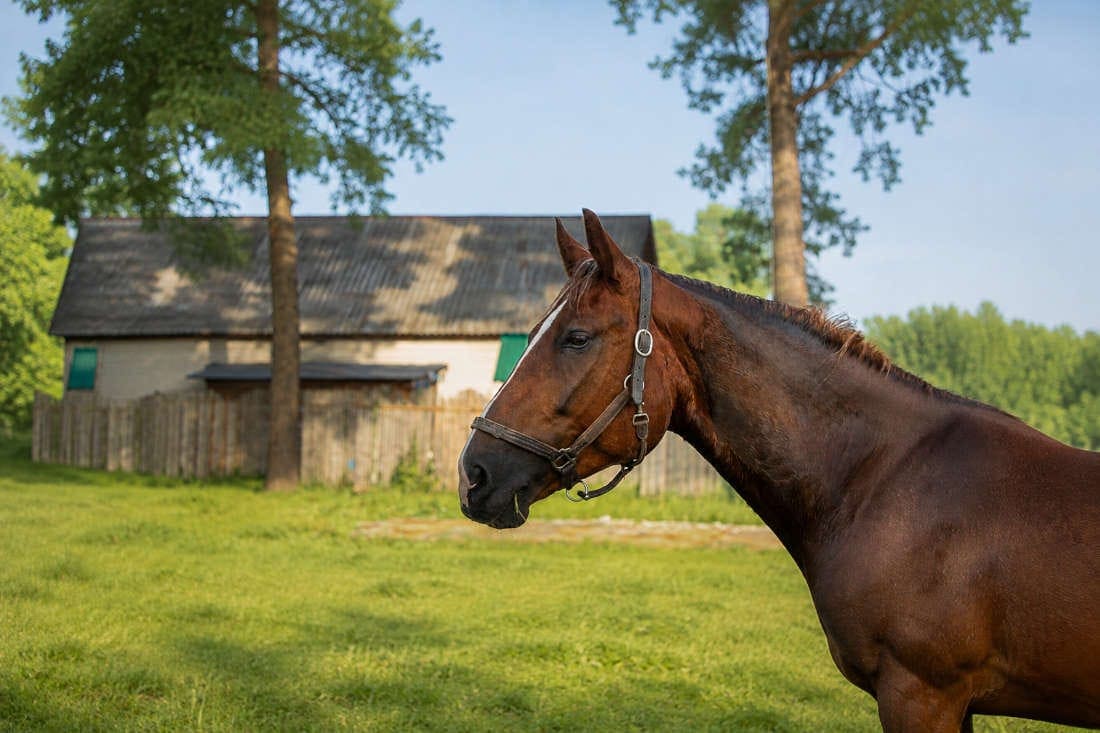
Horse facial expressions communicate emotional and physical states through subtle changes in the eyes, ears, nostrils, and muzzle. These cues can be easy to miss, but learning to recognize them can help you determine whether your horse is relaxed and curious or experiencing discomfort, fear, or stress. [1]
Facial cues are closely linked to equine welfare and may indicate something is not right before more obvious behavioral signs appear. Paying attention to changes in your horse’s expression can help you respond appropriately and support their comfort and well-being.
Accurate interpretation requires considering multiple facial features alongside the horse’s body language and surrounding environment. Knowing your horse’s resting expression also makes it easier to recognize meaningful changes.
Keep reading to learn what common horse facial expressions may mean, how researchers assess facial signs of pain, and how to interpret subtle cues in context.
Facial Expressions in Horses
Facial expressions are an increasingly recognized part of equine behavior. Research shows that changes in the face can reflect both emotional and physical states, often alongside or even before more obvious behavioral signs. [2]
Horses have a highly developed set of facial muscles, allowing for a wide range of subtle expressions. Small changes in the eyes, muzzle, and surrounding facial features can offer useful insight into how a horse is feeling. [3][4]
Interpreting these signals requires context. The same ear position or eye shape can mean different things depending on the situation, environment, and the individual horse. Looking at the full picture, such as what’s happening around the horse and how the rest of the body is positioned, helps prevent misinterpretation.
Key facial features to observe include:
- Ears: Direction, movement, and tension can indicate attention, relaxation, or irritation
- Eyes: Softness, tension, and visibility of the white (sclera) provide insight into stress or calmness
- Nostrils: Shape and flare can reflect arousal, effort, or anxiety
- Mouth and Lips: Tightness or relaxation can signal tension, discomfort, or contentment
- Overall Facial Tension: Subtle tightening or softening across the face often reflects emotional state
These features work together, rather than in isolation, to communicate how a horse is feeling in the moment.
Because facial expressions are closely linked to how a horse is feeling, they can also provide insight into horse welfare.
Subtle changes in facial tension or expression may reflect stress, discomfort, or pain, sometimes before more obvious signs appear. Paying attention to these cues can support earlier recognition and more timely responses. [5]
What's your top priority with your horse's health?

What's your top priority with your horse's health?
Interpreting Equine Facial Expressions
Recognizing common facial expressions can help you better understand how your horse is feeling in the moment. While these signals should be interpreted alongside body language and context, certain patterns are commonly associated with specific emotional states.
It’s important not to rely on a single feature in isolation. Ear position is one of the most obvious indicators for horse owners to observe, but ear position alone is not enough to confidently assess how a horse is feeling.
The horse’s eyes, muzzle, and overall facial tension alongside ear position gives a more accurate picture. [4][5][6]
Relaxed & Content
A relaxed horse has a soft, open expression with minimal tension across the face. The eyes appear calm and they may blink regularly, while the ears rest to the side or gently move in response to sounds, indicating a relaxed state.
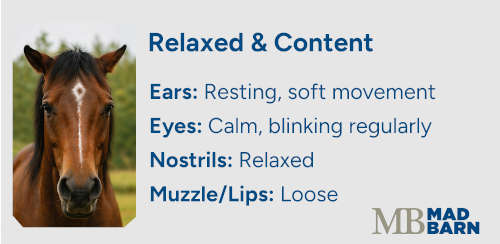
The muzzle looks loose rather than tight, and in some cases, the lower lip may droop slightly. This expression typically reflects a horse that feels comfortable and at ease in its environment.
Alert & Curious
When a horse is attentive or investigating something new, its facial features become more engaged without appearing strained. The ears are typically forward and mobile, tracking sounds or movement as the horse remains alert.
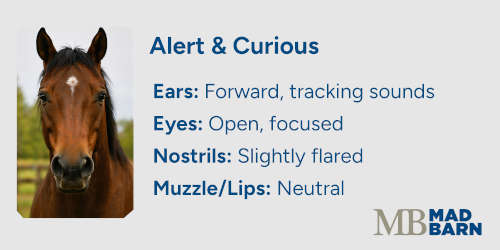
The eyes are open and focused, and the nostrils may flare slightly as the horse gathers more information. This reflects interest and awareness, though it can shift toward tension if the situation becomes overwhelming.
Fearful & Anxious
Fearful or anxious expressions are usually more pronounced and accompanied by visible tension. The eyes may widen, sometimes showing the white (sclera), and the muscles around the face tighten in response to fear. [1][2]
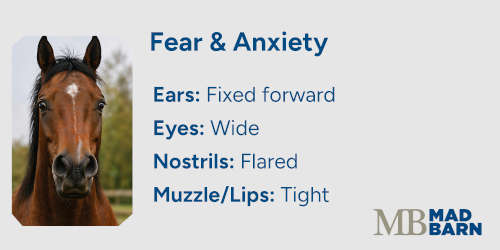
The nostrils often flare, and the ears may become fixed forward or move rapidly as the horse tries to assess its surroundings. These changes often appear before more obvious reactions like spooking or attempting to flee.
In Pain or Discomfort
Facial expressions associated with pain can be easy to overlook and are often mistaken for normal behavior. Horses experiencing discomfort may show changes in specific areas of the face, particularly around the eyes and muzzle. [4]
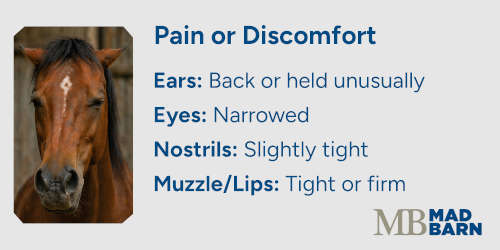
The eyes may appear narrowed or strained, while the lips can look tight rather than relaxed. Ear position may also shift, sometimes becoming fixed or held in an unusual position.
In some cases, these changes are very slight. Reduced blinking, a firmer-looking muzzle, or a less relaxed expression overall may appear before more obvious signs develop. Noticing differences from your horse’s normal expression is often the most reliable way to identify potential discomfort. [7][8]
Irritated or Aggressive
When a horse is irritated or defensive, the facial expression becomes more rigid and direct. The ears are typically pinned flat against the head, and the eyes may appear strained and/or squinted, reflecting irritation. [6]
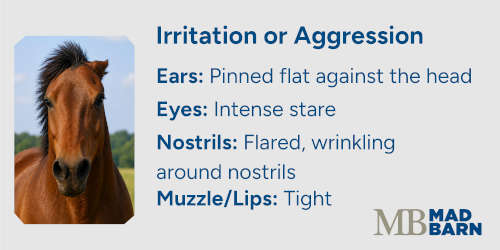
Tension around the muzzle is common, sometimes with wrinkling around the nostrils or lips. This suggests the horse is uncomfortable and may escalate its behavior if the source of irritation continues.
Can Horses Control Their Facial Expressions?
Unlike humans, horses likely do not consciously control their facial expressions. Most facial movements are instinctive and tied to the nervous system, meaning they tend to reflect how the horse is feeling in the moment. [1]
Because of this, facial expressions can provide useful insight into a horse’s internal state. While behavior may sometimes be influenced by training or learned responses, subtle facial changes are often less deliberate. [9]
Some horses may appear less expressive than others, but this doesn’t mean they are experiencing fewer emotions. Rather, less expression from an individual horse may reflect their temperament or demeanor.
The Horse Grimace Scale (Pain Indicators)
The Horse Grimace Scale is a validated, research-based tool used to identify pain in horses based on specific changes in facial tension. It focuses on areas where tension increases when a horse is experiencing discomfort, making it a useful tool for observation. [1][10][11][12]
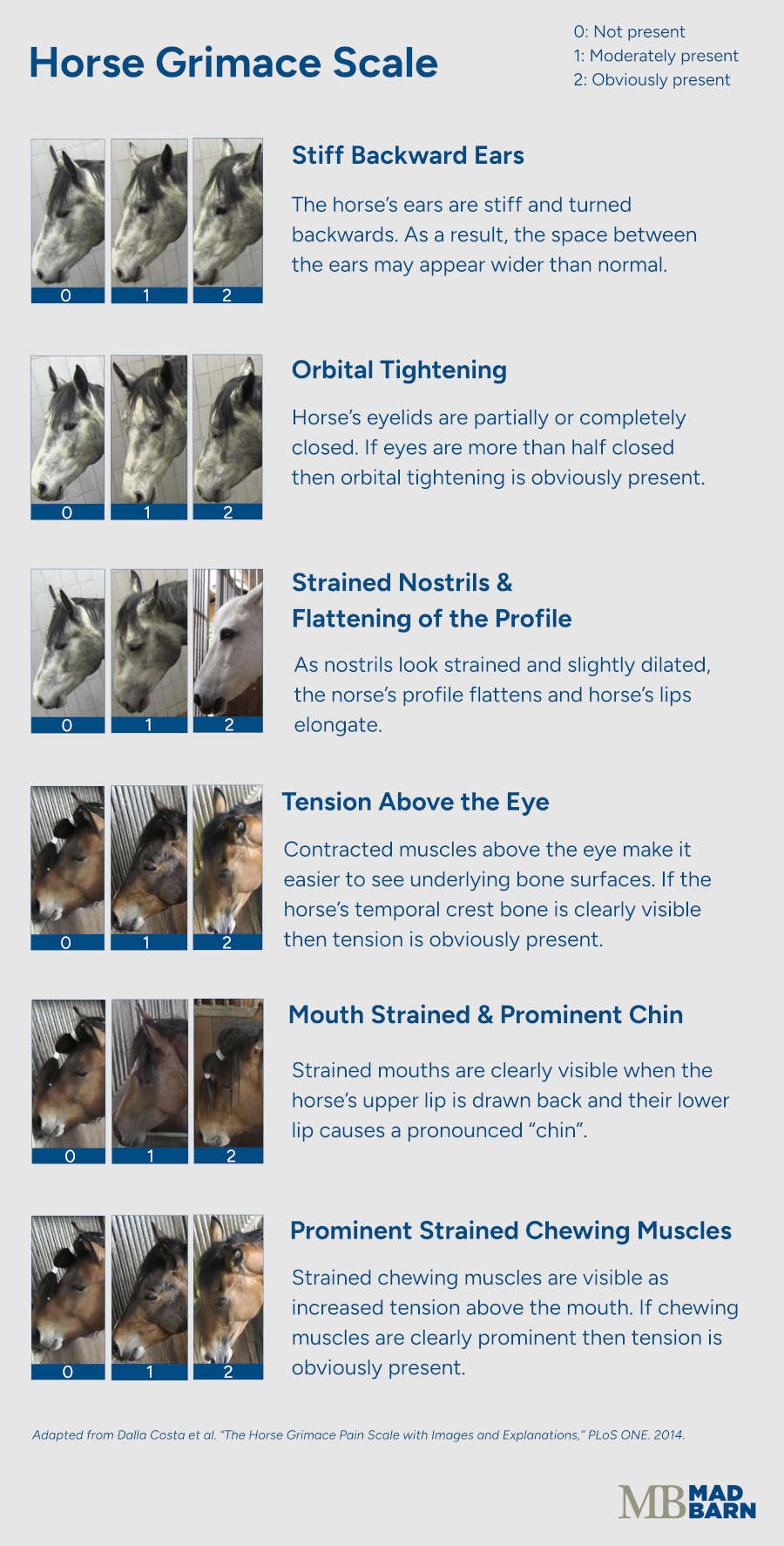
Rather than relying on a single feature, the scale looks at patterns across multiple areas of the face. These include ear position, nostril flaring and tightening around the eyes, jaw and muzzle. [10][11][13]
These features, sometimes referred to as facial action units (FAUs), are considered together rather than individually. A single change may not be meaningful on its own, but when several areas show tension at the same time, it may be more indicative of pain. [2][14]
Taken together, these changes create an overall impression that differs from the horse’s normal, relaxed expression. This is why knowing your horse’s baseline is especially important when applying these observations.
The Horse Grimace Scale is most commonly used in research and clinical settings when studying horse pain. However, horse owners can still apply the same principles by watching for consistent patterns and changes over time. [12]
This scale isn’t meant to replace a veterinary diagnosis, but it can help horse owners flag when their horse is in pain. If you notice ongoing facial changes alongside shifts in behavior or performance, it’s important to consult your veterinarian.
Other Tools for Assessing Facial Expressions in Horses
In addition to tools like the Horse Grimace Scale, researchers also use systems such as the Equine Facial Action Coding System (EquiFACS) to study facial expressions in more detail. [3][5][12][15]
EquiFACS is an objective method that identifies specific facial movements based on the underlying muscles involved. By analyzing video recordings, researchers can track how a horse’s face changes in response to different situations, such as feeding, handling, or environmental changes. [16]
While systems like EquiFACS are primarily used in research settings, they reinforce an important takeaway for horse owners: even small facial changes can be meaningful when interpreted in context.
How to Interpret Horse Facial Expressions
Facial expressions are only one part of how horses communicate. To interpret them accurately, it’s important to look at the full picture, including the horse’s body language, behavior, and environment. [17]
For example, forward ears and wide eyes might indicate curiosity in one situation, but tension or uncertainty in another. A slightly flared nostril could reflect excitement during exercise or stress in a more challenging setting, depending on the context. [6]
Consider the whole horse when assessing their expression. Facial cues work together with posture and movement. A relaxed face paired with a tense body, or vice versa, can send mixed signals, which is why assessing the whole horse is important. Changes in behavior, such as reluctance to move forward or sensitivity during grooming, can also provide useful clues.
Familiarity with your horse’s typical expressions helps guide interpretation of how they may be feeling. Individual differences also play a role in how horses express themselves. Some horses are naturally more expressive, while others show more subtle behaviors.
Because of this variation, learning what is typical for your horse is one of the most useful steps for assessing behavioral changes.
When Horse Facial Expressions May Be Misleading
While facial expressions can provide useful information, they are not always straightforward to interpret. Some horses may show features that appear tense or alert even when they are not experiencing pain, which can be misleading.
Breed and temperament can also influence how a horse appears. Some breeds are naturally more reactive or “hotter,” and may carry a more alert expression even when they are not responding to anything in their immediate environment. Facial expressions can also vary among individual horses, with some consistently appearing more tense than others. [18]
Lighting, angle, and momentary changes can also affect how a horse’s face appears. A brief tightening around the eye or muzzle may not always indicate a meaningful change. Because of this, it’s helpful to avoid drawing conclusions based on a single observation. Looking for consistent patterns over time provides a more reliable understanding.

Practical Tips for Interpreting Horse Expressions
Putting this knowledge into practice comes down to consistent observation and how you respond to what you see. These tips can help you apply these observations in everyday situations with your horse in a more practical way: [19]
- Start with a Baseline: Learning to read your horse’s facial expressions requires consistent observation over time. Spending time watching your horse in low-stress situations helps establish a baseline for what is normal
- Look at the Full Picture: When you notice a change in your horse’s facial expression, consider what might be influencing them at that moment. Factors like environment, handling, workload, or recent changes in routine can all affect how a horse responds.
- Watch for Patterns: It’s often more useful to look for consistent changes rather than one-off signs. A brief moment of tension may not be significant, but repeated or ongoing changes can indicate a meaningful pattern.
- Know When to Take a Closer Look: If you’re unsure, it’s reasonable to investigate further. Subtle changes, especially when paired with shifts in behavior or performance, can be early indicators that something isn’t quite right.
Frequently Asked Questions
Here are some frequently asked questions about how to read a horse's facial expressions:
Horse facial expressions can help you understand how a horse is feeling, but they should not be interpreted on their own. A horse’s face may show signs of relaxation, attention, stress, discomfort, or irritation, but these cues are most meaningful when considered alongside body posture, movement, behavior, and the horse's environment. For example, wide eyes and forward ears may reflect curiosity in one context, but uncertainty or tension in another. Looking at the whole horse, and comparing changes to what is normal for that individual, gives a more accurate understanding of their emotional state. [4][5][17]
Forward ears in horses usually indicate attention, but they do not always mean the horse is relaxed. A horse with forward ears may be curious and calm, or they may be alert, uncertain, or preparing to react. Other facial features help clarify the meaning, including the softness of the eyes, tension around the muzzle, nostril shape, and overall facial expression. Body language is also important. A horse with forward ears, a soft eye, and a loose muzzle is likely more relaxed than one with forward ears, a tight mouth, and a tense body. [4][6]
Signs of pain in a horse’s face often include subtle changes in the eyes, ears, muzzle, and overall facial tension. These may include tightening around the eyes, a strained or narrowed eye appearance, changes in ear position, and increased tension in the muzzle or lips. Some horses may show a firmer-looking mouth, flattened or stiff nostrils, reduced blinking, or a general expression that looks different from their normal relaxed face. These features are assessed in tools such as the Horse Grimace Scale, which looks at patterns of facial tension rather than one isolated sign. If these changes persist or appear alongside changes in behavior, movement, appetite, or performance, it is worth consulting a veterinarian. [7][8][10][12]
A relaxed horse typically has soft eyes, gently moving ears, loose lips, and minimal tension across the face. The muzzle appears relaxed rather than tight, and some horses may even let the lower lip droop slightly when fully at ease. Relaxed horses also tend to blink normally and show calm, fluid body posture. Because every horse has slightly different resting expressions, it is useful to learn what relaxed looks like for your individual horse. [1][5]
A horse may look tense while standing still because facial expressions can reveal stress, discomfort, or alertness before the body moves. Standing quietly does not always mean the horse is relaxed. Subtle signs such as a tight muzzle, reduced blinking, widened or fixed eyes, flared nostrils, or a rigid facial expression may suggest that the horse is alert, uncomfortable, anxious, or processing something in the environment. Context matters because nearby activity, unfamiliar surroundings, handling, pain, or anticipation can all affect expression. Looking for repeated patterns and comparing the expression to your horse’s normal baseline can help determine whether the tension is meaningful. [4][5]
Pinned ears in horses often signal irritation, discomfort, defensiveness, or a warning that the horse wants more space. This expression is usually more meaningful when paired with other signs of tension, such as a hard eye (fixed and/or still eye, without blinking), tight muzzle, wrinkling around the nostrils, raised head, tense posture, or tail swishing. In some situations, pinned ears may reflect pain, fear, frustration, or conflict with another horse or person. Because ear position alone can be misleading, it is important to consider what is happening around the horse and how the rest of the body looks. If pinned ears occur frequently during handling, grooming, tacking up, or riding, it may be worth investigating for discomfort. [6]
Horses do not smile in the same way humans do, even though some facial expressions may appear smile-like to people. Human interpretation of animal expressions can sometimes be misleading because horses communicate differently. A horse that appears to be “smiling” may simply have a relaxed muzzle, lifted lip, or facial movement unrelated to happiness. Instead of focusing on one expression, it is more accurate to evaluate the horse’s overall facial tension, posture, movement, and behavior. [1][5]
Wide eyes in horses can indicate heightened attention, excitement, fear, or stress depending on the context. Some horses may also show visible sclera, or the white of the eye, when emotionally aroused or anxious. However, wide eyes alone are not enough to determine emotional state because some horses naturally show more sclera than others. Looking at the ears, nostrils, muzzle tension, and overall behavior helps clarify whether the horse is curious, worried, or overstimulated. [1][2][4]
The Horse Grimace Scale works by evaluating patterns of facial tension associated with pain in horses. Instead of focusing on one isolated feature, the scale looks at changes around the eyes, ears, muzzle, nostrils, and chewing muscles together. Increased tension across several facial areas may indicate discomfort or pain. While the scale is mainly used in veterinary and research settings, horse owners can still apply the same principles by watching for changes from their horse’s normal expression. [10][11][12]
Stress can change a horse’s facial expression by increasing tension around the eyes, muzzle, nostrils, and ears. Horses experiencing stress or anxiety may show widened eyes, fixed attention, reduced blinking, flared nostrils, or a generally tighter facial appearance. These changes often occur before more obvious behavioral signs such as spooking or avoidance. Repeated exposure to stressful environments may also alter how expressive some horses appear over time. [2][4][19]
Some horses are naturally more expressive than others, and differences in personality, breed, temperament, and previous experience can affect how clearly they show facial expressions. Some horses naturally carry a more alert or reactive appearance, while others display emotional changes more subtly. Environmental sensitivity may also influence expression. This is why it is important to learn what expressions are typical for your own horse rather than relying entirely on generalized rules. Recognizing your horse’s typical baseline behaviors makes it easier to notice meaningful changes over time. [18]
Facial expressions can sometimes help identify health problems in horses because discomfort and pain often create subtle facial tension before obvious physical symptoms appear. Changes such as narrowed eyes, a tight muzzle, altered ear position, reduced blinking, or an unusually strained appearance may suggest that something is wrong. These signs become more important when paired with changes in appetite, movement, behavior, or performance. Persistent facial changes should be evaluated alongside the horse’s overall condition and may warrant veterinary attention. [7][8][13]
Context is important when reading horse facial expressions because the same facial feature can have different meanings in different situations. Forward ears may indicate curiosity in one setting but tension or uncertainty in another. Environmental factors, recent handling, nearby activity, exercise intensity, and the horse’s personality all influence how expressions should be interpreted. Looking at the full horse and observing patterns over time helps reduce the risk of misreading individual facial cues. [4][5][17]
Summary
Horses communicate through subtle facial and body cues that can be easy to miss without close observation.
- The eyes, ears, nostrils, and muzzle all work together to reflect a horse's emotional state
- Facial expressions can indicate relaxation, curiosity, fear, pain, or irritation depending on the context
- Subtle changes in facial tension may provide early signs of stress, discomfort, or potential welfare concerns
- Interpreting expressions accurately requires looking at the whole horse, not just one feature
- Learning your horse’s normal expression helps you recognize meaningful changes more quickly
References
- Zimmermann. B. et al. Anatomical and Functional Basis of Facial Expressions and Their Relationship with Emotions in Horses. Research in Veterinary Science. 2024. View Summary
- Phelipon. R. et al. Differences in Behaviour, Facial Expressions and Locomotion between Positive Anticipation and Frustration in Horses. Applied Animal Behaviour Science. 2024.
- Wathan. J. et al. EquiFACS: The Equine Facial Action Coding System. PLoS ONE. 2015. View Summary
- Lundblad. J. et al. Facial Expressions of Emotional Stress in Horses. bioRxiv. 2020.
- Lewis. K. et al. An Ethogram of Facial Behaviour in Domestic Horses: Evolutionary Perspectives on Form and Function. PeerJ. PeerJ Inc. 2025.
- McDonnell. S. M. The Equid Ethogram: A Practical Field Guide to Horse Behavior. Eclipse Press. 2003.
- Gleerup. K. B. Assessing Pain in Horses. In Practice. 2018.
- Gleerup. K. B. et al. An Equine Pain Face. Veterinary Anaesthesia and Analgesia. 2015. View Summary
- Tomberg. C. et al. Horses (Equus Caballus) Facial Micro-Expressions: Insight into Discreet Social Information. Scientific Reports. Nature Publishing Group. 2023. View Summary
- Dalla Costa. E. et al. Development of the Horse Grimace Scale (HGS) as a Pain Assessment Tool in Horses Undergoing Routine Castration. PloS one. 2014. View Summary
- Dalla Costa. E. et al. The Horse Grimace Pain Scale with Images and Explanations. PLoS ONE. 2014.
- Andersen. P. H. et al. Towards Machine Recognition of Facial Expressions of Pain in Horses. Animals. 2021. View Summary
- Ask. K. et al. Performance of Four Equine Pain Scales and Their Association to Movement Asymmetry in Horses with Induced Orthopedic Pain. Frontiers in Veterinary Science. 2022. View Summary
- Oberhammer. A. et al. Behind the Bridle: Understanding Facial Expressions in Lesson Horses before and after Riding. Applied Animal Behaviour Science. 2026.
- Rashid. M. et al. Equine Facial Action Coding System for Determination of Pain-Related Facial Responses in Videos of Horses. PLoS ONE. 2020. View Summary
- Ricci-Bonot. C. and Mills. D. S. Recognising the Facial Expression of Frustration in the Horse during Feeding Period. Applied Animal Behaviour Science. 2023.
- Mullard. J. et al. Development of an Ethogram to Describe Facial Expressions in Ridden Horses (FEReq). Journal of Veterinary Behavior. 2017.
- Danışan. S. et al. The Relationship of Personality Traits with Breed, Sex, and Racing Performance in Sport Horses. Journal of Veterinary Behavior. 2024.
- Budzyńska. M. Stress Reactivity and Coping in Horse Adaptation to Environment. Journal of Equine Veterinary Science. 2014.