English

Sitting trot is one of the most difficult skills for riders to master, but it is fundamental for advancing through the levels of dressage.
Unlike posting trot, where the rider rises from the saddle on one beat and returns on the other, sitting trot requires continuous whole-body coordination with a moving horse while the rider remains seated.
When learning this skill, many riders focus on trying to sit still, but locking down and bracing usually makes bouncing worse. A quiet seat does not come from holding the body in place. It comes from allowing the body to move with the horse while maintaining balance, posture, and independent aids.
Sitting trot is an active skill built on mobility, timing, and body awareness. It also depends on the horse’s way of going: a tense, hollow, hurried, or uneven trot is much harder to sit than one that is rhythmic, balanced, and swinging through the back.
Keep reading to learn the mechanics behind sitting trot, what the rider’s body must do to absorb movement, and how to build this skill effectively.
What Is the Sitting Trot?
The sitting trot is a riding position in which the rider maintains continuous contact with the saddle throughout both beats of the trot stride.
Rather than rising with each diagonal push-off, the rider follows the motion of the horse’s back by absorbing it through their body.
From the outside, a well-executed sitting trot looks quiet and effortless. In reality, it requires a high level of strength, coordination, and timing.
The Role of the Sitting Trot in Dressage
As dressage training advances and movements become more collected and complex, the rider needs to communicate with increasing subtlety. Sitting trot helps make this possible.
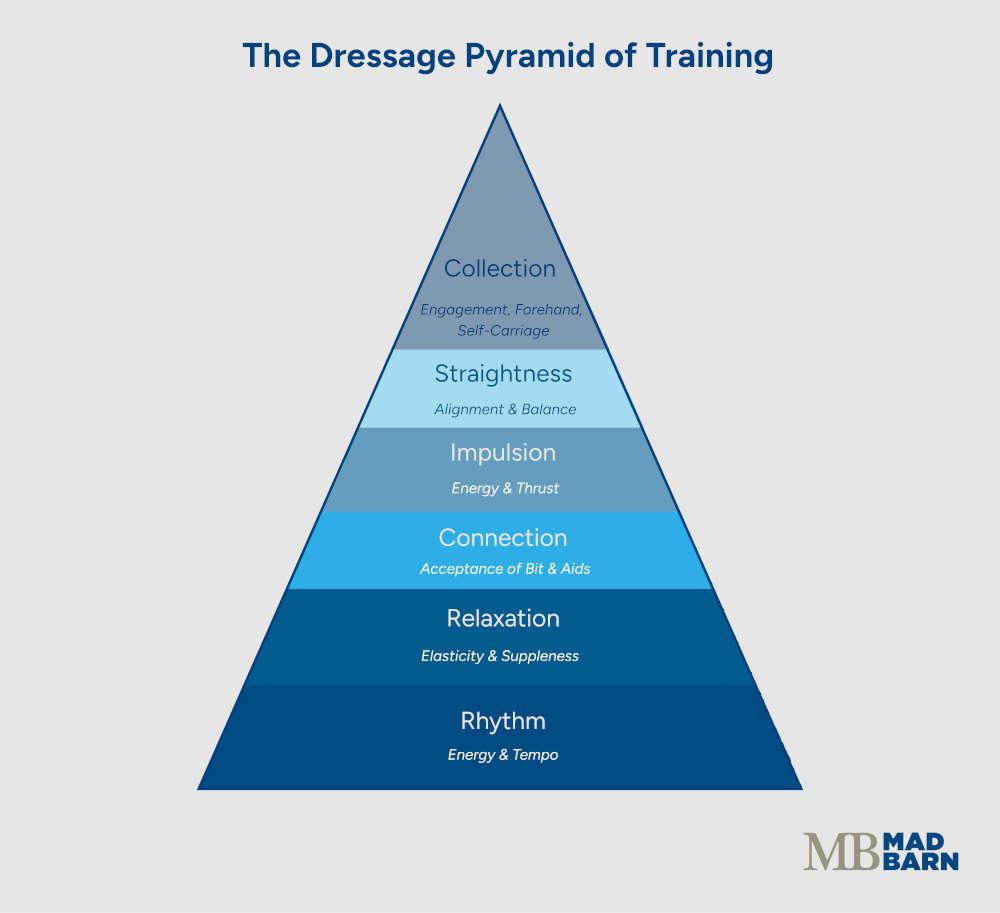
By maintaining unbroken contact with the saddle, the rider can apply seat and weight aids that are not possible while posting. These aids are essential for lateral work, transitions within the gait, and the development of collection.
Under USEF rules, sitting trot is required from Second Level onward in national competition. At FEI levels, it is required from Prix St. Georges through Grand Prix. [1]
An established sitting trot also reflects the horse’s training. The seat and the horse’s throughness develop together. When a horse swings freely through its back and accepts the rider’s weight without tension, sitting trot becomes easier.
When to Sit vs. When to Rise
Not every moment in training calls for sitting trot. Rising trot is preferable during warm-up, with young or green horses, and whenever the horse’s back has not yet loosened enough to carry the rider comfortably.
Research measuring head and pelvic movement symmetry in ridden horses found that seat style produced measurable differences in how the horse moved, confirming that the choice between sitting and rising trot has real effects. [2]
Sitting before the horse is forward, round, and working through its back tends to produce a choppy, tight feel and can reinforce the same habits riders are trying to correct. Use sitting trot when the horse is through. Use rising trot to help get there.
Table 1. When to use rising trot versus sitting trot
| Use rising trot when | Use sitting trot when |
|---|---|
|
|
The Biomechanics of the Sitting Trot
Understanding how horse and rider move at trot is the foundation of a good seat. Riders who approach sitting trot purely by feel often struggle longer than those who understand the biomechanics behind the movement.
How the Horse’s Back Moves at Trot
The trot is a two-beat gait in which the horse moves on alternating diagonal pairs of legs, with a brief moment of suspension between each pair. Each time a diagonal pair pushes off, the horse’s back rises on that side. As the opposite diagonal takes weight, it drops. This pattern repeats with every stride.
The horse’s back does not move only vertically. Research measuring spinal kinematics in high-level dressage horses during sitting trot found that the caudal thoracic and lumbar spine undergo complex three-dimensional rotational movement with each stride. [3]
The rider must follow vertical, lateral, and rotational motion simultaneously. As a result, absorbing sitting trot correctly involves the whole body, not just the seat.
How the Rider Follows the Movement
The rider’s job in sitting trot is to follow the horse’s motion in real time without adding resistance. Research on horse-rider biomechanics describes this as the pelvis following the movements of the saddle while the trunk maintains stability above. [4]
In practice, the hips absorb the motion while the core keeps the upper body steady.
Bouncing occurs when the rider gets out of phase with the horse’s stride. The horse’s back rises and the rider follows upward, but if the rider does not descend as quickly as the horse’s back does, the next upstroke catches the rider mid-descent.
Staying in phase requires the rider to actively match the descent, not simply relax and hope to follow the motion.
The Effects of Sitting Trot on the Horse
Research comparing vertical forces on the horse’s back in sitting and rising trot found that peak forces are significantly higher in sitting trot, with both sitting and standing phases of rising trot producing lower force peaks than continuous sitting. [5]
This means the quality of the rider’s seat matters for the horse’s comfort. In sitting trot, the rider remains in continuous contact with the saddle while the horse’s back moves through repeated cycles of lift, rotation, and recoil. If the rider follows this motion well, the forces are absorbed and distributed more smoothly.
A bouncing or asymmetrical seat amplifies these forces and distributes them unevenly across the lumbar and thoracic regions. Over time, poorly absorbed sitting trot may contribute to back soreness, muscle tension, and gait changes that may appear as resistance.
Research shows that the rider, saddle, and horse function as an interconnected system. In one study on equine spinal kinematics, changing the saddle design altered how the rider contacted the seat and produced measurable changes in the horse’s spinal movement. [6]
As a result, changes in the rider’s position, saddle contact, balance, or ability to absorb motion can influence how the horse uses its back during trot.
The relationship runs in both directions. A horse with a swinging, engaged back is far easier to sit, and a rider who sits correctly can encourage the horse to carry itself better.
What's your top priority with your horse's health?

What's your top priority with your horse's health?
How to Sit the Trot: Technique & Position
Sitting trot requires several components of technique and position to work together. Weakness or rigidity in any one area can impair effectiveness and balance.
Pelvic Alignment with a Neutral Spine
The pelvis is the rider’s foundation in the saddle. A neutral pelvis, positioned so it neither tips too far forward nor tucks too far under, allows the seat bones to bear weight evenly and the lumbar spine to retain its natural curve.
From this position, the pelvis tilts gently with the horse’s stride, rising with the upbeat and returning with the downbeat. The rhythm is the same as in rising trot, but the rider does not leave the saddle.
Research comparing forces across different trot positions found that sitting trot produces the highest peak forces on the horse’s back among all positions tested. [7]
Given this, riders should focus on developing a seat that follows the motion of the trot instead of bracing against it. The goal is not to press down into the saddle, but to absorb motion through the pelvis, hips, and spine while maintaining even contact.
The quality of the rider’s seat directly influences how riding forces are distributed. A balanced, well-aligned pelvis helps spread the rider’s weight more evenly, while a stiff, crooked, or unevenly weighted pelvis can concentrate pressure and make the horse’s back work harder.
Correct riding posture, with the ear, shoulder, hip, and heel in a vertical line, also applies to sitting trot. Any deviation makes shock absorption harder.
Hip Mobility & Shock Absorption
The rider’s hips are where most shock absorption happens. As each stride cycle unfolds, the hip joints open and close in a reciprocal motion. One hip rises as the corresponding seat bone lifts with the horse’s back, then closes as the back drops. This alternating hip motion continues with every stride.
When the hips are restricted, the lower back becomes the primary shock absorber. This restriction is both ineffective and uncomfortable. It is also one of the most common limiting factors among riders who struggle with sitting trot.
Many riders have adequate core strength and reasonable alignment, but cannot get comfortable because tight hip flexors and adductors block the motion the hips need to perform. Improving hip mobility with cross-training and targeted stretching is often the most impactful off-horse change a rider can make.
Core Engagement Without Bracing
The core’s job in sitting trot is frequently misunderstood. A forcefully braced core locks the lower back and prevents the hips from moving freely below it. A softly engaged core stabilizes the trunk without creating rigidity.
Research supports the importance of core strength. A study of ten dressage horse and rider pairs found that an eight-week unmounted core fitness program significantly improved rider symmetry and reduced peak forces on the horse’s back at sitting trot. [8]
The fitness program in the study ran three times per week for twenty minutes per session. [8] These results show that targeted core training does more than make the rider more comfortable. It can also reduce the forces transferred to the horse’s back.
Leg, Ankle, & Upper Body Position
The leg supports sitting trot by providing stability without grip. The thigh should drape around the barrel, the knee should stay relaxed, and the calf should maintain light contact without clamping.
When the knee grips, it pivots the seat out of the saddle. Gripping with the knee is one of the most common mechanical causes of bouncing.
The ankle also serves as a secondary shock absorber. A softly weighted, slightly flexed ankle helps dissipate vertical force traveling up the leg. Locking the ankle or pushing against the stirrup removes this buffer entirely.
Research measuring lateral saddle movement during sitting trot found that rider pelvic alignment asymmetries directly affected how far the saddle shifted relative to the horse’s spine. [9]
In other words, when the rider sits unevenly or stabilizes more strongly on one side, that asymmetry can be transmitted through the saddle and affect how pressure and movement are distributed across the horse’s back.
Leg and pelvis position have measurable consequences for the horse’s movement, not just theoretical ones. A rider who can keep the leg soft, the ankle elastic, and the upper body balanced is better able to follow the trot without creating unnecessary side-to-side motion, uneven loading, or bracing through the saddle.
Common Mistakes When Performing Sitting Trot
Bouncing arises from several common errors riders often make while learning to sit the trot. Although these habits can be challenging to overcome, they are all correctable with deliberate practice.
Gripping & Stiffness
The reflex to grip when feeling insecure is understandable but counterproductive. Gripping tightens the hip flexors and adductors, blocks the pelvis from moving, and turns the leg into a rigid lever that pushes the rider upward with each stride.
The harder the grip, the more the rider bounces. Softening the thigh and letting the leg hang from a loose hip almost always improves the sitting trot.
Loss of Phase & Rhythm
Phase errors produce an escalating bounce that worsens with each stride. The rider follows the horse’s back upward but does not descend quickly enough. The next stride collides with the rider, who is still coming down. The cycle repeats and amplifies.
Staying in phase is an active effort. The seat bones need to follow the horse’s rhythm deliberately, not simply react to it.
Chair Seat & Leaning Back
Tipping the leg forward and leaning behind the vertical is a common response to a big or bouncy trot.
Research measuring saddle pressure and spinal kinematics during rising trot found that the phases in which the rider sits into the saddle produce higher forces on the horse’s back and reduce spinal range of motion at certain vertebrae compared to the standing phase. [10]
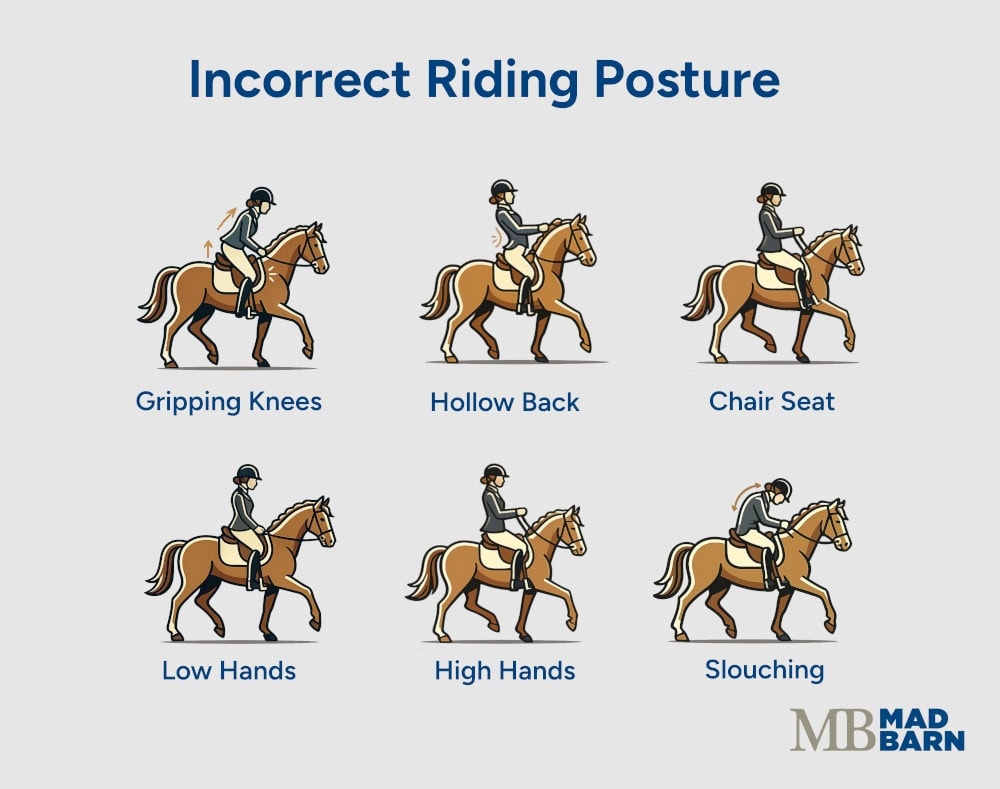
Leaning back concentrates additional load on the lumbar area, encourages the horse to travel on the forehand, and places long-term strain on the rider’s lower back. The fix is restoring pelvic mobility and alignment, not forcing the upper body upright.
Table 2. Common sitting trot mistakes and how to correct them
| Mistake | What it causes | How to correct it |
|---|---|---|
| Gripping with the knee |
|
|
| Bracing the core |
|
|
| Tight hips |
|
|
| Loss of phase |
|
|
| Chair seat |
|
|
| Leaning back |
|
|
| Locked ankle |
|
|
Exercises to Improve the Sitting Trot
Progress in sitting trot comes faster when riders address it with both structured mounted practice and targeted off-horse fitness work. This combined approach supports the rider’s coordination while helping the horse stay relaxed and balanced in the work.
In-Saddle Practice Methods
Riding on the lunge allows the rider to drop the reins and focus entirely on body mechanics.
Alternating between rising and sitting trot within the same gait helps the rider carry rising-trot timing into the sitting phase. Frequent walk-to-trot transitions reset position and relaxation before sitting trot becomes strained.
Short and correct always outperforms long and incorrect. Sustained sitting trot before the body is ready creates tension in both horse and rider, reinforcing the same habits being corrected.
Off-Horse Training & Fitness
Exercise ball work is one of the most direct off-horse tools for sitting trot preparation. Riders who combine off-horse fitness work with mounted practice tend to progress faster than those who rely on saddle time alone.
Research evaluated twenty experienced riders performing pelvic mobility exercises on a gymnastic ball and found that the ability to roll the pelvis from side to side was highly correlated with riding quality and harmony, as well as with fewer conflict behaviors in the horse. Active pelvic mobility practice proved more relevant to riding quality than static balance on the ball. [11]
Hip flexor stretches, hip circle drills, and yoga-based hip openers address the restriction that most commonly limits progress in sitting trot. Pilates-based core exercises build stability without rigidity.

Building a Better Sitting Trot
Sitting the trot is not a matter of trying to force the body to stay still in saddle. It is a dynamic skill that depends on timing, mobility, balance, and the rider’s ability to follow the horse’s movement without blocking it. A quiet seat comes from coordinated motion, not from tension.
For most riders, improvement starts with understanding where the bounce is coming from. Gripping with the knee, bracing through the core, leaning back, or losing phase with the stride can all make sitting trot feel harder than it needs to be. These habits are common, but they are also correctable when riders slow the process down and focus on short, accurate repetitions.
The best approach combines thoughtful mounted practice with off-horse work that improves hip mobility, core stability, and body awareness. Riders who train both in and out of the saddle are better prepared to absorb movement without stiffness and communicate with greater subtlety.
A good sitting trot should feel elastic, balanced, and connected for both horse and rider. Progress may take time, but the goal is not to sit longer at any cost. The goal is to sit better, with a seat that supports the horse’s movement instead of interrupting it.
Frequently Asked Questions
Here are some frequently asked questions about sitting trot:
Sitting trot is a riding position where the rider stays in continuous contact with the saddle throughout both beats of the trot. Instead of rising and sitting like in posting trot, the rider follows the horse's back with the pelvis, hips, core, legs, and upper body. A correct sitting trot looks quiet from the ground, but it requires active coordination, timing, and body awareness. The goal is not to sit still, but to move with the horse without blocking the stride.
Sitting trot is important in dressage because it allows the rider to use seat and weight aids with greater subtlety. As dressage movements become more collected and complex, the rider needs a stable connection to the saddle to influence lateral work, transitions within the gait, and collection. Under USEF rules, sitting trot is required from Second Level onward in national competition, and at FEI levels it is required from Prix St. Georges through Grand Prix. [1] A well-developed sitting trot also reflects the horse's training, because it becomes easier when the horse is through, swinging, and accepting the rider's weight without tension.
You should sit the trot when the horse is forward, round, relaxed, and working through the back. Rising trot is usually preferable during warm-up, with young or green horses, or any time the horse's back is not yet loose enough to comfortably carry the rider in sitting trot. Research shows that seat style affects how the horse moves, so the choice between sitting and rising trot has real biomechanical consequences. [2] A useful rule is to use sitting trot when the horse is through, and use rising trot to help the horse get there.
Riders bounce in sitting trot when they get out of phase with the horse's stride or block the motion with tension. If the horse's back drops and the rider does not descend quickly enough, the next upward movement catches the rider mid-descent and the bounce increases. Gripping with the knee, stiffening the hips, locking the ankle, bracing the core, or leaning back can all make this worse. Correcting bounce usually requires better timing, more pelvic mobility, softer legs, and a core that stabilizes without becoming rigid.
The pelvis should move in sitting trot by following the horse's stride from a neutral, balanced position. A neutral pelvis keeps the seat bones evenly weighted and allows the lumbar spine to maintain its natural curve. From there, the pelvis tilts gently with the upbeat and returns with the downbeat, following the same rhythm as rising trot without leaving the saddle. Because sitting trot produces high peak forces on the horse's back, good pelvic alignment helps distribute those forces more evenly. [5]
You should not relax completely in sitting trot, because the rider still needs active coordination and postural control. The hips need enough softness to absorb motion, but the trunk still needs steady support from a lightly engaged core. A collapsed or passive rider can fall behind the motion, while a braced rider blocks the movement and bounces. The best sitting trot combines mobility below, stability above, and timing that matches the horse's stride.
Hip mobility affects sitting trot because the hips are the main shock absorbers between the horse's back and the rider's upper body. As the horse's back rises and drops, the rider's hip joints need to open and close in an alternating pattern. When the hips are tight, the lower back often tries to absorb the motion instead, which is less effective and can become uncomfortable. Tight hip flexors and adductors are common limiting factors for riders who struggle to sit the trot smoothly.
Core strength helps with sitting trot by stabilizing the rider's trunk while allowing the hips and pelvis to keep moving. The core should be softly engaged rather than forcefully braced, because bracing locks the lower back and blocks shock absorption. Research in dressage horse and rider pairs found that an eight-week unmounted core fitness program improved rider symmetry and reduced peak forces on the horse's back at sitting trot. [6] This suggests that targeted core training can benefit both rider effectiveness and horse comfort.
One of the most common mistakes in sitting trot is gripping with the knee or thigh when the rider feels insecure. Gripping tightens the hip flexors and adductors, blocks pelvic motion, and turns the leg into a rigid lever that pushes the rider upward with each stride. Leaning back in a chair seat is another common compensation, especially on horses with a big or bouncy trot. These habits usually improve when the rider restores pelvic alignment, softens the leg, and practices sitting for short, correct intervals.
Sitting trot can be harder on the horse's back than rising trot because it produces higher peak forces. Research comparing trot positions found that peak forces on the horse's back are significantly higher in sitting trot than in the sitting or standing phases of rising trot. [10] A bouncing, stiff, or asymmetrical seat can amplify those forces and distribute them unevenly. This is why riders should develop sitting trot gradually and return to rising trot when the horse or rider becomes tense.
Poor sitting trot may contribute to back soreness in horses when the rider bounces, braces, sits unevenly, or applies excessive force through the saddle. Uneven or poorly absorbed motion can increase tension through the thoracic and lumbar regions and may show up as resistance, muscle tightness, or gait changes. The rider-saddle-horse system is closely connected, and changes in how the rider contacts the saddle can affect equine spinal movement. [11] If a horse shows persistent discomfort, resistance, or changes in performance, saddle fit, rider influence, training, and veterinary factors should all be considered.
Exercises that help improve sitting trot include short periods of sitting trot on the lunge, frequent walk-to-trot transitions, and alternating between rising and sitting trot. Lunge work allows the rider to focus on body mechanics without managing the reins. Alternating rising and sitting trot helps carry the timing of posting trot into the seated phase. Short, correct practice is more effective than long sessions that create tension in the horse or rider.
Off-horse exercises that help with sitting trot include exercise ball pelvic mobility work, hip flexor stretches, hip circle drills, yoga-based hip openers, and Pilates-style core training. Exercise ball work is especially relevant because it allows riders to practice controlled pelvic movement without the added complexity of riding. Research found that the ability to roll the pelvis side to side on a gymnastic ball was highly correlated with riding quality, harmony, and fewer conflict behaviors in the horse. [9] Active pelvic mobility appears more useful for sitting trot than static balance alone.
You should practice sitting trot in short, correct intervals rather than trying to sit for long periods before your body is ready. Sustained sitting trot with tension, bouncing, or gripping reinforces the same habits riders are trying to fix. Frequent resets through walk transitions or rising trot help the rider return to relaxation and alignment. As strength, timing, and mobility improve, the length of sitting trot work can gradually increase without sacrificing quality.
Sitting trot is easier on some horses than others because the horse's movement, training, throughness, and back mechanics all affect how the rider experiences the gait. A horse with a swinging, engaged back is generally easier to sit than one that is tight, hollow, rushed, or choppy. The horse's back moves vertically, laterally, and rotationally at trot, so the rider must follow a complex three-dimensional motion. [3] As the horse becomes more supple and balanced, and the rider becomes more coordinated, sitting trot usually becomes easier for both.
Summary
Sitting trot is an advanced riding skill that requires the rider to follow the horse's motion with balance, mobility, and timing. Developing a better sitting trot depends on correct position, relaxed movement, and thoughtful practice both in and out of the saddle.
- A good sitting trot depends on coordinated movement through the rider's pelvis, hips, core, legs, and upper body
- Bracing, gripping, tight hips, and leaning back can all increase bouncing and interfere with the horse's movement
- Rising trot is often the better choice during warm-up or when the horse is not yet loose through the back
- Off-horse training that improves hip mobility and core stability can support better sitting trot technique
- A balanced seat helps reduce uneven forces on the horse's back and supports clearer communication
References
- FEI Dressage Rules. FEI. 2026.
- Persson-Sjodin. E. et al. Influence of Seating Styles on Head and Pelvic Vertical Movement Symmetry in Horses Ridden at Trot. PLOS ONE. 2018. View Summary
- MacKechnie-Guire. R. and Pfau. T. Differential Rotational Movement of the Thoracolumbosacral Spine in High-Level Dressage Horses Ridden in a Straight Line, in Sitting Trot and Seated Canter Compared to In-Hand Trot. Animals. 2021.
- Clayton. H. et al. Riders' Effects on Horses: Biomechanical Principles with Examples from the Literature. Animals. 2023. View Summary
- de Cocq. P. et al. Vertical Forces on the Horse's Back in Sitting and Rising Trot. Journal of Biomechanics. 2010. View Summary
- Murray. R. et al. Saddle Thigh Block Design Can Influence Rider and Horse Biomechanics. Animals. 2023. View Summary
- Peham. C. et al. A Comparison of Forces Acting on the Horse's Back and the Stability of the Rider's Seat in Different Positions at the Trot. The Veterinary Journal. 2010.
- Hampson. A. and Randle. H. The Influence of an 8-Week Rider Core Fitness Program on the Equine Back at Sitting Trot. International Journal of Performance Analysis in Sport. 2015.
- Byström. A. et al. Lateral Movement of the Saddle Relative to the Equine Spine in Rising and Sitting Trot on a Treadmill. PLOS ONE. 2018. View Summary
- Martin. P. et al. Effect of the Rider Position During Rising Trot on the Horse's Biomechanics. Journal of Biomechanics. 2016. View Summary
- Uldahl. M. et al. Relationships between the Rider's Pelvic Mobility and Balance on a Gymnastic Ball with Equestrian Skills and Effects on Horse Welfare. Animals. 2021.