English
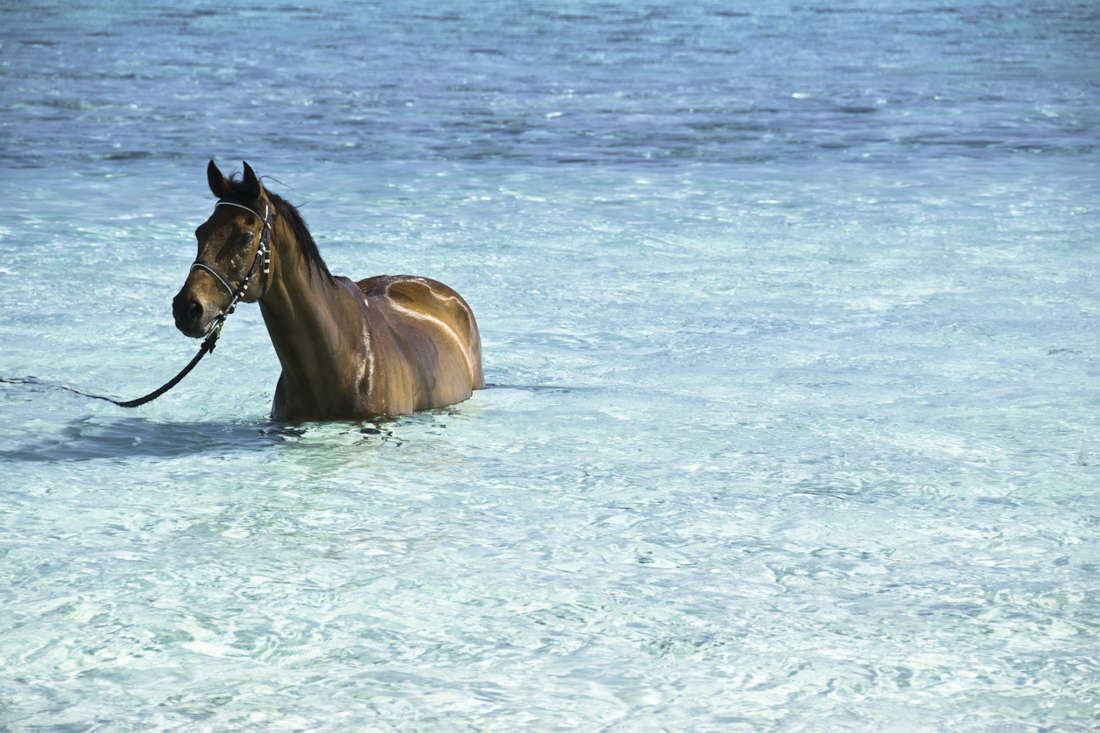
If you’ve seen photos or videos of horses swimming, you may wonder whether all horses can swim or whether it is a skill that only some horses learn.
Most healthy horses can swim instinctively, using coordinated limb movements to stay afloat and move through deep water. However, a horse’s confidence, fitness, and previous experience can affect how safely and comfortably it maneuvers in water.
Swimming is also used for conditioning, recreation, and selected rehabilitation programs because buoyancy reduces weight-bearing forces on the limbs. Although it is lower impact than many forms of land-based exercise, swimming is physically demanding and places significant demands on the horse’s heart, lungs, and muscles.
Not every horse is a suitable candidate for swimming, and horses should only swim under close supervision in an appropriate facility or environment. Veterinary guidance is especially important for horses recovering from injury or managing a health condition.
Keep reading to learn how horses swim, when swimming may be useful, the potential benefits and risks, and how to introduce a horse to deep water safely.
Swimming Ability in Horses
Yes, horses can naturally swim in open water. Swimming is an instinctive behavior rather than a learned skill.
When a horse enters water deep enough that their feet lose contact with the bottom, they automatically begin coordinated paddling movements with all four limbs to stay afloat and move forward. [1]
Unlike many ridden skills, the basic movement for equine swimming does not require training. However, individual horses vary in their confidence and ability.
A number of factors influence how calmly and efficiently a horse swims, including: [1]
- Temperament
- Previous experience
- Physical fitness
- Familiarity with water
Some horses enter water willingly and maintain smooth, symmetrical movements, while others become anxious or try to turn around, creating a safety risk for the horse and handler. [1]
Wild horses may swim when necessary to reach grazing areas, escape predators, or cross natural barriers such as rivers and tidal channels.
One of the best-known examples is the annual swim across the tidal channel between Assateague and Chincoteague Islands made by the Chincoteague ponies. [2] Although domestic horses rarely need to swim as part of everyday life, the same instinctive ability remains.
While most healthy horses are capable of swimming, this does not mean every horse enjoys it or should be encouraged to swim. Swimming places unique demands on the cardiovascular, respiratory, and musculoskeletal systems that differ from those experienced during exercise on land. [3]
Horses should be introduced to swimming gradually and under controlled conditions to build confidence and minimize the risk of stress or injury.
What's your top priority with your horse's health?

What's your top priority with your horse's health?
How Do Horses Swim?
Swimming requires a different kind of movement than walking, trotting, or cantering on land. Once a horse is in water deep enough that their feet no longer touch the bottom, they can no longer push off the ground.
Instead, they use their legs to propel themselves through the water, while buoyancy keeps them afloat. A horse’s large body pushes aside a substantial amount of water, and the air in its lungs helps it float at the surface. [1]
Horses typically hold the head and neck elevated in water to keep the nostrils above the surface, allowing them to breathe as they swim. [1]
Research shows that horses do not all swim in exactly the same way. Rather than using a standard swimming stroke, healthy horses naturally adopt a variety of limb coordination patterns.
Some display a classic “dog paddle,” while others use different combinations of alternating and synchronous movements of the forelimbs and hindlimbs. These patterns appear to represent normal individual variation in swimming technique, not poor performance or abnormal movement. [1]
Limb movement also differs from exercise on land. Studies show that swimming increases flexion in several forelimb and hindlimb joints while eliminating the impact forces associated with hoof contact on the ground. [4][5]
Because water provides continuous resistance throughout each stroke, the muscles propel the horse forward while stabilizing the body against the surrounding water. This combination of buoyancy and continuous resistance creates a form of exercise that conventional ridden work cannot replicate. [4][5]
Swimming also changes the way horses breathe. Unlike galloping, in which breathing is closely linked to stride pattern, swimming requires horses to keep their nostrils above the water while coordinating respiration with continuous limb movement. [6]
Can All Horses Swim?
Although swimming is instinctive for most healthy horses, willingness to enter the water and confidence while swimming vary considerably. Some horses readily enter pools, lakes, or rivers and swim with calm, coordinated movements. Others become hesitant or anxious when they can no longer touch the bottom.
Previous experience often has more influence on confidence than instinct alone. Horses introduced to swimming gradually in a calm, controlled environment are generally more confident than those suddenly exposed to deep or fast-moving water or those with a previous frightening experience.
Allowing the horse time to investigate the environment and progress at its own pace can help reduce the stress response and build confidence. [1][3]
Individual temperament and physical condition also influence how horses respond. Curious, confident horses often adapt more readily than cautious individuals, while horses with persistent pain or underlying health problems may be reluctant to enter the water or struggle to swim comfortably. [3][6]
Before swimming is introduced as part of a conditioning program or rehabilitation plan, owners should assess the horse to determine whether they are physically suited to swimming as an exercise.
Even confident swimmers require careful management. Swimming is physically demanding, and fatigue can develop quickly if sessions are too long or exceed the horse’s fitness level. Most programs begin with short sessions and increase the workload gradually as the horse gains confidence and conditioning.
Owners should monitor horses closely throughout each session for signs of fatigue or distress so they can leave the water before safety becomes a concern.
Assessing Swimming Readiness for Individual Horses
Not every horse is suited to swimming. Horses with certain respiratory conditions, cardiovascular disease, poorly controlled lameness, or injuries that could be aggravated by swimming movements may be better suited to alternative forms of exercise or rehabilitation. Decisions about therapeutic swimming should always be made with the attending veterinarian. [3][7][8]
Although swimming reduces impact on a horse’s limbs, the exaggerated range of motion required during swimming increases flexion in several joints and places different demands on muscles, tendons, and ligaments than exercise on land. Depending on the injury, these movements may delay rather than support healing. [3][4][5]
Swimming should only be incorporated into rehabilitation when specifically recommended by the attending veterinarian or rehabilitation professional.
Horses with cardiovascular disease or poor physical fitness may also be unsuitable candidates. Because they must keep moving until they reach the shallows, horses that fatigue quickly or have underlying cardiovascular abnormalities may be at greater risk of exercise intolerance or complications. [3][8]
Behavior must also be considered. Horses that panic in deep water, become difficult to control, or show persistent signs of distress despite gradual introduction are unlikely to benefit from swimming. Alternative conditioning or rehabilitation methods may provide comparable benefits with fewer welfare and safety concerns. [3]
Ultimately, whether to introduce a horse to swimming depends on the individual horse. Before starting a program, owners should consider: [3]
- Age
- Temperament
- Fitness
- Medical history
- The reason for swimming
These factors are especially important to weigh when swimming is included as part of a veterinary rehabilitation program. [3]
Benefits of Swimming for Horses
Swimming places substantial demands on the horse’s respiratory and cardiovascular systems, resulting in a greater workload than many people expect. As such, it is best viewed as a specialized form of exercise, not simply a low-impact activity. [6]
Trainers and veterinarians have used specially designed swimming pools for decades as a form of equine cross-training and, in selected cases, rehabilitation. Unlike exercise on land, buoyancy supports much of the horse’s body weight while water provides continuous resistance.
This combination allows horses to exercise without the repeated impact associated with walking, trotting, or cantering on firm ground. [4][5][6]
Because water resists movement in every direction, swimming provides a demanding cardiovascular workout while requiring muscles throughout the shoulders, back, and hindquarters to work continuously. Research has documented substantial physiological responses, including increases in heart rate and respiratory effort. These findings show that swimming is a vigorous exercise for horses despite reduced weight-bearing forces on the limbs. [6][9]
Swimming is often incorporated into training programs for performance horses to improve fitness while reducing repetitive loading of the musculoskeletal system. It may also be recommended during injury rehabilitation in selected cases, particularly when limiting weight-bearing forces is desirable. [3][10]
Suitability depends on the individual horse, the nature of the injury, and the stage of recovery. Rehabilitation programs require professional guidance and should be developed in consultation with the attending veterinarian or rehabilitation professional. [3][10]
Although swimming offers several potential advantages, it is not a replacement for ridden exercise. Horses do not develop the same patterns of balance, coordination, or bone loading in the water as they do during work on land.
Risks of Swimming
Although swimming can support conditioning and rehabilitation, it also places a substantial cardiovascular and respiratory workload on the horse. Unlike walking or trotting, horses cannot stop to rest while swimming. They must continue moving until they reach shallow water or leave the pool, making close supervision essential. [3]
Swimming places substantial demands on the cardiovascular and respiratory systems. As a result, horses can become fatigued more quickly than many owners expect, particularly when they are inexperienced or insufficiently conditioned. [3][6][9]
Swimming also changes how horses breathe. In one study of tethered swimming, all 10 horses showed complete upper airway collapse (closure of the nares, nasopharynx, and rima glottidis) during a brief apneic (non-breathing) phase after each inhalation. The authors interpreted this as a normal equine breathing strategy, possibly a dive reflex, not airway disease. [7]
Cardiac arrhythmias have been recorded in horses during swimming, although available research suggests they do not occur often. In one study of fit endurance horses, arrhythmias occurred at low frequency during swimming, and pathological arrhythmias were rare. The researchers concluded that repetitive swimming with active recovery did not represent a high-risk exercise for cardiac arrhythmias. [8]
Risks to Handlers
Swimming also creates safety risks for handlers and other people near the water. Any activity in or around a pool, lake, river, or pond carries a drowning risk, even for experienced swimmers.
Shallow waters are not safer than deep waters, outdoor conditions can change rapidly, and depth is often inconsistent in natural bodies of water. Footing may be unstable, and a frightened or fatigued horse can pull, strike, kick, or drag a person into deeper water.
Never handle a horse in or near a body of water alone. At least one other experienced person should be present and able to call for help if an emergency occurs.
Handlers should also follow basic safe handling practices, including:
- Staying aware of the horse’s body position
- Avoiding unsafe positions near the legs
- Never wrapping lead ropes, lunge lines, or other equipment around the hand, arm, waist, or body
A personal flotation device or life jacket is strongly recommended for anyone entering water with a horse. Water safety organizations advise never swimming alone and recommend properly fitted life jackets for water activities, especially when conditions are unpredictable. [11][12]
How to Introduce a Horse to Swimming
Most horses can swim instinctively, but owners should not expect them to enter deep water confidently without preparation. A gradual introduction reduces stress and promotes safer, more relaxed swimming.
Before entering the water, the horse should be comfortable with the surrounding environment. Walking around the pool or water-entry area allows the horse to investigate unfamiliar sights, sounds, and footing. Calm, patient handling is important because forcing a reluctant horse into deep water can create fear and make future sessions more difficult. [3]
The first sessions should be brief. Short swims allow the horse to become accustomed to buoyancy and the increased effort required to move through the water without becoming excessively fatigued.
As confidence and fitness improve, the duration and number of repetitions can be increased gradually while the horse continues to be monitored for stress or exhaustion.
Close supervision is essential throughout every session. Handlers should never leave horses unattended while swimming, and they should monitor the horse’s behavior, breathing, and swimming pattern from entry to exit.
Reasons to end a session immediately include: [3]
- Loss of coordination
- Reluctance to continue
- Excessive respiratory effort
- Obvious distress
After leaving the water, allow the horse to recover gradually and monitor for fatigue, soreness, or respiratory difficulty. As with any exercise program, adequate recovery between sessions allows the horse to adapt safely to the workload. [3]
Good practices when introducing a horse to swimming include: [3]
- Introduce the horse gradually in a calm, controlled environment
- Allow time to investigate the pool or water entry before swimming
- Keep the first sessions short and increase the workload progressively
- Supervise every session with experienced personnel
- End the session immediately if the horse shows distress, fatigue, or poor coordination
- Monitor the horse after swimming before returning it to normal exercise
Consistent, patient handling can help the horse build confidence without exceeding its physical limits.

Swimming vs. Underwater Treadmills
Although both involve exercise in water, swimming and underwater treadmill exercise are very different forms of conditioning and rehabilitation. The primary difference is that horses using an underwater treadmill continue to bear weight through their limbs while walking, whereas swimming horses are fully buoyant and do not maintain contact with the ground. [3][10]
Underwater treadmills allow handlers greater modification and control than swimming. Because horses remain in contact with the treadmill belt, clinicians can adjust water depth, speed, and exercise duration to suit the individual horse. [10]
Water depth can modify weight-bearing and joint motion, while treadmill speed controls exercise intensity. This makes underwater treadmills particularly useful during rehabilitation, when programs must often be tailored to a specific injury or stage of recovery. [10]
Swimming provides a different type of exercise. Without contact between the feet and the ground, horses rely entirely on coordinated limb movements for propulsion. This creates a demanding cardiovascular workout while eliminating impact loading on the limbs. However, swimming also places greater demands on respiration and requires continuous movement until the horse leaves the water. [3][10]
Neither method is inherently better. They serve different purposes, and the choice depends on the horse’s condition, training goals, available facilities, and veterinary recommendations.
Table 1. Comparison of swimming and underwater treadmill exercise
| Swimming | Underwater treadmill |
|---|---|
| No contact with the ground | Horse walks while maintaining ground contact |
| Minimal weight-bearing | Weight-bearing is adjusted through water depth |
| High cardiovascular demand | Exercise intensity is adjusted using water depth and treadmill speed |
| Continuous propulsion through the water | Controlled walking exercise |
| Conditioning and selected rehabilitation cases | Rehabilitation and controlled conditioning |
Swimming Safety
Swimming can be a valuable addition to a horse’s conditioning or rehabilitation program, but safety must remain the priority. Careful planning, appropriate facilities, and close supervision help reduce the risk of injury or distress for horses and handlers.
Safe swimming depends on more than the horse’s natural ability to stay afloat. Before each session, handlers should confirm that the facility, horse, personnel, and recovery plan are appropriate for the work being asked.
Use this checklist to support safer swimming sessions: [3]
- Use an appropriate facility: Pools and designated swimming areas should have safe entry and exit points, clean water, and enough space for the horse to swim freely.
- Introduce the horse gradually: Allow the horse to become familiar with the environment before asking it to swim, and never force a reluctant horse into deep water.
- Supervise every session: Experienced personnel should monitor the horse from the moment it enters the water until it has fully recovered after leaving.
- Keep sessions short: Swimming is physically demanding, particularly for inexperienced horses. Increase duration and intensity gradually as fitness improves.
- Watch for fatigue or distress: Difficulty maintaining a coordinated swimming pattern, excessive respiratory effort, reluctance to continue, or panic indicate that the session should end immediately.
- Consider the horse’s health: Horses with respiratory disease, cardiovascular problems, or injuries that swimming may aggravate should be evaluated by a veterinarian before starting a program.
- Allow adequate recovery: Monitor the horse after swimming and allow sufficient time to recover before returning to work or beginning another session.
- Use swimming to complement land-based exercise: Most horses still require regular work on land to develop balance, coordination, bone strength, and discipline-specific fitness.
Table 2. Horse swimming warning signs and when to stop
| Warning sign | What it may indicate | Recommended action |
|---|---|---|
| Loss of coordinated paddling | Fatigue, distress, or difficulty maintaining position | End the session immediately and guide the horse to the exit |
| Excessive respiratory effort | Overexertion or possible airway difficulty | Remove the horse from the water and monitor its breathing |
| Reluctance to continue | Fatigue, discomfort, anxiety, or pain | Stop the session and assess the horse before swimming again |
| Panic or attempts to turn around | Fear, loss of confidence, or environmental stress | Help the horse exit calmly and do not force re-entry |
| Unusual weakness or rapid fatigue | Insufficient fitness or a possible underlying health problem | Discontinue swimming and seek veterinary guidance |
| Respiratory difficulty after swimming | Delayed recovery or a possible respiratory complication | Monitor the horse closely and contact a veterinarian if signs persist |
| Soreness after swimming | Excessive workload or aggravation of an existing injury | Pause swimming and consult the attending veterinarian or rehabilitation professional |
Handlers should also follow established safe handling practices around water, where uncertain footing and a frightened or fatigued horse can increase risk. [3]
The Role of Swimming in Equine Training & Care
Most healthy horses can swim instinctively, but natural ability does not guarantee that every horse will feel confident or remain safe in deep water. Temperament, fitness, health, and previous experiences all influence how a horse responds.
Swimming can provide vigorous cardiovascular exercise while reducing weight-bearing forces on the limbs. Water resistance also challenges muscles throughout the body, making swimming a useful form of cross-training for some horses. It is most effective when used as part of a broader conditioning program.
Sessions should begin with short, manageable swims and increase only when the horse remains calm and recovers well. Experienced supervision, safe entry and exit points, and close monitoring before, during, and after each session are essential.
Swimming may support rehabilitation in selected cases, but suitability depends on the injury, the horse’s medical history, and the stage of recovery. Some movements used in the water can aggravate certain musculoskeletal conditions, while the cardiovascular and respiratory demands may be inappropriate for other horses.
Owners should consult their veterinarian or rehabilitation professional before using swimming therapeutically. With appropriate candidate selection, gradual progression, and careful supervision, swimming can be a valuable and enjoyable addition to an individual horse’s exercise program.
Frequently Asked Questions
Here are some frequently asked questions about horses swimming:
Most healthy horses can swim instinctively once their feet no longer touch the bottom, but not every horse is confident or physically suited to swimming. Temperament, previous experience, fitness, and health can all affect how calmly and efficiently a horse moves through the water. Horses with certain respiratory, cardiovascular, or musculoskeletal conditions may not be suitable candidates for swimming.
Horses do not need to be taught the basic swimming movement because it is an instinctive behavior. However, they should be introduced to the water gradually so they can become familiar with the surroundings, entry point, and changing footing. A calm, controlled introduction can reduce stress and help the horse swim more confidently.
Horses swim by using coordinated paddling movements of all four limbs while buoyancy keeps their bodies afloat. They typically hold their head and neck above the surface so their nostrils remain clear of the water. Individual horses may use different combinations of alternating or simultaneous limb movements, and these variations can be normal.
Swimming can be good exercise for suitable horses because it provides a demanding cardiovascular and muscular workout with minimal impact on the limbs. Water resistance requires the muscles of the shoulders, back, and hindquarters to work continuously. Swimming is commonly used for cross-training and may support rehabilitation in carefully selected cases.
The benefits of swimming for horses can include improved cardiovascular fitness, muscle strength, and endurance without the repeated impact of land-based exercise. It can also add variety to a conditioning program and reduce repetitive loading on the musculoskeletal system. However, the benefits depend on the horse's health, fitness, temperament, and reason for swimming.
Swimming cannot completely replace ridden exercise because it does not provide the same balance, coordination, bone loading, or discipline-specific conditioning as work on land. Although it can improve cardiovascular fitness and muscle conditioning, movement in the water differs substantially from conventional exercise. Swimming is best used as one part of a balanced training or rehabilitation program.
Whether swimming is safe for an injured horse depends on the type of injury and the stage of recovery. Buoyancy reduces weight-bearing forces, but the increased joint flexion and unique limb movements involved in swimming may aggravate some conditions. A veterinarian or qualified rehabilitation professional should determine whether swimming is appropriate for an injured horse.
Horses that should not swim may include those with respiratory disease, cardiovascular problems, poorly controlled lameness, or injuries that could be worsened by swimming movements. Horses that panic in deep water or remain distressed despite a gradual introduction may also be unsuitable. Age, fitness, temperament, medical history, and the intended purpose of swimming should all be considered before starting a program.
Swimming can be dangerous for horses when sessions are poorly supervised, too demanding, or unsuitable for the individual horse. Horses cannot stop and rest while they are in deep water, so fatigue, breathing difficulty, loss of coordination, or panic can quickly become serious. Swimming can also place substantial demands on the respiratory and cardiovascular systems, making appropriate assessment and close monitoring essential.
A horse should be introduced to swimming gradually in a calm, controlled environment with safe entry and exit points. The horse should first be allowed to investigate the surroundings, water, and footing without being forced into deep water. Initial swims should be brief, with the workload increased progressively as confidence and fitness improve.
Signs that a horse should stop swimming include excessive respiratory effort, loss of coordination, reluctance to continue, or obvious panic and distress. Because a horse must keep moving until it reaches shallow water or an exit, handlers should respond immediately when these signs appear. The horse should also be monitored after leaving the water for fatigue, soreness, or breathing difficulties.
Swimming differs from an underwater treadmill because a swimming horse is fully buoyant and has no contact with the ground, while a horse on an underwater treadmill continues to walk on a moving belt. Underwater treadmills allow water depth, speed, weight-bearing, and exercise duration to be adjusted more precisely. Swimming generally creates a greater cardiovascular demand, whereas underwater treadmills are often selected when controlled weight-bearing exercise is needed during rehabilitation.
An underwater treadmill is not inherently better than swimming because the two forms of exercise serve different purposes. Swimming may be useful for cardiovascular conditioning and selected rehabilitation cases with minimal limb loading, while an underwater treadmill provides controlled walking with adjustable weight-bearing. The most appropriate option depends on the horse's condition, training goals, stage of recovery, and veterinary recommendations.
Summary
Most healthy horses can swim instinctively, but swimming requires careful introduction and supervision.
- Horses use coordinated limb movements to stay afloat and propel themselves through deep water
- Swimming provides low-impact cardiovascular and muscular exercise by combining buoyancy with water resistance
- It can support conditioning and selected rehabilitation programs when the horse is an appropriate candidate
- Swimming does not replace land-based exercise for balance, coordination, bone loading, or ridden fitness
- Fatigue, breathing difficulty, poor coordination, panic, or reluctance to continue require an immediate stop
- Veterinary guidance is important before swimming horses with injuries, lameness, respiratory disease, or heart conditions
References
- Grossi. I. et al. Characteristics of Horse Gait during Swimming Exercise in Swimming Pool. Journal of Equine Rehabilitation. 2024.
- Segal. C. America's Famous Swimming Ponies Make Their Annual Trek across Ocean Channel. PBS News. 2015.
- McCrae. P. et al. Equine Swimming Exercise: A Guide for Users. Moulton College.
- Santosuosso. E. et al. Kinematic Analysis During Straight Line Free Swimming in Horses: Part 1 - Forelimbs. Frontiers in Veterinary Science. 2021.
- Santosuosso. E. et al. Kinematic Analysis During Straight Line Free Swimming in Horses: Part 2 - Hindlimbs. Frontiers in Veterinary Science. 2022.
- Leguillette. R. et al. Workload and Spirometry Associated with Untethered Swimming in Horses. BMC Veterinary Research. 2024.
- Jones. S. et al. Complete Upper Airway Collapse and Apnoea during Tethered Swimming in Horses. Equine Veterinary Journal. 2020.
- Santosuosso. E. et al. Frequency of Cardiac Arrhythmias in Horses during Straight and Untethered Swimming. Equine Veterinary Journal. 2023.
- Garcia. M. C. and Beech. J. Endocrinologic, Hematologic, and Heart Rate Changes in Swimming Horses. American Journal of Veterinary Research. 1986.
- Nankervis. K. et al. Consensus for the General Use of Equine Water Treadmills for Healthy Horses. Animals. 2021.
- Water Safety. American Red Cross.
- Summer Swim Safety. Centers for Disease Control and Prevention. 2026.