English
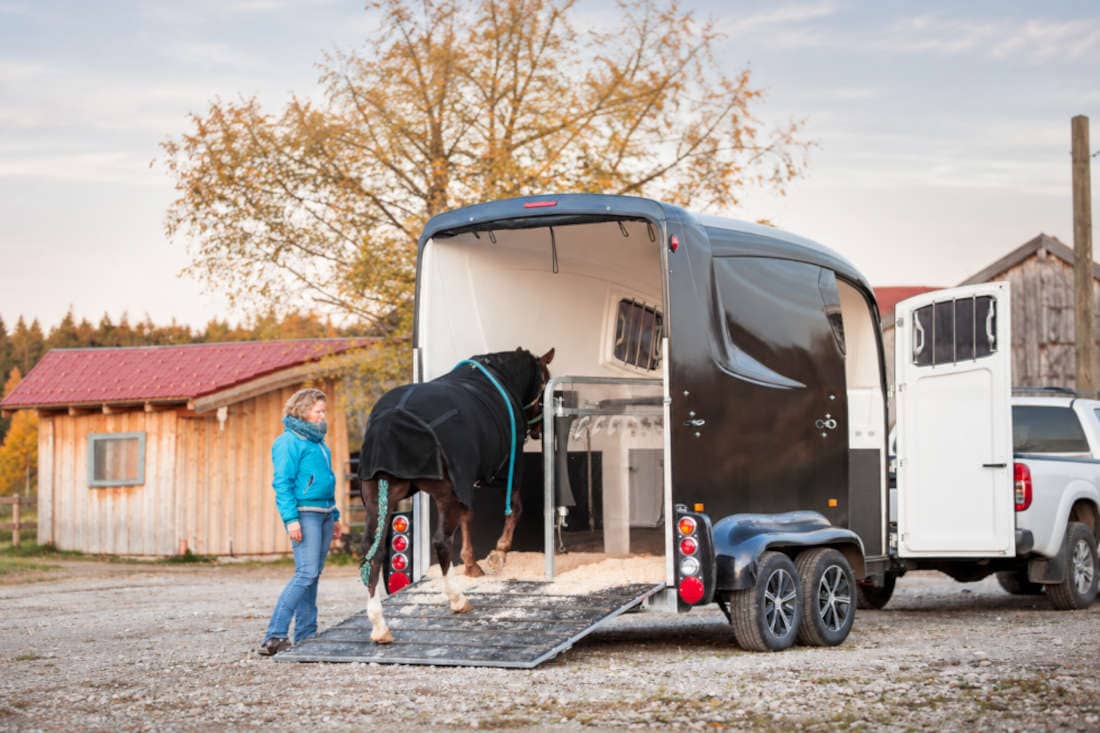
Training your horse to load into a trailer can make routine travel safer and ensure you are prepared when transportation is needed in an emergency. However, entering a narrow, enclosed space does not come naturally to horses, and loading difficulties can develop even in experienced travelers.
Calm, systematic training helps the horse develop confidence without becoming overwhelmed. By understanding how different training techniques relate to the way horses learn, you can lower your horse’s stress and make trailer loading a smoother process for everyone involved.
Follow this guide to get the most out of your trailer loading training sessions and ensure your horses keep this skill current for the long term.
Trailer Loading & Horse Training
Reliable trailer loading is an important safety skill, not just a convenience. Trailer transport is required for many aspects of horse care, including:
- Competition
- Moving to a new barn
- In-clinic veterinary care
- Emergency evacuation
Waiting until departure day to address loading leaves little room for patient training, and lack of trailer training represents a real safety risk. Injuries related to problem behaviors during transportation are well-documented and occur in horses and handlers alike, reinforcing the value of preparation before travel. [1][2]
What's your top priority with your horse's health?

What's your top priority with your horse's health?
Why Horses Resist Trailer Loading
Trailer refusal is frustrating for humans, but each time your horse reacts, it provides useful information that can help you understand the cause and address the behavior in future training.
Horses may resist trailer loading because they are unfamiliar with the trailer, afraid of entering it, physically uncomfortable, unsure of their footing or balance, or confused by the handler’s cues.
A horse that refuses to load is not necessarily being stubborn, and identifying the reason for the resistance can help determine what needs to change in training.
Lack of experience is a common factor, particularly in horses that have had little exposure to trailers, ramps, enclosed spaces, or transport. Even horses that usually load well may become reluctant when asked to enter a different trailer or when other details of the loading environment change.
As prey animals, horses are adapted to notice change and move away from possible threats. Domestication and training shape how they react to unfamiliar situations, but entering a narrow enclosure with a restricted exit is still a challenge to the horse’s flight-or-fight response. [3][4][5]
A trailer presents several features that can make loading difficult:
- A narrow entrance can restrict the horse’s view and room to move
- Changes in lighting can make the trailer interior harder to see from outside
- Unfamiliar footing may sound, flex, or feel different under the horse’s feet
- Confinement limits the horse’s ability to turn, create distance, or move away when frightened
- Movement and noise during travel can create additional negative associations with the trailer
A horse may also become reluctant to load after a negative experience, such as slipping, losing balance during transport, being rushed into the trailer, or experiencing excessive pressure during loading.
Changes in routine can also affect loading behaviour. A different ramp, unfamiliar flooring, the smell or presence of another horse, or a long gap between trips may be enough to make a normally cooperative horse hesitate. [4][5][6]
Training Strategies & Equine Learning
Effective trailer training takes the horse’s prey instincts into consideration. A frightened horse may understand a forward cue but be too stressed to respond calmly, while a relaxed horse may still need to learn the individual steps involved in approaching, entering, standing, and unloading.
Horses also learn from how humans respond to their behavior. For example, if backing away causes pressure to disappear or ends the loading attempt, retreat in the future is more likely. Clear timing and consistent cues are more useful than increasing pressure or having several people direct the horse at once. [2][7][8]
Both positive and negative reinforcement are useful tools for training a horse to load in trailer. Negative reinforcement refers to removing a stimulus when the horse performs the desired behavior, such as releasing light pressure after a forward response.
Positive reinforcement refers to rewarding a desired behavior, such as providing a treat or scratch after the horse correctly takes a cue. In either case, the reward or release should follow the specific action you are looking for so the horse makes the connection between their behavior and the expected outcome. [2][7][9]
Systematic Desensitization & Counter-Conditioning
For horses who are fearful of the trailer, systematic desensitization involves exposing the horse to the trailer gradually, beginning at a level that does not cause a strong fear response and increasing the difficulty in small steps as the horse becomes more comfortable.
The horse might first work at a comfortable distance, then approach the entrance, touch the ramp, place one foot inside, and eventually progress to standing in the enclosed trailer. [4][5][6]
Counter-conditioning is used to change the horse’s emotional response to the trailer by pairing it with something the horse values, such as food, scratching, rest, or retreat. Over time, the trailer becomes associated with a more positive or neutral experience rather than fear or avoidance.
Work Below the Horse’s Fear Threshold
The horse’s fear threshold is the level of fear or arousal at which the horse’s ability to process information, respond to familiar cues, and learn from the situation begins to decline.
Signs that a horse is approaching or exceeding this threshold can include freezing, rushing, pulling away, loss of attention, reduced responsiveness, or attempts to escape.
Training should be conducted at an intensity that allows the horse to remain attentive and responsive. Mild caution, hesitation, or increased vigilance may still be present without preventing learning.
If the horse shows progressively greater tension during repeated attempts, the exercise should be reduced to an easier step where the horse can again respond consistently. Training can then progress gradually as the horse becomes more comfortable with each stage of the loading process. [4][8]
Risks of Aversive Training Methods
Using increasing pressure, restraint, or other unpleasant consequences can sometimes get a horse to move forward, but it does not necessarily reduce fear of the trailer. In this context, these are considered aversive methods because the horse is motivated to respond in order to avoid or stop something unpleasant. [3][4][2]
If the horse manages to pull away or escape when pressure increases, that response can become more likely in future loading attempts. A strongly unpleasant loading experience can also create a negative association with the trailer, especially if the horse feels trapped, frightened, or unable to control what is happening.
Flooding is an extreme form of exposure in which the horse is confronted with a feared situation at high intensity and prevented from escaping.
During trailer loading, this could involve forcing a horse into the trailer or preventing it from leaving while it is actively trying to get out. The horse may eventually stop struggling, but reduced movement does not necessarily mean that fear has resolved.
Repeated exposure to situations in which attempts to escape or avoid discomfort are unsuccessful may contribute to learned helplessness. This occurs when the horse stops trying to change the situation because previous attempts have had no effect.
A horse in this state may appear quiet or compliant while still experiencing fear or stress. Uncontrollable unpleasant experiences can also interfere with later learning and raise welfare concerns. [8][10]
Training a Horse to Load: Setting Up a Successful Session
Thoughtful preparation provides a safer and more effective learning environment. Before bringing the horse to the trailer, decide what behavior you will practice, how you will reinforce it, where the handler and any assistant will stand, and what will signal the end of the session.
If possible, begin trailer practice well before the horse needs to travel. When training must take place close to a departure deadline, allow as much extra time as possible and avoid escalating pressure simply to get the horse loaded quickly.
Time pressure can lead handlers to skip steps, continue after the horse becomes increasingly tense, or push for more progress than the horse is ready to make.
Check the Horse & Trailer
A horse that previously loaded well and then begins resisting may have a physical or situational reason for the change.
Factors to investigate include:
- Pain or physical discomfort
- Difficulty maintaining balance during transport
- Changes in coordination or mobility
- Recent travel experiences
- Changes to the trailer, footing, ramp, or loading setup
Training will not resolve pain or physical discomfort. A horse that enters the trailer willingly but becomes distressed once the trailer begins moving may be having difficulty with balance, footing, or another source of discomfort during transport.
Trailer design and condition affect both loading and travel safety. [1] Inspect the trailer before every training session. It should be parked on firm, level ground and secured according to the manufacturer’s instructions.
Check all of the working components of the trailer for damage or sharp edges, including:
- Floor beneath removable mats
- Ramp or step
- Hinges
- Latches
- Partitions
- Breast and butt bars
- Tie points
Strategies to help make the training session as effective as possible include:
- Make the entrance easy for the horse to identify by opening the door all the way and propping it open
- Open vents and safe, screened windows for light and airflow
- Secure doors and partitions so they cannot swing during training
- Use intact, non-slip flooring
- Remove loose equipment that may shift or rattle
If a divider or bar can be adjusted to create more room for initial training, follow the trailer manufacturer’s directions and restore all required equipment before travel.
Groundwork Prerequisites
The trailer is not the best place to introduce basic leading responses. Before loading practice, the horse should be able to:
- Walk forward from a light, familiar cue
- Stop without crowding the handler
- Back one step at a time
- Move the shoulders and hindquarters when asked
- Stand briefly while the handler changes position
These skills allow the handler to organize the horse’s feet without pulling or pushing. They are especially important for unloading because the horse may need to back through a narrow space without turning to see the route. [3][6][7]
Use groundwork exercises to practice changes in surface, width, light, and elevation away from the trailer. Walking over a secure rubber mat, between poles, through a wide gateway, or onto a low stable platform can reveal which element needs more preparation.
Handler Equipment & Safety
Trailer loading can put the handler at risk of injury if they are caught between the horse and the trailer, struck by the horse, or pulled off balance during sudden movement.
Basic safety equipment for handlers working on loading includes:
- A well-fitting halter
- A lead rope long enough to avoid pulling the horse into the handler
- Gloves
- Sturdy, closed-toe footwear
- Helmet
Do not wrap the lead rope around a hand or body part. Keep the line organized so it cannot tangle around feet, bars, or latches.
Before the horse approaches, rehearse the sequence for opening and closing the specific trailer. Everyone helping should know their role and safe position. Avoid standing directly behind the horse, between the horse and a fixed wall, or underneath a bar or partition being moved.
One person should direct the horse. An assistant may operate a divider or provide a planned secondary cue, but several people pulling, pushing, and waving from different directions make the horse’s task harder to understand.
4-Step Guide to Train a Horse to Load in Trailer
The following is a four-step guide to training horses to load safely onto a trailer. These steps should be viewed as a progression rather than four separate training sessions.
A horse may complete several stages in one calm session or spend multiple sessions on one element. Advance when the behavior is repeatable and the horse remains responsive, then revisit earlier steps whenever tension returns.
Keep sessions focused and stop before fatigue or frustration degrades the response. Ending after a small, calm success gives the next session a clear starting point.
Step 1) Build Confidence Near the Trailer
Start at a distance where the horse notices the trailer but can still perform familiar groundwork. The correct distance varies by horse and may change from one day to the next.
Practice walking, halting, backing, and yielding without aiming directly at the entrance. Use ordinary paths around the trailer, including walking past it in both directions. Reward the horse for maintaining a regular pace, soft posture, and attention to light cues. [3][4][6]
Gradually work closer. Change one feature at a time so the horse can identify what is new. For example, first approach the trailer with the ramp closed, then stand near the open ramp, then walk across the line of the entrance without turning in.
Do not keep circling a worried horse until they are exhausted. Repetition supports learning only while the horse can process the task. If posture becomes progressively tighter or the response to familiar cues deteriorates, increase the distance and restore a calm rhythm.
Ready to progress: The horse can approach and pass the trailer on either side, halt nearby, and respond to ordinary groundwork cues without rushing away.
Step 2) Investigate the Entrance
Turn toward the trailer from a comfortable distance and allow the horse time to look. A pause is not automatically refusal. Keep the lead line quiet enough that the horse can lower or turn their head to inspect the entrance without stepping into the handler.
Use approach and retreat to increase demands. Approach until the horse shows mild concern but remains responsive, pause, then retreat calmly before arousal escalates. Over repetitions, the horse learns that approaching does not lead to entrapment and that calm behavior preserves options. [4][5]
Retreat should be deliberate, not the result of the horse dragging the handler away. If the horse surges backward, regain a safe working distance and re-establish a light response before approaching again.
The horse may sniff the ramp, touch it, paw once, or look inside. Investigation is useful as long as it remains safe. Mark and reward specific calm behaviors, such as lowering the head, shifting weight forward, or standing square at the entrance.
Ready to progress: The horse can stand at the entrance, investigate without escalating, and step away and return without rushing.
Step 3) Load One Step at a Time
Choose the first criterion before asking. It might be one forward weight shift, one hoof on the ramp, or two feet inside. Give the horse’s familiar forward cue and reinforce the first correct effort.
Do not change the goal during the repetition. Asking for one step and then withholding reinforcement until the horse loads completely makes the cue less predictable.
Once the horse can repeat the first behavior calmly, add the next increment:
- One front hoof on the ramp or floor
- Both front feet on
- Hind feet at the base of the ramp
- One step further into the stall
- All four feet inside with the exit still open
After a correct effort, allow the horse to back out calmly when asked. Loading and unloading are trained together from the beginning. Preventing every retreat can increase anxiety about confinement, while uncontrolled rushing backward creates a separate safety problem.
Ready to progress: The horse can walk fully inside, pause, and back out one step at a time without rushing, freezing, or pushing into the handler.
Target Training
Target training is a specific method that lends itself to trailer loading. In a small study of five mares with previous loading problems, target training reduced inappropriate behavior and produced successful loading that carried across to a different trainer and trailer. [7]
To use this method, teach the horse to touch or follow a target away from the trailer. Then place the target progressively closer to and inside the trailer, rewarding the horse as they continue following or touching as they have been trained to do.
Positive reinforcement has also been used to teach horses to self-load. In one study, the trained horses loaded more quickly and showed fewer stress-related behaviors than untrained controls. The procedure rewarded specific steps in a planned sequence rather than using food as a lure during a confrontation. [9]
Handlers familiar with clicker training can use an established marker to identify the exact step being reinforced. Those using pressure and release should release at the onset of the requested forward response, then reset before asking again. [7][9][8]
Step 4) Build Comfort & Progress to Travel
Entering the trailer is only part of the finished behavior. The horse must also learn that standing inside, hearing equipment move, feeling the space narrow, and waiting for an unloading cue are separate, predictable tasks.
Begin with the trailer open. Ask for a brief pause, reward quiet standing, and unload before tension rises. Gradually increase the duration.
Once the horse can wait comfortably, introduce one piece of equipment at a time. An assistant might touch a divider, move it a short distance, return it, and reward the horse for standing. Build toward securing the partition, butt bar, door, or ramp in the correct order for that trailer.
Practice sounds and movement in small increments. The horse may need separate repetitions for a latch clicking, a ramp lifting, the handler leaving through an escape door, or the tow vehicle starting. If one change produces tension, reopen the space and repeat a less intense version of the stimulus.
Only tie a horse in the trailer when the horse is prepared for restraint and the trailer setup supports it. Use an appropriate quick-release arrangement for the rig, provide enough length for balance without allowing entanglement, and follow a consistent order for placing restraints, bars, and doors. Learn and rehearse that order with an experienced person before handling the horse.
When the horse can remain relaxed with the trailer secured, begin with a brief, smooth journey suited to the individual horse and local conditions. The first trip should be long enough to introduce motion but short enough to avoid unnecessary fatigue. Drive as though the horse is standing unsecured: accelerate gradually, brake early, and take turns slowly.
Ready to progress: The horse stands quietly while each part of the trailer is secured, remains settled when the vehicle starts, and unloads under control after a short trip.
Table 1. Step-by-step trailer loading training plan
| Training stage | Goal | Signs the horse is ready | Handler focus |
|---|---|---|---|
| Work near the trailer | Maintain familiar responses around the trailer | Horse approaches, passes, halts, and yields without rushing | Begin at a manageable distance and change one feature at a time |
| Investigate the entrance | Approach and stand at the opening without feeling trapped | Horse looks, sniffs, and waits while remaining responsive | Use approach and retreat; reinforce calm, specific behavior |
| Load incrementally | Shape one forward step into a complete load | Horse repeats each increment and can back out calmly | Set one criterion at a time and reinforce it promptly |
| Stand and secure | Teach waiting while trailer equipment is moved and closed | Horse remains settled as one component changes at a time | Practice the rig’s closing sequence and avoid rushing confinement |
| Add movement | Introduce the sensations of travel | Horse remains balanced and unloads without rushing | Use a smooth driver, suitable route, and appropriately brief first trip |
Teaching a Horse to Unload
Unloading deserves as much training as entering. A horse that rushes backward can fall from a step-up, slip on a ramp, strike the trailer frame, or collide with a handler. Practice the component skills before asking the horse to negotiate the trailer exit.
Teach the horse to back from a light cue on level ground, through a wide corridor, and over safe changes in surface. Ask for one deliberate step, pause, and ask again. The horse should not need to see directly behind to trust the cue, but the handler must ensure the path is clear.
Inside the trailer, release restraints and open bars, dividers, doors, or ramps in the correct sequence for the rig. Keep the horse contained until the exit is fully prepared. Stand to the side rather than directly behind, and maintain enough lead rope to guide without being pulled underfoot.
If the horse rushes, do not repeatedly reload only to let them bolt out again. Return to shorter backing sequences: one step back, one step forward, stand, then unload another step. Reward pauses and a consistent tempo.
Some horses also need desensitization to the visual change that occurs when a rear door opens or a ramp drops.
Troubleshooting Common Loading Problems
When progress stalls, identify the first point at which the horse’s behavior changes. That point is usually more useful than the final refusal. A horse that walks calmly to the ramp and then stops needs a different adjustment from one that becomes tense when the trailer comes into view.
Also compare the current session with previous successful ones. Changes in location, trailer type, lighting, companions, handler tension, physical comfort, and other factors can alter the horse’s response. [3][5][7]
The Horse Will Not Approach
Increase distance until the horse can respond to familiar cues, then rebuild the approach in smaller increments. Check whether the entrance is dark, the ramp is moving, a partition is rattling, or an unfamiliar smell is concentrated inside.
Counter-conditioning is useful for reactive horses, but food should be used carefully. Place hay or give small rewards at a distance where the horse is already able to eat calmly; do not use food to draw a horse who is past their fear threshold into a space they immediately want to flee. [3][4]
Prior handling affects how horses respond to transport. Horses with calm, consistent handling histories have lower markers of stress than horses with poor or limited handling experience, which highlights the value of establishing basic groundwork before moving up to more demanding tasks like loading. [11]
The Horse Loads Partway & Backs Out
Determine whether the horse is frightened by increasing confinement, uncertain about the hind feet, or repeating a learned retreat. Return to the last step in the process where the horse could pause and respond. Reward that point several times before asking for more.
Avoid adding strong pressure as the horse backs out. Pressure applied during backward movement may cause the horse to accelerate or rear, while a release delivered only after escape may reinforce retreat. Instead, keep the line organized, allow a safe controlled exit, reset, and ask for a smaller forward response. [4][7][9]
A calm companion horse may facilitate loading for some individuals, but it is not a universal solution. The horse still needs to learn the behavior independently so the skill is available when that companion is absent.
The Horse Rushes Backward
Rushing is usually a response to confinement, pressure from behind, or uncertainty about footing. Reopen the trailer and reduce the amount of time the horse is asked to stand. Reinforce a pause before the horse decides to leave, then cue the first backward step yourself.
Practice transitions between standing, one step back, and one step forward. This replaces an all-or-nothing pattern with controllable pieces. Do not stand behind the horse or try to stop a rushing horse by bracing against the lead rope from inside the trailer.
The Horse Panics When Equipment Closes
Return to the stage at which the horse can stand comfortably with the exit open. Separate each trigger: movement behind the hindquarters, the sound of a latch, narrowing of a divider, loss of light, and loss of direct access to the exit.
Introduce the relevant equipment at low intensity. For example, move the divider a few inches and reopen it before progressing to closing and latching. Have an assistant operate equipment only after roles and escape routes are clear. Do not use prolonged confinement to force habituation if the horse is scrambling, kicking, or attempting to escape.
The Horse Loaded Before but Refuses Today
Treat the change as useful information rather than proof that the horse is testing the handler. Check the horse, trailer, and environment for any relevant triggers that may be related to the new behavior. If there is no obvious cause, ask for an easier version of a familiar response and rebuild.
A horse may understand loading in a familiar straight-load trailer at home but not recognize the same task in a stock trailer at an event. Once the behavior is secure, vary one contextual feature at a time, such as the parking location, handler, stall, or trailer. [7][8]
When to Ask a Professional Trainer for Help
Seek experienced help when the horse rears, strikes, kicks, bolts, pulls free, traps handlers against the trailer, or repeatedly panics inside. Professional support is also appropriate when sessions show no measurable improvement despite consistent, low-pressure work. [6][2]
Choose a trainer who can explain the learning process, identify observable criteria for progress, and demonstrate safe positions around the specific trailer. The plan should address the horse’s emotional state as well as the mechanics of getting all four feet inside.
Sedation may be necessary for urgent transport under veterinary direction, but it does not retrain the loading response. Sedated horses may also balance differently, so emergency use requires professional guidance and an appropriate transport plan. [3][1]
Table 2. Common trailer loading problems and training adjustments
| Loading problem | What to assess | Training adjustment | Avoid |
|---|---|---|---|
| Will not approach | Distance, visibility, noise, odor, footing, previous experience | Work farther away; use gradual approach and retreat | Dragging, chasing, or surrounding the horse with helpers |
| Loads partway and backs out | Fear of confinement, hind-foot placement, learned retreat | Reinforce a smaller forward criterion and allow a controlled exit | Escalating pressure during backward movement |
| Rushes backward | Duration inside, exit cue, footing, pressure from behind | Train one backward step and a pause before continuing | Standing behind the horse or blocking an unsafe exit |
| Panics when closed in | Divider, bar, ramp, latch, light, restraint | Introduce one component at low intensity and reopen it | Closing everything at once or using flooding |
| Refuses after loading reliably | Pain, recent travel, new context, trailer change, handler urgency | Check for a practical cause and return to an easier step | Assuming the horse is stubborn because they loaded before |
| Becomes less responsive | Rising arousal, conflicting cues, session length | Reduce difficulty and restore one clear cue-response sequence | Increasing the number or intensity of simultaneous cues |

Maintaining Reliable Trailer Loading
Loading reliability is maintained through repetition in low-pressure situations. If the trailer appears only when the horse is leaving home, loading always predicts separation, travel, and a change in routine.
Practice without a departure deadline. The session might involve approaching and walking away, loading halfway, standing inside for a short period, or completing the entire closing sequence without driving. Match the practice to the part of the skill that needs maintenance.
Generalize the Skill
Once the horse loads confidently in the training setup, introduce variation gradually. Practice at a different time of day, park in another safe location, use the other stall, or ask another competent handler to repeat the familiar sequence. Later, practice with a suitable different trailer if possible.
Change one factor at a time. If the horse struggles, the altered context has identified a training gap rather than erased all previous learning. Return to an easier criterion in that setting and rebuild.
Keep Practice Brief & Purposeful
Frequent successful repetitions are more useful than occasional confrontations. The ideal practice schedule depends on the horse: a horse rebuilding confidence may benefit from closely spaced sessions, while a reliable traveler may need only periodic refreshers.
Avoid drilling after the horse has practiced the planned skill for that session. Load, stand, unload, and finish. On another day, practice closing the divider or standing while the handler changes position. Each session should have a specific, achievable purpose.
Prepare the Horse for the Whole Journey
A horse may load willingly and still find travel difficult. Standing in a moving trailer requires continuous balance adjustments, and stress-related behaviors are often most frequent early in a journey.
When possible, observe the horse during transport using a trailer camera or other monitoring system that does not require the driver to take attention away from the road. If problems occur after departure, consider the driver’s technique, stall configuration, ventilation, and footing. [1][12]
Provide forage in a safely positioned hay net or bag when appropriate for the horse and trailer. Avoid tying the horse’s head so short that normal balancing and head movement are restricted.
In an eight-hour transport study, horses that lowered their heads less frequently and showed more stress-related behavior had greater physiological markers of stress and worse measures of lower-airway contamination after travel. This association does not mean hay alone prevents respiratory disease, but it supports allowing a safe degree of head movement. [12]
Frequently Asked Questions
Here are some frequently asked questions about training horses to load in the trailer:
A horse may refuse to load in the trailer because the space feels narrow, dark, unstable, or unsafe. Horses are prey animals, so entering an enclosed space with limited exits can trigger a natural avoidance response. Refusal can also come from a previous frightening loading event, pain, poor handling, or learned evasion if the horse has discovered that resisting makes the pressure stop.
Trailer loading training can take a few sessions, several weeks, or longer depending on the horse's history and stress level. A horse with no traumatic loading experiences may progress quickly through groundwork, approach-and-retreat, and one-step-at-a-time loading. A horse with a long pattern of fear or resistance usually needs more repetition and smaller steps to rebuild confidence.
The best way to train a horse to load is to use systematic desensitization, calm groundwork, and gradual shaping. Start far enough from the trailer that the horse can stay relaxed, then slowly decrease the distance over multiple sessions. Once the horse is comfortable at the entrance, reward small forward choices such as sniffing the trailer, placing one foot inside, standing quietly, and eventually loading fully.
Forcing a horse into the trailer is not recommended because it can increase fear and make future loading harder. Escalating pressure on a frightened horse may create a lasting negative association with the trailer, especially if the horse panics or escapes. A safer approach is to keep the horse below its stress threshold and reward calm, voluntary progress.
Food treats can be useful during trailer loading training when they are used as a reward, not as bait. The treat should arrive immediately after the horse offers the desired behavior, such as stepping toward the trailer or placing a foot inside. Timing matters because a late reward may reinforce the wrong behavior, while a well-timed reward helps the horse understand exactly what earned it.
Many horses can be taught to self-load once they understand the trailer and can stay calm during the loading process. Target training is one effective method, where the horse learns to follow a target object progressively deeper into the trailer. Over time, the target can be faded so the horse responds reliably to the loading cue without needing to be led every step of the way.
A horse should be able to lead calmly, yield to light pressure, halt, and move forward and back from a clear cue before trailer loading begins. These skills help the horse understand what the handler is asking and reduce confusion near the trailer. Groundwork over unfamiliar surfaces, such as rubber mats, wooden boards, or tarps, can also prepare the horse for the sound and feel of a trailer ramp or floor.
The trailer should be bright, open, well ventilated, and as inviting as possible before training starts. Open windows and vents, remove dividers or breast bars when appropriate, and make sure the floor has secure non-slip mats. A hay net or small feed bucket inside can encourage investigation, but the horse should still be allowed to approach at its own pace.
A whip or lunge whip should not be the starting point for a horse that is afraid to load. Pressure from behind can intensify the fear response and make the horse more likely to rush, pull back, kick, or escape. Pressure tools require very precise timing and are not a substitute for calm, systematic training.
If a horse loads partway and backs out, allow the horse to step out calmly and then ask again from an easier point. Adding pressure as the horse backs out can make retreat feel more stressful and reinforce the cycle of stepping in and pulling away. Work in smaller increments and reward the horse for each calm forward step before asking for more.
If a horse panics inside the trailer, prioritize safety and do not trap the horse or close the door while it is in acute distress. If unloading can be done safely, let the horse come out and return to an easier stage of training. Keeping a panicking horse confined until it stops reacting is flooding, not desensitization, and it can increase fear and injury risk.
A horse that suddenly stops loading after loading well before may be reacting to pain, a rough trip, a different trailer, a new location, or a recent stressful experience. Rule out physical discomfort first, especially if the change is sudden or out of character. If health concerns are not found, return to earlier desensitization steps and rebuild confidence rather than pushing through the refusal.
Trailer design can affect whether a horse is willing to load because some trailers feel more confined than others. Stock-style and slant-load trailers may feel easier for some horses because they provide more space, light, and freedom of movement. A dark, low, narrow, or tightly divided trailer can feel more threatening, especially for a large or anxious horse.
Practicing trailer loading several times a week can help keep the skill reliable, especially when no trip follows. Short, low-pressure sessions where the horse walks in, stands quietly, eats hay, and walks out can be more useful than occasional long sessions. Regular practice teaches the horse that the trailer does not always predict work, stress, or travel.
A horse should not be taken on a long or demanding trip immediately after its first successful load. First, practice loading, standing quietly, unloading, and repeating the sequence until the horse stays relaxed. When the horse can load and stand with the trailer closed, start with a very short, calm trip and finish before the horse becomes stressed.
An older horse with a long loading problem can often be retrained using the same learning principles as a younger horse. Age does not prevent a horse from forming new associations, but entrenched avoidance patterns usually require more time and consistency. Progress may be slower, but calm repetition and clear rewards can still change the horse's response.
You should call a professional for trailer loading help if the horse becomes dangerous, aggressive, or highly panicked, or if you feel unsafe handling the situation. Professional support is also appropriate when several weeks of consistent training produce little or no progress. A veterinarian should be involved if pain, illness, or physical discomfort may be contributing to the refusal.
Sedation can help in an emergency when a horse must be transported for safety or medical care, but it does not solve a trailer loading problem. Sedation may get the horse into the trailer for that trip, but it does not teach the horse to feel safe or respond calmly in the future. Long-term reliability still depends on training that changes the horse's emotional response and loading behavior.
Summary
Trailer-loading refusal can develop through fear, unfamiliarity, previous negative experiences, or learned avoidance. Calm, progressive training can help most horses become safer and more reliable loaders.
- Trailers can trigger a horse's natural avoidance response because they are narrow, enclosed, unfamiliar, and difficult to exit
- Systematic desensitization introduces the trailer gradually at an intensity that allows the horse to remain calm
- Pressure-and-release, positive reinforcement, shaping, and target training can reward small steps toward complete loading
- Safe preparation includes reliable groundwork, non-slip footing, adequate lighting and ventilation, and sufficient interior space
- Handlers should return to an easier training step when resistance increases and seek professional support if loading becomes dangerous
- Frequent low-stakes loading sessions and calm first trips help preserve the horse's confidence over time
References
- Dai. F. et al. Equine Transport-Related Problem Behaviors and Injuries: A Survey of Italian Horse Industry Members. Animals. 2021.
- Padalino. B. et al. Investigations Into Equine Transport-Related Problem Behaviors: Survey Results. Journal of Equine Veterinary Science. 2017.
- Lee. J. et al. A survey of trailering problems in horses. Journal of Equine Veterinary Science. 2001.
- Christensen. J. W. et al. Training methods for horses: habituation to a frightening stimulus. Equine Veterinary Journal. 2006.
- Yngvesson. J. et al. Loading horses (Equus caballus) onto trailers—Behaviour of horses and horse owners during loading and habituating. Applied Animal Behaviour Science. 2016.
- Shanahan. S. Trailer loading stress in horses: behavioral and physiological effects of nonaversive training (TTEAM). Journal of Applied Animal Welfare Science. 2003.
- Ferguson. D. L. and Rosales-Ruiz. J. Loading the problem loader: the effects of target training and shaping on trailer-loading behavior of horses. Journal of Applied Behavior Analysis. 2001.
- ISES Training Principles. International Society for Equitation Science.
- Dai. F. et al. Positive Reinforcement-Based Training for Self-Loading of Meat Horses Reduces Loading Time and Stress-Related Behavior. Frontiers in Veterinary Science. 2019.
- Hall. C. et al. Is There Evidence of Learned Helplessness in Horses? Journal of Applied Animal Welfare Science. 2008.
- Fazio. E. et al. Pituitary-adrenocortical adjustments to transport stress in horses with previous different handling and transport conditions. Veterinary World. 2016.
- Padalino. B. et al. Behaviour during transportation predicts stress response and lower airway contamination in horses. PLOS ONE. 2018.