English

Praziquantel for horses is an antiparasitic medication used to control tapeworm infections. The main tapeworm affecting horses is Anoplocephala perfoliata, which attaches to the intestinal lining and can contribute to inflammation and colic when present in large numbers.
Praziquantel works by disrupting calcium regulation in tapeworms, causing paralysis and allowing them to detach from the intestine. It is commonly included in combination dewormers with ivermectin or moxidectin, providing coverage for tapeworms and other species of internal parasites in one product.
Praziquantel has a relatively narrow target range and is not effective against common equine roundworms when used alone. Product selection and treatment timing should reflect the horse’s exposure risk, geographic location, management, and veterinary parasite control plan.
Understanding what praziquantel treats, how it works, and how to administer it responsibly can help horse owners manage tapeworm risk while preserving dewormer effectiveness.
Praziquantel for Horses
Praziquantel is an anthelmintic used to treat tapeworms, or cestodes. In the United States, it is approved for horses in combination with ivermectin or moxidectin. Health Canada has also approved a praziquantel-only oral paste for horses. [1][3][4]
The most common species of equine tapeworm is Anoplocephala perfoliata. Most infected horses show few or no clinical signs of infection, but larger burdens are associated with gastrointestinal disease, including some forms of colic. A. perfoliata is most commonly found near the ileocecal junction, where the small intestine meets the cecum.
Horses become infected by ingesting pasture mites that serve as intermediate hosts for tapeworm larvae. Tapeworm infections can also be difficult to detect because eggs are shed intermittently, so routine fecal egg counts may underestimate infection.
Praziquantel has a relatively narrow target range and should be used within an individualized parasite control program. Treatment decisions depend on the horse’s exposure risk, geographic location, management, product label, and veterinary guidance.
Available Forms
Praziquantel for horses is supplied as an oral gel or paste, either alone or in a combination dewormer. Most products come in calibrated oral syringes with weight markings on the plunger. Selecting the horse’s weight on the syringe before administration delivers the corresponding amount product. [2]
Equine products containing praziquantel include: [3][4]
- Droncit®
- Equimax®
- Eqvalan Gold® or Zimecterin Gold®
- Quest Plus®
Product availability and formulations vary by country. Always check the active ingredients and label rather than relying on the brand name alone.
What's your top priority with your horse's health?

What's your top priority with your horse's health?
Drug Class: Pyrazinoisoquinoline Anthelmintics
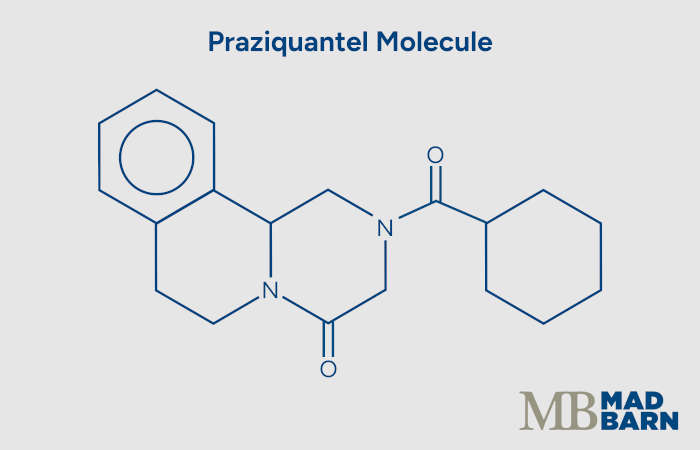
Praziquantel is a synthetic pyrazinoisoquinoline derivative with activity against parasitic flatworms. In horses, its relevant activity is cestocidal, meaning it kills tapeworms. [1][5]
This target range distinguishes praziquantel from several other major equine dewormer classes. Drugs such as ivermectin and moxidectin primarily target nematodes and certain external parasites, while praziquantel provides the tapeworm activity in combination products containing these drugs.
Mechanism of Action
Praziquantel acts on susceptible tapeworms by disrupting the normal regulation of calcium within their cells. Exposure to the drug increases calcium availability in parasite tissues, producing intense contraction of the tapeworm’s muscles followed by paralysis.
This loss of normal muscle control interferes with the parasite’s ability to maintain its position and function normally in the intestinal tract. [1]
Praziquantel also damages the tapeworm’s tegument, the specialized outer surface that protects the parasite and participates in nutrient exchange with its environment. The surface develops structural damage and becomes more permeable, further disrupting normal parasite function. [1]
Uses in Horses
Praziquantel is used to treat equine tapeworms, particularly Anoplocephala perfoliata. In the United States and Canada, most approved equine products combine praziquantel with ivermectin or moxidectin. These combination products treat tapeworms as well as susceptible parasites covered by the second active ingredient. [3][4]
Praziquantel is not a broad-spectrum dewormer when used on its own. It does not provide effective control of common equine nematodes such as strongyles, ascarids, or pinworms. Product selection should reflect the parasites being targeted rather than the assumption that every dewormer treats every internal parasite.
Equine Tapeworm Infection
Tapeworms are common in grazing horses, although prevalence varies by region and management. A. perfoliata adults are usually found around the junction of the ileum and cecum. One postmortem survey of adult horses in Alberta found infection in approximately 8% of horses, with some carrying heavy burdens. [6][7]
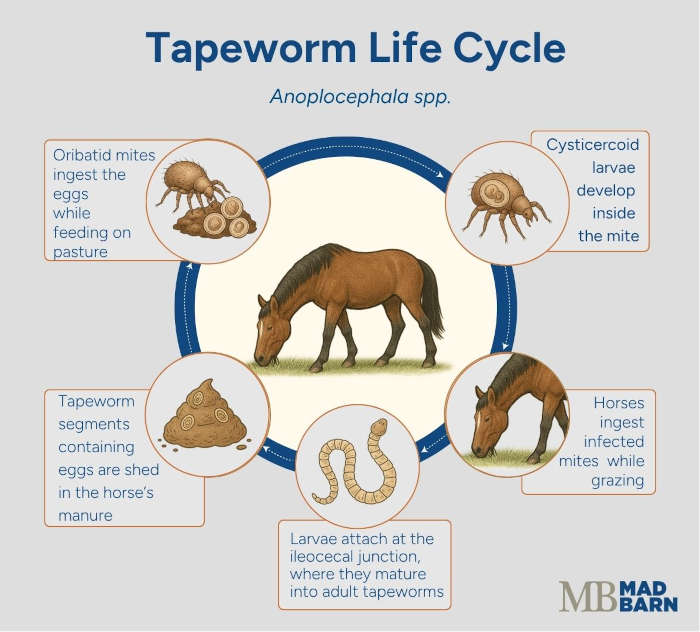 Illustration: Dr. Ana Mesa, PhD
The tapeworm has an indirect life cycle involving a free-living oribatid mite. Adult tapeworms release egg-containing segments that pass in manure, and the mites ingest the eggs. The immature tapeworm develops into an infective cysticercoid within the mite, and horses become infected when they consume infected mites while grazing. [7]
Adult A. perfoliata are fleshy, segmented tapeworms that may reach approximately 8 cm long and 1 cm wide. Adult worms or segments may occasionally be visible in manure, particularly after treatment. [7]
Routine fecal testing has low sensitivity for tapeworms because egg-containing segments are released intermittently. A positive egg result confirms infection, but a negative result does not reliably rule it out, and the number of eggs does not reflect the number of worms. Specialized fecal techniques and, in some regions, antibody-based tests may provide additional information. [6][7]
Most infected horses have relatively low burdens and show few adverse effects. Higher burdens can damage the intestinal lining around the ileocecal junction and are associated with ileal impaction, ileocecal intussusception, and spasmodic colic. [6][7]
Administration Routes
Praziquantel is administered by mouth as a gel or paste. Before dosing, estimate or measure the horse’s body weight, read the complete product label, and confirm whether the syringe scale is marked in pounds or kilograms. Position the syringe as directed on the label so the horse receives the full dose.
Estimating body weight as accurately as possible is important because underdosing may reduce efficacy and increase selection pressure for resistance, while overdosing exposes the horse to unnecessary medication.
A weight tape or scale can provide a more reliable estimate than visual assessment alone.
Dosage
The recommended dose of praziquantel varies depending on the product formulation and label instructions.
Some ivermectin-praziquantel products provide 1 mg of praziquantel per kilogram of body weight, while other combination products use a different dose. [8]
The product should be dosed according to its label rather than calculating the praziquantel component in isolation. This is especially important with combination dewormers because the same syringe also delivers ivermectin or moxidectin, and the dose is based on the horse’s body weight.
Storage
Store praziquantel and combination products according to the manufacturer’s instructions. Requirements may vary with the formulation and the other active ingredient. In general, keep the medication in its original, tightly closed container at room temperature and protect it from direct light. [2]
Keep dewormers out of reach of children and animals. Check the expiration date before use and safely discard damaged, contaminated, or expired products according to local requirements.
Safety Warnings & Precautions
Praziquantel has a wide margin of safety when used appropriately. Laboratory animals have tolerated doses far above the usual therapeutic dose, but these findings do not establish an unlimited safety margin in horses. [1]
Praziquantel has been used in breeding and pregnant animals of several species. Horse-specific safety information is more limited, so owners should follow the label and consult their veterinarian before treating pregnant, breeding, very young, ill, or debilitated horses. [8]
Most equine praziquantel products contain ivermectin or moxidectin, and the safety profile of the entire product applies. Age restrictions, dosing limits, warnings, and adverse effects may differ between products. Check the full product label and follow veterinary guidance rather than relying on safety information for praziquantel alone.
Monitoring
Monitoring an equine parasite control program commonly includes fecal testing before and after treatment to evaluate whether a dewormer remains effective on a farm. This approach is particularly useful for strongyles and ascarids. [2][6]
Tapeworms require a different interpretation. Their eggs are released sporadically, so routine fecal egg counts may miss infected horses and cannot quantify tapeworm burden.
Specialized testing of samples collected from a group of horses before and after treatment can provide information about praziquantel efficacy, but results should be interpreted with a veterinarian because test sensitivity is limited. [6][7]
Effective treatment may temporarily increase the chance of detecting tapeworm eggs 24 to 48 hours later as damaged parasites release egg-containing segments. A veterinarian may use this timing to improve diagnostic sensitivity, but it is not a simple individual pass-or-fail test of treatment success. [6][7]
Anthelmintic Resistance
Anthelmintic resistance occurs when a parasite population becomes less susceptible to a dewormer that was previously effective. Evidence of reduced praziquantel efficacy against equine tapeworms remains limited to early indications from a few single-farm reports, rather than widespread confirmed resistance. [6][9]
Resistance is still a practical reason to avoid automatic, unnecessarily frequent treatment. Fixed-interval deworming and blind rotation among products can increase selection pressure without accounting for the parasites present or local treatment efficacy. [6]
When reduced efficacy is suspected, a veterinarian can review dosing accuracy, administration, product storage, testing methods, and herd-level results before concluding that resistance is present. Depending on the findings, the parasite-control plan or active ingredient may need to change.
Contraindications
Contraindications are circumstances in which a drug should be avoided or used with particular caution.
No specific contraindications are noted for praziquantel as a sole deworming agent in horses. However, the label for the specific product controls its use, and combination products may have additional restrictions based on their other active ingredient.
Do not use praziquantel in horses intended for human consumption. [8]

Side Effects
Praziquantel is generally well-tolerated by horses. Side effects are uncommon in horses receiving praziquantel alone. In other species, reported effects include the following: [2]
- Lethargy
- Diarrhea
- Excessive salivation
- Weakness
- Temporary loss of appetite
Additional side effects may be related to ivermectin or moxidectin in combination products. These reactions are uncommon to rare when products are used correctly but may include: [2]
- Lethargy
- Incoordination or ataxia
- Tremors
- Seizures
Clinical signs after deworming may reflect the active ingredients, incorrect dosing, or the horse’s response to rapid parasite death. Contact your veterinarian promptly if a horse develops marked lethargy, persistent gastrointestinal signs, weakness, incoordination, tremors, seizures, or any other concerning change after treatment.
Acute Toxicity (Overdose)
Praziquantel has a wide safety margin, and overdose from correctly using a calibrated syringe is unlikely. The maximum tolerated dose in horses has not been established, so laboratory findings from other species should not be used to justify exceeding the label dose. [1][2]
The ivermectin or moxidectin in a combination product may have a narrower safety margin. Reported signs of moxidectin overdose include lethargy, ataxia, and seizures. [2]
Drug Interactions
No specific drug interactions are documented for praziquantel in horses. [2] Owners should still tell their veterinarian about all medications and supplements the horse receives before administering a new dewormer, particularly when using a combination product.
Other oral medications may affect or be affected by gastrointestinal absorption. When a horse receives omeprazole, ranitidine, antacids, or another oral medication, ask the veterinarian whether doses should be separated by two to three hours. [2]
Regulatory Status & Legal Considerations
In the United States, praziquantel is approved for horses in oral combination products with ivermectin or moxidectin. Health Canada has approved combination products and a praziquantel-only oral paste. [3][4]
Approved formulations and sale classifications vary by country. Read the label before use, follow all listed restrictions, and use the calibrated syringe supplied with the product. Confirm whether body weight is marked in kilograms or pounds before administration.
Before purchasing or administering a praziquantel product, consult your veterinarian to confirm that tapeworm treatment is appropriate and the selected product fits the horse’s broader parasite-control plan. Product choice should reflect the parasites being targeted, recent fecal testing results, previous deworming, and the effectiveness of available drugs on the farm.
Status in Competition
Praziquantel is not named on the FEI Equine Prohibited Substances List. [10]
Most equine praziquantel products are combination dewormers containing another active ingredient, such as ivermectin or moxidectin. Competition eligibility therefore depends on the complete product, not praziquantel alone. The person responsible for the horse should check every active ingredient against the current rules of the applicable governing organization before treatment.
Always check the current regulations for your sport before starting your horse on a new medication. Work with your veterinarian to determine appropriate withdrawal times.
Frequently Asked Questions
Here are some frequently asked questions about praziquantel for horses:
Praziquantel is used in horses to treat tapeworm infections, particularly infections involving Anoplocephala perfoliata. This tapeworm inhabits the intestinal tract and can contribute to gastrointestinal disease when present in large numbers. Praziquantel is often included in combination dewormers that target tapeworms and other susceptible internal parasites.
Praziquantel primarily kills equine tapeworms, including Anoplocephala species. It has a relatively narrow target range and does not provide broad control of common roundworms such as strongyles, ascarids, or pinworms. Broader parasite control requires another appropriate deworming medication, which is why praziquantel is commonly combined with ivermectin or moxidectin.
Praziquantel disrupts calcium balance within tapeworm cells, causing intense muscle contraction followed by paralysis. It also damages the parasite's protective outer surface, or tegument. Together, these effects interfere with normal function and contribute to the tapeworm's death and elimination.
Praziquantel is combined with ivermectin or moxidectin to provide broader parasite coverage in a single treatment. Praziquantel targets tapeworms, while the other medication controls susceptible parasites that praziquantel does not treat. The appropriate product should be selected as part of a veterinary-directed parasite-control program rather than simply because it provides the broadest possible coverage.
Yes. Praziquantel is an effective treatment for the main tapeworm species affecting horses, including Anoplocephala perfoliata. Treatment should still be incorporated into an individualized parasite-control program rather than given automatically or unnecessarily.
Yes. Higher tapeworm burdens are associated with gastrointestinal disease, including spasmodic colic, ileal impaction, and ileocecal intussusception. Many infected horses have no obvious clinical signs, so the absence of colic does not establish that a horse is free of tapeworms.
Horses become infected by consuming infected oribatid mites while grazing. These pasture mites act as intermediate hosts for developing tapeworm larvae. Once an infected mite is swallowed, the parasite develops into an adult tapeworm in the horse's intestinal tract.
Many horses with tapeworms show no obvious signs. Standard fecal egg counts can also miss tapeworm infections because eggs are released intermittently. Veterinarians may use modified fecal testing, herd-level results, exposure history, and other diagnostic methods to assess tapeworm risk.
Yes. Fecal testing is an essential part of a modern parasite-control program. Routine fecal egg counts help veterinarians identify horses that are shedding large numbers of strongyle eggs, while fecal egg count reduction testing helps determine whether the dewormers being used on a farm are still effective. Standard fecal testing is less sensitive for tapeworms, but this limitation does not make routine parasite testing unnecessary.
Annual testing helps your veterinarian monitor parasite patterns and determine whether the dewormers used on your farm are still working. Current equine parasite-control guidelines recommend routine fecal egg counts and regular fecal egg count reduction testing rather than relying on fixed deworming schedules. Testing reduces unnecessary drug use and helps preserve the effectiveness of available dewormers.
Giving dewormers automatically at fixed intervals treats horses whether or not additional treatment is needed and increases selection pressure for resistant parasites. Modern parasite control uses fecal testing, the horse's age and management, local parasite risks, treatment history, and veterinary guidance to determine when additional deworming is appropriate.
Equine dewormers may be available without a prescription, but that does not mean owners should select them without veterinary guidance. The appropriate product depends on the parasites being targeted, fecal testing, previous treatments, the horse's age and exposure, and known drug efficacy on the farm. Working with a veterinarian helps avoid unnecessary treatment, ineffective drug choices, and practices that promote anthelmintic resistance.
Praziquantel is given by mouth as a paste or gel. Equine products generally come in calibrated dosing syringes based on body weight. Owners should confirm whether the syringe scale uses pounds or kilograms and administer the complete product according to its label and veterinary instructions.
The appropriate dose depends on the horse's body weight and the specific formulation. Combination products must be dosed according to their own label because the syringe also contains ivermectin, moxidectin, or another active ingredient. An accurate estimate of body weight is important for avoiding underdosing or unnecessary excess medication.
Praziquantel should not automatically be given on the same fixed schedule to every horse. Treatment decisions depend on tapeworm risk, geographic location, grazing exposure, previous deworming, farm management, and the overall parasite-control plan. A veterinarian can determine when tapeworm treatment is appropriate within the broader deworming program.
Testing helps your veterinarian understand the parasite situation on the farm before selecting additional treatment. Fecal egg counts are particularly useful for monitoring strongyle shedding, while modified testing may be needed when tapeworms are the specific concern. The results are interpreted alongside the horse's age, management, treatment history, and exposure risk rather than used as a stand-alone diagnosis.
Praziquantel does not kill botfly larvae. Bots are targeted by other dewormers, particularly ivermectin. A combination product containing praziquantel and ivermectin may therefore control both tapeworms and bots, but the bot activity comes from the ivermectin component.
Praziquantel does not provide effective control of large or small strongyles. Combination products commonly pair praziquantel with ivermectin or moxidectin to broaden parasite coverage. Whether either drug remains effective against the parasites present on a particular farm should be evaluated as part of a veterinary-directed parasite-control program.
Praziquantel does not treat equine pinworms (Oxyuris equi). Pinworm control requires a dewormer with activity against that parasite along with appropriate management. A veterinarian can help determine whether persistent tail rubbing or irritation is actually caused by pinworms and select treatment accordingly.
Praziquantel has a wide margin of safety when used correctly in horses. However, most equine praziquantel products also contain ivermectin or moxidectin, so the safety instructions and restrictions for the complete product apply. Owners should follow the label and veterinary guidance rather than considering praziquantel in isolation.
Adverse effects from praziquantel alone appear to be uncommon in horses. Combination products can have additional adverse effects associated with ivermectin or moxidectin. Any marked lethargy, weakness, gastrointestinal signs, incoordination, tremors, seizures, or other concerning change after deworming warrants veterinary advice.
Contact your veterinarian promptly if a horse develops concerning signs after treatment. Provide the product name, active ingredients, amount administered, horse's estimated weight, and time of treatment. This information can help determine whether the reaction may be related to the medication, dosing, parasite die-off, or another problem.
Praziquantel has a wide safety margin, but dosing errors should still be taken seriously. Most equine praziquantel products contain another dewormer, and ivermectin or moxidectin may have a narrower safety margin. Contact your veterinarian if too much product may have been administered.
Use in pregnant or breeding horses depends on the specific product and its complete active-ingredient profile. Combination products may have different reproductive safety instructions. Check the current product label and consult your veterinarian before treating a pregnant or breeding horse.
No specific drug interactions are documented for praziquantel in horses, but owners should still tell their veterinarian about all medications and supplements the horse receives. This is particularly important when administering a combination dewormer or when several oral medications are being given around the same time.
Reduced praziquantel efficacy has been reported on some farms, although widespread praziquantel resistance in equine tapeworms has not been established. Responsible treatment remains important because unnecessary deworming increases selection pressure on parasite populations. Veterinary monitoring can help determine whether products remain effective within a particular herd.
Veterinarians use fecal egg count reduction testing to measure dewormer efficacy within a herd or barn. Egg counts are compared before and after treatment to determine how much shedding decreased. Standard fecal egg counts work best for parasites such as strongyles and ascarids; tapeworms require different interpretation because their eggs are shed intermittently and are commonly missed by routine methods.
A second fecal sample allows your veterinarian to compare parasite egg shedding before and after treatment. This is called a fecal egg count reduction test and is used to determine whether a dewormer remains effective on the farm. Without post-treatment testing, poor drug efficacy or developing resistance can go unnoticed.
Parasite populations and dewormer efficacy can change over time. Repeated testing helps veterinarians monitor which horses are contributing the most eggs to the environment and whether the drugs being used continue to work. Current equine parasite-control recommendations include routine fecal testing and regular efficacy testing rather than assuming that a previously effective dewormer will remain effective indefinitely.
Horse dewormers containing praziquantel include Equimax®, Eqvalan Gold® or Zimecterin Gold®, and Quest Plus®. Most combine praziquantel with ivermectin or moxidectin. Droncit® oral paste is a praziquantel-only equine formulation available in Canada. Product availability and approval status vary by country.
Praziquantel dewormers should be stored according to the manufacturer's instructions. Requirements can vary depending on the formulation and other active ingredients. Keep the medication in its original container, check the expiration date, and protect it from inappropriate temperatures and direct light as directed on the label.
Food-animal restrictions depend on the specific product and jurisdiction. Many equine praziquantel products are not approved for horses intended for human consumption. Owners should follow the current product label and consult a veterinarian before treating any horse that may enter the food chain.
Praziquantel itself is not listed as a prohibited substance under current FEI medication-control rules. Owners and riders should still check the current rules and every active ingredient in the specific dewormer before treatment. Competition requirements can differ among governing organizations and may change over time.
Summary
Praziquantel is an anthelmintic used to control tapeworms in horses. Accurate dosing and targeted use help protect the horse while preserving dewormer effectiveness.
- Praziquantel primarily targets equine tapeworms, especially Anoplocephala perfoliata
- Most equine products combine praziquantel with ivermectin or moxidectin for broader parasite coverage
- The product label, an accurate body weight, and veterinary guidance should determine the dose and timing
- Routine fecal egg counts have limited sensitivity for tapeworms and do not measure tapeworm burden
- Early reports of reduced efficacy reinforce the need for risk-based treatment and anthelmintic stewardship
References
- Cole. C. et al. Ed. Equine Pharmacology. John Wiley & Sons. 2014.
- Plumb. D. C. Plumb's Veterinary Drug Handbook. 7th ed. PharmaVet; distributed by John Wiley & Sons. 2011.
- Drug Product Database. Health Canada. 2019.
- Animal Drugs @ FDA. Food and Drug Administration.
- Yang. X. et al. An Updated Review of Isoquinoline Alkaloids: Biological Activity and Mode of Action, Structural Modifications, and Agricultural Applications. Industrial Crops and Products. 2025.
- Nielsen. M. K. et al. Internal Parasite Control Guidelines. American Association of Equine Practitioners. 2024.
- Anoplocephala and Paranoplocephala - Learn About Parasites. Western College of Veterinary Medicine. 2021.
- Droncit 9% Oral Paste for Horses. Elanco Canada Limited. 2020.
- Finnerty. C. A. et al. Evidence of Tapeworm Treatment Failure on a Central Kentucky Thoroughbred Farm. Equine Veterinary Education. 2024.
- 2026 Prohibited Substances List. FEI. 2025.