English
Dressage movements are structured exercises that progressively develop a horse’s balance, responsiveness, strength, and coordination. From basic arena figures to advanced collected work, each movement builds on skills established earlier in training.
For riders, understanding this progression is just as important as learning the aids for individual movements. It helps them recognize their horse’s readiness, address gaps in the foundation, and avoid advancing before the horse can perform the work with confidence and correct form.
Knowing the purpose and expectations of each movement can also make schooling more effective. Riders can choose exercises that support a specific training goal while maintaining the rhythm, relaxation, and clear communication needed for correct development.
Keep reading to explore how dressage movements are performed, judged, and introduced from the earliest competition levels through Grand Prix.
What Are Dressage Movements?
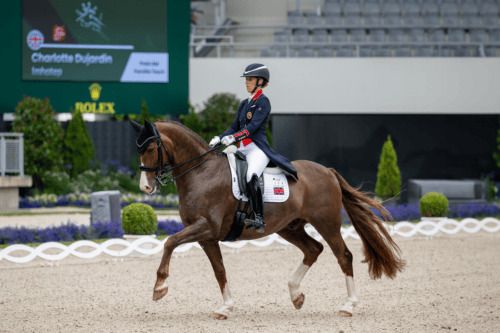
Dressage movements are the individual exercises, figures, and gaits that make up a dressage horse’s training and competition tests. They range from a young horse’s first 20-meter circle at working trot to the brilliance of piaffe and passage performed on the international stage.
Every movement has a purpose. Each asks the horse to develop a specific quality, whether that is suppleness, straightness, engagement, or collection, and prepares the horse for the movement that comes next.
Understanding how movements fit into the full arc of dressage training makes it easier to set realistic goals and recognize when a horse is ready to progress.
What's your top priority with your horse's health?

What's your top priority with your horse's health?
Training Scale & Movement Progression
Before looking at individual exercises, it helps to understand how dressage movements fit together as a system.
They are not a random collection of skills. Instead, they follow an underlying structure that shapes every level of training, from a horse’s first weeks under saddle to international Grand Prix competition.
Dressage training follows a progression commonly called the training scale or training pyramid. It begins with rhythm and suppleness, moves through contact and impulsion, and builds toward straightness and collection. [1]
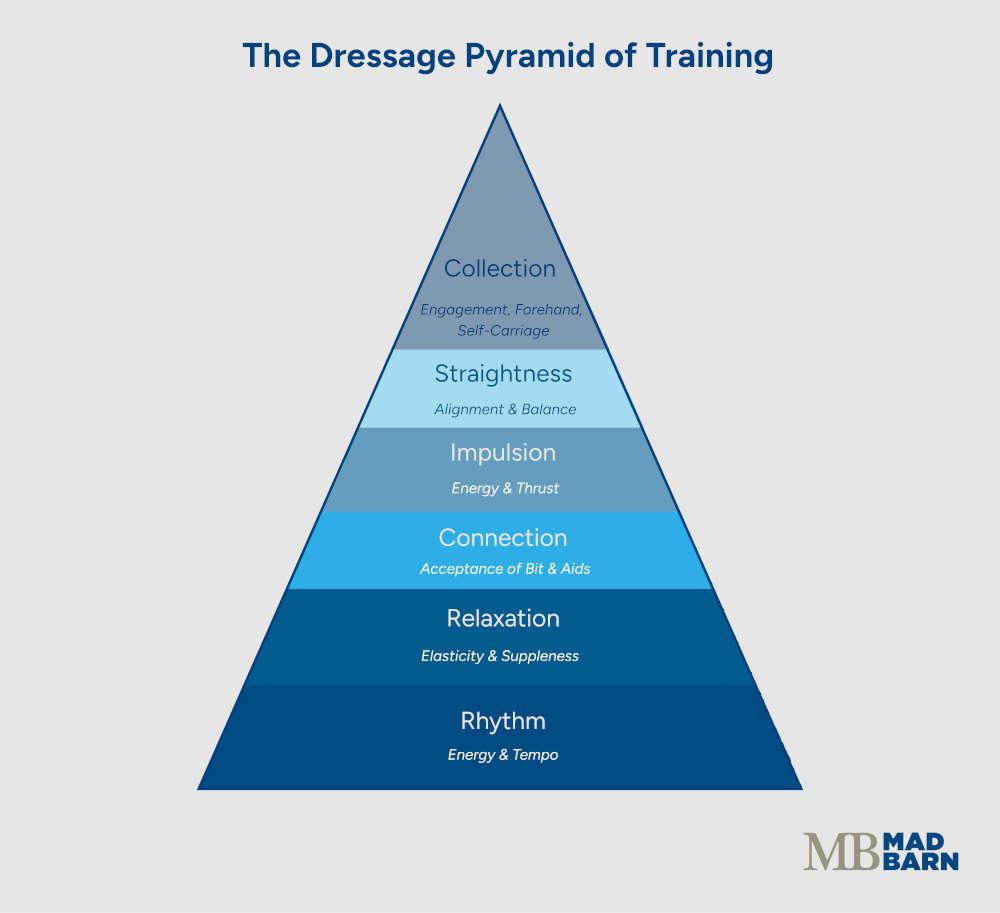
Lateral work develops suppleness and straightness. Transitions strengthen the connection and engagement that impulsion depends on. Piaffe and passage become possible only after the horse progresses through the training scale to the highest level of collection.
Riders who understand this structure can see why training programs introduce movements in a particular order. Skipping ahead before the horse has the required foundation rarely produces a correct result and often creates problems that trace back to a missing earlier step.
How Movements Are Grouped
To make this guide easier to navigate, the movements are grouped according to how they are typically introduced in training.
Foundational movements and basic paces come first, followed by lateral work; turns and pirouettes; collection and extension; counter canter and simple changes; flying changes; and, finally, piaffe and passage.
This order roughly mirrors how a horse and rider progress from Training Level through Grand Prix. However, individual training programs may vary depending on the horse.
Table 1. Dressage movement progression by competition level [2][10]
| Competition level | Key movements introduced | Skills developed | Preparation for the next stage |
|---|---|---|---|
| Training Level |
|
|
|
| First Level |
|
|
|
| Second Level |
|
|
|
| Third Level |
|
|
|
| Fourth Level |
|
|
|
| Prix St. Georges and Intermediate I |
|
|
|
| Intermediate II and Grand Prix |
|
|
|
How Movements Are Judged in Competition
In dressage competition, each movement in a test receives a numerical score from zero to ten based on how well the horse performs it relative to the ideal described in the rulebook. [2]
Some movements carry a coefficient, meaning their score is doubled because of their importance at that level. Understanding how movements are scored can help riders prioritize their training time.
Judges also award collective marks at the end of a test. These scores reflect qualities such as gaits, impulsion, and submission across the entire ride rather than any single movement.
Foundational Movements & Basic Paces
Every dressage horse begins with the basics. These paces and simple exercises provide the foundation for all later movements and remain relevant even when the horse is schooling advanced work.
The Basic Paces
Dressage tests are built around the three natural horse gaits: walk, trot, and canter. Each gait has collected, working, medium, and extended variations that appear as training progresses. [2]
Working gaits establish the baseline, showing a horse moving forward with even, active steps before collection or extension is introduced.
Medium and extended variations lengthen the frame and stride. Collected variations shorten the stride while increasing engagement behind. These variations are covered in more detail in the collection and extension section of this guide.
Circles & Bending Lines
A correct 20-meter circle may look simple, but it is one of the most important tools in early training. Riding an accurate circle asks the horse to bend evenly while maintaining rhythm, providing the foundation for later lateral movements.
Smaller circles and bending lines gradually increase the demand. A horse that struggles to maintain a balanced 15-meter circle is rarely ready for shoulder-in or travers because both movements require a similar quality of bend under greater sideways pressure.
Turn on the Forehand
The turn on the forehand asks the horse to move the hindquarters in an arc around the forehand. The inside foreleg steps almost in place while the hind legs cross and move around it. It is usually one of the first lateral exercises a young horse learns and is most commonly used as a training exercise rather than a test movement.
This movement teaches the horse to yield away from a single leg aid without travelling forward at the same time, making it a useful stepping stone before the leg yield.
Riders typically introduce the exercise from a halt, asking for a few steps at a time and rewarding a clear, unhurried response. Because the movement does not require collection, trainers can introduce it relatively early.
Halt & Rein Back
A square, balanced halt looks easy, but it asks the horse to remain attentive and evenly weighted on all four legs while standing still. This can be challenging for a young or tense horse.
The rein back builds on the halt by asking the horse to step backward in a clear, two-beat diagonal rhythm without hollowing the back or rushing.
Because reversing direction can interrupt a horse’s established forward response to the aids, the rein back should be introduced carefully and only after the horse halts calmly and accepts the bit without resistance.
Lateral Movements
Lateral movements ask the horse to travel forward and sideways at the same time. They are a primary tool for developing suppleness, straightness, and responsiveness to the rider’s leg and rein aids.
Table 2. Lateral dressage movements at-a-glance
| Movement | Bend and alignment | Track or direction | Primary training purpose | Typical stage of progression |
|---|---|---|---|---|
| Leg Yield |
|
|
|
|
| Shoulder-In |
|
|
|
|
| Travers |
|
|
|
|
| Renvers |
|
|
|
|
| Half Pass |
|
|
|
|
Leg Yield
The leg yield is a two-track movement in which the horse travels forward and sideways while remaining nearly straight through the body, with only slight flexion at the poll away from the direction of travel.
It is usually the first true lateral movement a horse learns because it does not require the degree of bend or collection demanded by shoulder-in and half pass.
The US Dressage Federation describes the leg yield as one of the best tools for making a horse supple, loose, and responsive to a single leg aid. [3]
Shoulder-In
Shoulder-in places the horse on three tracks, with the forehand brought slightly to the inside while the hindquarters continue along the original line of travel. The horse maintains an inside bend.
This movement encourages the horse to shift more weight toward the hindquarters by improving forehand mobility. It also helps the rider balance the horse between the inside leg and the outside rein.
Shoulder-in appears in competition tests from Second Level onward. Many trainers consider it one of the most valuable schooling exercises in dressage because it develops bend, straightness, and hind-limb engagement simultaneously.
Travers & Renvers
Travers, also called haunches-in, is a four-track lateral movement that asks the horse to bring the hindquarters toward the inside of the arena. The forehand continues along the rail while the body bends to the inside.
Renvers, or haunches-out, is essentially the mirror image: the horse’s forehand moves off the wall while the body bends toward the outside of the arena. It is generally considered more demanding than travers because the rider no longer has the arena wall to help guide the forehand.
Travers and renvers appear in competition at Second Level. Both exercises increase the demand for collection and prepare the horse for half pass.
Half Pass
The half pass is a two-track movement performed on a diagonal line. The horse bends through the body in the direction of travel while moving forward and sideways.
The key difference between half pass and leg yield is the direction of bend. In leg yield, the horse remains nearly straight. In half pass, the horse bends toward the direction of travel, considerably increasing the demand for engagement and balance.
Research on equine spinal kinematics has shown that bend through the back and neck increases measurably when horses work on curved or lateral lines compared with straight-line movement. [4] This additional demand for bend makes half pass an effective suppling exercise once the horse is ready for it.
Turns & Pirouette Work
Turns ask the horse to move the forehand or hindquarters around a fixed point while the other end of the body continues moving. These exercises eventually develop into the pirouette, one of the most demanding movements in dressage.
Turn on the Haunches
The turn on the haunches asks the horse to move the forehand around the hindquarters from medium walk. The hind feet may trace a small arc rather than remaining fixed in one spot.
The half turn on the haunches is first required at Second Level and continues through Third Level, where it often carries a coefficient that doubles its score. [5]
This movement develops shoulder mobility and responsiveness to the rider’s weight and leg aids while laying the groundwork for the walk pirouette required at higher levels.
Walk Pirouette
The walk pirouette is performed from collected walk rather than medium walk. The horse turns on a much smaller radius, roughly equal to the length of its body, while the inside hind leg steps up and down close to the same spot. [6]
Because it requires more collection and a smaller turn than the turn on the haunches, the walk pirouette is introduced only after the horse demonstrates a reliably clear, unhurried four-beat rhythm in collected walk.
Rushing the turn or allowing the hind legs to become planted are among the most common faults at this stage.
Canter Pirouette
The canter pirouette is one of the most advanced movements in dressage. It asks the horse to turn 360 degrees in highly collected canter while maintaining the same three-beat rhythm, with the forehand and outside hind leg moving around the inside hind leg.
Research comparing canter pirouette strides with collected canter strides in elite dressage horses found meaningful differences in stride timing. These differences highlight the additional collection and balance that a pirouette demands compared with ordinary collected canter. [7]
Because of this difficulty, the canter pirouette appears only in FEI-level tests. Judges look for the horse to preserve rhythm, balance, and purity of gait throughout the turn.
Collection and Extension
Collection and extension are often described as opposites, but both express the horse’s ability to compress energy through the body and release it forward.
Collected Gaits
In collection, the horse shortens its stride, increases flexion through the hip, stifle, and hock, and shifts more weight toward the hindquarters.
A review of the biomechanics of collected trot found that the hind limbs increasingly act like springs as collection deepens, storing and releasing elastic energy with each stride rather than simply moving more slowly. [8]
Collection is not the same as slowing down. A horse can trot more slowly without truly collecting if engagement behind does not increase as well. Given this, developing correct collection requires time and strength.
Medium & Extended Gaits
Medium gaits lengthen the stride and frame moderately compared with working gaits. Extended gaits ask for the fullest lengthening the horse can produce while remaining balanced and in rhythm.
Extended trot depends directly on the carrying power developed through collection. A horse that has not learned to collect may run faster instead of lengthening the stride correctly when asked to extend because it lacks the strength to release stored energy without tipping onto the forehand.
The Half-Halt
The half-halt is an aid that allows the rider to move between collected and extended work by briefly rebalancing the horse and shifting weight toward the hindquarters before the next transition.
Research on rider biomechanics confirms that small changes in a rider’s position and weight distribution have measurable mechanical effects on the horse’s movement. [9]
A clear, well-timed half-halt from a balanced rider can make a visible difference in the quality of transitions between collected and extended gaits. An unclear or poorly timed aid may flatten the transition instead. Effective half-halts depend on precise communication through the rider’s aids and an established response from the horse.
Counter Canter & Simple Change of Lead
Counter canter and simple changes of lead bridge the gap between basic canter work and flying changes. Both exercises test the horse’s balance and obedience to the aids without requiring the degree of collection demanded by flying changes.
Counter Canter
In counter canter, the horse canters on a curved line while maintaining the lead that would normally be the outside lead for that direction, such as cantering on the left lead while turning to the right.
Counter canter is a valuable balance and straightness exercise because it challenges the horse’s natural tendency to fall onto the inside shoulder through a turn.
Riders typically introduce it on shallow loops before progressing to full circles because maintaining the counter lead through a tighter turn requires greater balance and obedience to the outside aids.
Simple Change of Lead
A simple change of lead asks the horse to change from one canter lead to the other through a few steps of walk rather than changing directly within the canter stride.
This exercise is typically taught before flying changes because it allows the rider to confirm that the horse understands a change of bend and lead without the added complexity of a change in midair.
A horse that struggles to perform clean, balanced simple changes is usually not ready to begin flying changes.
Flying Changes & Tempi Changes
Flying changes ask the horse to switch canter leads in a single stride without breaking rhythm or passing through another gait. Tempi changes repeat that demand across a sequence of strides, making them one of the most technically challenging skills in dressage.
Single Flying Changes
In a flying change, the horse switches the leading front and hind legs during the moment of suspension in canter, changing leads while remaining in the same gait.
Single flying changes first appear in competition at Third Level. They depend heavily on the horse’s ability to collect because the change is most likely to remain clean and balanced when the horse is light in the forehand rather than running forward.
Tempi Changes
Tempi changes are sequences of flying changes performed at set intervals. Changes every fourth stride appear at Fourth Level, while changes every third and second stride are introduced at FEI levels. [10]
The most demanding variation, the one-tempi change, asks the horse to change leads with every stride. It represents the highest expression of this skill and appears only at Intermediate II and Grand Prix.
Piaffe and Passage
Piaffe and passage sit at the top of the training scale. Both are highly collected and demanding, and both depend on years of correct preparation through the movements covered earlier in this guide.
Piaffe
Piaffe is a highly collected, cadenced trot performed almost in place. The horse raises and lowers diagonal pairs of legs while covering little or no ground.
Force-plate research on piaffe found that the forelimbs carry more peak vertical force than the hind limbs during the movement. At the same time, the hind limbs bear relatively more weight in piaffe than they do in ordinary trot or passage. [11]
The same study found considerable step-to-step variability in horizontal forces, reflecting the difficulty of maintaining balance on a diagonal pair of limbs without forward momentum. [11]
Passage
Passage is also highly collected but keeps the horse moving forward with elevated strides and a pronounced moment of suspension. The result resembles a slow, floating trot rather than an ordinary trot performed at a slower speed.
Biomechanically, passage behaves like a true running gait according to the measures researchers use to classify gaits. Piaffe behaves more like a hybrid of walking and running mechanics because it lacks a clear aerial phase. [8]
This distinction helps explain why passage often feels more forward and expressive to ride than piaffe, even though both movements require a high degree of collection.
Piaffe & Passage Transitions
Many trainers introduce piaffe before passage because the carrying strength developed through piaffe supports the horse’s ability to sustain the elevation and suspension required in passage.
The aids also differ between the two movements. Piaffe is produced primarily through the leg and back, while passage relies more heavily on the rider’s seat. In both cases, timing and coordination of the aids are essential to maintaining rhythm and balance.
How Movements Progress Through the Levels
Every movement in dressage fits into a larger sequence that runs from Training Level through Grand Prix. Seeing the sequence in one place helps explain why certain movements appear only after earlier skills have been established.
Movement Requirements by Level
Key movements introduced at different levels of USEF, USDF, and FEI competition include the following: [2]
- Training Level: Free walk, working gaits, 20-meter circles, and basic transitions
- First Level: Lengthened strides and leg yield
- Second Level: Shoulder-in, turn on the haunches, medium trot and canter, simple changes, travers, and renvers
- Third Level: Half pass, extended trot and canter, and single flying changes
- Fourth Level: Four-tempi changes, working canter pirouettes, and extended walk
- Prix St. Georges and Intermediate I: Three-tempi and two-tempi changes and canter pirouettes
- Intermediate II and Grand Prix: One-tempi changes, piaffe, and passage
Individual test requirements may change between years, so riders preparing for a specific test should always confirm the current requirements in the official rulebook. [10]
How the Levels Build on Each Other
Each level introduces movements that help prepare horses and riders for the next stage.
A horse that struggles with a clean simple change at Second Level is unlikely to produce a reliable flying change later. Similarly, a horse that cannot maintain rhythm in collected trot will find piaffe and passage much harder to develop than one with a well-established foundation.
This is why trainers often return to seemingly basic exercises, such as a 20-meter circle or simple change, even with horses schooling advanced movements. The basics remain essential at every level and do not become irrelevant as training progresses.

Building a Systematic Approach to Dressage Movements
Learning every movement in this guide takes years, not months. Dressage rewards patience because each movement depends directly on the skills that precede it. Riders should prioritize their horse’s readiness over any predetermined timeline.
The most reliable path through this progression is to ensure that each stage of the training scale is genuinely established before asking for the next movement.
A horse that yields consistently from the leg, bends evenly on a circle, and accepts a half-halt without resistance already has many of the skills needed to begin more demanding lateral work, turns, and eventually collection.
A horse’s ability to perform these movements comfortably also depends on more than training. Collected trot, half pass, and piaffe place significant demands on the horse’s topline and hindquarter muscles.
A horse that is not adequately conditioned or nutritionally supported may struggle to sustain this work over time. A program that supports muscle health and progressive fitness can help the horse meet the physical demands of training.
Whether a horse is schooling its first leg yield or working through tempi changes, the same principle applies: build each movement on a solid foundation, and the next movement will be easier to teach.
Frequently Asked Questions
Here are some frequently asked questions about dressage movements:
Dressage movements are the individual gaits, figures, transitions, and exercises used to develop and demonstrate a horse's training. Each movement targets qualities such as rhythm, suppleness, straightness, engagement, balance, or collection. They range from basic 20-meter circles and transitions to advanced exercises such as flying changes, piaffe, passage, and canter pirouettes.
The basic dressage movements include working walk, trot, and canter, along with halts, transitions, 20-meter circles, bending lines, and changes of direction. Early lateral exercises may include turn on the forehand and leg yield. These movements establish the rhythm, responsiveness, balance, and suppleness needed for more advanced work.
Dressage movements are generally taught according to the training scale, beginning with rhythm, suppleness, and consistent contact before progressing to impulsion, straightness, and collection. Horses usually learn basic paces and figures first, followed by lateral work, turns, collected and extended gaits, lead changes, pirouettes, piaffe, and passage. The exact sequence may vary depending on the horse's development, but each new movement should build on skills that are already established.
Dressage movements are scored individually from zero to ten based on how closely each performance matches the required standard. Judges consider qualities such as accuracy, rhythm, balance, impulsion, straightness, and submission. Some important movements carry a coefficient, which means their scores are doubled, while collective marks assess qualities shown throughout the entire test.
The difference between a lateral movement and a turn is the path the horse follows. In lateral movements such as leg yield and half pass, the horse travels forward and sideways along a line. In turns such as turn on the haunches or pirouette, one end of the horse moves around a smaller central area while the other traces a wider arc.
The main difference between leg yield and half pass is the horse's bend. During leg yield, the horse remains nearly straight and is flexed slightly away from the direction of travel. During half pass, the horse bends through the body toward the direction of travel, requiring more engagement, collection, and balance.
Shoulder-in, travers, and renvers differ in how the horse's body is positioned relative to the line of travel. Shoulder-in brings the forehand inward while the hindquarters remain on the original track, whereas travers brings the hindquarters inward while the forehand stays on the track. Renvers is the mirror image of travers, with the forehand positioned away from the wall and the horse bent toward the outside of the arena.
True collection is different from slowing down because the horse shortens the stride while increasing engagement and carrying more weight through the hindquarters. A horse that merely moves more slowly may lose energy, activity, or balance without developing greater carrying power. Correct collection preserves rhythm and impulsion while making the horse feel more elevated and responsive.
A half-halt briefly rebalances the horse and prepares it for a transition, movement, or change in stride. It helps shift the horse's balance toward the hindquarters while maintaining forward energy and connection. The timing and clarity of the half-halt strongly influence the quality of transitions between working, collected, medium, and extended gaits.
A simple change switches the canter lead through a few steps of walk, while a flying change switches the lead directly within the canter. Simple changes help confirm that the horse can rebalance, change bend, and respond correctly to the aids before learning flying changes. A horse that cannot perform clean, balanced simple changes is generally not ready for reliable flying changes.
Single flying changes first appear in USEF and USDF competition at Third Level. Four-tempi changes are introduced at Fourth Level, while three-tempi and two-tempi changes appear at the FEI levels. One-tempi changes, in which the horse changes lead every stride, are required only at Intermediate II and Grand Prix.
Counter canter is a canter performed on the lead opposite to the one normally used for the direction of travel. For example, a horse traveling on a right-hand curve may deliberately remain on the left lead. This exercise develops balance, straightness, and obedience to the outside aids while preparing the horse for simple and flying changes.
The difference between a turn on the haunches and a walk pirouette is primarily the degree of collection and the size of the turn. A turn on the haunches begins from medium walk and allows the hind feet to describe a small arc. A walk pirouette is performed from collected walk on a much smaller radius, with the inside hind leg stepping close to the same spot without becoming planted.
The hardest dressage movements include piaffe, passage, canter pirouettes, and one-tempi changes. Each requires exceptional strength, collection, balance, responsiveness, and coordination developed through years of progressive training. The most difficult movement for an individual horse may depend on its conformation, natural gaits, temperament, and training foundation.
The difference between piaffe and passage is that piaffe is performed almost in place, while passage continues to travel forward. Both are highly collected trot movements, but passage has a pronounced moment of suspension and a slow, elevated stride. Piaffe is often introduced first because the carrying strength it develops helps prepare the horse to sustain passage.
Not all dressage movements require collection. Foundational exercises such as 20-meter circles, turn on the forehand, and leg yield can be introduced before a horse develops true collection. Collection becomes increasingly important for advanced lateral work, pirouettes, flying changes, piaffe, and passage.
A horse may be ready for more advanced dressage movements when it maintains a reliable rhythm, accepts steady contact, bends evenly, and responds clearly to the rider's leg and half-halt. The horse should also remain balanced and relaxed during the preparatory movements for the skill being introduced. Difficulty with basic circles, transitions, simple changes, or collected work usually indicates that more foundation training is needed.
Learning advanced dressage movements typically takes years rather than months. Progress depends on the horse's age, physical development, temperament, conformation, previous training, and the rider's skill and consistency. Training should follow the horse's readiness instead of a fixed timeline, particularly because collected movements place significant demands on the topline and hindquarters.
Advanced dressage horses still practice basic movements because every higher-level exercise depends on rhythm, suppleness, contact, impulsion, and straightness. Circles, transitions, and simple lateral exercises can reveal and correct weaknesses before those weaknesses affect more difficult work. Returning to the basics also helps preserve relaxation, accuracy, and responsiveness throughout the horse's training.
There is no single official number of dressage movements because core exercises can be performed in different gaits, directions, patterns, and combinations. Dressage tests draw from a recognized progression that includes basic paces, figures, transitions, lateral movements, turns, lead changes, collected and extended work, piaffe, and passage. The required selection becomes more complex as horses advance from Training Level to Grand Prix.
Summary
Dressage movements follow a systematic progression that develops balance, strength, responsiveness, and collection. Each stage builds on the training scale and earlier competition levels.
- Basic paces, transitions, circles, and bending lines establish rhythm, balance, contact, and responsiveness
- Lateral movements develop suppleness, straightness, engagement, and coordination
- Turns and pirouettes require greater collection and balance through smaller turning patterns
- Counter canter and simple changes prepare the horse for flying and tempi changes
- Piaffe and passage require advanced collection, strength, conditioning, and years of systematic training
References
- Scales of Training. British Dressage. 2021.
- Dressage Division Rules. United States Equestrian Federation. 2026.
- Lesson Topic: Leg-Yielding. United States Dressage Federation. 2012.
- Byström. A. et al. Differences in Equine Spinal Kinematics between Straight Line and Circle in Trot. Scientific Reports. 2021.
- Lesson Topic: Turn on the Haunches. United States Dressage Federation. 2012.
- Lesson Topic: Pirouette in Walk and Canter. United States Dressage Federation. 2012.
- Burns. T. and Clayton. H. Comparison of the Temporal Kinematics of the Canter Pirouette and Collected Canter. Equine Veterinary Journal Supplement. 1997.
- Clayton. H. and Hobbs. S. A Review of Biomechanical Gait Classification with Reference to Collected Trot, Passage and Piaffe in Dressage Horses. Animals. 2019.
- Clayton. H. et al. Riders' Effects on Horses: Biomechanical Principles with Examples from the Literature. Animals. 2023.
- FEI Dressage Rules 2026. Fédération Equestre Internationale. 2026.
- Clayton. H. and Hobbs. S. Ground Reaction Forces of Dressage Horses Performing the Piaffe. Animals. 2021.