English

Training horses to stretch and collect develops their ability to adjust the frame while maintaining balance, rhythm, and connection. Stretching and collection represent two very different frames, but a horse needs to develop both to move with balance, suppleness, and strength.
In a correct stretch, the horse reaches forward and down, lengthening the topline and swinging freely through the back. In collection, the frame shortens and lifts as the horse carries more weight behind and lightens the forehand.
Although these shapes look like opposites, both depend on connection from the hindquarters to the bit without losing rhythm or relaxation.
For horse owners, the challenge is recognizing correct movement rather than focusing only on head and neck position. Asking for either frame before the horse is physically prepared can lead to tension, loss of impulsion, or increased weight on the forehand.
With progressive training, stretching and collection can work together to improve elasticity, self-carriage, and overall quality of movement. Keep reading to learn how to develop these skills correctly and help your horse transition smoothly between them.
What Does It Mean to Stretch & Collect a Horse?
Stretching and collection describe two different shapes of the horse’s frame. Understanding each shape makes it easier to see why they are trained together rather than treated as separate goals. [1][2]
The Stretch
In the stretch, the horse lowers their head and neck forward and down while maintaining rhythm, contact, and balance. The neck lengthens, the back lifts and rounds slightly, and the horse reaches toward the bit instead of being pulled into position. [1][2]
Dressage tests assess this quality through the stretching circle, during which the horse maintains rhythm and balance while lengthening its frame forward and downward on a 20 m circle. [1]
A correct stretch is offered, not imposed. The horse maintains a steady rhythm and contact with the bit rather than diving down or hollowing the back to escape the contact. [1][2]
Collection
In collection, the horse shortens their stride, steps farther under their body with the hind legs, and lifts through the base of the neck and shoulders. Weight shifts back away from the forehand and onto the hindquarters while the horse maintains energy and rhythm rather than simply slowing down. [1][2]
Classical training texts describe collection as more than a Genuine collection requires greater weight-bearing behind through deeper flexion of the hip, stifle, and hock, all while the horse remains supple and responsive to the aids. [2]
Shortening the neck without engaging the hindquarters produces a compact-looking frame, not true collection. [2]
Table 1. Stretching vs. collection in horses
| Movement Feature | Stretching | Collection |
|---|---|---|
| Head and neck |
|
|
| Back and topline |
|
|
| Hind-leg action |
|
|
| Weight distribution |
|
|
| Stride |
|
|
| Rein contact |
|
|
| Signs of correct movement |
|
|
| Common incorrect appearance |
|
|
The Biomechanics of Stretching & Collection
Stretching and collection involve changes in the horse’s entire body, not only the position of the head and neck. Each frame affects how the horse uses their back, limbs, and balance during movement.
Understanding these differences helps riders recognize correct movement through the whole body and develop both frames progressively. [2][3][4]
How Stretching Changes Back Motion
A study measuring the effect of head and neck position in unridden horses found that lowering the head and neck increases flexion through the lumbar back and expands the spine’s overall range of motion. Raising the head and neck has the opposite effect, extending the thoracic region while reducing flexion farther back. [3]
This finding helps explain why a genuine stretch involves coordinated movement through the horse’s entire topline, and not just low head carriage. When a horse lowers their neck and reaches forward correctly, the back rounds and the muscles along the topline lengthen through a fuller range of motion. [2][3]
Dropping the head without changing the back posture does not produce the same benefit. Correct stretching involves the whole frame. [2][3]
What's your top priority with your horse's health?

What's your top priority with your horse's health?
How Collection Shifts Load to the Hindquarters
As a horse moves from working gaits into collected work, the hind limbs take on a different role. [2][4]
A review comparing collected trot, passage, and piaffe found that compression in the hind limbs increases progressively as collection deepens, allowing them to absorb and generate more force with each stride. By comparison, the forelimbs show less compression and behave more like struts, supporting the lifted forehand rather than driving the movement. [4]
This explains why collection places specific demands on the hindquarters. Strength and joint flexibility through the hips, stifles, and hocks need to be established before a horse can sustain a collected frame for more than a few strides. [2][4]
Loading patterns also change when a rider is added. Comparisons between ridden and unridden trot show that a rider’s weight and influence on balance affect how the horse manages movement through the thoracolumbar back. [5]
For this reason, collection work should be developed gradually through fitness and strength, not forced. [2]
What Your Horse Needs Before Training to Stretch & Collect
Certain basics need to be in place before a horse can stretch correctly or begin developing collection. Without a proper foundation, both exercises tend to create tension instead of the intended benefit. [1][2]
Rhythm & Relaxation
A rushed, tense, or unsteady horse cannot stretch correctly because the stretch depends on the back swinging freely with every stride. Collection requires the same foundation: a relaxed, forward-thinking horse, not one held together by the rider’s hands. [1][2][6]
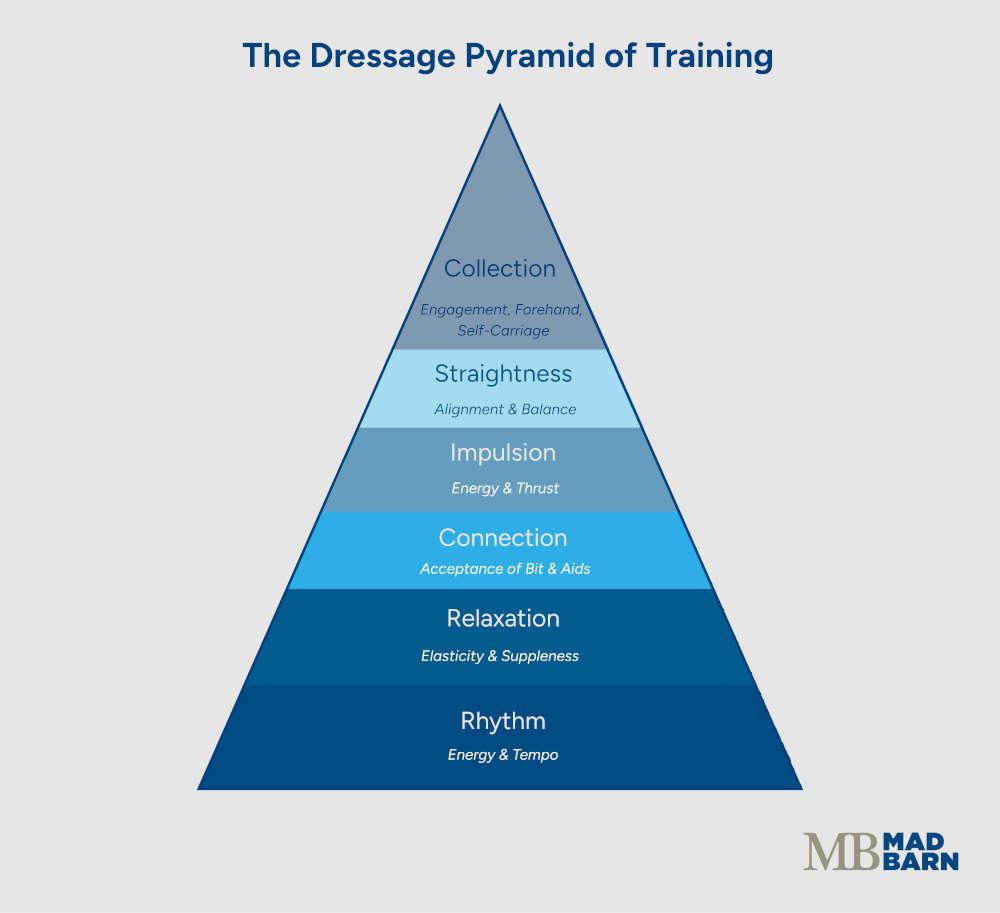
The dressage training scale places rhythm and relaxation ahead of contact and collection for this reason. Returning to these basics often resolves problems that emerge later in stretching or collection work. [2][6]
Contact & the Half Halt
A horse needs to seek steady, elastic contact with the bit before either end of the frame can be trained well.
In the stretch, the horse reaches forward into contact rather than dropping it. In collection, the contact becomes shorter and more compressed while remaining steady and even. [1][2][6]
The half halt links these two frames. Through a half halt, the rider briefly rebalances the horse, shifting weight back and preparing for a shorter, more contained stride without breaking rhythm. [6]
Horses that respond reliably to the rider’s aids, including the half halt, find it much easier to move between stretched and collected frames later in training. [2][6]
How to Train the Stretch
Training the stretch takes patience and a light hand. The goal is a horse that offers the frame willingly, rather than one pushed or pulled into position. [2][6]
The Stretchy Circle Exercise
To perform this exercise, ride a 66 ft (20 m) circle at the walk or trot in a working frame, then gradually lengthen the reins while asking the horse to follow the contact forward and down. [1][2][6]
Rhythm and bend should remain consistent throughout, without the horse speeding up, slowing down, or falling onto the forehand. If balance or rhythm slips, shorten the reins and re-establish both before trying again. [2][6]
Some horses stretch more easily in one direction than the other. Work both directions evenly and note any consistent difficulty on one side, as it may indicate stiffness or asymmetry worth addressing separately. [5][6]
Using Stretch Work for Warm-Up & Cool Down
Many trainers begin and end a ride with several minutes of stretching at the walk and trot. Including stretching in the warm-up loosens the horse’s topline before more demanding work and allows the muscles to move through a fuller range before taking on a shorter frame. [7]
Ending a session with stretch work also gives the horse’s back a chance to release tension after collected exercises. A gradual cool-down after riding can support recovery between sessions. [7]
Common Errors When Asking for Stretch
One of the most common mistakes riders make when asking a horse to stretch is assuming that a low head position means the horse is stretching correctly. A horse that drops their head while hollowing the back or trailing the hind legs is not performing a true stretch, even if the neck appears low. [1][2]
A true stretch keeps the back rounded and the hind legs stepping actively under the body. [1][2]
It is also possible to overdo stretch work. Asking for the stretch without balancing it with collection or other forward-thinking work can leave a horse heavy on the forehand and reluctant to carry themselves. [2]
Most horses do well with stretch work incorporated into the warm-up and cool-down, along with occasional stretchy circles during a session. [1][7]
How to Train Collection
Collection develops slowly through consistent transition work rather than through any single exercise. It depends on the strength and responsiveness established during stretching and foundational training. [1][2][6]
Building Collection Through Transitions and Lateral Work
Frequent transitions within a gait, shortening for a few strides and then riding forward again, are among the most effective tools for developing collection. Asking the horse to shorten, engage, and lengthen again teaches the hind legs to carry more weight without losing forward energy. [1][2][4]
Transitions between gaits work in the same way. Moving from walk to trot to walk, or from trot to canter to trot, with attention to balance in each transition, gradually develops the same carrying strength. [1][2]
The shoulder-in and leg yield encourage the inside hind leg to step farther under the horse’s body, supporting the increased hind limb engagement required for collection. [1][2]
Common Errors When Asking for Collection
The most common mistake riders make is shortening the horse’s neck rather than asking for genuine engagement behind. This produces a compact-looking frame without the weight shift that defines true collection and often creates tension through the poll and neck. [2][3][4]
Loss of impulsion is another frequent issue. A horse that slows or flattens while shortening is being asked for compression without enough forward energy to support it. Riding more forward before asking again for the shorter frame usually helps restore energy without rushing. [1][2][4]
Training the Transition Between Stretch & Collection
A horse transitioning between stretch and collection should move fluidly between frames rather than performing each one in isolation. The quality of the transition reveals how elastic and connected the horse’s frame is. [1][2][6]
Building an Elastic Frame
Practice riding the stretch, then gradually shorten the frame while asking for more engagement without losing the swing through the back established in the stretch. If the horse tightens or hollows as the frame shortens, return briefly to the stretch before asking again. [1][2][6]
This work depends on a strong, well-conditioned back. Research on core-strengthening exercises in horses found that regular practice increases the size and symmetry of the deep stabilizing muscles along the spine.
A horse with a stronger, more symmetrical topline is better equipped to maintain a steady posture while moving between stretched and collected frames. [8][9]
Signs the Transition Is Working
A horse transitioning correctly stays rounded through the back in both directions rather than becoming hollow or tense as the frame shortens. Rhythm and contact should remain consistent, without contact dropping during the stretch or the horse bracing during collection. [1][2][3]
Resistance or loss of rhythm in either direction usually signals that one frame needs more independent development before the two are combined. [1][2][6]
Common Problems in Stretch & Collection Training
Problems in stretching and collection training almost always trace back to a missing element in the horse’s foundation rather than a flaw in the exercise itself. [2][6]
Stretching Problems
Falling onto the forehand during the stretch often means the horse is moving too quickly or lacks the core strength to support the lower frame. The rider can typically help by slowing the tempo and rebuilding hind-leg engagement before asking for the stretch again. [2][8][9]
Rushing forward while stretching, rather than lengthening within a steady rhythm, can indicate that the horse is avoiding contact instead of seeking it. Shorten the stretch and re-establish rhythm before lengthening the frame again. [1][2][6]
Collection Problems
Tension and resistance during collection work often indicate that the rider is asking for more than the horse’s current strength allows. The rider will typically achieve better results by returning to easier transition work and rebuilding gradually instead of pushing through resistance. [2][6][9]
Correct stretching and collection should be self-maintained without constant force from the rider. This quality distinguishes both frames from forced overbending or hyperflexion. [2][3][6]

Supporting Topline & Soundness Through Training
Stretching and collection both place significant physical demands on the horse’s topline and core. Supporting this development contributes to soundness and steady training progress. [8][9]
Research on core function in horses shows that the deep stabilizing muscles of the back and abdomen are commonly underdeveloped, which directly limits a horse’s ability to sustain collected work comfortably. [9]
Targeted exercises that strengthen these muscles, including the stretching and transition work described above, support a stronger, more stable topline over time. A progressive conditioning program helps the horse build the fitness needed for more demanding work. [8][9]
Nutrition also plays a role in developing topline muscles. A horse in regular training needs adequate protein to maintain and build muscle, along with nutrients that support joint health and connective tissues during a demanding training program. [10]
Meeting these needs helps the horse recover between sessions and build strength consistently. A dietary review can confirm whether the overall diet supports this development. Book a free consultation with one of Mad Barn’s equine nutritionists to build a plan customized to your horse’s training level.
Frequently Asked Questions
Here are some frequently asked questions about training horses to stretch and collect:
Stretching in dressage lengthens the horse's frame forward and down while maintaining rhythm, contact, and balance. The neck lengthens, the back lifts and rounds slightly, and the horse reaches toward the bit. Collection shortens the stride, brings the hind legs further underneath the body, and shifts more weight onto the hindquarters while lightening the forehand. Both frames depend on relaxation, energy, and connection from the hindquarters to the bit.
A horse needs to stretch before developing collection because stretching encourages the back to swing, the topline to lengthen, and the frame to remain supple. Lowering the head and neck correctly can increase flexion through the lumbar back and expand the range of motion through the spine. [3] These qualities help establish the strength and relaxation needed to shorten the frame without creating tension. Asking for collection too early can cause the horse to resist, tighten, or hollow through the back.
A correct stretch occurs when the horse willingly lowers and lengthens the head and neck while continuing to seek steady contact. The rhythm, bend, and balance should remain consistent as the back rounds and the hind legs stay active. The horse should not rush, slow down, dive toward the ground, or fall onto the forehand. Correct stretching is offered and self-maintained rather than imposed by the rider.
To ride a stretchy circle correctly, begin on a 20 m circle at the walk or trot in a balanced working frame. Gradually lengthen the reins and allow the horse to follow the contact forward and down without losing rhythm, bend, or balance. Dressage tests use this exercise to assess whether the horse can lengthen the frame while remaining connected and steady. [1] If the horse rushes or falls onto the forehand, shorten the reins, reestablish balance, and try again.
Signs that a horse is not truly stretching include dropping the head without rounding the back, trailing the hind legs, losing contact, or changing tempo. A low neck alone does not provide the same benefit as a genuine forward and downward reach that changes the posture of the back. The horse may also rush to avoid contact or become heavy on the forehand. In these cases, restore rhythm and hind leg engagement before asking for a smaller stretch again.
Genuine collection feels energetic, balanced, and responsive rather than slow or restricted. The horse shortens the stride, steps further underneath the body, and carries more weight through the hindquarters while lifting the base of the neck and shoulders. Deeper flexion through the hips, stifles, and hocks supports this increased carrying effort. [2] Rhythm, impulsion, relaxation, and steady contact should remain present as the frame becomes shorter.
Signs of false collection include a shortened neck or stride without increased engagement and weight-bearing behind. The horse may lose impulsion, flatten the movement, hollow the back, or become tense through the poll and neck. This creates a compact-looking frame but does not produce the balance and carrying strength of genuine collection. Riding forward to restore energy before asking for a shorter frame can help correct the problem.
Collection should be introduced gradually through balanced transitions rather than by holding the horse in a short frame. Transitions within a gait teach the horse to shorten for a few strides and then move forward again without losing energy. Transitions between gaits, shoulder-in, and leg yield can also encourage the hind legs to step further underneath the body. Short, successful efforts are more appropriate than asking an inexperienced horse to sustain collection for long periods.
The time required for a horse to develop collection depends on its strength, balance, responsiveness, conformation, and training foundation. Collection develops slowly because the hindquarters must become strong and flexible enough to absorb and generate more force as the work becomes more demanding. [4] Progress should be measured by the quality of a few balanced strides rather than by how long the horse can be held in a shortened frame. Persistent tension or resistance usually indicates that the horse needs more foundational strength before progressing.
Most sound horses can learn a useful degree of collection when training is suited to their conformation, fitness, and ability. Individual structure may affect how elevated or expressive the collected movement appears, but genuine collection is primarily about improved balance and weight-bearing behind. The added weight and balance demands of a rider also influence how the horse uses its back, so strength must be developed progressively. [5] A horse should not be pushed beyond the degree of collection it can perform comfortably and correctly.
The half halt helps a horse move between stretching and collection by briefly rebalancing the body without disrupting the rhythm. It prepares the horse to shift weight backward and take a shorter, more contained stride while maintaining forward energy. [6] In the stretch, elastic contact allows the horse to lengthen toward the bit instead of dropping the connection. A reliable response to the half halt makes transitions between the two frames smoother and more balanced.
A rider can train the transition between stretching and collection by gradually lengthening and shortening the frame while preserving rhythm, contact, and swing through the back. After allowing the horse to stretch, shorten the reins progressively and ask for more hind leg engagement without abruptly restricting the neck. If the horse becomes hollow, tight, or resistant, return briefly to an easier frame before trying again. Smooth transitions show that the horse is becoming more elastic, connected, and able to maintain its own balance.
Stretching and collection can both be included regularly, but the amount of each should reflect the horse's current strength and training level. Stretching is often used for several minutes during the warm-up and cool-down, with occasional stretchy circles added during the session. [7] Collection should be practiced in short segments with forward work or stretching between efforts. Excessive stretching can make a horse heavy on the forehand, while excessive collection can create fatigue, tension, and resistance.
The difference between correct stretching and hyperflexion is whether the horse willingly maintains a natural, connected posture. During a correct stretch, the horse reaches forward and down, keeps a steady rhythm, and maintains contact without force from the rider. Hyperflexion forces the neck into an extreme position and may place the horse behind the vertical rather than allowing it to seek the bit. A correct frame should remain self-maintained instead of depending on constant pressure.
Topline strength and nutrition support stretch and collection work by helping the horse stabilize its back, carry more weight behind, and recover between sessions. Regular core-strengthening exercises can improve the size and symmetry of the deep muscles that stabilize the spine. [8] Horses in consistent training also require a balanced diet that supplies adequate protein and the nutrients needed to support muscles, joints, and connective tissues. [10] A dietary review with an equine nutritionist can help determine whether the feeding program matches the horse's workload and development.
Summary
Stretching and collection develop complementary qualities that help horses move with greater balance, suppleness, and self-carriage. Both frames should be introduced progressively and maintained through the whole body rather than created through head and neck position alone.
- A correct stretch lengthens the horse's frame while maintaining active hind legs, a rounded back, steady rhythm, and elastic contact
- True collection increases weight-bearing through the hindquarters while shortening the frame and lightening the forehand
- Rhythm, relaxation, consistent contact, and a reliable half halt provide the foundation for both frames
- Stretchy circles, balanced transitions, shoulder-in, and leg yield develop suppleness, engagement, and carrying strength
- Progressive conditioning, proper nutrition, and adequate recovery support the topline and core strength needed for advanced work
References
- USDF Dressage Tests. United States Dressage Federation. 2022.
- Podhajsky. A. The Complete Training of Horse and Rider. Doubleday. 2013.
- Gómez Álvarez. C. B. et al. The Effect of Head and Neck Position on the Thoracolumbar Kinematics in the Unridden Horse. Equine Veterinary Journal. 2006.
- Clayton. H. M. and Hobbs. S. J. A Review of Biomechanical Gait Classification with Reference to Collected Trot, Passage and Piaffe in Dressage Horses. Animals. 2019.
- MacKechnie-Guire. R. and Pfau. T. Differential Rotational Movement and Symmetry Values of the Thoracolumbosacral Region in High-Level Dressage Horses When Trotting. PLOS ONE. 2021.
- McGreevy. P. D. et al. Equitation Science, 2nd Edition. Wiley-Blackwell. 2018.
- Frick. A. Stretching Exercises for Horses: Are They Effective?. Journal of Equine Veterinary Science. 2010.
- Stubbs. N. C. et al. Dynamic Mobilisation Exercises Increase Cross Sectional Area of Musculus Multifidus. Equine Veterinary Journal. 2011.
- Clayton. H. M. Core Training and Rehabilitation in Horses. Veterinary Clinics of North America: Equine Practice. 2016.
- Nutrient Requirements of Horses: Sixth Revised Edition. National Academies Press. 2007.