English

Dressage levels are a graduated system of tests that measure how far a horse and rider have progressed in their training. Every dressage test ridden in competition, from a small schooling show to the Olympic Games, belongs to a defined level.
Each level matches test difficulty to the horse’s stage of training. Horses and riders perform movements appropriate for that stage and compete against combinations with similar experience. This system keeps competition fair and, just as importantly, encourages progressive training.
In the United States, USDF and USEF set the national levels, from Introductory through Fourth Level. The FEI governs the international levels, beginning with Prix St Georges and progressing to Grand Prix.
Keep reading to learn about the different dressage levels, the movements required at each stage, how tests are scored, and what research suggests about progressing safely and effectively.
What Are Dressage Levels?
A dressage level is a defined stage of training with its own required movements and purpose statement.
Every test within a level shares that purpose and asks for a similar degree of difficulty. The levels help protect the horse, standardize competition, and give riders a clear, incremental training path rather than a vague sense of improvement.
This principle of matching test difficulty to training stage appears in national dressage systems around the world. Each country operates its own national progression, and most systems align broadly with the FEI framework at the upper levels.
This guide focuses on the national dressage levels in the United States and the international levels above them.
National vs. International Levels
National tests in the United States are written and governed by USEF and USDF. They range from a horse’s first outing at Introductory Level through the demanding work of Fourth Level.
International tests, by contrast, are written by the FEI and used at competitions worldwide, from regional shows to the Olympic Games. However, international tests are not limited to elite events. Riders can enter Prix St Georges or Intermediate I at many national shows, often as a stepping stone toward their first FEI-recognized competition.
What's your top priority with your horse's health?

What's your top priority with your horse's health?
How Levels Relate to the Training Pyramid
The levels provide a competition framework, but they are built around a training framework: the dressage pyramid of training.
The scale progresses from rhythm and suppleness through contact, impulsion, straightness, and finally collection. These qualities guide a horse’s development regardless of competition level.
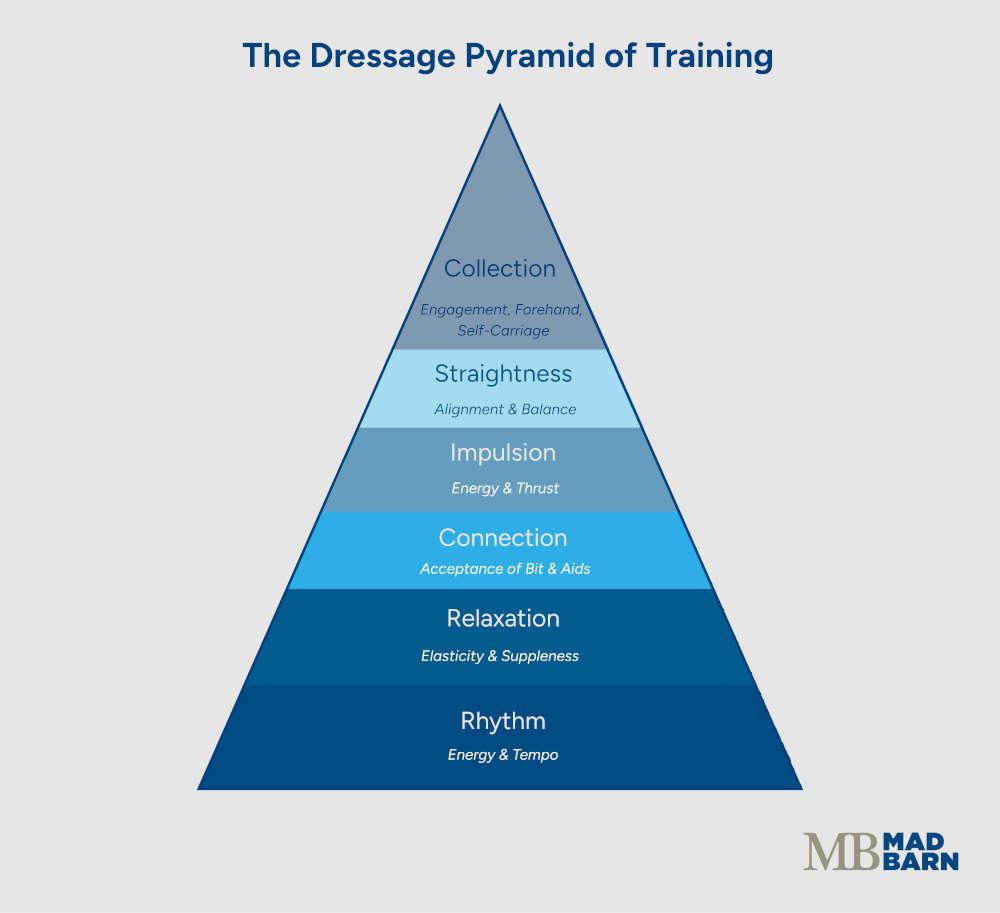
The lower levels emphasize the early stages of the pyramid, including rhythm, suppleness, and steady contact. The upper levels require the highest degree of collection. A horse cannot successfully skip ahead to Fourth Level movements without first confirming the basics assessed at Training Level.
USDF & USEF National Dressage Levels
The US national system includes six levels: Introductory, Training, First, Second, Third, and Fourth.
Each level contains several numbered tests of increasing difficulty. Most combinations spend anywhere from several months to a couple of years working through the tests within a level before moving up.
Introductory Level
USDF Introductory Level is designed to introduce a horse, rider, or both to dressage competition. [1]
Tests at this level use walk and trot, with canter included only in the most advanced Introductory test, and do not require lateral movements. Judges look for a rider who can guide the horse through correct arena geometry, including accurate circles and corners, while riding forward into a steady, elastic contact.
Green horses and first-time competitors often debut here because the level is intended to be approachable rather than demanding.
Training Level
Training Level asks the horse to demonstrate greater consistency. The tests confirm that the horse is supple, moves freely forward in a clear and steady rhythm, and accepts contact with the bit. [1]
Riders show walk, trot, and canter on 20-meter circles, along with a free walk on a long rein. There is still no lateral work at this stage.
Many riders consider Training Level the true starting point of competitive dressage because Introductory tests are not eligible for national ranking or permanent score tracking at USEF competitions.
First Level
First Level confirms that the horse has developed enough thrust to show improved balance and a more consistent connection to the bit, building directly on Training Level. [1]
This is generally where lengthening of stride and leg yield are introduced. For many horses and riders, leg yield is their first experience with lateral work.
Second Level
Second Level marks a significant turning point. Its purpose statement calls for a horse that accepts more weight on the hindquarters, shows the beginnings of true collection, and moves with an uphill tendency in the medium gaits. [1]
Shoulder-in and travers appear for the first time, along with simple changes of lead through walk and more pronounced medium paces. At this stage, riders often feel the horse begin to sit and carry itself differently rather than simply moving forward.
Third Level
Third Level requires sustained collection and introduces half pass and the single flying change of lead. Extended gaits become more pronounced, and the overall picture should show a horse that is more supple, powerful, and straight than at Second Level.
Combinations that reach Third Level have usually invested several years in consistent training because half pass and flying changes both require a solid foundation of collection.
Fourth Level
Fourth Level is the top of the national progression and a training ground for international competition. It introduces flying changes in sequence, working canter pirouettes, and a marked increase in collection, engagement, and cadence compared with Third Level.
Horses that perform well at Fourth Level are often ready, physically and mentally, to begin schooling the movements in Prix St Georges, even if they are not yet competing at that level.
FEI International Dressage Levels
Once a horse and rider progress beyond Fourth Level, they enter the international system governed by the FEI.
These tests are used at Concours de Dressage International (CDI) events worldwide, as well as at the Olympic Games and World Championships. FEI levels are grouped into what riders commonly call the Small Tour, Medium Tour, and Big Tour.
Minimum-age requirements apply at these levels. A horse must be at least seven years old to compete at Prix St Georges or Intermediate I and at least eight years old for the levels above them. [2]
Prix St Georges & Intermediate I
Prix St Georges is the entry point to FEI competition and the first test in the Small Tour. It requires half pirouettes, three-tempi changes, and a clear distinction between collected and extended gaits.
Intermediate I builds directly on Prix St Georges under the same age rule, adding full pirouettes and two-tempi changes at a higher standard of collection.
Many combinations ride both tests at the same show because they are close in difficulty and both belong to the Small Tour.
Intermediate A & Intermediate B
Intermediate A and Intermediate B form what is commonly called the Medium Tour. Both are relatively recent additions to the FEI system.
This is where piaffe and passage, along with one-tempi changes, first enter the competition progression, although they appear in shorter, less demanding sequences than at the levels above. [3]
Where Intermediate II calls for eleven one-tempi changes, for example, Intermediate A and B ask for approximately seven. The piaffe is also allowed to travel farther forward rather than remaining strictly on the spot.
For a horse that shows promise but is not ready for the full physical demands of Grand Prix, these levels provide an opportunity to continue developing without being rushed.
Intermediate II
Intermediate II is the final preparatory step before Grand Prix. It requires the same family of movements introduced at Intermediate A and B, but in longer, more demanding sequences and with piaffe covering noticeably less ground. The minimum age of eight years applies here and at every level above it. [2]
Exact movement requirements can change slightly when tests are revised, so riders should always consult the current official test sheet rather than assume what a test will require.
Grand Prix
Grand Prix sits at the top of the sport. Used at the Olympic Games and World Championships, it requires the fullest expression of piaffe and passage, extended lines of one-tempi changes, and the most demanding canter pirouettes.
The Grand Prix Special and Grand Prix Freestyle are different tests at the same level. The Special follows a set test for international competition, while the Freestyle is performed to music.
Reaching Grand Prix typically represents a decade or more of correct, progressive training.
Youth, Young Horse & Special Divisions
Alongside the standard levels, USEF and the FEI offer divisions organized around age or purpose rather than test difficulty alone. These divisions give young horses and young riders a competition path that reflects their stage of development.
FEI Young Horse Classes
The FEI offers young horse tests for defined age groups, with judging focused on quality of gaits, natural balance, and rideability rather than only on the movements found in the standard levels.
USEF operates a parallel Young Horse Dressage Program, along with Developing Horse Prix St Georges and Grand Prix divisions for eligible horses.
These divisions are structured around physical development rather than an arbitrary point on the competition ladder, an approach consistent with research on progressive training.
Children, Pony, Junior & Young Rider Divisions
Age-based divisions also exist for younger competitors. The Children’s division is roughly equivalent in difficulty to Second Level, while the Pony division presents a similar standard for riders on smaller mounts.
Juniors compete at a level closer to Third or Fourth Level, and Young Riders, typically aged 16 through 21, ride tests equivalent to Prix St Georges.
An Under-25 Grand Prix division bridges youth and senior competition, with riders in that age group working at a standard close to Intermediate II.
Para Dressage & Materiale Classes
Para dressage uses its own grading system, assigning riders to competition grades based on functional ability rather than age or the standard level progression. This allows riders with different physical needs to compete against others with similar functional profiles.
Materiale classes take a different approach, judging young or lightly started horses on conformation, natural movement, and suitability for the sport rather than on trained movements.
Both divisions sit alongside the main level system rather than within it, offering competition paths suited to different horses and riders.
How Dressage Tests Are Scored
Every dressage test produces a final score expressed as a percentage. Understanding how that number is calculated helps explain why two horses competing at the same level can look very different yet receive similar scores.
Movement Scores & Collective Marks
Each individual movement in a test receives a score from zero to ten. Some particularly important movements carry a coefficient that doubles their weight in the final total.
Judges may also award collective marks for broader qualities identified on the test sheet, such as the horse’s gaits and the rider’s position and effectiveness. These marks are added to the movement scores and used to calculate the final percentage.
Directive ideas printed on the test sheet explain what the judge is evaluating in each movement. Riders who study these directives often gain more useful training insight than those who focus on the numerical score alone.
Judging Consistency & Challenges
Because dressage scoring depends on a judge’s trained eye rather than an automated measurement, researchers have examined how consistent those scores are.
One study analyzed more than 30,000 individual movement marks from Olympic-level classes. It found that scores were not always consistent among judges and recommended assessing judging quality before using results in further analysis. [4]
More recent research examined over 500 scores from elite international competitions. It found that factors unrelated to performance, including whether riders competed in their home countries, shared nationalities with judges, or rode early or late in the order, measurably influenced final results. [5]
The researchers argued that clearer, evidence-based judging guidelines could help reduce these effects. [5]
Other research has compared judges’ scores with objective motion-sensor data collected from horses and riders during a standard test.
In one such study, a slower stride frequency was associated with higher gait scores for the horse, while more symmetrical movement through the rider’s trunk was linked to higher rider scores. [6]
These findings suggest that some measurable qualities align with what judges reward, even though subjective scoring is not perfectly consistent from one judge to another.
For riders, the practical takeaway is that a single score may vary somewhat depending on who is in the judge’s box. Written comments and directive ideas on the test sheet are often more useful for training than the percentage alone.
Movements & Skills Introduced at Each Level
Reading about each level individually highlights its requirements, but comparing the levels side by side makes the major increases in difficulty easier to identify.
Table 1. Key movements and focus introduced at each dressage level
| Level | Key Movements Introduced | Gait & Balance Focus |
|---|---|---|
| Introductory Level | Walk and trot tests, basic figures, and introductory canter in the most advanced test | Relaxation, steering, rhythm, and correct geometry |
| Training Level | Walk, trot, canter, 20-meter circles, and free walk | Forward rhythm, suppleness, and steady contact |
| First Level | Leg yield and lengthenings of stride | Improved thrust and balance |
| Second Level | Shoulder-in, travers, and simple changes | Early collection and medium gaits |
| Third Level | Half pass and single flying changes | Sustained collection and extended gaits |
| Fourth Level | Sequential flying changes and working canter pirouettes | Uphill balance and increased engagement |
| Prix St Georges | Half pirouettes and three-tempi changes | Beginning international-level collection |
| Intermediate I | Full pirouettes and two-tempi changes | Refined collection and extension |
| Intermediate A/B | Introduction to piaffe, passage, and one-tempi changes | Shorter, less demanding Grand Prix elements |
| Intermediate II | Longer tempi-change sequences and more collected piaffe | Demands approaching Grand Prix |
| Grand Prix | Fullest expression of piaffe and passage | Peak collection and expression |
These levels show a clear progression as movements build on one another. Lateral work begins at First and Second Levels, followed by flying changes and half pass at Third Level.
Sequential changes and pirouette work develop through Fourth Level and into the FEI system. Piaffe and passage, the movements most commonly associated with elite dressage, do not appear until the Medium Tour, well into the international levels.
The Science Behind Progressing Through the Levels
Scientists did not design the dressage level system, but equine research helps explain why progressive training matters and what it means for horses moving through the levels safely.
Skeletal Maturity & Readiness for Higher-Level Training
Researchers comparing equine growth and bone development with stages used to describe human growth classified horses as reaching skeletal maturity at around two years of age, with little variation among breeds. [7]
This finding supports beginning appropriate ridden work when the workload matches the horse’s development. It does not mean that a young horse is prepared for the strength, coordination, and sustained collection required at advanced levels.
That distinction helps explain the logic behind graduated systems such as the FEI Young Horse program, which introduces horses to competition progressively instead of holding them back for years or asking for full collection before they are ready.
Biomechanics of Collection & Advanced Movements
A detailed review of the biomechanics of collected trot, passage, and piaffe found that these gaits place distinct and increasingly demanding requirements on a horse’s body compared with ordinary paces. [8]
Passage and piaffe in particular involve joint angles and timing that differ meaningfully from the collected trot performed at lower levels.
These findings help explain why piaffe and passage appear near the top of the level system. A horse that has only recently confirmed the basics of Training or First Level does not yet have the coordination and strength these movements demand.
Rate of Progression
Not every horse advances through the levels at the same pace, and research supports what many trainers observe in practice.
A study using standardized tests to evaluate gait and movement quality in young horses found that some early measures correlated with later success in dressage competition. [9]
This variation helps explain why some combinations progress from Training Level to Third Level in a few years while others take considerably longer. The system accommodates both because it measures readiness rather than time elapsed.
Welfare When Advancing Levels
As tests become more demanding, so does the training required to prepare for them. Researchers have examined how horses respond to this increased workload.
One study followed young Lusitano horses through a structured six-week training protocol, measuring stress markers including cortisol and heart rate. After training, the horses showed reduced cortisol, heart rate, and white blood cell counts, along with signs of improved cardiac fitness. [10]
Together, these changes suggest that a well-designed, progressive program can support welfare and fitness.
Responsible advancement is not simply a matter of checking off new movements. It also requires gradually building the horse’s fitness and confidence through an appropriate conditioning program.
Related research on head and neck position has raised separate welfare concerns when horses are ridden in an extreme frame for extended periods, particularly as they take on the more collected work required at higher levels. [11]
Good dressage training at every level prioritizes horse welfare. Advancing too quickly at the expense of welfare can contribute to poor performance and health problems.
How to Choose the Right Level for Your Horse
Understanding the expectations at each dressage level can help riders determine the most appropriate stage of training and competition for their horse.
When to Move Up
A horse ready for the next level should already perform the current level’s movements confidently and correctly at home, rather than merely managing them in the show ring.
Consistent scores in the high 60s or above at the current level, combined with the strength and balance to maintain the next level’s more difficult movements, can indicate that it is time to move up.
The most common mistake is moving up because of boredom or ambition rather than genuine readiness. This often appears as lower scores or a horse that becomes tense and hurried.
Skipping foundational work to pursue a flashier movement, or prioritizing a test result over correct basics, tends to create problems that surface later. These issues are usually visible at a higher level where they are more difficult to correct.
Working With a Trainer
An experienced outside perspective is one of the most valuable resources when deciding whether to advance.
A trainer who knows the horse well, or a judge providing feedback at a schooling show or ride-a-test session, can identify gaps that are difficult to feel from the saddle. Clear, consistent rider aids also help the horse understand increasingly complex requests.

Progressing Through the Dressage Levels
Dressage levels give horses and riders a structured path from introductory walk-and-trot tests to the collected movements of Grand Prix. Each stage builds on skills established earlier, with rhythm, suppleness, and steady contact supporting the balance, strength, and collection required at the upper levels.
The right level for a horse depends on demonstrated readiness rather than age, ambition, or time spent in training. Before moving up, the horse should perform the current level’s movements confidently and correctly while beginning to show the strength and balance needed for the next stage. Consistent competition scores can help confirm progress, but they should be considered alongside the horse’s relaxation, physical development, recovery, and quality of work at home.
Feedback from a knowledgeable trainer, judge, or ride-a-test session can provide valuable perspective when assessing readiness. Written comments and directive ideas on dressage test sheets are especially useful because they identify the qualities behind the numerical marks. Riders can use this feedback to strengthen weak areas, refine their aids, and avoid carrying foundational problems into more demanding work.
Progress through the dressage levels looks different for every horse-and-rider combination. Some horses advance steadily through several levels, while others benefit from additional time consolidating strength, confidence, or technical skills.
A progressive conditioning program, careful attention to welfare, and respect for the horse’s individual development support lasting success. Riders should also consult current USEF, USDF, or FEI test sheets before competing, as movement requirements and regulations may change when tests are revised.
Frequently Asked Questions
Here are some frequently asked questions about dressage levels:
The US national dressage levels are Introductory, Training, First, Second, Third, and Fourth Level. The international FEI progression continues with Prix St Georges, Intermediate I, Intermediate A and B, Intermediate II, and Grand Prix. Each level builds on the balance, strength, and skills developed at the levels below it.
Introductory Level is the easiest and most accessible level in dressage. Its tests primarily use walk and trot, with canter appearing only in the most advanced Introductory test and no lateral movements required. This level is designed for green horses, inexperienced riders, and combinations attending their first dressage competitions.
The main difference between Introductory Level and Training Level is the consistency and range of gaits expected. Introductory tests provide an approachable introduction to competition, while Training Level requires the horse to demonstrate walk, trot, and canter with clear rhythm, suppleness, and steady contact. Introductory tests are also not eligible for national ranking or permanent score tracking at USEF competitions.
The difference between USDF and FEI dressage levels is that USDF and USEF govern the national progression used in the United States, while the FEI governs international tests. US national levels run from Introductory through Fourth Level. FEI levels begin with Prix St Georges and progress through the Small, Medium, and Big Tours to Grand Prix.
Dressage levels differ between countries because each national federation operates its own competition system. Most national systems follow a similar progression from basic rhythm and contact toward greater collection and more advanced movements. At the upper levels, these systems generally align with the international tests governed by the FEI.
First Level dressage introduces leg yield and lengthenings of stride while building on the rhythm and contact established at Training Level. The horse should demonstrate improved balance, thrust, and a more consistent connection to the bit. For many horses and riders, the leg yield is their first competitive lateral movement.
Lateral work begins at First Level with the leg yield. Second Level adds more demanding movements such as shoulder-in and travers, while Third Level introduces half pass. This progression allows the horse to develop suppleness, balance, and strength before performing more collected lateral work.
The beginnings of true collection are expected at Second Level dressage. At this stage, the horse should accept more weight on the hindquarters and show an uphill tendency in the medium gaits. Collection becomes progressively more sustained and demanding through Third Level, Fourth Level, and the FEI levels.
The difference between Third Level and Fourth Level dressage is the degree of collection and complexity of the canter work. Third Level introduces half pass and the single flying change, along with more pronounced extended gaits. Fourth Level adds flying changes in sequence, working canter pirouettes, and substantially greater engagement, cadence, and uphill balance.
Prix St Georges is the first international dressage level and the entry point to the FEI Small Tour. The test requires movements such as half pirouettes and three-tempi flying changes, with a clear distinction between collected and extended gaits. Intermediate I follows Prix St Georges and adds full pirouettes and two-tempi changes.
The Small, Medium, and Big Tours are groupings used for the international FEI dressage levels. Prix St Georges and Intermediate I form the Small Tour, while Intermediate A and Intermediate B are commonly called the Medium Tour. The progression toward the Big Tour continues through Intermediate II to Grand Prix, where the most demanding collected movements are performed.
Horses first perform piaffe and passage in competition at Intermediate A and Intermediate B in the FEI Medium Tour. These tests use shorter and less demanding versions of the movements than the levels above them. Intermediate II and Grand Prix require increasingly collected piaffe, more developed passage, and longer advanced movement sequences.
Moving up a dressage level can take anywhere from several months to a couple of years for many horse-and-rider combinations. The timeline depends on the horse's natural ability, the rider's experience, and the consistency and quality of training. Advancement should be based on readiness rather than a fixed amount of time.
A horse may be ready to move up a dressage level when it can perform the current level's movements confidently and correctly at home. Consistent competition scores in the high 60s or above can support that decision, provided the horse also has the strength and balance required for the next level. Feedback from an experienced trainer, judge, schooling show, or ride-a-test session can help identify gaps before moving up.
A horse that moves up the dressage levels too quickly may become tense, hurried, or unable to perform the required movements correctly. Weaknesses in rhythm, contact, balance, or straightness often become harder to correct as the work grows more demanding. Progressive training should build fitness, coordination, confidence, and collection without sacrificing horse welfare.
Not every horse can reach Grand Prix dressage, even with progressive training. This level requires soundness, willingness, natural athletic ability, and the capacity to develop exceptional strength, coordination, and collection. Correctly preparing a suitable horse for Grand Prix typically requires a decade or more of training.
Dressage tests are scored by awarding each movement a mark from zero to ten. Some important movements have coefficients that double their contribution to the final result, and the test may also include collective marks for broader qualities such as the horse's gaits and the rider's effectiveness. The marks are combined and converted into a final percentage.
Dressage scores are partly subjective because they depend on a judge's trained evaluation of each performance. Research has found that marks can vary among judges and may be influenced by factors such as competition order, location, and shared nationality. Riders can often gain more useful training guidance from the judge's written comments and the test's directive ideas than from a single percentage alone.
A horse must be at least seven years old to compete at Prix St Georges or Intermediate I. Horses must be at least eight years old for Intermediate A, Intermediate B, Intermediate II, and the levels above them. Meeting the minimum age requirement does not automatically mean a horse has the physical strength, coordination, or training needed for advanced competition.
Riders can compete in FEI-level tests such as Prix St Georges and Intermediate I at many national dressage shows. International tests are not restricted to CDI events, championships, or the Olympic Games. National competitions can provide a useful stepping stone for combinations preparing to enter FEI-recognized competition.
Youth and young horse divisions provide competition paths based on age and development rather than following only the standard level progression. Children's tests are roughly comparable to Second Level, Junior tests are closer to Third or Fourth Level, and Young Riders typically compete at a Prix St Georges-equivalent standard. Young horse classes place greater emphasis on gait quality, natural balance, and rideability, while the Under-25 division helps bridge the transition to senior Grand Prix competition.
Summary
Dressage levels provide a structured progression from introductory walk-and-trot tests to the collected movements required at Grand Prix. Each stage builds on earlier training while placing greater demands on the horse's strength, balance, coordination, and confidence.
- USDF and USEF govern the six national levels from Introductory through Fourth Level, while the FEI governs international competition
- Lateral work begins in the lower national levels, followed by flying changes, pirouettes, piaffe, and passage as horses advance
- Judges score individual movements from zero to ten and may apply coefficients that increase the weight of important movements
- Progressive conditioning helps horses develop the fitness and coordination needed for increasingly collected and demanding work
- Readiness to move up should reflect consistent performance, physical development, relaxation, and the quality of the horse's work at home
References
- Purpose of Tests. United States Dressage Federation. n.d.
- Dressage Tests. Fédération Equestre Internationale. n.d.
- Slade. L. FEI Introduces New Dressage Tests. The Chronicle of the Horse. 2013.
- Stachurska. A. and Bartyzel. K. Judging dressage competitions in the view of improving horse performance assessment. Acta Agriculturae Scandinavica, Section A - Animal Science. 2011.
- Wolframm. I. Let Them Be the Judge of That: Bias Cascade in Elite Dressage Judging. Animals. 2023.
- Hobbs. S. et al. Evaluating Overall Performance in High-Level Dressage Horse-Rider Combinations by Comparing Measurements from Inertial Sensors with General Impression Scores Awarded by Judges. Animals. 2023.
- Rogers. C. et al. Growth and Bone Development in the Horse: When Is a Horse Skeletally Mature?. Animals. 2021.
- Clayton. H. and Hobbs. S. A Review of Biomechanical Gait Classification with Reference to Collected Trot, Passage and Piaffe in Dressage Horses. Animals. 2019.
- Barrey. E. et al. Early evaluation of dressage ability in different breeds. Equine Veterinary Journal Supplement. 2002.
- Coelho. C. et al. Training Effects on the Stress Predictors for Young Lusitano Horses Used in Dressage. Animals. 2022.
- König von Borstel. U. et al. Hyperflexing the horse's neck: a systematic review and meta-analysis. Scientific Reports. 2024.